TLDR
Choosing a rugged edge AI computer involves far more than checking a spec sheet. This 10-point checklist walks procurement teams and engineers through the critical selection criteria — from thermal design and GPU compatibility to certification standards and long-term supply chain stability — so the hardware investment matches the deployment environment.
Overview
Edge AI deployments are expanding from controlled factory floors into unpredictable field environments: outdoor infrastructure, mobile vehicles, chemical plants, and remote installations. Each environment introduces a unique combination of temperature extremes, shock and vibration, moisture, dust, and electromagnetic interference that consumer-grade or lightly ruggedized hardware cannot survive.
The cost of choosing the wrong platform extends beyond the purchase price. Field failures trigger unplanned downtime, emergency truck rolls, and project delays that can exceed the original hardware cost by 5-10x. Yet many buyers still evaluate rugged edge AI computers using the same criteria they apply to office workstations — CPU clock speed, RAM capacity, and sticker price. This guide reframes the evaluation around the 10 factors that actually determine success in harsh-environment edge computing.
Key Selection Criteria
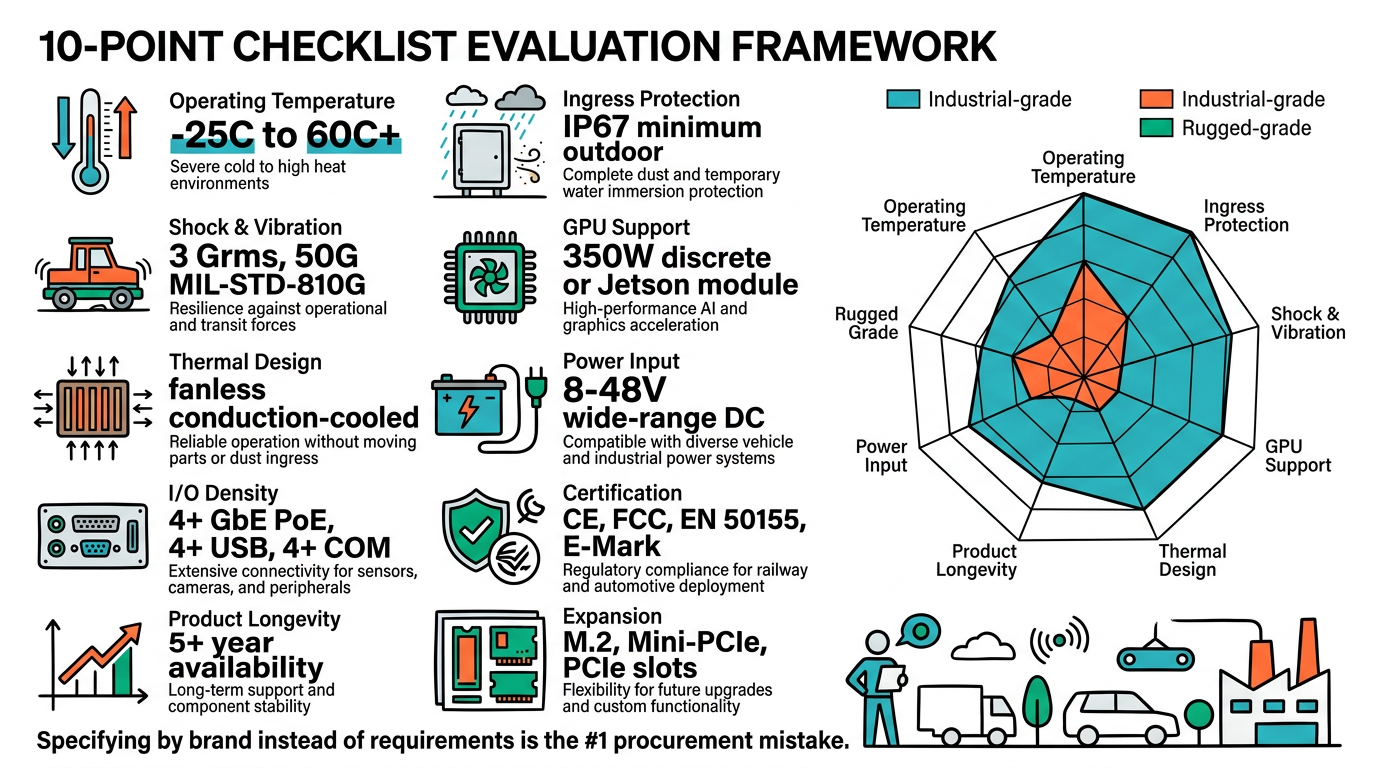
The following comparison table maps each checklist criterion against typical industrial-grade and true rugged-grade specifications. Use it to benchmark vendor claims against real deployment requirements.
| # | Criterion | Industrial-Grade Typical | Rugged-Grade Requirement |
|---|---|---|---|
| 1 | Operating Temperature | 0°C to 50°C | -25°C to 60°C or wider |
| 2 | Ingress Protection | IP40–IP54 | IP67 minimum for outdoor |
| 3 | Shock & Vibration | 1 Grms, 10G shock | 3 Grms, 50G shock (MIL-STD-810G) |
| 4 | GPU Support | None or low-profile only | Full 350W discrete GPU or Jetson module |
| 5 | Thermal Design | Internal fan, filtered intake | Fanless conduction-cooled chassis |
| 6 | Power Input Range | 12V fixed | 8–48V wide-range DC with ignition control |
| 7 | I/O Density | 2 LAN, 2 USB, 1 COM | 4+ GbE (PoE+), 4+ USB 3.x, 4+ COM |
| 8 | Certification | CE, FCC | CE, FCC, EN 50155, MIL-STD-810G, E-Mark |
| 9 | Product Longevity | 2–3 year lifecycle | 5+ year availability commitment |
| 10 | Expansion | None | M.2, Mini-PCIe, or PCIe cassette slots |
Criterion 1–3: Environmental survivability. These three factors eliminate the most candidates. A system rated for 0–50°C will thermal-throttle in a desert kiosk or freeze-lock in a northern rail depot. The POC-700 series demonstrates true rugged-grade design: -25°C to 70°C operating range, 3 Grms vibration tolerance, and a 0.57-liter fanless chassis — smaller than many consumer NUCs yet certified to MIL-STD-810G.
Criterion 4–5: Compute architecture. Edge AI workloads split into two categories. Lightweight inference tasks (object detection at 5–15 FPS) fit compact platforms like the Nuvo-11531 with its integrated Intel AI Boost NPU. Heavy-duty inference (multi-camera vision, real-time analytics) demands discrete GPU power. The Nuvo-10208GC supports up to a 350W NVIDIA RTX GPU in a fanless or hybrid-cooled enclosure — something no standard 1U rackmount server can survive outside a data center.
Criterion 6–7: Power and connectivity. Vehicle-mounted and field-deployed systems face voltage sags, spikes, and cold-crank events. Wide-range DC input (8–48V) with ignition sensing prevents data corruption during engine start/stop cycles. I/O density matters because every external adapter or hub is a potential failure point. The Nuvo-11000 series packs up to 6x GbE with PoE+, 8x USB, and 4x COM into a single chassis — replacing what would otherwise require three separate boxes.
Criterion 8–10: Lifecycle and compliance. Certification gaps delay project timelines. If a deployment targets railway onboard systems, EN 50155 compliance is non-negotiable. For outdoor or waterproof applications, IP67 with M12 sealed connectors — as found on the POC-766AWP — eliminates the need for expensive NEMA 4X enclosures. Product longevity guarantees (5+ years) protect against mid-project discontinuation that forces costly re-qualification.
Decision Matrix
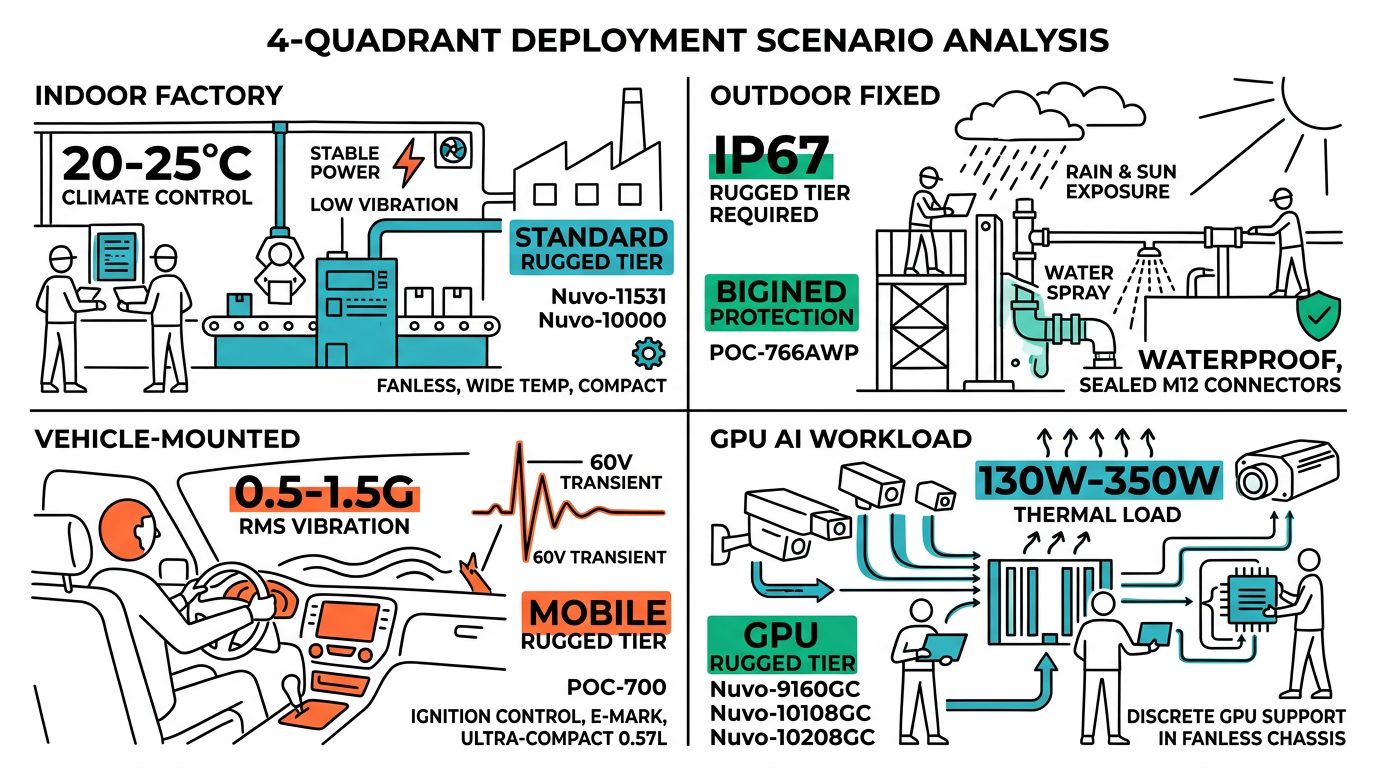
Use this matrix to match deployment scenarios with the right product tier. Score each factor 1–3 for your specific project, then total the points.
| Deployment Scenario | Recommended Tier | Key Products | Primary Differentiator |
|---|---|---|---|
| Indoor factory / clean room | Standard rugged | Nuvo-11531, Nuvo-10000 | Fanless, wide temp, compact |
| Outdoor fixed installation | IP67 rugged | POC-766AWP | Waterproof, sealed M12 connectors |
| Vehicle-mounted (transit, fleet) | Mobile rugged | POC-700 | Ignition control, E-Mark, ultra-compact |
| GPU-accelerated AI (vision, analytics) | GPU rugged | Nuvo-9160GC, Nuvo-10108GC, Nuvo-10208GC | 130W–350W GPU support, fanless option |
| NVIDIA Jetson / embedded AI | Edge AI module | NRU-220 | Jetson Orin, low power, compact |
Common Pitfalls
Pitfall 1: Specifying by brand instead of requirement. Teams often write RFPs around a single vendor's naming convention rather than performance envelopes. This limits competitive bidding and sometimes locks in products that do not match the actual environmental conditions. Start with the deployment environment, then map to specifications.
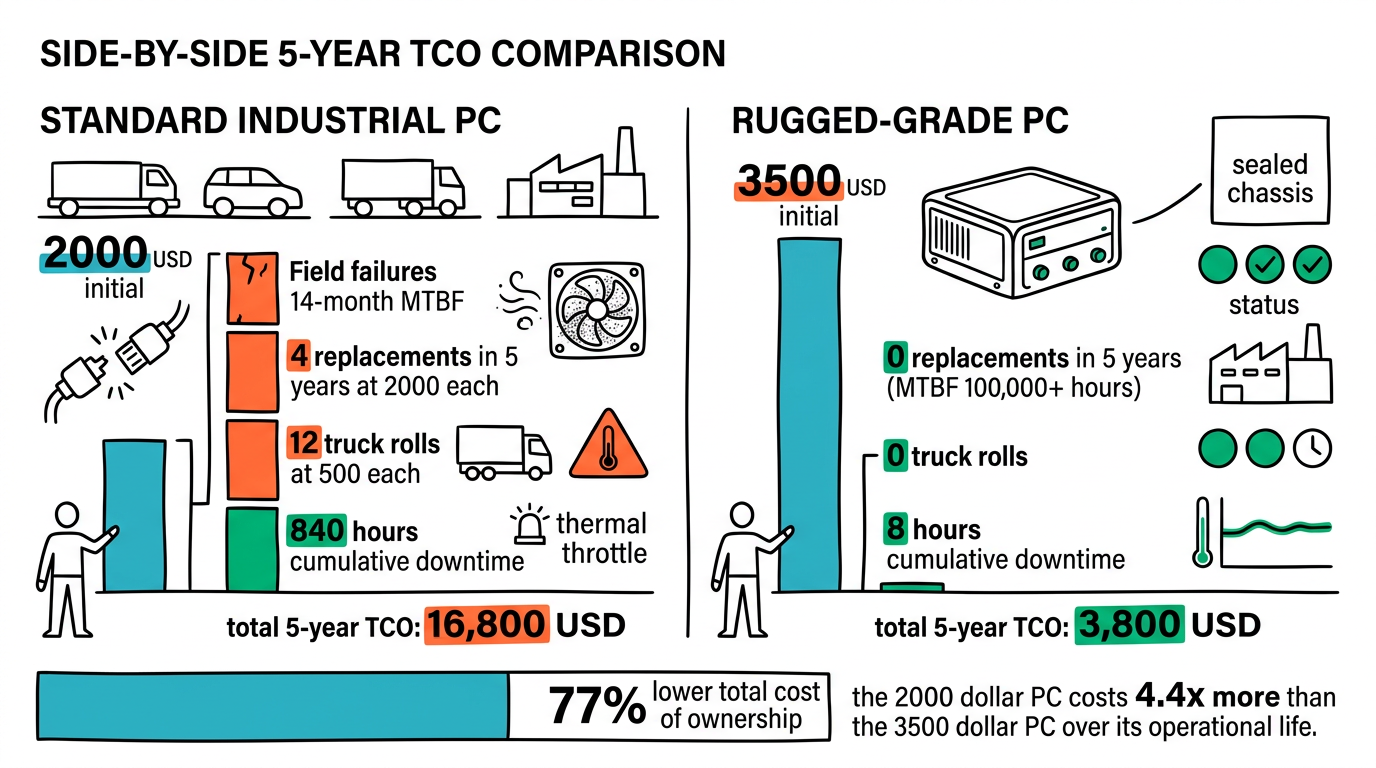
Pitfall 2: Ignoring total cost of ownership. A $2,000 industrial PC that fails every 14 months costs more over 5 years than a $3,500 rugged system with a 7-year MTBF. Factor in truck rolls, downtime penalties, re-imaging labor, and warranty terms when comparing quotes.
Pitfall 3: Overlooking thermal derating. Most CPU benchmark numbers are measured at 25°C in open air. At 55°C inside a sealed enclosure, a platform without proper thermal design loses 30–40% of its rated throughput. Always request thermal derating curves from vendors, not just peak specifications.
Pitfall 4: Underestimating I/O requirements. Adding USB hubs and Ethernet switches in the field introduces single points of failure and complicates cable routing in tight enclosures. Choose a platform with native I/O density that matches the final sensor and communication layout.
Conclusion
Selecting a rugged edge AI computer is an engineering decision, not a purchasing shortcut. The 10-point checklist above compresses months of field experience into a repeatable evaluation framework. For detailed specifications, datasheets, and configuration guidance across the full Neousys product line, visit www.neteon.net or contact [email protected]. Follow Neteon on LinkedIn for the latest deployment guides and product updates.
FAQs
What temperature range should a rugged edge AI computer support?
For most outdoor and vehicle-mounted deployments, the minimum operating range should be -25°C to 60°C. Systems rated only for 0–50°C will thermal-throttle in hot environments and may freeze-lock in cold climates, causing unplanned downtime.
Do I need a fanless design for edge AI deployment?
In most harsh environments, yes. Fans pull in dust, moisture, and contaminants that cause premature failure. Fanless conduction-cooled designs eliminate moving parts and sealed chassis prevent ingress — extending MTBF by 2-3x compared to fan-cooled systems.
What GPU options are available in rugged edge AI computers?
Rugged platforms now support discrete NVIDIA GPUs up to 350W (RTX 5000/4000 series) in fanless or hybrid-cooled enclosures. For lower-power inference, NVIDIA Jetson Orin modules deliver strong AI performance in compact, vibration-resistant form factors.
Why does product longevity matter when selecting industrial edge AI hardware?
Edge AI projects typically span 5-10 years. If a hardware platform is discontinued after 2-3 years, the entire software stack must be re-qualified on new hardware — costing months of engineering time and delaying deployments. Look for vendors offering 5+ year availability commitments.
What certifications should I require for rugged edge AI computers?
At minimum, CE and FCC for electromagnetic compliance. For specific industries, add MIL-STD-810G (military/defense), EN 50155 (railway), E-Mark (automotive), and IP67/IP69K (outdoor/washdown). Missing certifications can block project deployment entirely.