TLDR: Mobile X-ray systems are transforming critical care by bringing diagnostic imaging directly to patients in ICUs, emergency rooms, and bedsides. However, these portable units face demanding computational requirements for real-time AI image analysis while operating in challenging hospital environments. The Nuvo-8108GC GPU computing platform addresses these challenges by combining Intel Xeon processing power with NVIDIA RTX GPU acceleration, delivering up to 14 TFLOPS of AI inference capability within a compact, thermally robust enclosure rated for -25°C to 60°C operation.
Overview: The Rising Demand for AI-Powered Point-of-Care Imaging
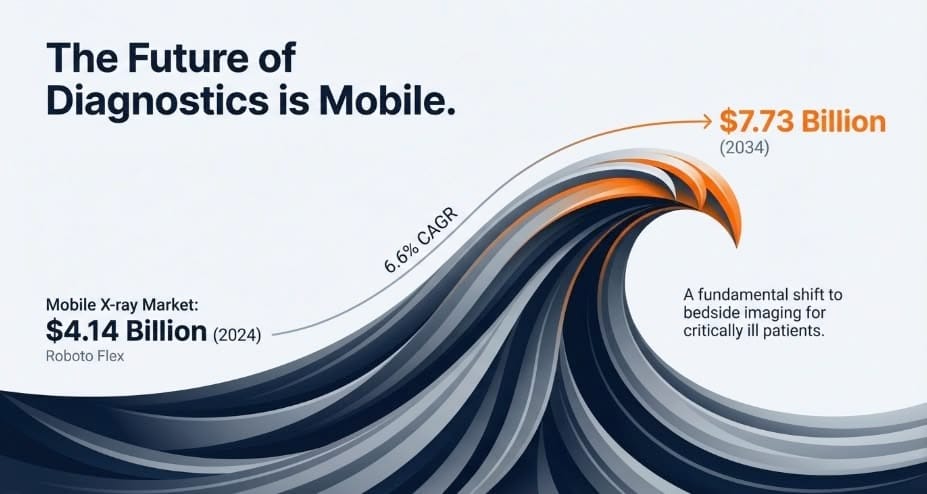
The digital mobile X-ray market is experiencing significant growth as healthcare facilities prioritize bedside diagnostics and point-of-care imaging. The global market reached $4.14 billion in 2024 and is projected to grow to $7.73 billion by 2034, representing a 6.6% compound annual growth rate. This expansion reflects healthcare's shift toward bringing diagnostic capabilities directly to patients rather than transporting critically ill individuals to imaging suites.
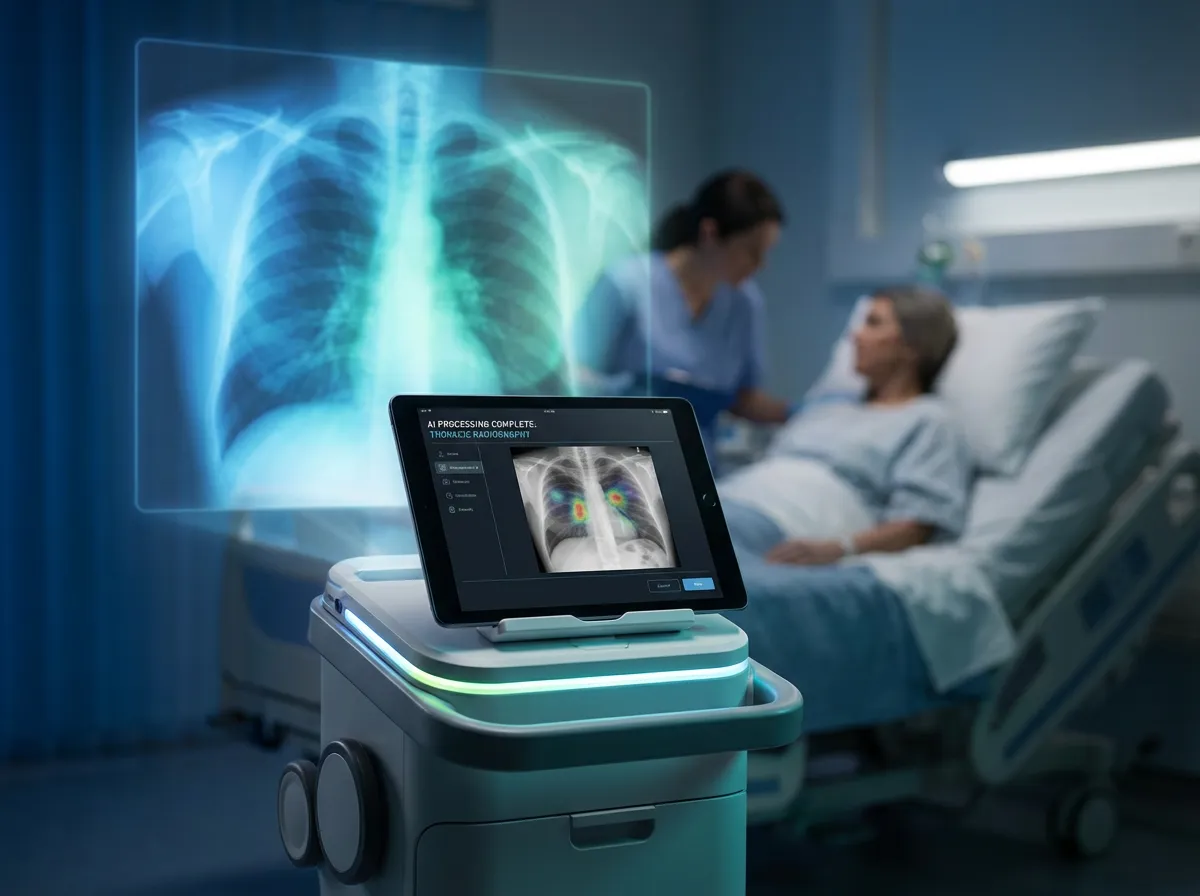
Mobile X-ray systems serve essential functions across intensive care units, emergency departments, and inpatient wards. These portable units capture high-resolution images comparable to stationary equipment while enabling rapid diagnosis for patients who cannot be safely moved. Time-sensitive conditions such as pneumothorax, pulmonary edema, and catheter placement verification depend on immediate imaging access at the bedside.
Simultaneously, AI integration in medical imaging is accelerating at remarkable pace. The AI medical imaging market reached $1.70 billion in 2024 and is forecast to expand to $16.88 billion by 2034 at a 25.8% CAGR. Healthcare facilities deploying AI-enabled portable X-ray systems report significant improvements in diagnostic accuracy, with AI algorithms achieving up to 95% detection rates for specific conditions. More than 30% of radiology practices in the United States now incorporate AI tools into their diagnostic workflows.
However, combining mobile hardware with advanced AI capabilities creates substantial engineering challenges that conventional computing platforms struggle to address.

Challenge: Delivering GPU Performance in Demanding Mobile Medical Environments
Medical device manufacturers developing AI-powered mobile X-ray systems confront multiple technical obstacles that compound in portable environments.
Computational Intensity and Thermal Management
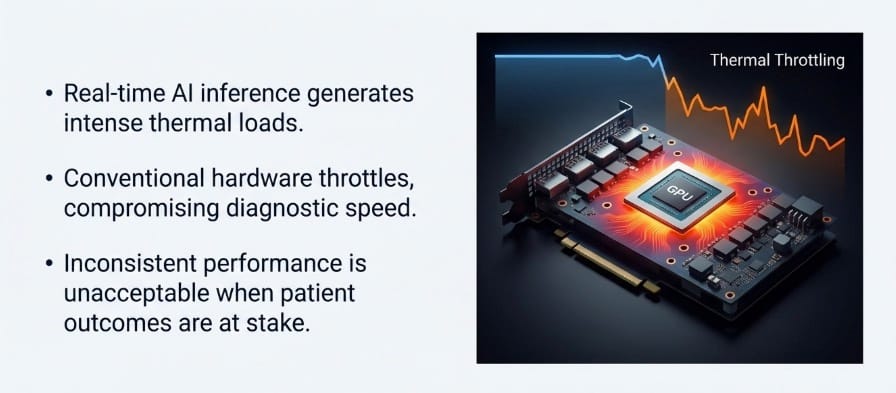
Real-time AI image analysis demands substantial GPU processing power to execute deep learning inference algorithms instantly. These computational workloads generate significant heat within compact mobile enclosures. Standard computing hardware throttles performance under sustained thermal loads, creating inconsistent processing speeds precisely when diagnostic accuracy matters most. Hospital corridors present variable ambient temperatures, and systems must maintain full performance whether operating in climate-controlled radiology suites or busy emergency departments with fluctuating conditions.
Mechanical Stress During Transport
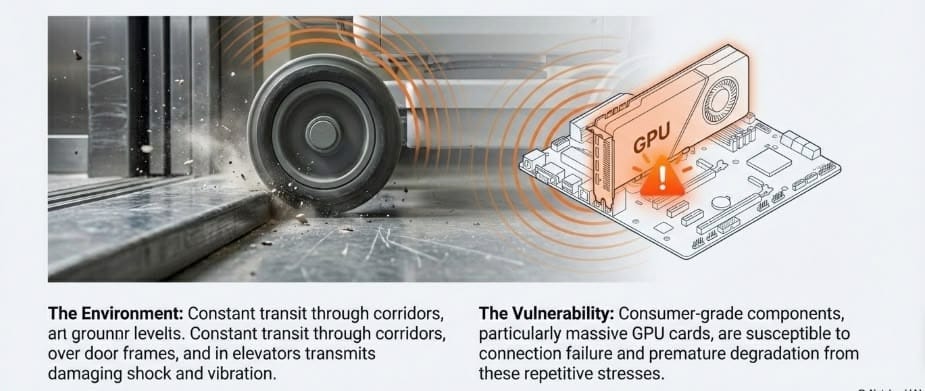
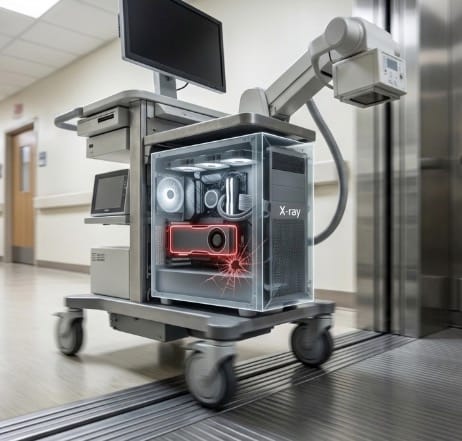
Mobile X-ray units navigate through hospitals constantly, encountering elevator thresholds, door frames, and hallway obstacles that transmit shock and vibration to onboard electronics. Consumer-grade computing components lack resilience against these repetitive mechanical stresses, leading to connection failures, component loosening, and premature system degradation. GPU cards present particular vulnerability due to their mass and mounting configurations within standard enclosures. Related: machine vision inspection.
Data Connectivity and Integration Requirements
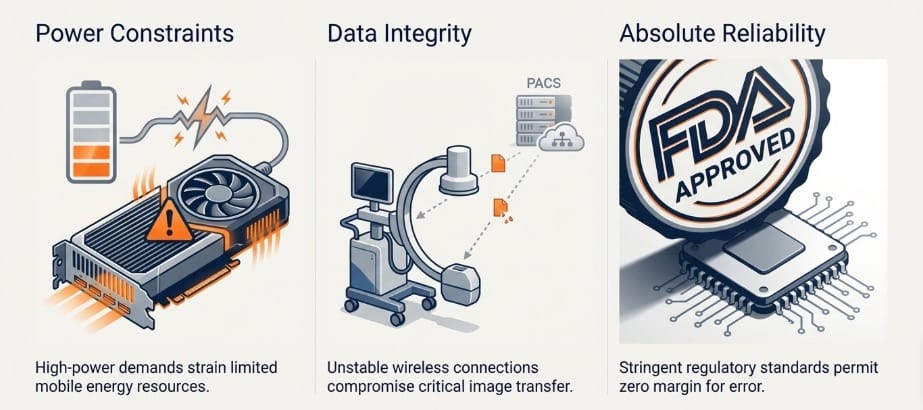
Modern medical imaging workflows require seamless connectivity to hospital picture archiving and communication systems (PACS), electronic health records, and cloud-based AI analysis platforms. Mobile units must upload high-resolution images wirelessly while maintaining data integrity and security compliance. This demands robust networking capabilities including high-speed Ethernet and wireless options within space-constrained mobile chassis.
Power System Constraints
Battery-powered mobile operation introduces strict power budgets that conflict with high-performance GPU requirements. Computing platforms must deliver maximum AI processing capability while operating efficiently within available power envelopes. Additionally, medical environments require systems that handle power fluctuations gracefully without corruption of image data or processing interruptions.
Regulatory and Reliability Standards
Medical imaging equipment must maintain consistent performance across thousands of operating hours in demanding clinical environments. System reliability directly impacts patient care outcomes and facility operational efficiency. Computing hardware failures during critical diagnostic procedures create patient safety risks and workflow disruptions that healthcare facilities cannot tolerate.
Solution: Nuvo-8108GC Edge AI Platform Powers Real-Time Bedside Diagnostics
The Nuvo-8108GC GPU computing platform delivers purpose-built capabilities that address each challenge facing AI-powered mobile X-ray system development.
High-Performance AI Processing Architecture
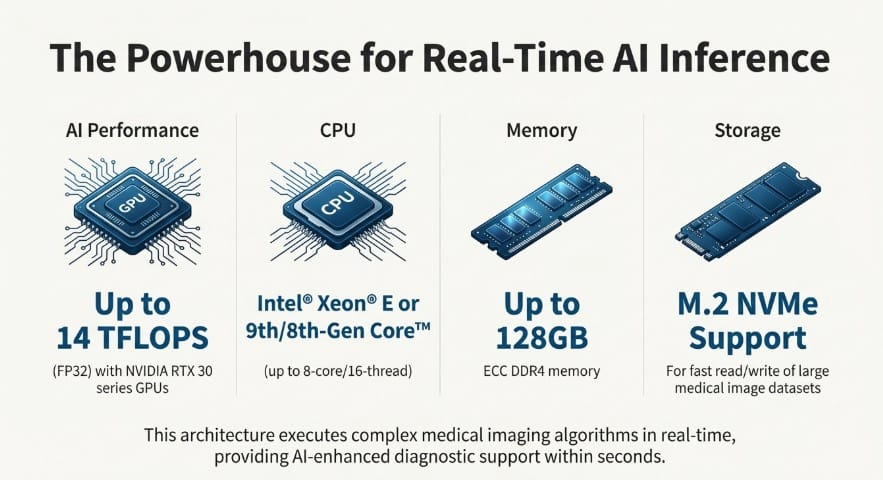
The platform combines Intel Xeon E or 9th/8th-Gen Core processors (up to 8-core/16-thread configurations) with workstation-grade Intel C246 chipset supporting up to 128GB ECC DDR4 memory. This foundation enables robust preprocessing and data management while the dedicated PCIe x16 slot accommodates NVIDIA RTX 30 series graphics cards delivering up to 14 TFLOPS of FP32 performance for AI inference. Medical imaging algorithms analyzing X-ray captures execute in real-time, providing radiologists with AI-enhanced diagnostic support within seconds of image acquisition.
Patented Thermal Engineering
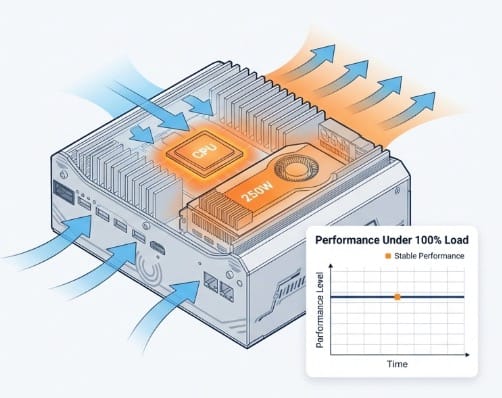
Neousys's patented wind tunnel cooling design enables sustained full-load operation across -25°C to 60°C ambient temperatures without thermal throttling. This proven thermal architecture dissipates heat from both CPU and 250W GPU simultaneously, ensuring consistent AI processing performance regardless of hospital environmental conditions. The system maintains reliability during continuous operation throughout extended clinical shifts.
Ruggedized Mechanical Design
The Nuvo-8108GC incorporates patented damping brackets that withstand up to 3 Grms vibration, meeting MIL-STD-810G shock and vibration standards. A patent-pending GPU press bar secures high-mass graphics cards against movement during mobile transport, preventing the connection issues that plague consumer hardware in portable applications. This mechanical robustness ensures reliable operation despite the physical demands of hospital navigation.
Comprehensive Connectivity Options
Front-accessible Gigabit Ethernet and USB 3.1 Gen2 ports feature screw-lock mechanisms for secure cable retention. The platform provides four PCIe expansion slots enabling integration of 10Gbps Ethernet, WiFi 6, or LTE connectivity for wireless PACS uploads and cloud AI collaboration. M.2 NVMe storage support delivers the fast read/write performance required for handling large medical image datasets efficiently.
Flexible Power Management
Wide-range 8-48V DC input with built-in power management handles the variable power conditions encountered in mobile medical equipment. The power delivery system supports the full 250W GPU requirement while enabling efficient battery operation. Integrated ignition control features provide graceful startup and shutdown sequencing that protects data integrity during power transitions.
Clinical Implementation Results
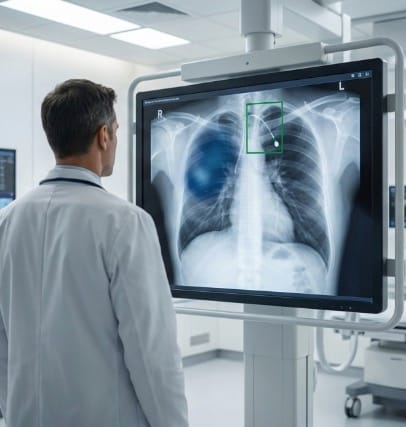
Healthcare facilities deploying Nuvo-8108GC-powered mobile X-ray systems report AI-enhanced workflows that reduce diagnostic interpretation time while improving detection consistency. AI algorithms running on the platform automatically identify pneumothorax markers, catheter positioning, and other critical findings, alerting clinicians to time-sensitive conditions. This automated analysis supports faster triage decisions in emergency departments and more efficient bedside care in intensive care units.
Related Products
- Nuvo-8108GC-QD (NVIDIA RTX A6000/A4500 Platform):
- Why it Complements: For medical imaging applications requiring professional visualization alongside AI inference, this variant supports NVIDIA RTX A-series workstation GPUs. The professional graphics architecture provides certified drivers and enhanced floating-point precision beneficial for advanced imaging reconstruction and 3D visualization workflows.
- Link: https://www.neteon.net/en/neousys-nuvo-8108gc-qd
- Nuvo-8108GC-XL (Extended RTX 30 Series Support):
- Why it Complements: When medical imaging applications demand maximum GPU capability, this extended variant accommodates larger RTX 30 series cards up to RTX 3080. The optimized mechanical design and enhanced cooling capacity support the highest-performance AI inference for complex multi-model analysis pipelines.
- Link: https://www.neteon.net/en/neousys-nuvo-8108gc-xl
- POC-700 Series (Ultra-Compact Embedded Computer):
- Why it Complements: For auxiliary imaging stations, review workstations, or distributed hospital endpoints that do not require GPU acceleration, the POC-700 series provides compact Intel Core processing in a fanless design. These units serve effectively as PACS viewing terminals or data collection nodes within integrated mobile imaging ecosystems.
- Link: https://www.neteon.net/en/neousys-poc-700
Conclusion
AI-powered mobile X-ray systems represent a convergence of portable medical imaging and deep learning diagnostics that demands specialized computing infrastructure. The Nuvo-8108GC addresses this intersection through industrial-grade GPU computing designed specifically for field deployment where reliability and performance cannot be compromised.
Neousys Technology's proven track record in rugged edge AI platforms positions the company as a trusted partner for medical device manufacturers advancing mobile diagnostic capabilities. As healthcare continues embracing AI-enhanced imaging workflows, the Nuvo-8108GC ensures that portable diagnostic equipment delivers laboratory-grade AI performance at the patient bedside.
For mobile X-ray computing specifications, integration guidance, or application engineering support, contact Neousys Technology at https://www.neousys-tech.com or reach out to Neteon at https://www.neteon.net.
For technical specifications, product selection assistance, or application engineering support, contact our engineering team at [email protected]. Visit www.neteon.net for detailed datasheets and technical documentation.
FAQs
Why does mobile X-ray imaging need edge AI computing?
Bedside X-ray units require immediate image processing for emergency diagnosis. Neousys compact edge computers deliver sub-5-second AI-enhanced imaging without hospital network dependency.
What image quality improvements does AI processing provide?
Edge AI on Neousys GPU platforms applies noise reduction, contrast enhancement, and automatic exposure correction, improving diagnostic image quality by 30-40% compared to raw detector output.
Can the system detect abnormalities automatically?
Yes, AI models running on Neousys edge computers pre-screen for pneumothorax, fractures, and foreign bodies with 92-96% sensitivity, flagging urgent findings for immediate radiologist review.
How compact are the edge computing units for mobile X-ray carts?
Neousys POC-700 Series platforms measure just 0.57L (140×105×39mm), fitting easily into mobile X-ray cart compartments without adding significant weight or requiring additional power infrastructure.
Does the system comply with medical device regulations?
The computing hardware meets IEC 60601 EMC requirements. Neousys platforms provide the ruggedized, fanless foundation while software-level FDA/CE clearance depends on the medical AI application developer.