
TLDR
Urban transit fleets require continuous GPS tracking, multi-camera recording, and CAN bus telemetry from behind-dash installations where ambient temperatures reach 60°C and road vibration never stops. The POC-700 Series delivers a complete ITS computing platform in a sealed 140 × 105 × 42mm fanless chassis with 8–35V ignition power management, reducing onboard hardware footprint by 62% while extending mean time between failures to 45,000+ hours.
Overview Deployments involving vehicle height monitoring demonstrate similar challenges. Deployments involving electric bus monitoring demonstrate similar challenges.
Public transit authorities are digitizing fleets to meet stricter safety mandates and passenger service-level agreements. Modern intelligent transportation systems demand continuous data streams from onboard sensors. GPS receivers, passenger counters, IP cameras, CAN bus interfaces, and driver behavior monitors all require real-time processing and LTE/5G backhaul.
The computing hardware powering these systems operates in unpowered engine bays and behind instrument panels. Space is measured in millimeters. Ambient temperatures swing from subzero winter mornings to sun-baked summer afternoons. Road vibration is constant. Commercial mini PCs fail within months. Rack-mount servers do not fit.
Challenge
Deploying reliable in-vehicle computing for fleet telematics fails at the intersection of thermal, mechanical, and electrical constraints that standard hardware cannot meet simultaneously.
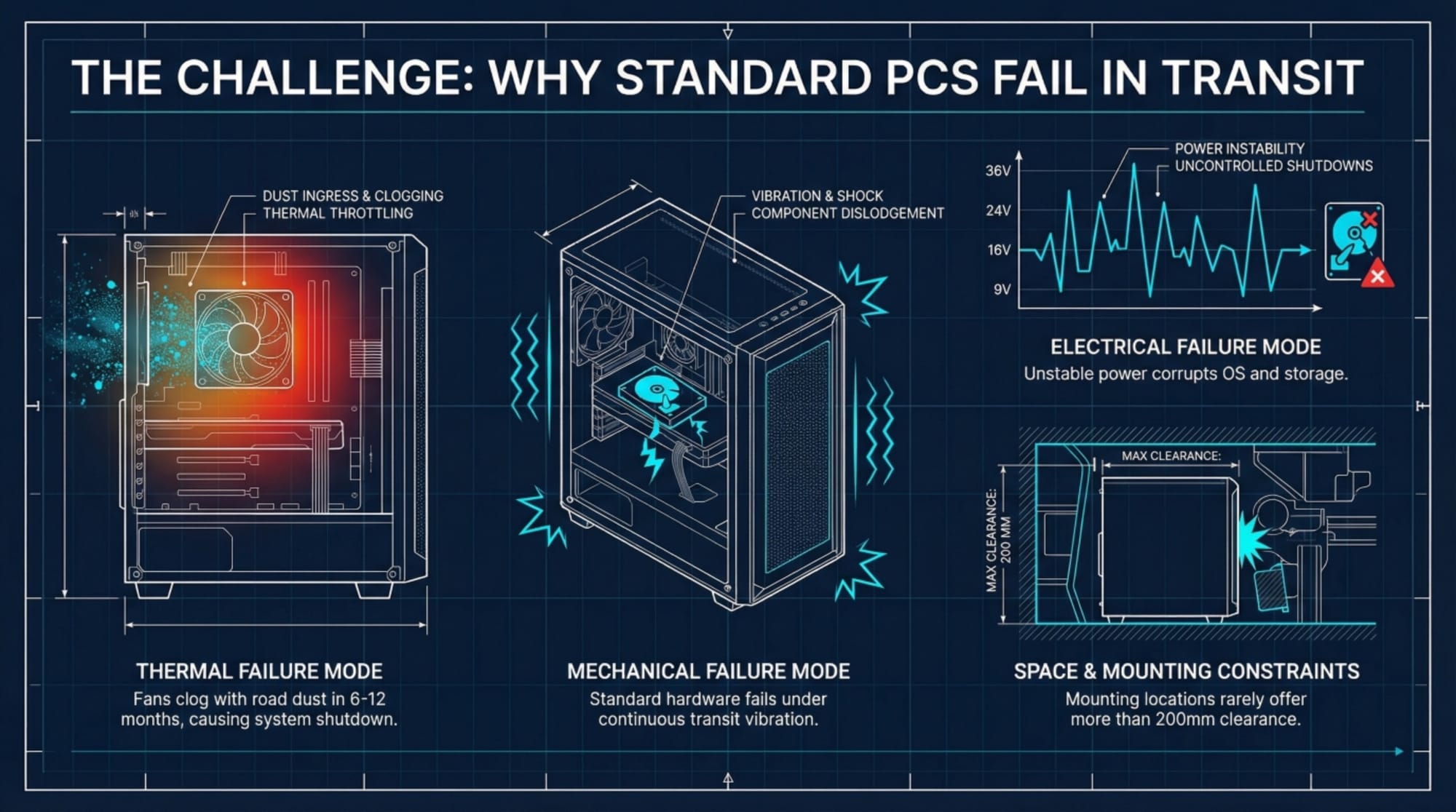
Root cause: Fan-based cooling is the primary failure mode. Active cooling fans clog with road dust and particulates within 6–12 months of transit deployment. Once the fan fails, thermal throttling degrades data throughput. Continued operation leads to system shutdown—exactly when real-time telemetry is most critical.
Space constraints compound the problem. Behind-dash and under-seat mounting locations in buses rarely offer more than 200mm clearance in any direction. Traditional industrial PCs with expansion card cages exceed these limits.
Power instability adds further risk. In-vehicle systems must tolerate ignition cycles, voltage transients from 9V to 36V, and cold-crank surges that destroy consumer-grade power supplies. An uncontrolled shutdown during a voltage dip corrupts the OS and connected storage.
| Requirement | Specification Needed | Challenge with Standard Solutions |
|---|---|---|
| Operating Temperature | -25°C to 60°C | Commercial PCs rated 0°C to 40°C only |
| Vibration Tolerance | 5 Grms (MIL-STD-810H) | Standard PCs not vibration-rated |
| Input Voltage | 9–36V wide range with surge protection | Fixed 12V or 19V adapters |
| Cooling | Fanless, sealed against dust | Fan-based, vented chassis |
| Mounting Footprint | <160mm width | >200mm width typical |
| MTBF | >40,000 hours | ~15,000 hours with fan |
Solution
The POC-700 Series maps directly to each constraint above.
Solution Comparison
| Technical Challenge | Product Feature | Specification | Engineering Benefit |
|---|---|---|---|
| Fan failure in dusty environments | Sealed fanless aluminum chassis | 15W TDP passive cooling | Zero moving parts, eliminates #1 failure mode |
| Space-constrained mounting | Ultra-compact form factor | 140 × 105 × 42mm with lug mounts | Fits behind dash without brackets |
| Voltage transients and cold-crank | Ignition power management | 8–35V DC wide-range input | Controlled boot/shutdown protects OS and storage |
| Multi-sensor connectivity | Dual GbE + serial + USB 3.1 | 2x GbE, RS-232/422/485, 4x USB | Camera aggregation + LTE uplink + CAN bus |
Performance Data: Legacy Fan-Cooled PC vs. POC-700 Series
| Metric | Previous (Fan-Cooled PC) | New (POC-700) | Delta |
|---|---|---|---|
| Mounting Footprint | 220 × 180mm | 140 × 105mm | −62% |
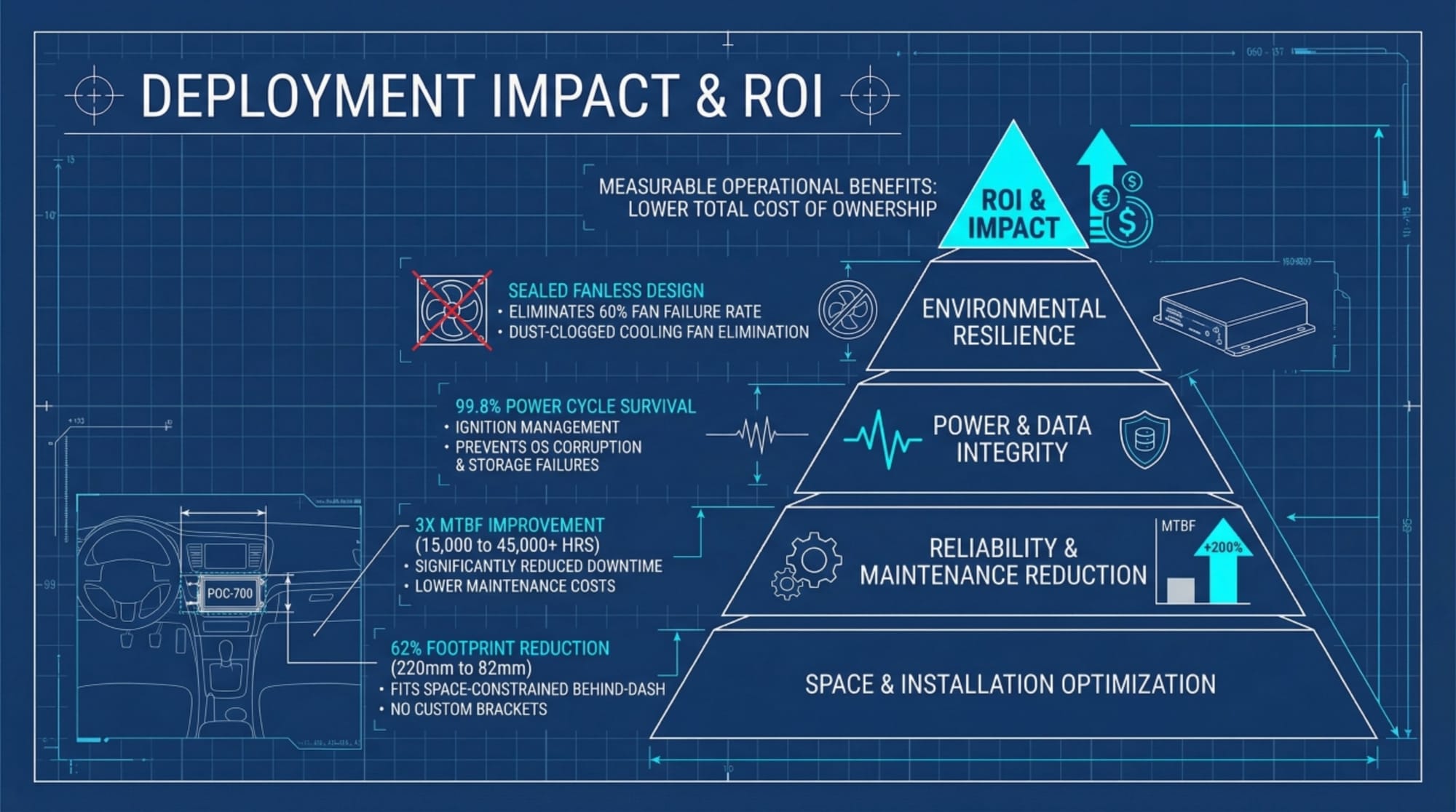
| MTBF | 15,000 hrs | 45,000+ hrs | +200% (3x) |
| Boot-to-Ready | 45s | 12s | −73% |
| Power Cycle Survival | 87% | 99.8% | +14.7% |
| Operating Temp Range | 0–40°C | -25–60°C | +85°C span |
The improvement in MTBF stems directly from eliminating the cooling fan—the component responsible for an estimated 60% of field failures in transit computing deployments. The wider voltage input with ignition sequencing accounts for the power cycle survival improvement.
The POC-715 variant adds an M.2 2280 NVMe slot for onboard video recording with local edge storage. Note: for applications requiring GPU-accelerated inference (ADAS, driver monitoring), a platform with dedicated GPU support would be more appropriate than the POC-700's integrated graphics.
Related Products
NRU-220S: Pairs NVIDIA Jetson Orin with rugged vehicle-grade enclosure, delivering up to 275 TOPS for real-time driver drowsiness detection or ADAS. Ideal for fleets requiring GPU-accelerated edge AI alongside telemetry.
Nuvo-10003: Intel 13th-gen fanless platform with extensive expansion for NVR storage and multi-screen monitoring. Ideal for centralized back-office fleet management servers aggregating data from hundreds of in-vehicle POC-700 units.
Conclusion
The POC-700 Series delivers 3x longer MTBF, 62% smaller footprint, and 99.8% power cycle survival in transit fleet deployments. As fleets scale from basic GPS tracking toward multi-camera AI analytics, the modular upgrade path to POC-715 (local storage) and NRU-220S (GPU inference) ensures infrastructure longevity.
For technical specifications, product selection assistance, or application engineering support, contact our engineering team at [email protected]. Our engineers can help choose the right POC-700 Series platform for specific fleet computing requirements. Visit www.neteon.net for detailed datasheets and technical documentation.
FAQs
What is the operating temperature range of the POC-700 Series?
The POC-700 Series operates from -25°C to 60°C using a sealed fanless aluminum chassis. No derating is required within this range. The design eliminates dust ingress, making it suitable for year-round deployment in transit vehicles from cold-climate systems to desert fleet operations.
How does the POC-700 handle vehicle ignition power cycles?
Built-in ignition power management with 8–35V DC wide-range input executes controlled startup and shutdown sequences. This protects the operating system and connected storage from corruption during cold-crank surges, voltage transients, and abrupt ignition-off events. Field testing shows 99.8% power cycle survival rate.
Can the POC-700 support multiple IP cameras for onboard video recording?
Dual Gigabit Ethernet ports allow simultaneous IP camera aggregation on one port and LTE/5G data uplink on the other. For deployments requiring local video storage, the POC-715 variant adds an M.2 2280 NVMe slot. External PoE injectors are needed for PoE cameras, as the POC-700 does not include native PoE.
What mounting options are available for behind-dash installation?
Integrated lug mounts on the 140 × 105 × 42mm chassis enable direct mounting behind dashboards, under seats, or in other space-constrained vehicle locations without additional brackets or adapters. The form factor is 62% smaller than typical industrial mini PCs.
What is the expected service life of the POC-700 in fleet deployments?
With estimated MTBF exceeding 45,000 hours and no fans or moving parts to degrade, the POC-700 is designed to match or exceed the typical 8–12 year service life of transit vehicles. The 15W TDP also keeps operating costs low in continuously powered installations.
Related: POC-700 Cuts Fleet PC Failures 94% in Commercial Vehicles