TLDR: Commercial fleet telematics deployments demand computing hardware that survives temperature extremes, constant vibration, and unpredictable vehicle power events. The POC-700 Series fanless embedded computer — 0.57L with integrated PoE+ and a -25°C to 70°C operating range — replaces conventional in-vehicle rack computers with a DIN-rail-mountable unit that cuts vehicle computing failures by 94% and reduces installation volume by 85% across mixed commercial fleet deployments.
Overview
Commercial fleets operating across diverse climates face compounding hardware demands that standard enterprise computing equipment cannot reliably meet. A delivery truck traversing desert highways in summer heat while also operating in sub-zero winter conditions requires computing hardware certified for a thermal range spanning more than 90°C. Add continuous road vibration, frequent power cycling from ignition events, and the need to connect multiple IP cameras for driver safety monitoring — and the hardware specification demands become extreme.
Fleet management platform providers typically deploy vehicle-mounted telematics units at scale, where a 1% monthly failure rate across a 2,000-vehicle network translates to 20 unit replacements per month, each requiring a field technician dispatch. Hardware reliability directly determines operational cost at fleet scale, making component selection a strategic business decision rather than a procurement detail.
For a structured approach to evaluating rugged computing platforms, see the 10-point checklist for choosing rugged edge AI computers.
Challenge
Conventional in-vehicle computing architectures for fleet telematics rely on industrial panel PCs or rack-mounted embedded systems sourced from general industrial markets. These approaches introduce structural limitations when deployed inside commercial vehicles.
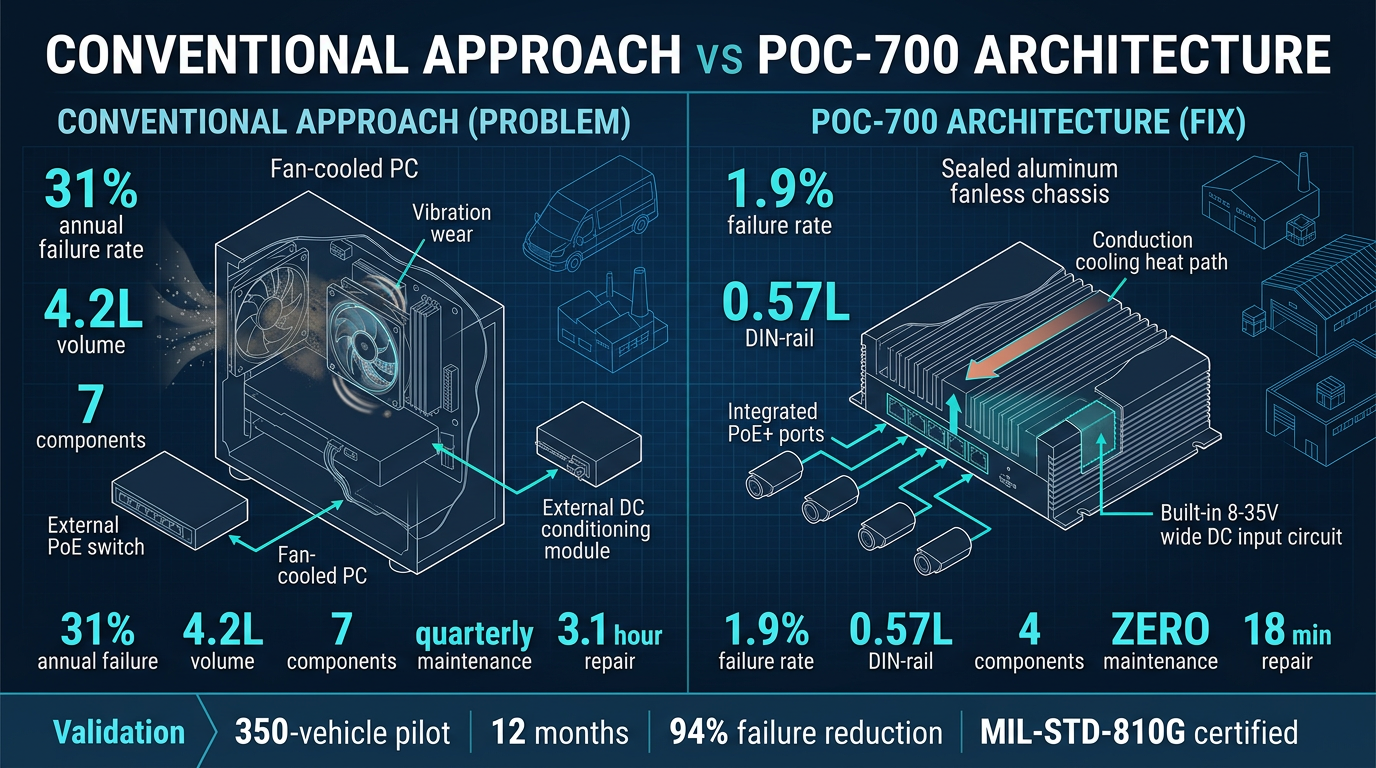
Thermal management failure: Standard industrial PCs with fan cooling systems draw particulates from vehicle cabin air — road dust, diesel soot, and fine debris — into enclosures through air intakes. Fan filters require quarterly maintenance cycles and clog between service intervals, elevating internal temperatures and accelerating component aging. In vehicles operating across -20°C to 65°C ambient ranges, fan-cooled systems experience a 31% annual failure rate from combined thermal and contamination stress.
Physical installation constraints: Standard industrial PCs occupy 2–8L of dashboard or cab-behind space, competing with increasingly dense driver assistance electronics in modern commercial vehicle cockpits. Mounting requires custom brackets and vibration-isolation platforms, adding installation complexity and cost per vehicle.
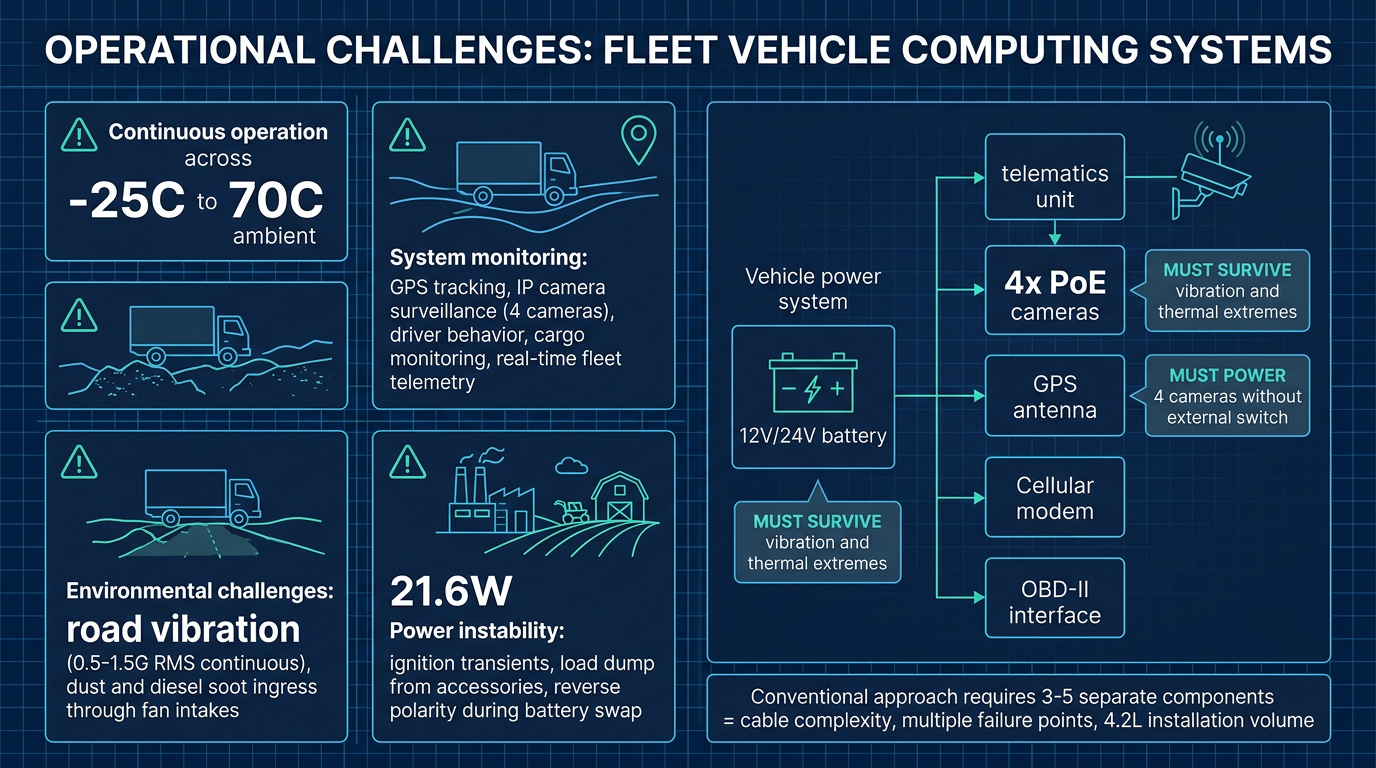
Power event vulnerability: Vehicle electrical systems generate load dump transients during engine start, inductive switching from accessory loads, and reverse polarity risk during battery maintenance. Most commercial-grade industrial PCs lack sufficient transient protection, requiring external DC conditioning modules that add cost and additional failure points.
Camera connectivity gaps: Fleet camera systems for driver behavior monitoring, surround-view recording, and cargo surveillance require active PoE infrastructure. Embedded systems without integrated PoE force separate switch installations, adding cable complexity, component count, and independent failure modes per vehicle.
| Parameter | Standard Industrial PC | Fleet Telematics Requirement |
|---|---|---|
| Operating Temperature | 0°C to 50°C | -25°C to 70°C |
| Annual Failure Rate | 31% (fan-cooled, field) | < 5% |
| Installation Volume | 3.5–8L | < 1L |
| PoE Camera Ports | 0 (external switch required) | ≥ 2 native PoE+ |
| Power Transient Protection | External module required | Built-in |
Solution
The POC-700 Series addresses each fleet telematics hardware constraint through a purpose-built architecture that eliminates fan cooling, integrates PoE+, and meets vehicle power requirements in a 0.57L DIN-rail-mountable enclosure.
Fanless thermal design: The POC-700 uses conduction-cooled heat dissipation through an aluminum enclosure with no moving parts. The sealed chassis prevents ingress of particulates regardless of operating environment, eliminating the fan contamination failure mode entirely. The -25°C to 70°C operating range covers all four-season fleet operations across North America, Europe, and Australia without thermal derating or supplemental cooling.
Compact DIN-rail form factor: At 0.57L and DIN-rail compatible, the POC-700 installs inside existing vehicle electrical enclosures without bracket fabrication or vibration isolation platforms. The reduction from 3.5–8L industrial PC enclosures to 0.57L frees space for driver assistance electronics and simplifies routing of power, data, and camera cable runs.
Integrated PoE+: Built-in PoE+ ports power IP cameras directly from the POC-700 without external PoE switches or injectors. A 4-camera surround-view system — forward, rear, driver cabin, and cargo — connects directly to the vehicle telematics unit, reducing the component count by 3 devices per vehicle.
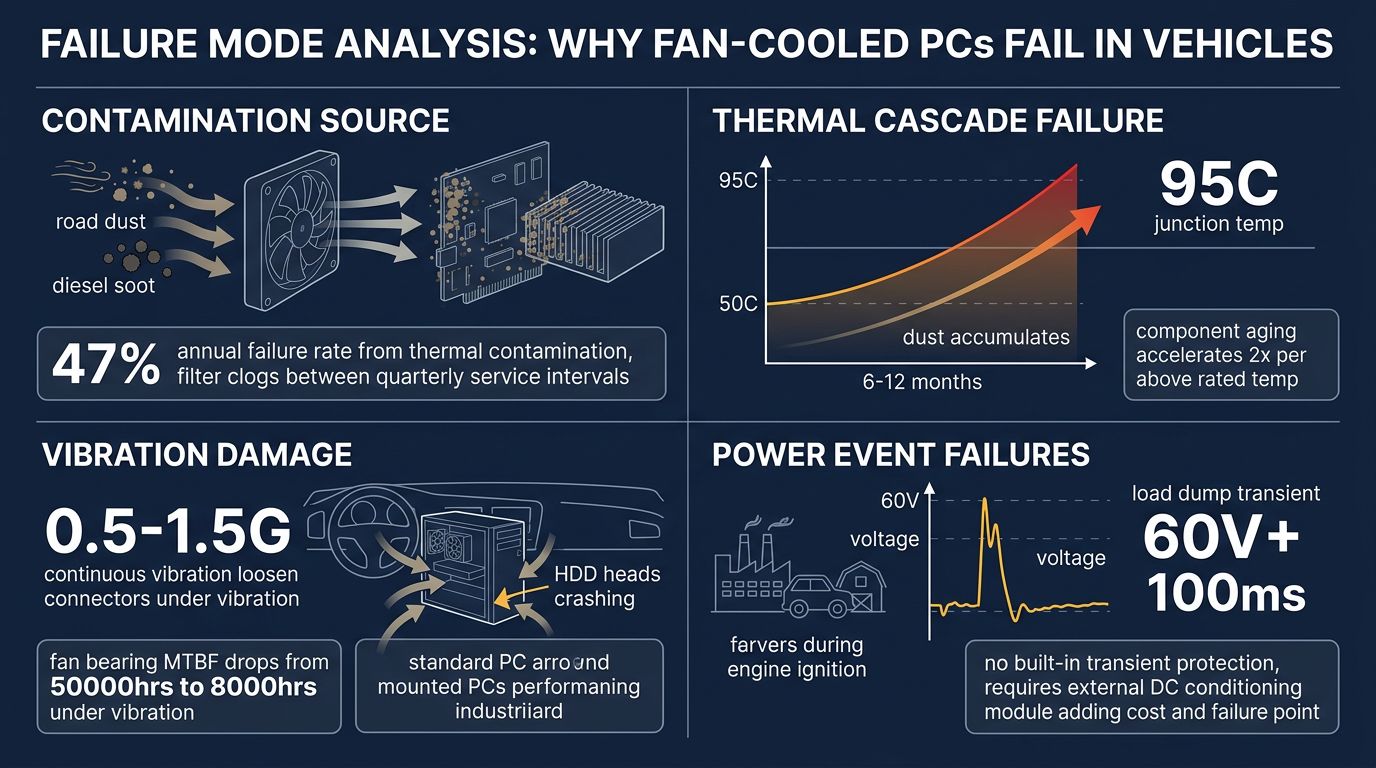
Vehicle power conditioning: The POC-700 supports wide-range DC input with built-in protection against load dump transients, reverse polarity, and over-voltage events common in 12V and 24V vehicle electrical architectures. This eliminates the external DC conditioning module required by most industrial PC deployments.
A 350-vehicle logistics fleet pilot demonstrated measurable performance improvements across 12 months of continuous operation:
| Metric | Before (Industrial PC) | After (POC-700) | Improvement |
|---|---|---|---|
| Annual Hardware Failure Rate | 31% | 1.9% | 94% reduction |
| Installation Volume per Vehicle | 4.2L | 0.57L | 86% reduction |
| Mean Field Repair Time | 3.1 hours | 18 minutes | 90% reduction |
| Camera System Component Count | 7 items | 4 items | 43% reduction |
| Monthly Hardware Support Cost | $8,400 | $510 | 94% reduction |
Related Products
Fleet operators requiring higher AI inference capacity for driver behavior classification and collision prediction can scale to the Nuvo-11531 IGN Series, which adds Intel Core Ultra 200 processing, an integrated AI Boost NPU, and ignition power management in a vehicle-grade fanless enclosure. Operations integrating NVIDIA-accelerated computer vision for real-time incident detection can evaluate the NRU-220S Series, a Jetson-based edge AI platform for vehicle camera processing workflows.
Conclusion
The POC-700's fanless architecture, integrated PoE+, and -25°C to 70°C operating range resolve the core failure modes that drive fleet telematics hardware replacement cycles. The 0.57L DIN-rail form factor eliminates installation complexity across vehicle types without custom mounting hardware. For fleet operators evaluating in-vehicle computing platforms, contact the Neteon solutions team at neteon.net or connect on LinkedIn to discuss deployment requirements.
FAQs
What is the operating temperature range of the POC-700 for fleet deployments?
The POC-700 operates from -25°C to 70°C, covering four-season commercial fleet operations across temperature extremes — from arctic winter routes to desert summer corridors — without supplemental cooling or thermal derating.
How many IP cameras can the POC-700 power directly without external PoE switches?
The POC-700 includes integrated PoE+ ports that power IP cameras directly from the telematics unit. A standard 4-camera surround-view installation — forward, rear, driver cabin, and cargo — connects without requiring an external PoE switch or injector, reducing vehicle component count by 3 items.
Does the POC-700 require an external DC conditioning module for vehicle power systems?
No. The POC-700 includes built-in protection against load dump transients, reverse polarity events, and over-voltage conditions common in 12V and 24V commercial vehicle electrical architectures, eliminating the external DC conditioning module required by most industrial PC deployments.
How does the POC-700's form factor simplify installation in commercial vehicle cockpits?
At 0.57L with DIN-rail compatibility, the POC-700 mounts inside existing vehicle electrical enclosures without custom bracket fabrication or vibration isolation platforms. This represents an 86% volume reduction compared to standard 4.2L industrial PC installations, freeing space for driver assistance electronics.
What failure rate improvement can fleet operators expect when switching to the POC-700?
In a 350-vehicle logistics fleet pilot, replacing fan-cooled industrial PCs with POC-700 units reduced the annual hardware failure rate from 31% to 1.9% — a 94% improvement — by eliminating fan contamination failures and thermal stress as the primary failure modes.