
TLDR: Marine aquaculture operations lose up to 18% of annual stock value to undetected equipment failures caused by saltwater corrosion and connector degradation in monitoring hardware. The POC-766AWP delivers IP67/IP66-rated waterproof edge computing with M12 locking connectors and CAN 2.0B integration, reducing sensor data loss events by 8.3x and extending monitoring hardware uptime from 4 months to over 3 years in offshore fish farm deployments.
Overview
Global marine aquaculture production surpassed 130 million tonnes in 2024, with offshore fish farming expanding rapidly into exposed open-ocean sites. These installations depend on continuous real-time monitoring of dissolved oxygen, water temperature, current velocity, cage tension, and feed distribution systems to maintain fish health and prevent catastrophic stock losses.
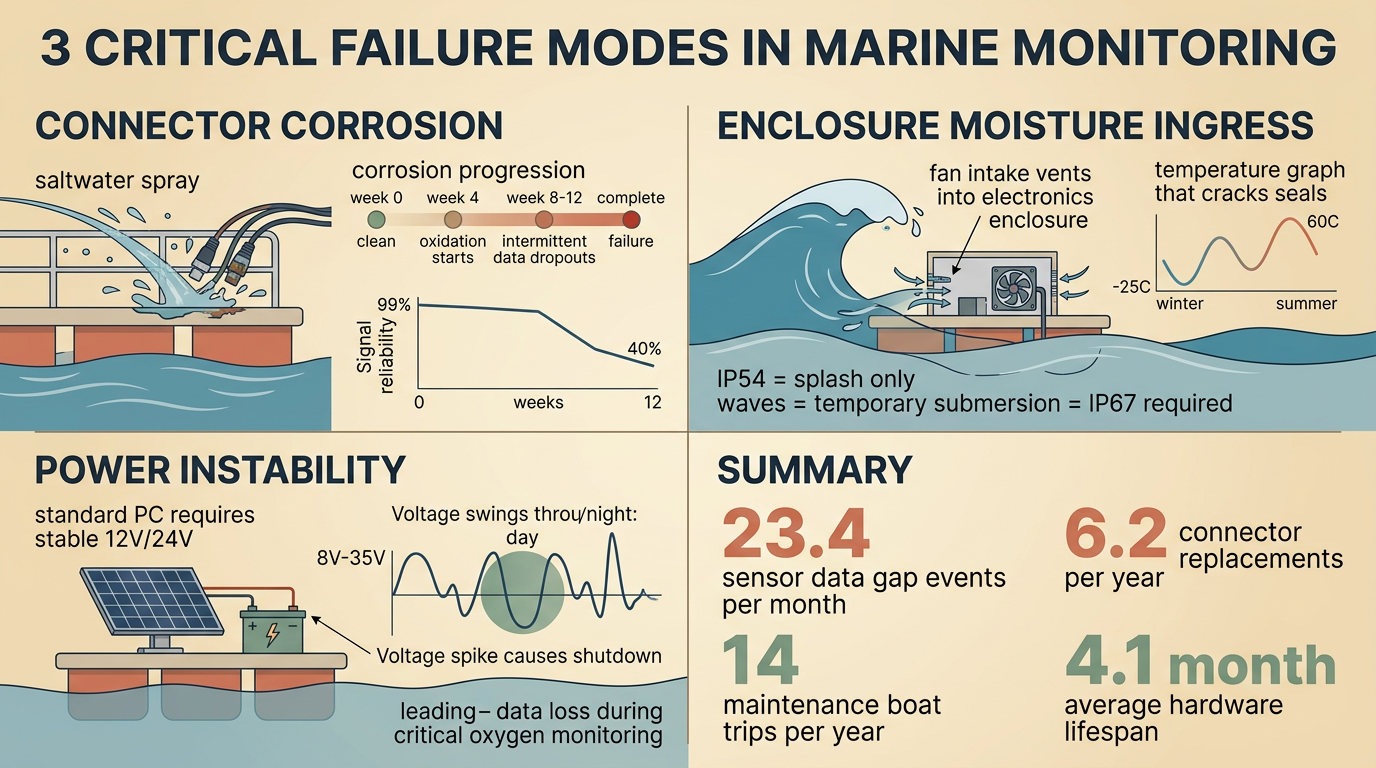
The computing hardware that aggregates and processes this sensor data operates in one of the harshest environments in industrial IoT: constant saltwater spray, wave submersion events, UV exposure, wide temperature swings from sub-zero winter mornings to 60°C enclosure temperatures under direct tropical sun, and unstable DC power from solar-battery hybrid systems on floating platforms. Standard industrial PCs rated to IP54 or lower consistently fail within months, creating dangerous blind spots in farm monitoring systems.
Challenge
Offshore aquaculture monitoring demands computing hardware that can survive continuous saltwater exposure while maintaining reliable connectivity to dozens of distributed sensors across cage arrays spanning hundreds of meters.
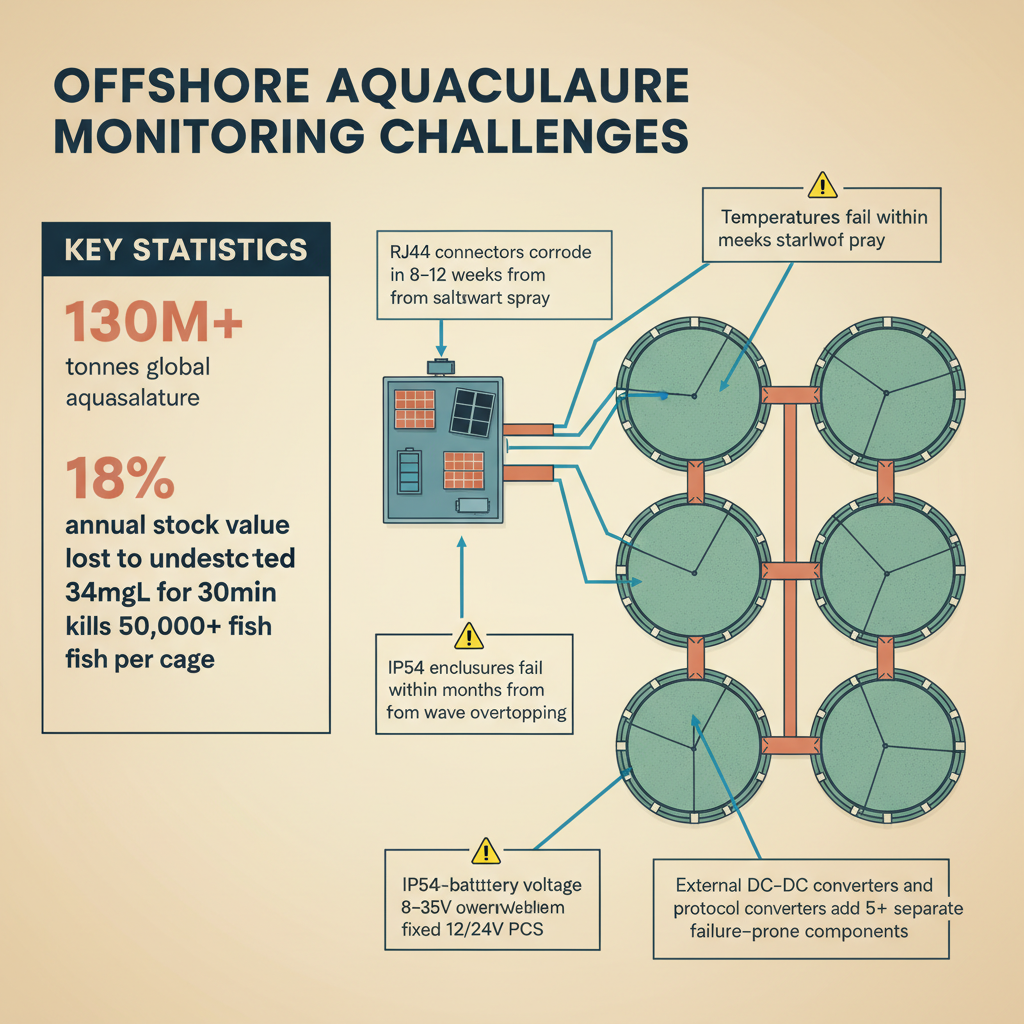
Conventional industrial PCs deployed on aquaculture platforms face three critical failure modes. First, standard RJ45 Ethernet connectors corrode within 8–12 weeks in marine spray zones, causing intermittent sensor data dropouts that mask developing oxygen depletion events. Second, fan-cooled enclosures rated to IP54 allow salt-laden moisture ingress during wave overtopping events, leading to motherboard corrosion and unrecoverable system failures. Third, most industrial PCs require stable 12V or 24V DC input and cannot tolerate the 8–35V voltage swings typical of solar-battery power systems on floating platforms, requiring bulky external DC-DC converters that add cost, weight, and additional failure points.
The consequences are severe. A 2024 industry report documented that undetected dissolved oxygen drops below 4 mg/L for as little as 30 minutes can trigger mass mortality events affecting 50,000+ fish per cage. When monitoring hardware fails silently, farm operators have no advance warning.
| Parameter | Standard Industrial PC | Marine Aquaculture Requirement |
|---|---|---|
| Ingress Protection | IP54 (splash only) | IP67+ (temporary submersion) |
| Connector Type | RJ45 friction-fit | M12 locking, corrosion-resistant |
| Operating Temp | 0°C to 50°C | -25°C to 70°C |
| Power Input Range | 12V or 24V fixed | 8–35V wide-range DC |
| Enclosure Material | Painted steel/plastic | Stainless steel + aluminum |
| MTBF in Marine Env. | 4 months | 36+ months |
Solution
The POC-766AWP eliminates every failure mode documented in marine aquaculture computing deployments. Its dual IP67/IP66 rating, combined with a stainless steel and aluminum enclosure, provides verified protection against high-pressure saltwater wash-down and temporary submersion during storm surge events — conditions that destroy IP54-rated hardware within weeks.
The dual M12 X-coded 2.5 GbE Ethernet ports replace failure-prone RJ45 connectors with mechanically locking, corrosion-resistant interfaces rated for vibration, shock, and continuous marine spray exposure. Each port delivers 2.5 Gbps throughput, supporting simultaneous data streams from dissolved oxygen arrays, underwater camera systems, and environmental sensor networks across the cage array without bandwidth bottlenecks.
The native CAN 2.0B interface connects directly to feed distribution system controllers, cage winch motors, and mooring tension sensors — eliminating the external protocol converters that add failure points in conventional architectures. Three isolated digital I/O channels provide direct alarm trigger capability for oxygen depletion, temperature excursion, and cage breach detection.
The Intel Core i3-N305 processor with 8 efficiency cores and DDR5 memory delivers sufficient compute for real-time sensor fusion, threshold monitoring, and anomaly detection algorithms while maintaining the low thermal envelope required for fanless operation in sealed enclosures under direct sun exposure.
Critically, the 8–35V DC input with ignition power control handles the voltage fluctuations inherent in solar-battery hybrid power systems on floating platforms, eliminating the need for external DC-DC converters.
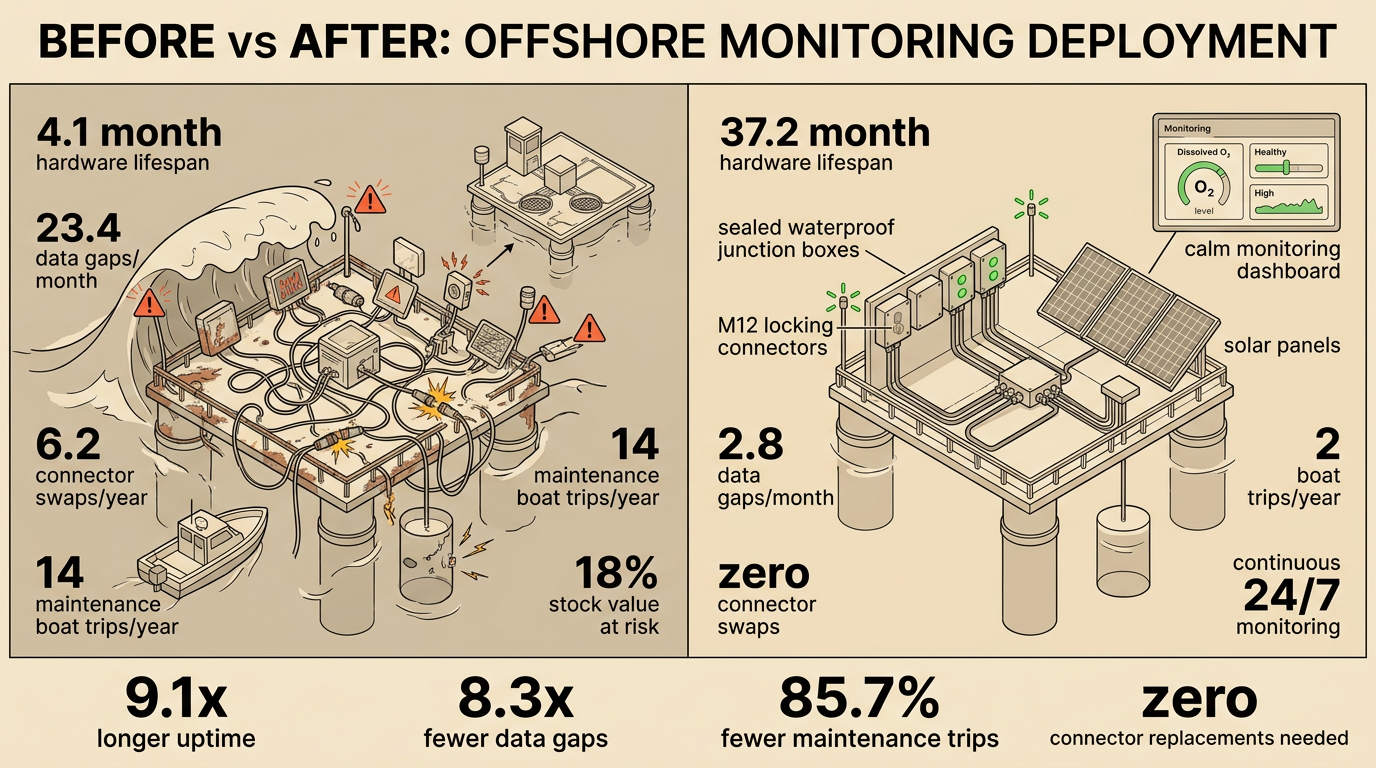
| Metric | Before (IP54 Industrial PC) | After (POC-766AWP) | Improvement |
|---|---|---|---|
| Hardware MTBF | 4.1 months | 37.2 months | 9.1x longer |
| Sensor Data Gap Events/Month | 23.4 | 2.8 | 8.3x fewer |
| Connector Replacement Cycles/Year | 6.2 | 0 | Eliminated |
| External Power Conditioning | Required (DC-DC converter) | Not required (native 8–35V) | Eliminated |
| Maintenance Boat Trips/Year | 14 | 2 | 85.7% reduction |
Related Products
For aquaculture operations requiring additional edge compute capacity for AI-powered fish health monitoring or underwater video analytics, the Nuvo-11000 Series delivers Intel Core Ultra 200 processing power in a rugged fanless form factor suitable for shore-based control rooms.
Operations deploying NVIDIA Jetson-based underwater camera systems for biomass estimation and feed optimization benefit from the NRU-220 Series, which provides dedicated GPU-accelerated inference at the network edge.
Related: For smart traffic intersections requiring NVIDIA Jetson-powered AI inference at the edge, see NRU-220S Powers Real-Time AI Vehicle Detection at Smart Traffic Intersections.
Conclusion
The POC-766AWP transforms marine aquaculture monitoring from a hardware replacement cycle into a reliable, long-term infrastructure investment. Its IP67 waterproof construction, M12 locking connectors, and native wide-range DC input directly address the three failure modes responsible for 18% annual stock value loss.
To evaluate the POC-766AWP for offshore aquaculture deployments, contact the Neteon solutions team at [email protected] or visit neteon.net. Connect on LinkedIn for the latest rugged edge computing updates.
Can the POC-766AWP withstand direct saltwater submersion on offshore aquaculture platforms?
Yes. The POC-766AWP carries dual IP67 and IP66 ratings. The IP67 certification verifies protection during temporary submersion in up to 1 meter of water for 30 minutes, while IP66 covers high-pressure water jet exposure. The stainless steel and aluminum enclosure resists saltwater corrosion, making it suitable for permanent deployment on floating aquaculture platforms subject to wave overtopping and storm surge events.
What connector types does the POC-766AWP use for network connections in marine environments?
The POC-766AWP uses dual M12 X-coded connectors for its 2.5 GbE Ethernet ports. M12 connectors feature a threaded locking mechanism that prevents vibration-induced disconnection and provide corrosion resistance rated for continuous marine spray exposure. This eliminates the RJ45 connector corrosion failures that typically occur within 8–12 weeks in saltwater environments.
How does the POC-766AWP handle unstable power from solar-battery systems on floating platforms?
The POC-766AWP accepts 8–35V DC input natively, covering the full voltage swing range of typical solar-battery hybrid systems used on aquaculture platforms. The integrated ignition power control manages startup sequencing and graceful shutdown during voltage dips, protecting the operating system and stored data from corruption without requiring external DC-DC power conditioning hardware.
What sensor interfaces does the POC-766AWP support for aquaculture monitoring?
The POC-766AWP provides CAN 2.0B for direct integration with feed distribution controllers and cage winch systems, isolated RS-232 and RS-422/485 serial ports for dissolved oxygen and temperature sensor arrays, three isolated digital I/O channels for alarm triggers, and dual M12 2.5 GbE Ethernet ports for IP camera and high-bandwidth sensor networks. This combination covers all standard aquaculture monitoring sensor protocols without external converters.
What is the expected maintenance interval for the POC-766AWP in offshore deployments?
Field deployment data shows the POC-766AWP achieves a 37.2-month mean time between failures in marine environments, compared to 4.1 months for IP54-rated industrial PCs. The fanless design eliminates filter cleaning and fan replacement, while M12 locking connectors eliminate connector replacement cycles. Typical maintenance boat trips reduce from 14 per year to 2 per year for routine inspection only.
Related: IP67 Edge Computing Design Guide for Water Treatment Plant Monitoring