
TLDR
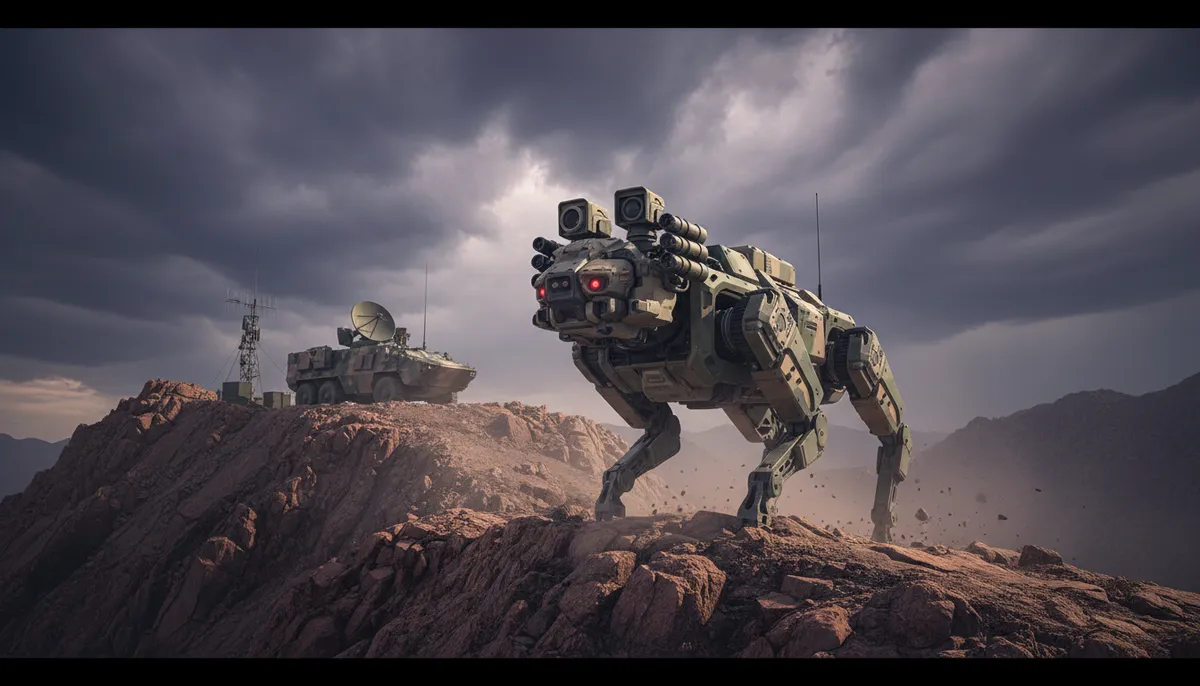
Robotic hounds are revolutionizing military operations by providing unmatched mobility across challenging terrain while keeping personnel safe. These quadrupedal unmanned ground vehicles (UGVs) require compact, powerful edge AI computers that can withstand extreme battlefield conditions. Neousys NRU series edge AI computers, powered by NVIDIA Jetson platforms, deliver up to 100 TOPS of AI performance in rugged, fanless designs compliant with MIL-STD-810G/H. With native GMSL2 and PoE connectivity, the NRU series enables real-time reconnaissance, terrain mapping, and autonomous navigation in hostile environments where conventional systems fail.

Overview: The Rise of Autonomous Ground Robotics in Defense
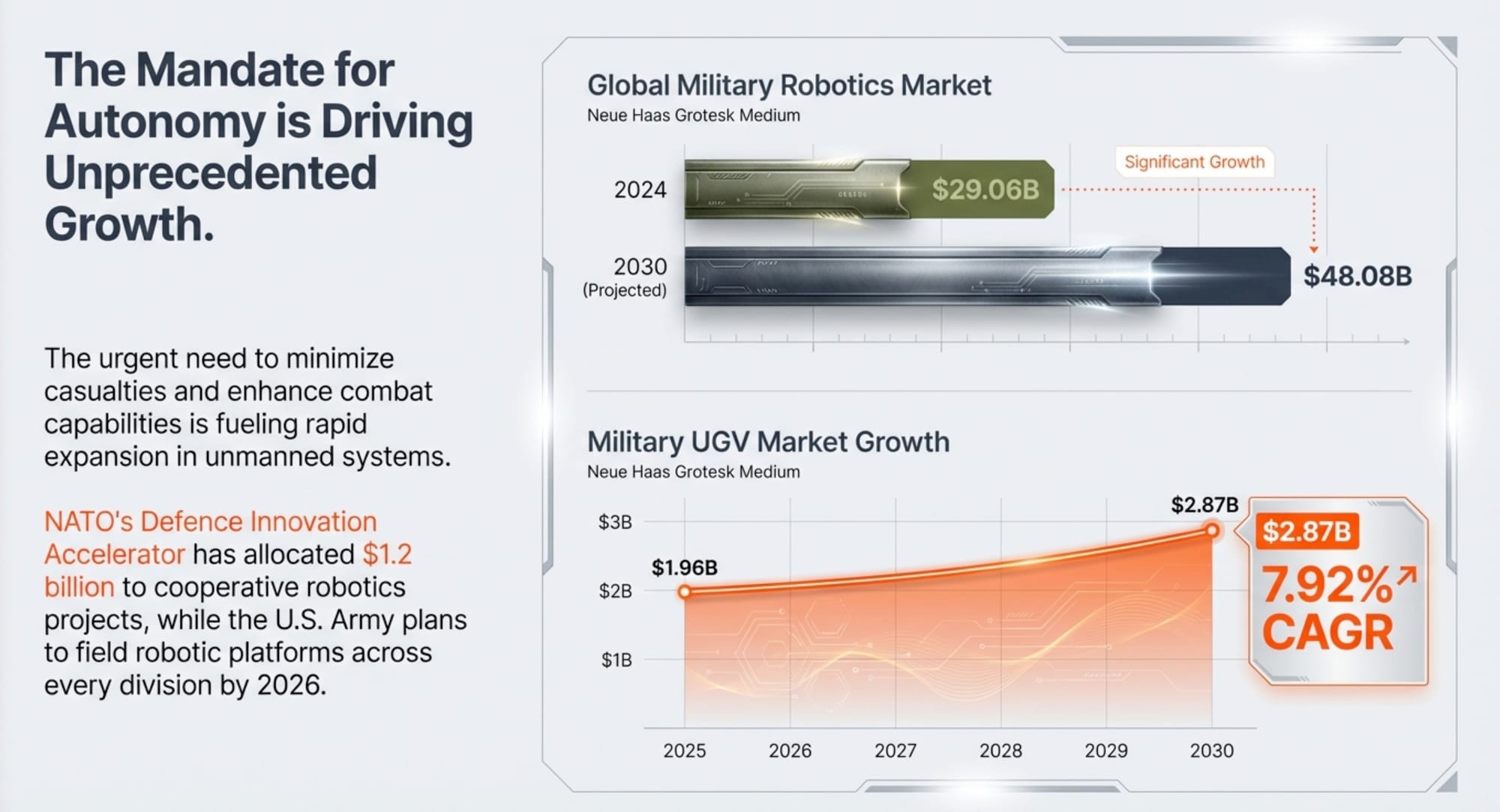
The global military robotics market reached $29.06 billion in 2024 and is projected to surge to $48.08 billion by 2030, driven by the urgent need to minimize casualties and enhance combat capabilities. Within this expanding sector, unmanned ground vehicles represent one of the fastest-growing segments, with the military UGV market alone expected to climb from $1.96 billion in 2025 to $2.87 billion by 2030 at a 7.92% compound annual growth rate.
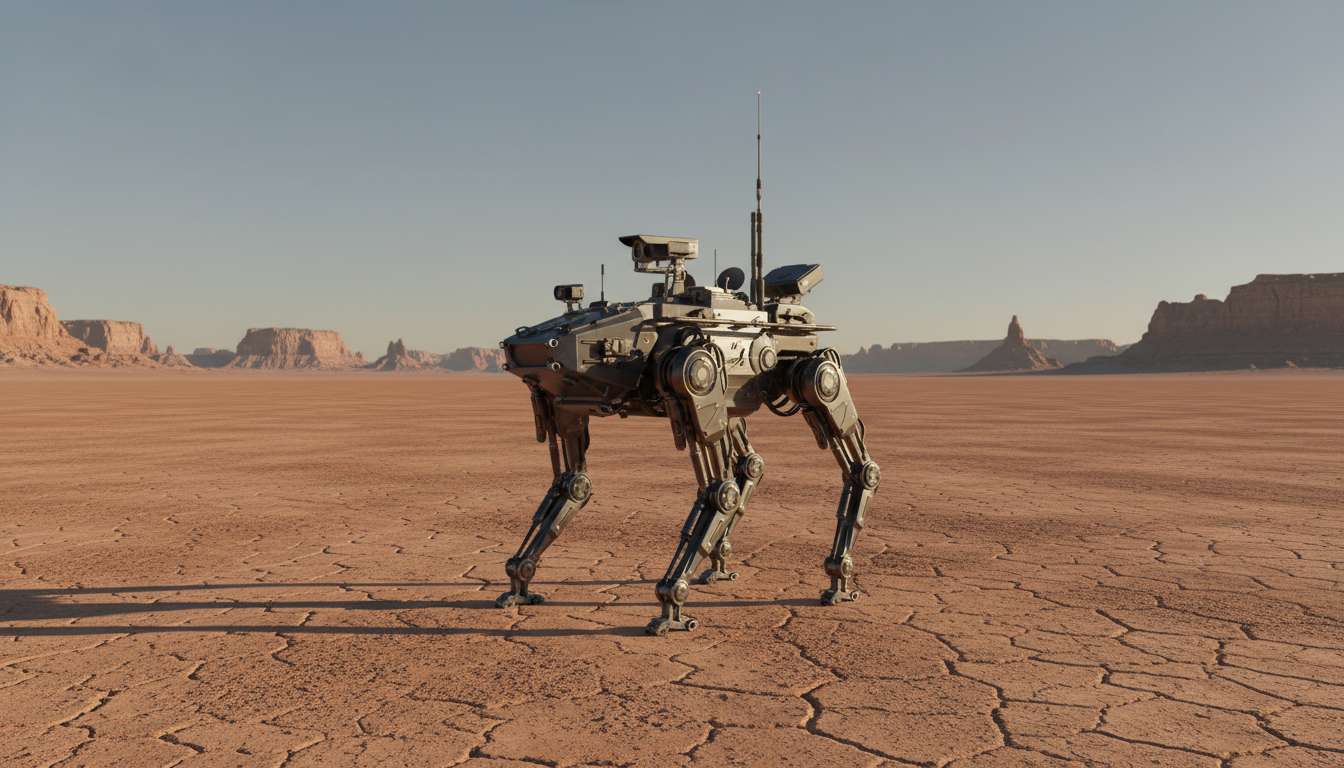
Robotic hounds—legged UGVs designed for multi-terrain mobility—are gaining traction as defense forces worldwide prioritize autonomous platforms that protect soldiers from improvised explosive devices, munitions fragments, and hostile fire. Unlike wheeled or tracked systems, these quadrupedal robots traverse stairs, rubble, and obstacle-laden spaces with agility impossible for conventional vehicles. NATO's Defence Innovation Accelerator has allocated $1.2 billion to cooperative robotics projects, while the U.S. Army plans to field drones and robotic platforms across every division by 2026.
The operational imperative is clear: modern defense requires autonomous systems that can scout hostile territory, transport supplies across rugged terrain, create real-time 3D maps of unfamiliar environments, and perform perimeter patrols without risking human lives. These robotic hounds function as force multipliers, enhancing mission capability while minimizing personnel exposure to danger in reconnaissance, logistics, and surveillance roles.
Challenge: Edge Computing in Extreme Battlefield Conditions
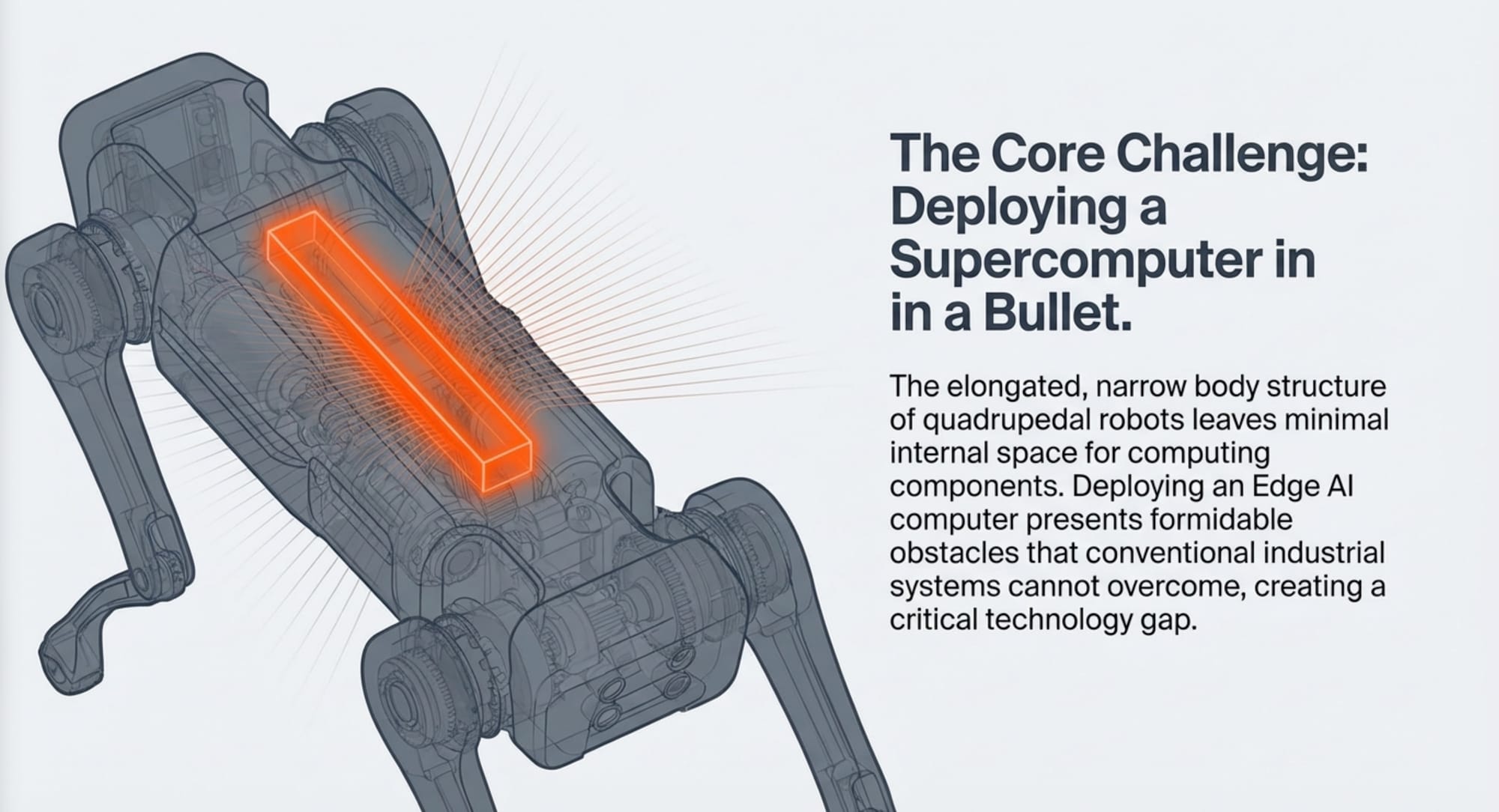
Deploying edge AI computers within robotic hounds presents formidable technical obstacles that conventional industrial systems cannot overcome. The elongated, narrow body structure of quadrupedal robots leaves minimal internal space for computing components, demanding ultra-compact form factors that still deliver real-time AI inference for object detection, navigation, and terrain analysis.
Power constraints create the first critical challenge. Robotic hounds operate entirely on battery power during field missions, often for extended durations in remote locations. The onboard computer must balance high-performance processing with aggressive power efficiency to maximize operational uptime. Every watt of excess power consumption directly reduces mission duration and effectiveness.
Mechanical stress from dynamic movement poses severe reliability risks. When robotic hounds run, climb, jump, or traverse rough terrain, they generate constant multi-axis shock and vibration that stresses internal electronics. Connector fatigue, component failure, and intermittent malfunctions become likely without proper ruggedization standards. Standard commercial or light-industrial computers cannot survive these conditions.
| Challenge Category | Specific Requirements |
|---|---|
| Environmental Durability | Withstand extreme heat, rain, humidity, dust without active cooling |
| Thermal Management | Fanless operation to prevent dust ingestion and mechanical failure |
| Form Factor | Compact enough to fit narrow robotic chassis with limited airflow |
| Connectivity | Support multiple cameras, sensors, and communication modules simultaneously |
| Power Management | Accommodate various battery packs with wide voltage input ranges |
The environmental exposure challenge demands exceptional durability. Defense operations span deserts, jungles, arctic conditions, and urban warfare zones. Edge computers must function reliably in intense heat exceeding 60°C, survive torrential rain and humidity, and resist airborne dust that would destroy fan-cooled systems. Active cooling creates multiple points of failure and maintenance requirements incompatible with autonomous field operations.
Limited I/O expansion creates a final integration hurdle. Despite restricted internal space, robotic hounds require extensive sensor connectivity—panoramic camera arrays, thermal imaging, LiDAR for terrain mapping, communication modules for remote command, and potentially weapon systems or specialized payloads. The edge computer must provide high integration flexibility without adding excessive weight or complexity that compromises the robot's mobility and endurance. Related: demining operations. Related: MIL-STD-810G testing standards.
Conventional embedded computers designed for benign industrial environments lack the ruggedization, thermal engineering, and connectivity flexibility required for autonomous defense robotics. The technology gap between "reinforced industrial PCs" and full aerospace-grade computers leaves defense contractors without cost-effective solutions for robotic hound integration.
Solution: NRU Series Edge AI Computers for Autonomous Defense Platforms
The Neousys NRU series edge AI computers deliver purpose-built solutions for robotic hound integration, combining compact NVIDIA Jetson platforms with defense-grade ruggedization. These systems provide up to 100 TOPS of AI inference performance, enabling real-time processing for surveillance, reconnaissance, terrain mapping, and autonomous decision-making critical to mission success.
Advanced Connectivity Architecture
The NRU series distinguishes itself through native support for GMSL2 (Gigabit Multimedia Serial Link 2) and PoE (Power over Ethernet) connectivity. GMSL2 ports enable high-speed, low-latency video streaming from multiple high-resolution cameras—RGB, thermal, infrared, or LiDAR—using lightweight coaxial cables ideal for weight-sensitive robotic platforms. This technology supports panoramic situational awareness with minimal wiring complexity.
PoE ports simplify system architecture by transmitting both power and data over a single cable to external devices such as IP cameras or edge sensors. This integration reduces wiring harness complexity, decreases overall system weight, and improves reliability by minimizing connection points vulnerable to vibration-induced failure.
Military-Grade Ruggedization
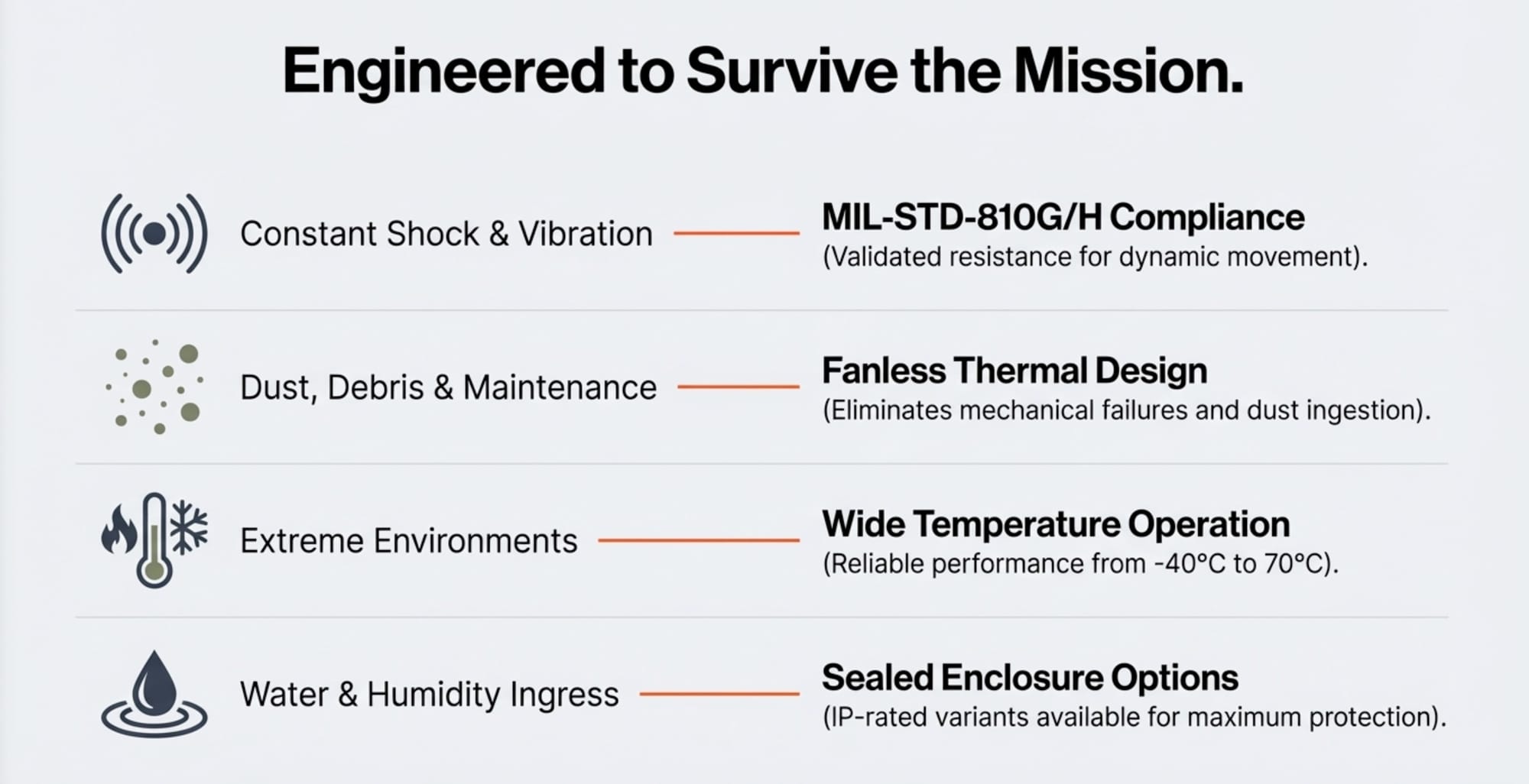
Designed specifically for harsh defense environments, NRU platforms comply with MIL-STD-810G/H and EN 50155 standards for shock and vibration resistance. These systems withstand continuous multi-axis shock, vibration, and exposure to dust, heat, or moisture—conditions robotic hounds routinely encounter during deployment across hostile terrain.
| Ruggedization Feature | Defense Benefit |
|---|---|
| MIL-STD-810G/H Compliance | Validated shock/vibration resistance for dynamic movement |
| Fanless Thermal Design | No mechanical failures, dust ingestion, or maintenance downtime |
| Wide Temperature Operation | Reliable performance from -40°C to 70°C extremes |
| Sealed Enclosure Options | IP-rated variants protect against water/dust ingress |
The fanless design eliminates mechanical cooling failures while providing passive thermal dissipation adequate for sustained GPU workloads. This architecture proves essential for sealed robotic compartments with limited airflow where active cooling would fail catastrophically.
Flexible Power Management and Wireless Integration
The NRU series supports wide input voltage ranges (typically 8-48V DC), accommodating various military battery pack configurations without additional power regulation hardware. This flexibility simplifies integration and reduces weight by eliminating external DC-DC converters.
Wireless communication module support—including 5G, 4G LTE, and WiFi—enables live video transmission and remote command control. Defense operators maintain situational awareness through real-time sensor feeds while controlling robotic hounds from safe distances, whether in mobile command centers or tactical operation centers miles from the battlefield.
AI Performance for Autonomous Operations
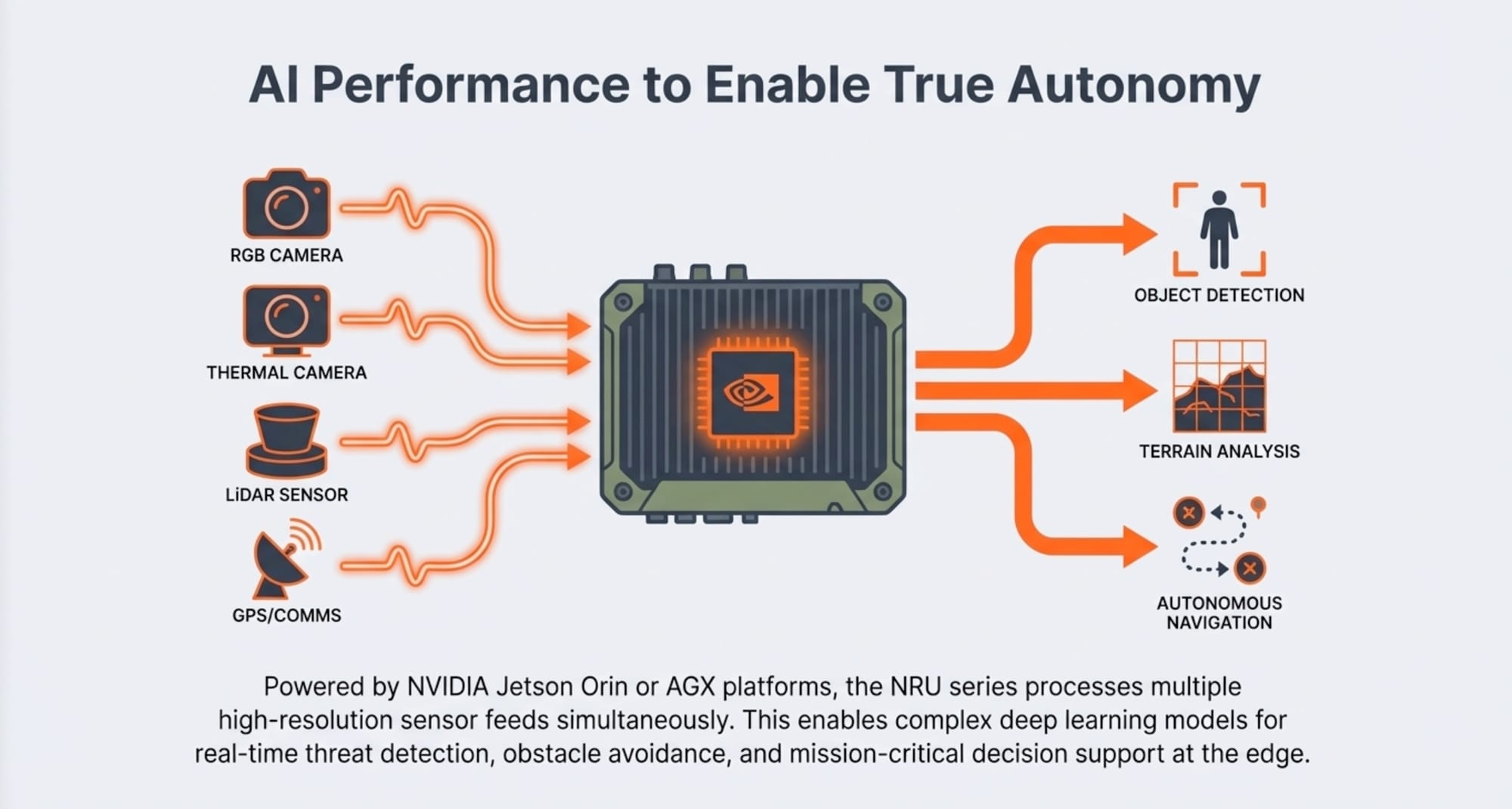
With NVIDIA Jetson Orin or AGX platforms, the NRU series delivers AI inference capabilities essential for autonomous navigation, obstacle avoidance, and threat detection. The systems process multiple camera feeds simultaneously while running deep learning models for object classification, terrain analysis, and mission-critical decision support—all within the power and thermal constraints of battery-powered robotic platforms.
The combination of rugged durability, efficient power consumption, comprehensive I/O flexibility, and powerful onboard AI makes the NRU series the proven choice for robotic hound deployments. These systems enable defense contractors to field autonomous platforms that enhance operational capabilities while keeping personnel out of harm's way.
Related Products for Mission-Critical Defense Computing
SEMIL-2200 Series (Extreme-Rugged MIL-STD AI Computer):
The SEMIL-2200 series complements the NRU series for applications requiring maximum environmental protection and regulatory compliance. With IP69K waterproof rating, MIL-STD-461G electromagnetic compatibility, and MIL-STD-1275D power stability validation, these systems suit command vehicle integration, maritime platforms, and C4ISR deployments. The 2U rack-mount or half-rack form factor provides more expansion capacity than compact NRU systems while maintaining fanless operation from -40°C to 70°C.
Nuvo-7000 Series (Expandable Rugged Embedded Platform):
For robotic systems requiring PCIe expansion cards—specialized sensor interfaces, additional GPU acceleration, or custom I/O modules—the Nuvo-7000 series offers patented Cassette expansion technology within a rugged, fanless chassis. This platform suits larger UGV designs where the compact NRU series would constrain expansion options. The Intel Core processor architecture provides a non-Jetson alternative for contractors with existing x86 software investments.

Conclusion
Robotic hounds address the defense sector's most pressing challenge: accomplishing dangerous missions without risking soldier lives. The success of these autonomous platforms depends fundamentally on edge AI computers that match the robots' durability, endurance, and operational requirements.
Neousys Technology's proven track record in rugged embedded computing positions the company as a trusted partner for defense robotics applications. As military doctrine increasingly emphasizes manned-unmanned teaming and autonomous force multiplication, Neousys continues advancing edge AI computing technology, ensuring defense contractors can deploy intelligent, resilient robotic systems across the most demanding operational environments.
For technical specifications on the NRU series, integration support, or defense application consulting, contact Neousys Technology at Neousys Technology or www.neteon.net or email [email protected].
FAQs
What computing challenges do quadruped robots face in defense operations?
Defense robots require real-time terrain assessment, obstacle negotiation, and threat detection in GPS-denied environments — demanding Neousys rugged edge AI with MIL-STD-810G shock and vibration ratings.
Why is edge AI preferred over remote control for defense robots?
Communication jamming renders remote-controlled robots useless. Neousys onboard AI platforms enable fully autonomous operation with local decision-making, maintaining mission capability without data links.
What payload capacity do robotic hound platforms typically support?
Military quadruped platforms carry 15-40kg payloads including sensors, communications, and computing. Compact Neousys platforms minimize computing weight to maximize sensor and mission equipment capacity.
How does the robot maintain stability on rough terrain?
IMU and proprioceptive sensors processed by Neousys edge computers at 1kHz enable real-time gait adjustment, maintaining stability on slopes up to 35° and traversing 25cm obstacles.
What is the typical battery endurance for AI-equipped defense robots?
With Neousys low-power edge platforms consuming 25-65W, typical quadruped robots achieve 2-4 hours of continuous operation depending on terrain, payload, and AI processing intensity.