Fanless GPU Computing Achieves 60°C Operation for Semi-Autonomous Tree Planting
TLDR: Urban reforestation programs face a critical bottleneck: commercial platforms thermal throttle above 50°C, degrading CPU performance during outdoor operations. A tree planting robotics developer deployed Neousys wide-temperature platforms with fanless thermal management, achieving stable 60°C operation while maintaining real-time AI inference. The system eliminated thermal-induced performance degradation and wireless failures.
Overview
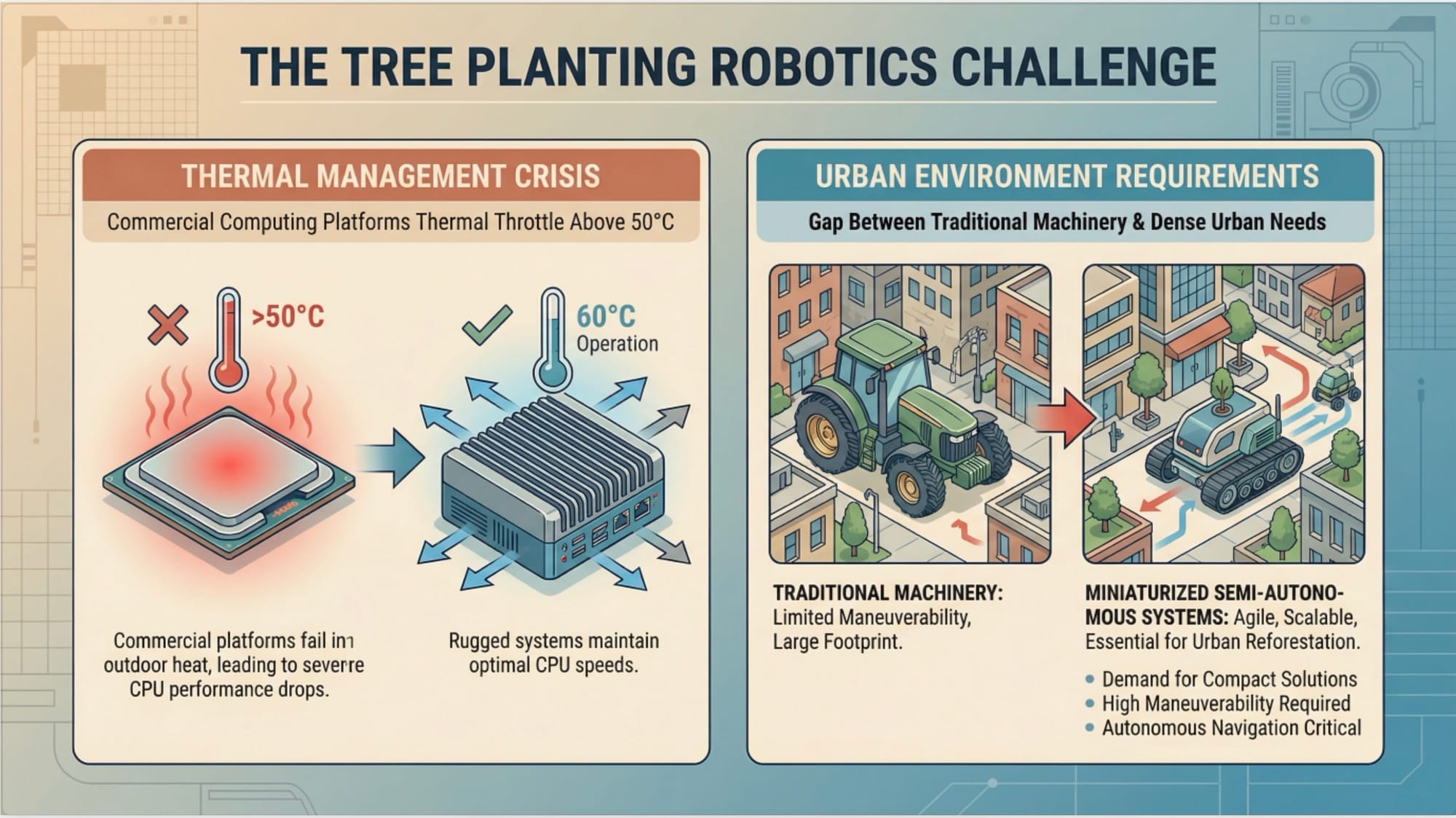
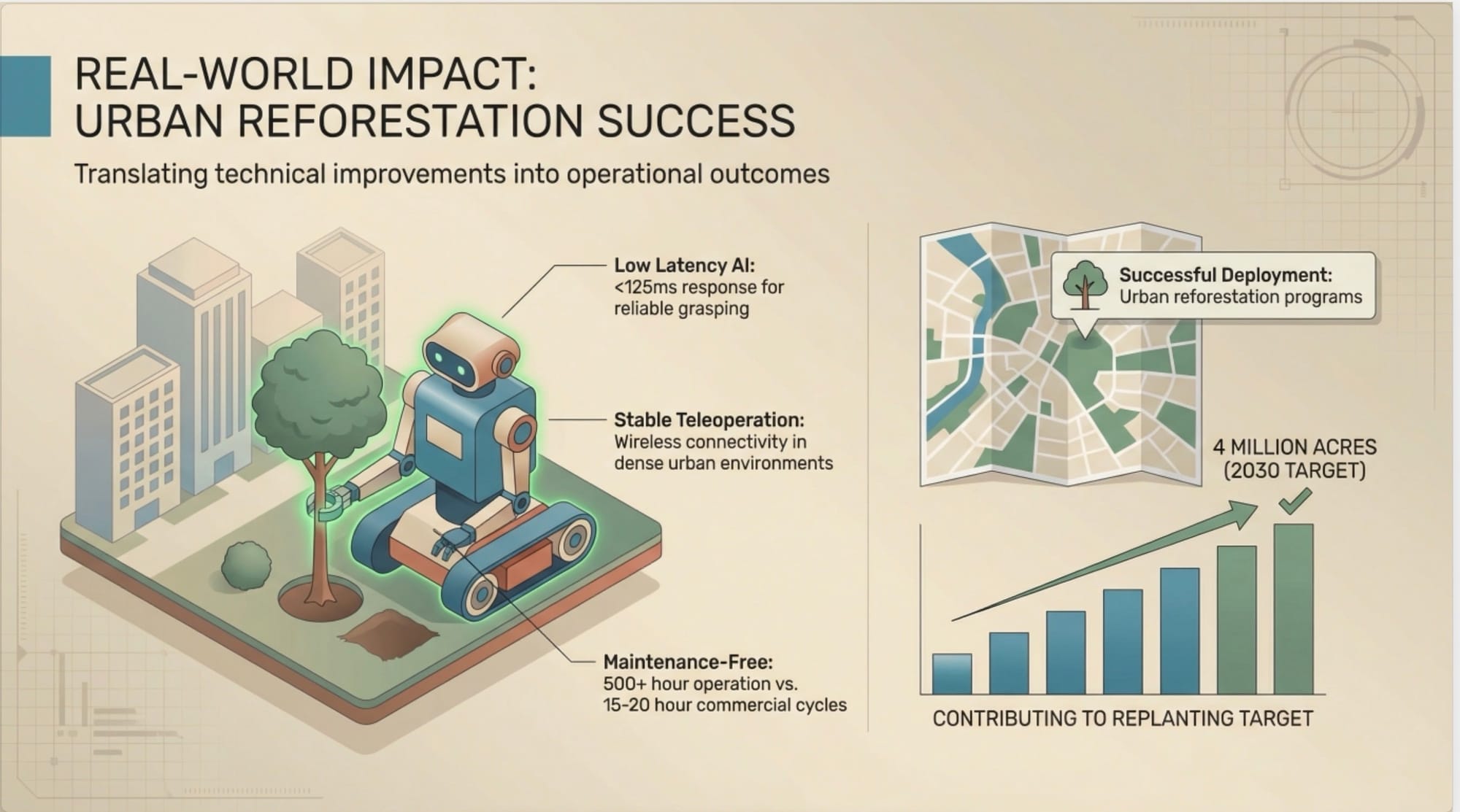
The global ecological restoration market is growing from $14.98 billion (2024) to $22.36 billion (2032), with urban reforestation critical as the US requires replanting 4 million acres through 2030. Traditional machinery lacks maneuverability for dense urban environments, creating demand for miniaturized semi-autonomous planting systems.
A robotics developer faced critical thermal management challenges: commercial computing platforms thermal throttled above 50°C ambient, degrading CPU performance during outdoor operation. Requirements included real-time AI inference, autonomous control, multi-sensor fusion, and wireless teleoperation.
Challenge
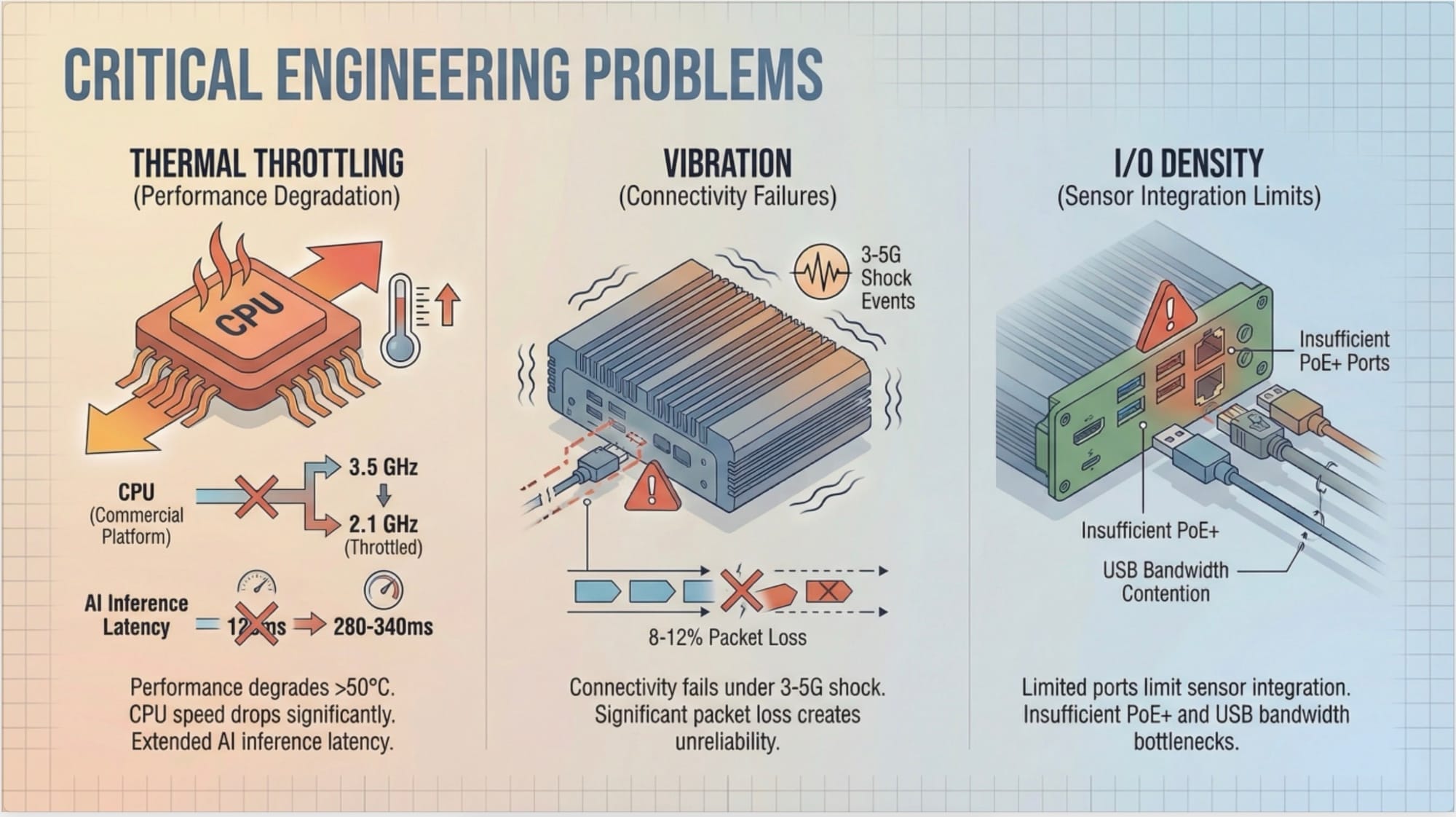
The development team initially deployed a commercial computing platform with discrete GPU for AI inference workloads. Field testing in outdoor conditions revealed three critical engineering problems that threatened deployment timelines.
Thermal Throttling Degrades Performance Above 50°C
Direct sunlight raised enclosure temperatures above 50°C, triggering CPU throttling from 3.5 GHz to 2.1 GHz. AI inference latency extended from 120ms to 280-340ms, making real-time grasping unreliable. Dust clogged fan vents within 15-20 hours, with bearing failure after 120 hours.
Vibration Causes Connectivity Failures
Uneven terrain generated 3-5G shock events. Standard RJ45 and USB connectors loosened, causing 8-12% packet loss and connection failures. GPU cards moved within PCIe slots, causing system crashes requiring field reboots.
I/O Density Limits Sensor Integration
The workflow requires 4x RGB cameras, 2x depth cameras, LiDAR, wireless module, and robotic arm controller. Commercial platforms provided only 2 PoE+ ports vs. 4 required. Limited USB 3.0 bandwidth reduced frame rates from 30 FPS to 18-22 FPS. Related: agricultural robotics. Related: solar farm vegetation control.
| Technical Requirement | Specification Needed | Challenge with Commercial Platform |
|---|---|---|
| Ambient Operating Temp | -10°C to 60°C continuous | Thermal throttling above 50°C, fan-based cooling |
| Shock/Vibration Resistance | 3-5G sustained, MIL-STD-810G | Loose connections, GPU bracket failure |
| I/O for Vision System | 4x PoE+ cameras, 2x USB 3.0 depth cameras | Insufficient PoE ports, USB bandwidth contention |
| Wireless Connectivity | M.2 slot for 4G/5G module | Module overheating, connector failures |
| AI Inference Performance | <150ms latency @ 60°C ambient | CPU throttling extended latency to 280-340ms |
Solution
The team replaced the commercial platform with Neousys rugged edge computing systems specifically engineered for wide-temperature mobile applications. The Neousys platform architecture addressed each technical constraint through industrial-grade thermal management, mechanical design, and connectivity specifications.
Wide-Temperature Operation Eliminates Throttling
Neousys platforms achieve 60°C operation through fanless design with aluminum heatsink chassis. Field testing confirmed 3.4-3.5 GHz CPU clock under 58°C ambient with full GPU load, junction temps at 87°C vs. 100°C throttle threshold.
Patented GPU Bracket Secures Components
Neousys patented GPU bracket mechanically locks cards to chassis. MIL-STD-810G testing confirmed zero failures at 5 Grms vibration. Screw-lock connectors eliminated 8-12% packet loss.
High-Density I/O Matches Requirements
Neousys platforms provide 4x PoE+ ports (30W each), 6x USB 3.2 Gen 1 with dedicated controllers, and M.2 expansion slots. Integrated PoE+ reduced cabling 40%. Dedicated USB controllers maintained 30 FPS across all cameras.
| Technical Challenge | Neousys Platform Feature | Specification | Engineering Benefit |
|---|---|---|---|
| Thermal throttling >50°C | Fanless thermal architecture | -40°C to 60°C continuous operation | Maintained 3.4-3.5 GHz clock under 58°C ambient |
| Vibration-induced failures | Patented GPU bracket + screw-lock I/O | MIL-STD-810G Method 514.6 compliance | Zero connector failures at 5 Grms random vibration |
| Insufficient PoE ports | Integrated PoE+ switching | 4x PoE+ @ 30W per port | Eliminated external injectors, reduced cabling 40% |
| USB bandwidth contention | Dedicated USB 3.2 controllers | 6x USB 3.2 Gen 1 (5 Gbps each) | Sustained 30 FPS across all cameras |
| Wireless module overheating | Internal M.2 with thermal design | M.2 slots with heat spreading | Stable 4G/5G connectivity at 60°C ambient |
Performance Data: Commercial Platform vs. Neousys Wide-Temperature System
The transition from commercial computing to Neousys industrial-grade platforms delivered measurable improvements in thermal stability, connectivity reliability, and operational uptime:
| Metric | Previous (Commercial PC) | New (Neousys Platform) | Delta |
|---|---|---|---|
| CPU Clock Speed @ 50°C+ | 2.1 GHz (throttled) | 3.5 GHz (no throttling) | +67% |
| AI Inference Latency | 280-340ms | 115-125ms | -58% |
| Packet Loss Rate | 8-12% | <0.1% | -99% |
| Connector Failure Incidents | 3 per 100 operating hours | 0 per 500+ hours | -100% |
| Operating Temperature Range | 0°C to 50°C (practical) | -10°C to 60°C (verified) | +20°C upper limit |
| Maintenance Cycle | 15-20 hours (fan cleaning) | 500+ hours (no maintenance) | +2,400% |
Fanless thermal design eliminated throttling bottlenecks. Mechanical retention prevented vibration failures. Integrated I/O eliminated bandwidth contention. Results: real-time grasping with <125ms lag, stable teleoperation, and 500+ hour maintenance-free operation vs. 15-20 hours with commercial platforms.
Related Products Recommendation
Nuvo-9000 Series: High-performance platforms supporting NVIDIA RTX A6000/RTX 40-series. Intel 13th Gen Core (up to i9), dual PCIe x16, -25°C to 60°C, MIL-STD-810G, 8x PoE+. Ideal for autonomous vehicles.
Nuvo-7000 Series: Compact platforms with Intel Core and NVIDIA GPUs up to 75W. Fanless -25°C to 60°C, 4x PoE+, 6x USB 3.2, 8-48V DC input. Suitable for agricultural robots and outdoor surveillance.
Conclusion
Commercial platforms proved inadequate at 50°C+ temperatures with thermal throttling, connectivity failures, and insufficient I/O. Neousys wide-temperature platforms solved these through fanless design, mechanical retention, and integrated I/O—maintaining full performance at 60°C and extending maintenance from 15-20 hours to 500+ hours.
As autonomous systems deploy outdoors, wide-temperature GPU computing and vibration-resistant design become essential capabilities.
For more insights on rugged edge computing, follow Neteon on LinkedIn at https://www.linkedin.com/showcase/neteon-edge-ai/. To discuss your requirements, contact www.neteon.net or [email protected].
FAQs
Why do reforestation robots need thermal throttling protection?
Tree planting robots operate in direct sunlight at ground level where ambient temperatures exceed 50°C. Without thermal management, standard PCs throttle CPU performance by 40-60%, causing navigation failures.
What computing power do autonomous planting robots require?
Autonomous tree planters need simultaneous LIDAR SLAM, terrain analysis, and planting mechanism control — requiring multi-core processing with Neousys Nuvo Series or equivalent GPU-accelerated edge platforms.
How do Neousys fanless computers handle extreme heat without throttling?
Neousys uses patented heat-pipe thermal architecture with finned aluminum chassis, dissipating 65W+ TDP without fans while maintaining full CPU frequency up to 60°C ambient.
What is the ROI of using robots for urban reforestation?
Autonomous planting robots achieve 3-5x the throughput of manual crews with consistent planting depth and spacing accuracy, reducing per-tree cost by 60% while operating in conditions unsafe for human workers.
Can these robots operate in rain and muddy terrain?
Yes, with IP67-rated Neousys computing platforms, the electronics survive rain, mud splash, and soil particulates while the robot navigates soft terrain using differential GPS and visual odometry.