TLDR
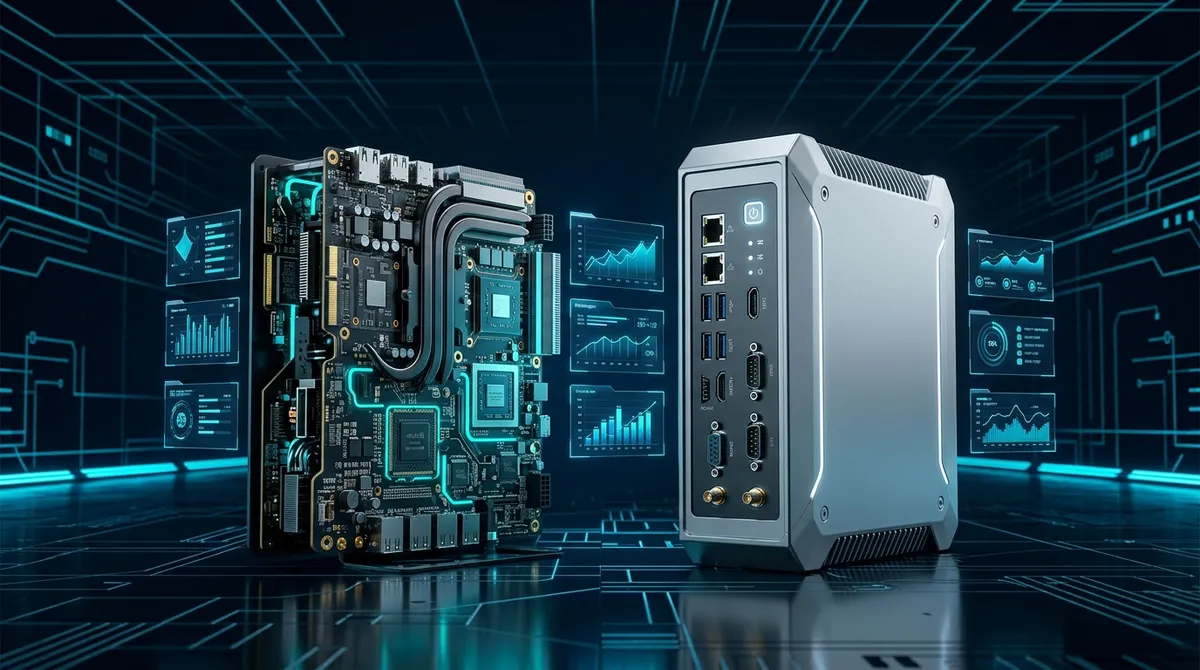
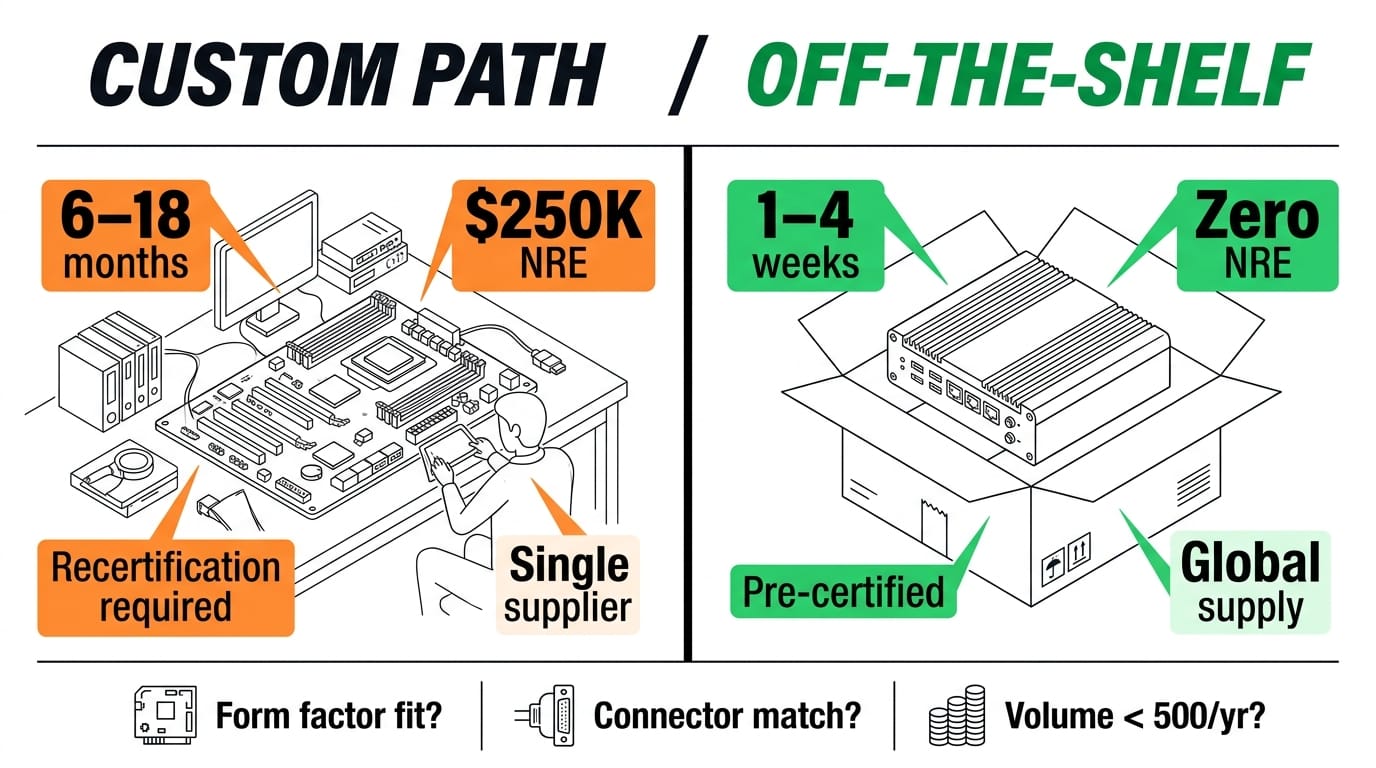
Off-the-shelf industrial PCs deploy faster and cost less for most applications. Custom designs are justified only when standard form factors fail, proprietary I/O is required, or volume exceeds 500+ units annually with specific mechanical constraints. This guide helps engineers determine which path applies to their deployment.
A practical example of choosing an expandable platform: a construction contractor selected the Nuvo-11531 for multi-camera AI safety monitoring specifically because its PCIe expansion slot accepted a full-size GPU — something no compact embedded PC could offer.
Overview
The custom-vs-off-the-shelf question comes up at almost every industrial edge computing evaluation. The answer is rarely obvious: custom hardware promises a perfect fit but carries lead times, NRE costs, and supply risk. Off-the-shelf systems ship faster and come with proven validation, but may require workarounds for edge cases.
Before evaluating either path, run through the 10-Point Checklist for Choosing a Rugged Edge AI Computer to establish baseline requirements. And if you're sourcing from Taiwan-based OEMs — as most industrial PC buyers eventually do — the Sourcing Rugged PCs from Taiwan guide covers supply chain and MOQ considerations that directly affect the custom decision.
The core tradeoff breaks down along three axes: time-to-deployment, per-unit cost at volume, and specification fit.
Key Selection Criteria
The following table compares the two approaches across the dimensions that matter most for industrial deployments:
| Criteria | Off-the-Shelf | Custom Design |
|---|---|---|
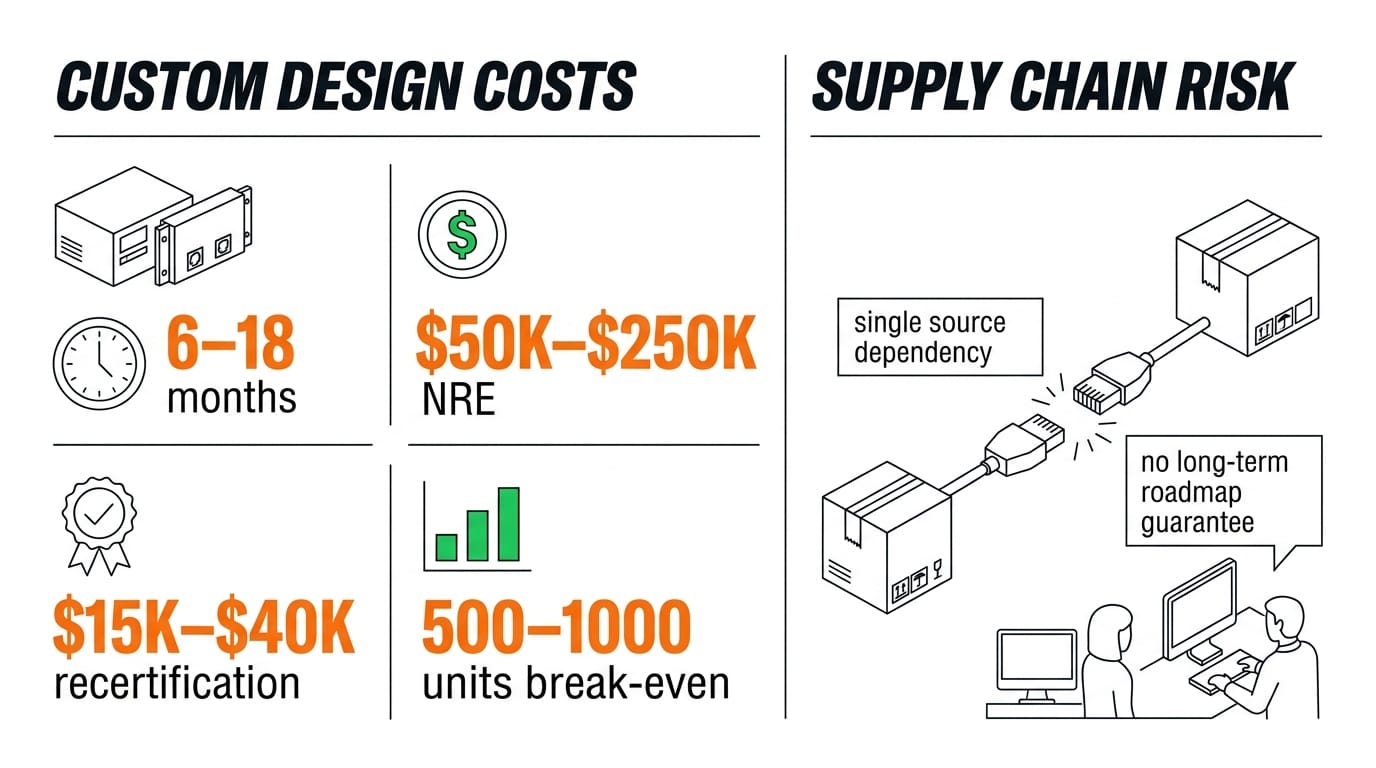
| Lead time | 1–4 weeks (stock) | 6–18 months (NRE + tooling) |
| NRE cost | $0 | $50,000–$250,000+ |
| Per-unit cost (100 units) | Standard MSRP | 10–25% premium |
| Per-unit cost (1,000+ units) | Standard MSRP | Potential 15–30% savings |
| Spec fit | 80–95% (configurable) | 100% (purpose-built) |
| Validation & certification | Pre-certified (CE, FCC, etc.) | Full recertification required |
| Supply risk | Multi-source available | Single-source dependency |
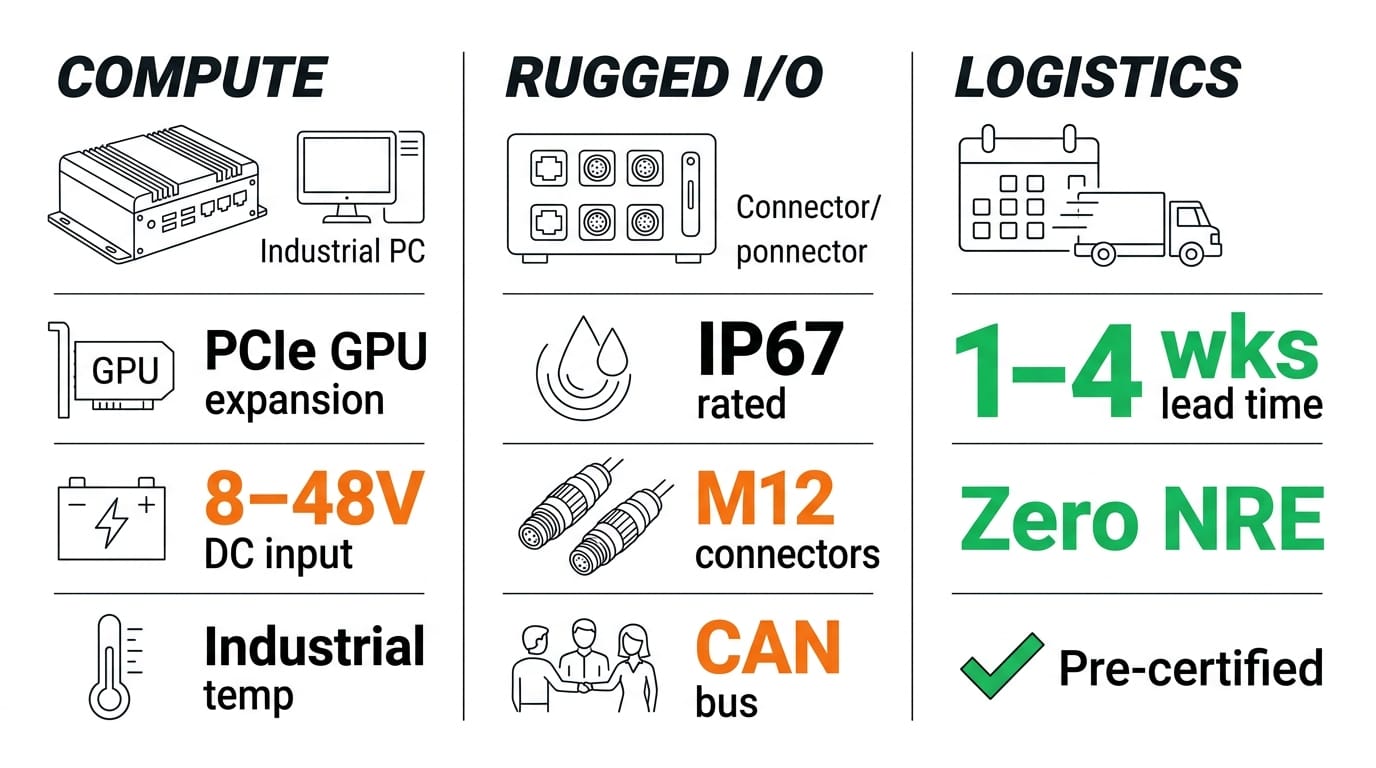
Modern configurability has narrowed the gap considerably. The Nuvo-11000 supports Intel Core Ultra 200 CPUs, multiple PCIe expansion slots, and accepts 8–48V DC input — covering the majority of factory floor requirements without custom design. The POC-766AWP and POC-700 address applications requiring IP67 sealing, wide-range DIO, CAN bus, and ignition power management natively.
Decision Matrix
Use this matrix to determine which path fits your application. Match your deployment scenario to the recommendation:
| Scenario | Quantity | Recommendation | Rationale |
|---|---|---|---|
| Standard I/O, industrial temp, DIN rail mount | Any | Off-the-shelf | Products like Nuvo-11000 cover this directly |
| IP67 + wide-temp + M12 connectors | Any | Off-the-shelf | POC-766AWP is purpose-built for this spec |
| Unique mechanical envelope (non-standard chassis) | < 500/yr | Off-the-shelf + enclosure | Enclosure adaptation is faster and cheaper than chassis NRE |
| Unique mechanical envelope | 500–1,000+/yr | Evaluate custom | NRE can be amortized; run total cost of ownership (TCO) model |
| Proprietary connector type (non-M12/RJ45/DB) | Any | Custom required | Standard connector sets limit off-the-shelf fit |
| Integrated display + compute in single chassis | Any | Custom required | Panel PC requirements typically mandate custom tooling |
| Standard compute + GPU inference | Any | Off-the-shelf | Nuvo-11000 + PCIe GPU expansion handles most workloads |
| Military-specific form factor (VPX, VITA) | Any | Custom required | Standards require specific slot configurations |
| Price-sensitive, high volume (1,000+/yr), no special I/O | 1,000+ | Custom if lead time allows | Savings at scale, but validate that NRE payback period is < 18 months |
Common Pitfalls
Overspecifying mechanical requirements. Engineers sometimes assume a custom chassis is necessary when an off-the-shelf unit with a custom bracket or DIN adapter would work. Adapter tooling costs $5,000–$15,000, versus $100,000+ for chassis NRE.
Underestimating recertification costs. A custom industrial PC requires full CE, FCC, and EN 55032/55035 emissions testing. Budget $15,000–$40,000 per certification cycle, plus 3–6 months on timeline.
Ignoring configuration options. Most industrial PC OEMs offer SKU-level configuration: CPU tier, RAM, storage, expansion modules. A configured Nuvo-11000 with PCIe GPU expansion covers AI inference requirements without triggering a custom design process.
Locking into single-source supply. Custom hardware creates supply dependency. Off-the-shelf platforms from established manufacturers maintain multi-year production commitments and carry spare inventory.
Underestimating MOQ pressure. Custom OEMs typically require 100+ unit MOQs with 6–12 month forecasts. Pilot phases with 10–20 units are difficult to support in custom programs.
Conclusion
For most industrial edge computing deployments, off-the-shelf configurable platforms deliver 80–95% spec fit at lower cost and faster lead time than custom designs. Custom development is justified when mechanical integration is impossible with standard platforms, proprietary interface requirements exist, or annual volume exceeds 500–1,000 units with a validated payback model.
For technical evaluation or configuration guidance on the Nuvo-11000, POC-766AWP, or POC-700, contact [email protected] or visit www.neteon.net. Follow Neteon on LinkedIn for ongoing coverage of industrial edge computing procurement and deployment.
FAQs
What is the typical NRE cost for a custom industrial PC design?
Non-recurring engineering (NRE) costs for custom industrial PCs typically range from $50,000 to $250,000 or more, depending on mechanical complexity, PCB design requirements, and certification scope. This does not include per-unit tooling costs or the 6–18 month development timeline. Off-the-shelf configurable platforms like the Nuvo-11000 eliminate NRE entirely.
At what volume does custom industrial PC design become cost-effective?
Custom design typically becomes financially viable at 500–1,000+ units per year with a validated payback model showing NRE recovery within 18 months. Below 500 units annually, the per-unit savings (15–30% at high volume) rarely offset NRE, recertification, and engineering maintenance costs. Most deployments under 500 units are better served by off-the-shelf configurable platforms.
Can off-the-shelf industrial PCs like the Nuvo-11000 meet custom application requirements?
Modern configurable platforms like the Nuvo-11000 cover the majority of industrial edge computing requirements without custom design: Intel Core Ultra 200 CPUs, PCIe GPU expansion for AI inference, multiple I/O configurations, 8–48V DC wide-range power, and industrial temperature ratings. The POC-766AWP and POC-700 add IP67 sealing, M12 connectors, CAN bus, and ignition power management. Genuine gaps requiring custom design typically involve proprietary connectors, non-standard mechanical form factors, or military-specific standards like VPX/VITA.
How long does customization take compared to off-the-shelf deployment?
Off-the-shelf industrial PCs typically ship from stock in 1–4 weeks. Custom industrial PC development requires 6–18 months from specification to first production units, including PCB design, mechanical tooling, prototype iterations, and full certification testing (CE, FCC, EN 55032/55035). For applications with firm deployment deadlines, the lead time gap alone often makes off-the-shelf the only viable option.
What recertification costs should be budgeted for custom industrial PCs?
Custom industrial PC designs require full regulatory recertification including CE marking, FCC Part 15, and emissions standards (EN 55032/55035). Budget $15,000–$40,000 per certification cycle plus 3–6 months on the project timeline. Off-the-shelf platforms from established manufacturers come pre-certified, eliminating this cost and timeline entirely. Any hardware change to a custom design typically triggers a new certification cycle.