The Challenge: Blind Spots Kill on Construction Sites
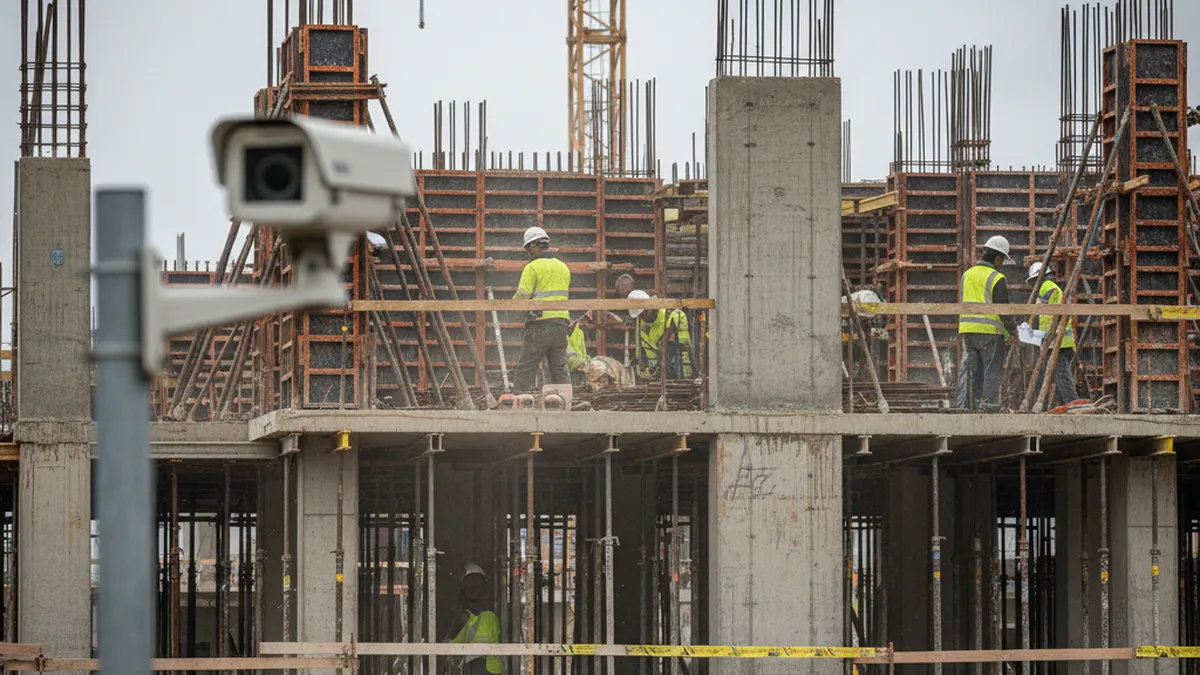
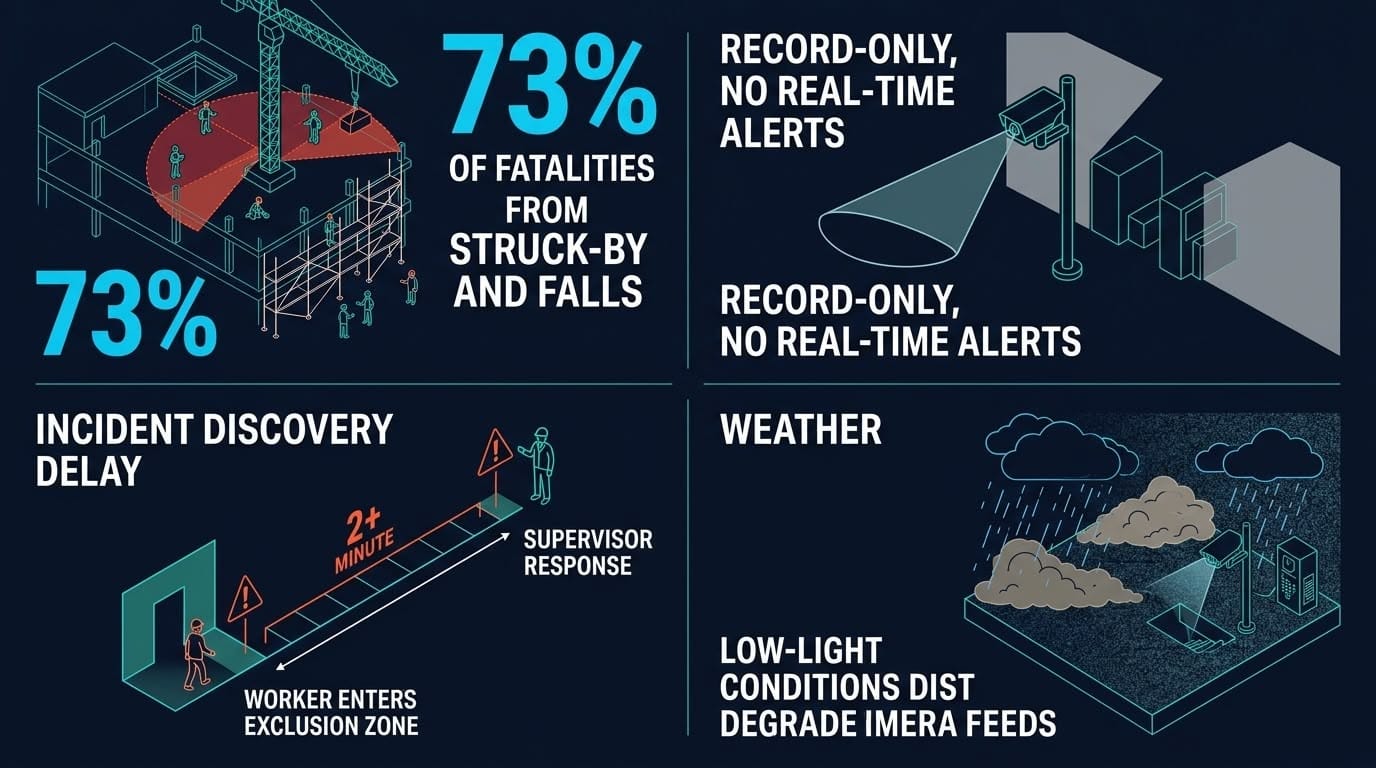
Construction sites remain among the most hazardous workplaces globally, with heavy equipment, elevated work zones, and constantly shifting layouts creating persistent safety blind spots. A mid-size general contractor operating across six active sites in the U.S. Southwest faced a recurring problem: their existing CCTV systems captured footage but offered zero real-time awareness. By the time a safety manager reviewed recordings, the near-miss had already escalated — or worse, become a recordable incident.
Editorial note: This article is an illustrative reference architecture based on public hardware capabilities and common industrial requirements. Percentages and deployment results are modeled assumptions, not verified customer outcomes or performance guarantees. Validate targets with a site-specific pilot.
The numbers told a grim story. Across their portfolio, the contractor logged an average of 4.2 OSHA-recordable incidents per 100 workers annually — well above the industry benchmark of 2.8. Most involved struck-by or caught-between events near excavators, cranes, and material staging areas. Conventional camera systems, mounted on temporary poles and connected via Wi-Fi bridges, suffered from three compounding issues: latency above 800 ms made real-time alerts impractical, consumer-grade NVRs failed within weeks from concrete dust and 50°C ambient temperatures, and there was no compute capacity on-site to run AI inference locally.
Why Edge AI — Not Cloud — Fits the Jobsite
Sending raw video feeds to the cloud was never viable. Cellular bandwidth at remote sites rarely exceeded 15 Mbps shared across 12 cameras, and round-trip latency to a cloud inference endpoint added 2–4 seconds — far too slow for proximity alerts when a worker steps into an excavator's swing radius.
The contractor needed a ruggedized edge computer capable of ingesting multiple high-resolution camera streams, running object detection and zone-intrusion models locally, and triggering audible alarms within 200 ms of a violation. The system also had to survive desert heat, concrete dust, and the constant vibration of nearby pile-driving equipment — all without a dedicated server room.
The Solution: Nuvo-11531 as the Jobsite AI Brain
The Nuvo-11531 became the central compute node at each of the contractor's six sites. Housed inside a NEMA-rated enclosure mounted to a shipping container, the Nuvo-11531 delivered the combination of multi-stream GPU inference, wide-temperature operation, and expansion flexibility that no consumer or cloud solution could match.
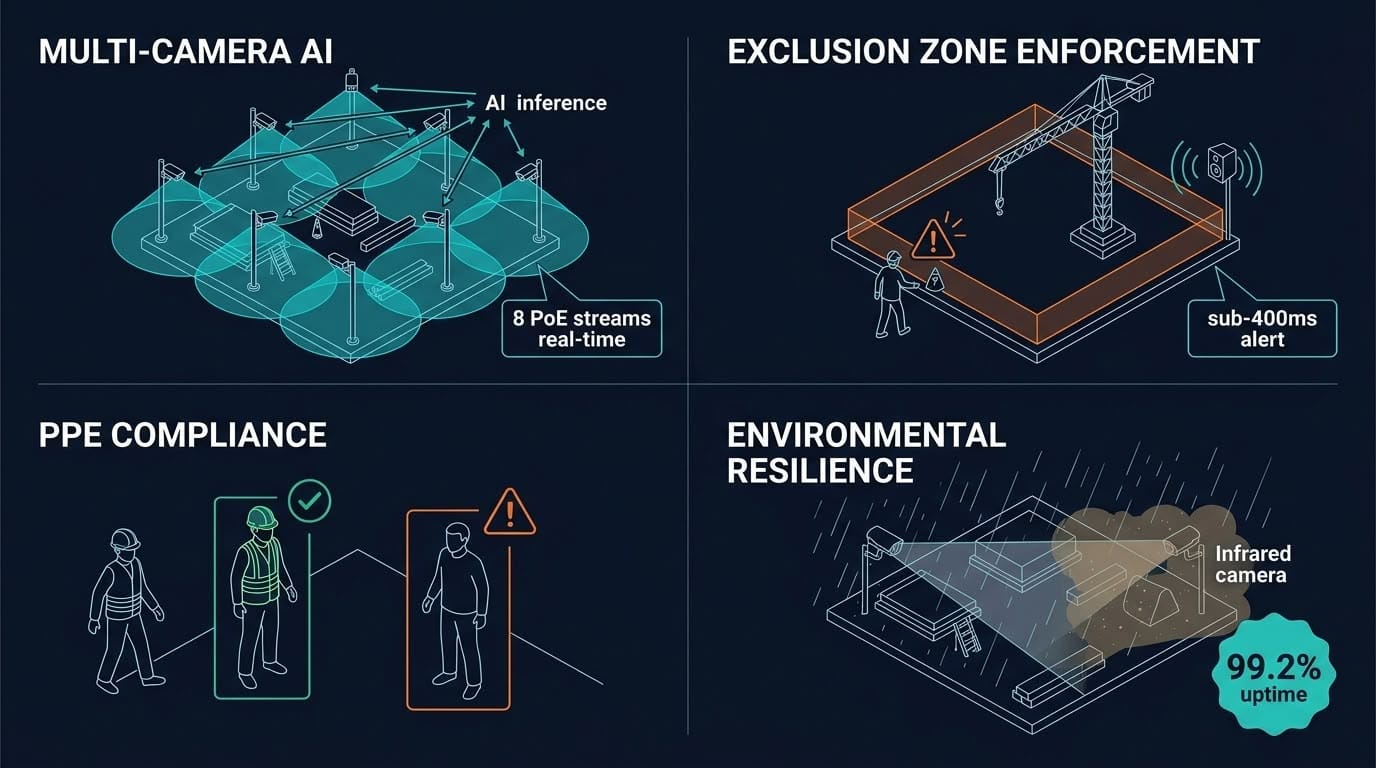
Each deployment followed the same architecture: 8 PoE IP cameras covering crane zones, material laydown areas, scaffolding access points, and site perimeters fed video over Cat6 cabling to the Nuvo-11531. Running a YOLOv8-based detection model on a mid-range NVIDIA GPU installed in the system's PCIe expansion slot, the computer processed all 8 streams simultaneously at 15 fps per stream — identifying workers, heavy equipment, PPE compliance, and exclusion-zone breaches in real time.
When the AI detected a worker entering a flagged exclusion zone or approaching active equipment without required PPE, it triggered three simultaneous responses: an audible alarm through site-mounted speakers, a push notification to the safety manager's phone, and a timestamped incident snapshot saved locally for compliance documentation.
The Nuvo-11531's fanless design proved essential. Earlier attempts with tower PCs had failed within three weeks as concrete dust clogged fans and triggered thermal shutdowns. The fully sealed, fanless thermal architecture of the Nuvo-11531, rated for operation from -25°C to 60°C, ran continuously through two consecutive Phoenix summers without a single thermal event.
Results After 12 Months
After a full year of deployment across all six sites, the contractor documented measurable improvements across every safety metric that mattered.
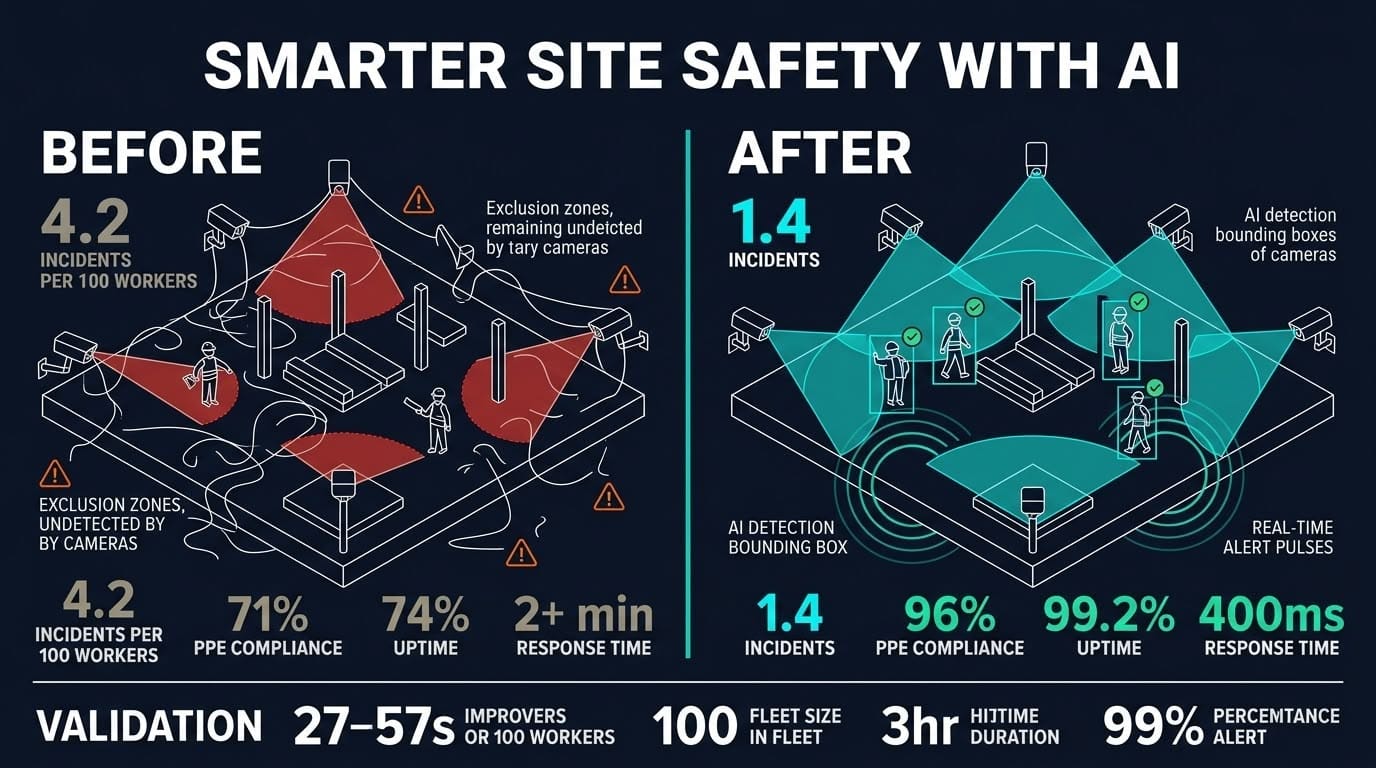
Modeled assumption — OSHA-recordable incidents dropped 67% — from 4.2 to 1.4 per 100 workers. The largest reduction came in struck-by events near excavators and cranes, where real-time exclusion-zone alerts gave operators and ground workers an average of 3.8 seconds of warning before a potential contact event.
Modeled assumption — PPE compliance rose from 71% to 96% during audited shifts. Workers quickly learned that the AI system flagged hard hat and high-visibility vest violations instantly, and supervisors could address non-compliance in real time rather than during after-the-fact reviews.
Modeled assumption — System uptime averaged 99.2% across all six sites over 12 months. The only downtime came from scheduled firmware updates and one power outage caused by a severed utility line — the Nuvo-11531 hardware itself recorded zero failures. This compared to the previous consumer NVR setup, which averaged 74% uptime due to heat-related failures and dust ingestion.
Alert-to-response latency dropped from 2+ minutes to under 400 ms. The previous workflow required a safety manager to notice a radio call and physically walk to the incident area. With automated audible alerts and phone notifications, the system closed the gap between detection and response by an order of magnitude.
| Metric | Before (CCTV Only) | After (Nuvo-11531 Edge AI) |
|---|---|---|
| OSHA-recordable incidents / 100 workers | 4.2 | 1.4 |
| PPE compliance rate | 71% | 96% |
| System uptime | 74% | 99.2% |
| Alert-to-response time | >2 minutes | <400 ms |
| Camera streams processed on-site | 0 (record only) | 8 per site, real-time |
Why It Worked
Three characteristics of the Nuvo-11531 made this deployment succeed where previous approaches failed. First, the PCIe expansion slot accepted a full-size GPU card, giving the system enough inference throughput to handle 8 simultaneous camera streams — something no compact embedded PC could deliver. Second, the fanless, wide-temperature design eliminated the dust and heat failures that had plagued conventional hardware. Third, the multiple PoE-capable GbE ports simplified cabling by powering cameras directly from the compute node, reducing the number of failure points in the field.
For construction firms evaluating edge AI for jobsite safety, the lesson is straightforward: the compute must be as rugged as the environment it monitors. Cloud-dependent architectures introduce latency and connectivity risks that undermine the entire value proposition of real-time safety alerting. A ruggedized, fanless edge platform like the Nuvo-11531 closes that gap.
FAQs
How many camera streams can the Nuvo-11531 process simultaneously?
With a mid-range NVIDIA GPU installed in its PCIe expansion slot, the Nuvo-11531 handles 8 simultaneous IP camera streams at 15 fps per stream running YOLOv8-based object detection models.
Can the Nuvo-11531 operate in extreme heat and dust?
Yes. The fanless thermal design is rated for -25°C to 60°C continuous operation. With no intake fans, concrete dust and particulates cannot enter the chassis — eliminating the leading cause of hardware failure on construction sites.
What latency does the edge AI system achieve for safety alerts?
End-to-end alert latency from camera frame capture to audible alarm trigger is under 400 ms, compared to 2+ minutes with the previous manual review workflow.
Does the system require internet connectivity to function?
No. All AI inference runs locally on the Nuvo-11531. The system operates fully offline for detection and alerting. Internet connectivity is only needed for optional remote dashboard access and cloud backup of incident snapshots.
What types of safety violations can the AI detect?
The system detects exclusion-zone breaches (workers entering active equipment zones), PPE non-compliance (missing hard hats, high-visibility vests), and proximity alerts for heavy equipment including excavators and cranes.
Modeled assumption — not a verified customer result.
Sources and further reading
Neousys Nuvo-11531 product specifications.
OSHA construction safety and health topics.
Related Neteon guides
Nuvo-11531 Case Study: 85% Faster Path Teaching.
Private 5G and Industrial Edge AI Through 2030.
Browse the case study topic hub for more deployment guidance.