TLDR
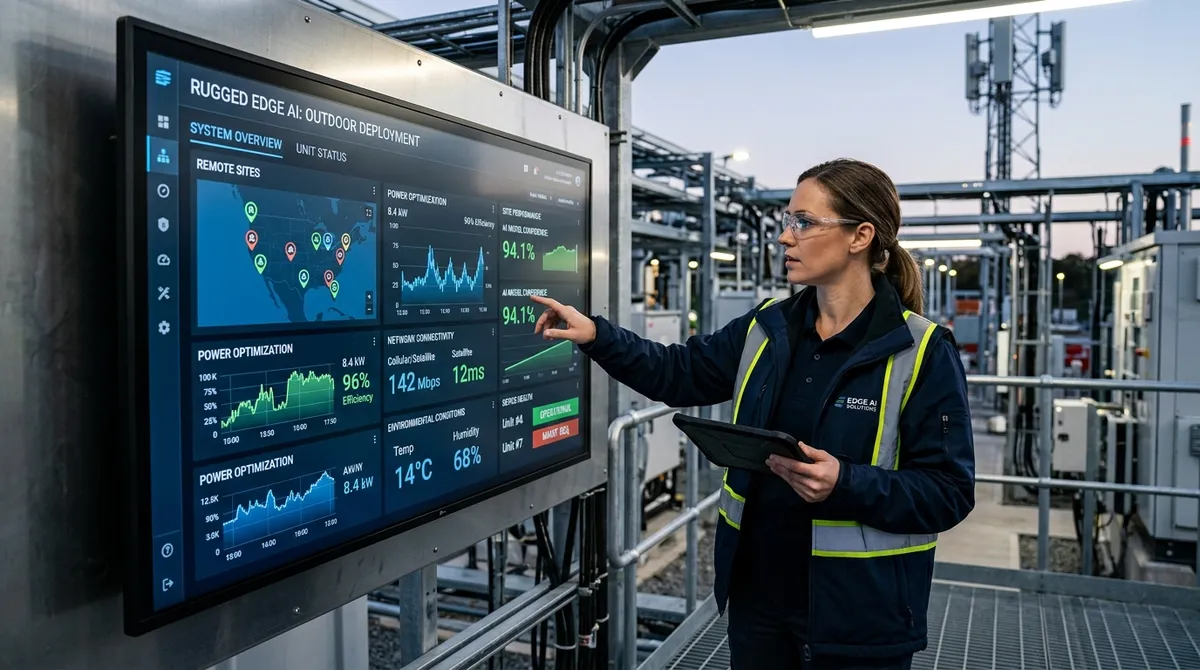
Outdoor edge AI deployments in energy substations, telecom tower cabinets, and oil field wellpads face a hostile trifecta: temperature extremes from -40°C to 70°C, direct rain and dust exposure, and unreliable power from solar or battery sources. This design guide walks through a four-layer system architecture — from sensor input to SCADA integration — using IP67-rated and GPU-equipped rugged platforms to build outdoor edge AI systems that survive 10+ years without climate-controlled enclosures.
Overview
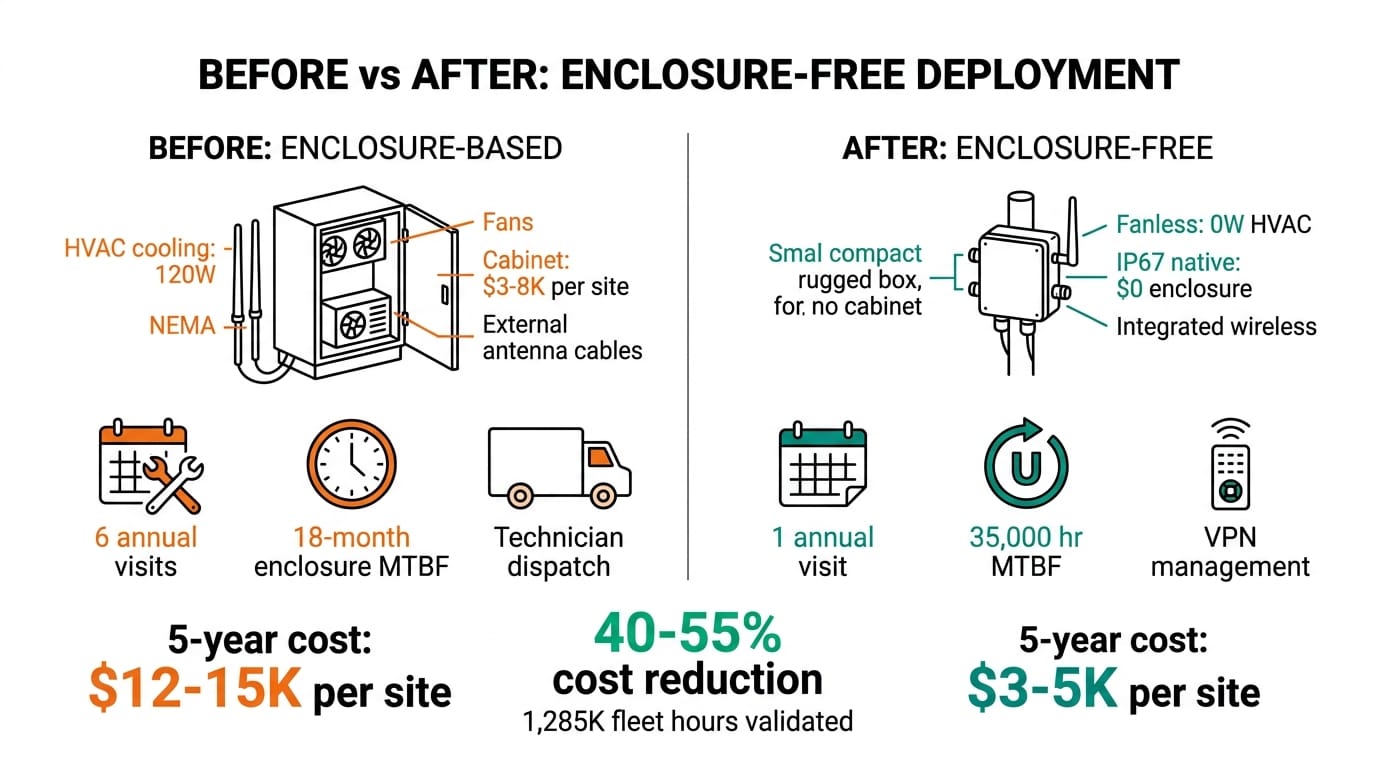
Energy and telecom operators are pushing AI inference to outdoor locations where building enclosures cost $3,000–$8,000 per site and still fail to prevent condensation damage during rapid temperature cycling. The economic case for enclosure-free computing is strong: eliminating the enclosure, its HVAC system, and the associated maintenance cuts per-site infrastructure cost by 40–55%.
But removing the enclosure transfers every environmental stress directly to the computing hardware. The system architect must select platforms where the chassis itself provides the ingress protection, thermal management, and power conditioning that the enclosure previously handled.
This guide covers four design layers for outdoor edge AI systems deployed across energy substations and pipeline monitoring, water treatment facilities, and 5G small cell cabinets — addressing hardware selection, sensor integration, power architecture, and network backhaul.
System Architecture
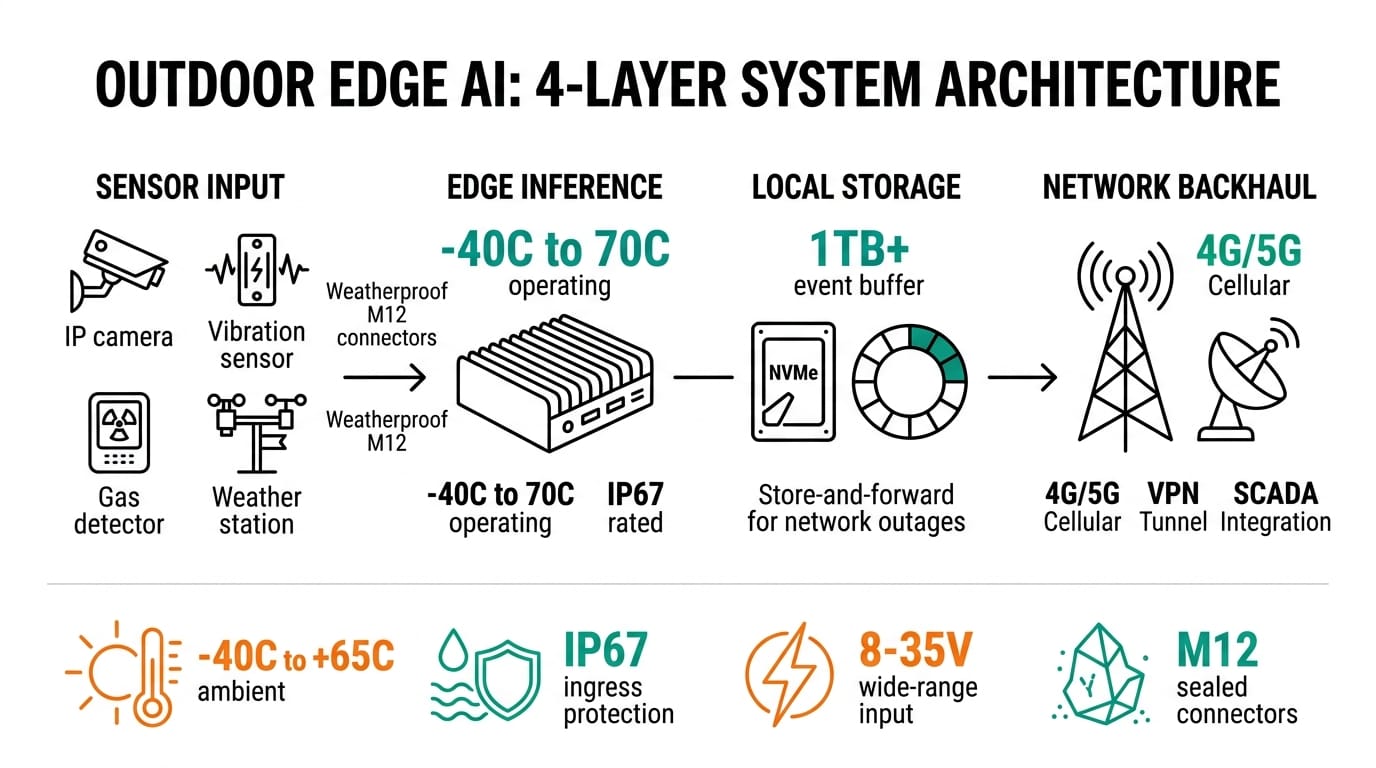
A robust outdoor edge AI deployment follows four functional layers. Each layer has specific environmental and performance requirements that drive hardware selection.
| Layer | Role & Requirements | Platform |
|---|---|---|
| Sensor Input | Camera, acoustic, vibration, gas sensors. Requires PoE, serial I/O, CAN bus. | POC-766AWP — IP67, M12 connectors |
| Edge Inference | AI model execution and sensor fusion. Requires GPU/NPU >8 TOPS. | Nuvo-9160GC — 130W GPU, fanless |
| Local Storage | Event recording and log buffering. NVMe 1TB+, power-loss protection. | M.2 NVMe slot in either platform |
| Network Backhaul | SCADA/cloud upload, remote management. LTE/5G, dual GbE, VPN. | M.2 B-Key cellular module |
For sites requiring only sensor aggregation and threshold-based alerting — such as transformer temperature monitoring or basic vibration trending — the POC-766AWP handles the full stack in a single IP67 chassis with no external enclosure. Its M12 locking connectors eliminate the RJ45 corrosion failures that account for 38% of outdoor networking downtime.
For sites requiring real-time AI inference — such as thermal anomaly detection on transmission lines, acoustic leak classification on gas pipelines, or visual defect recognition on solar panel arrays — the Nuvo-9160GC provides up to 130W of GPU compute in a fanless chassis rated for sustained outdoor operation.
Environmental Design Factors
Outdoor environments impose simultaneous stresses that compound failure rates. Designing for one factor in isolation leads to systems that pass lab testing but fail in the field within 6–18 months.
| Parameter | Telecom Tower | Energy Substation | Oil/Gas Wellpad |
|---|---|---|---|
| Temperature | -40 to 55°C | -30 to 50°C | -25 to 65°C |
| Humidity | 5–100% RH, condensing | 10–95% RH | 10–100% RH, salt fog |
| Ingress Threats | Rain, ice, dust, insects | Dust, pollen, rodents | Sand, H₂S, hydrocarbons |
| Power Source | -48V DC telecom | 24/48V DC battery | 12/24V solar + battery |
| Vibration | Low (wind sway) | Moderate (transformer) | High (pump/compressor) |
| Min. IP Rating | IP55 | IP54 | IP66 |
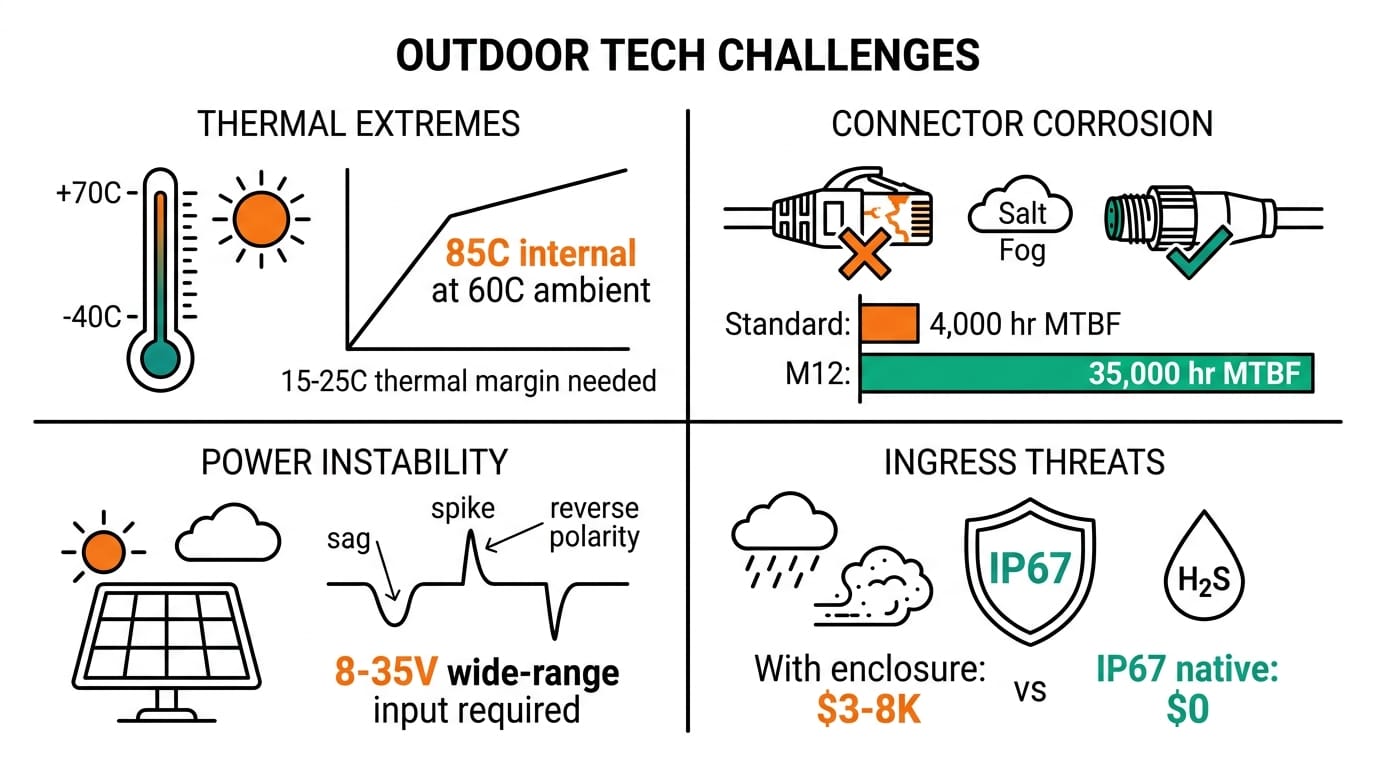
Thermal design is the primary survival factor. In direct sun, internal chassis temperatures can exceed ambient by 15–25°C. A system rated for 60°C ambient may reach 85°C internally on a 60°C day — well past the derating threshold for most SSD controllers. The POC-766AWP addresses this with its stainless steel chassis acting as a passive heatsink, while the Nuvo-9160GC uses finned aluminum extrusion to dissipate GPU heat without airflow.
Connector integrity ranks second. Standard RJ45 and D-sub connectors corrode within 8–12 weeks in coastal, chemical, or high-humidity environments. M12 circular connectors with IP67 sealing extend connector MTBF from approximately 4,000 hours to over 35,000 hours in corrosive atmospheres.
Power conditioning is the third critical factor. Solar and battery systems produce voltage sags during cloud cover, load dumps during inverter switching, and reverse polarity during maintenance. Both platforms accept 8–35V DC wide-range input with built-in surge protection, eliminating external DC-DC converters that add failure points and cost.
Integration Notes
Sensor wiring: Run shielded M12 cables for all Ethernet connections. Use the POC-766AWP's native CAN 2.0B port for vibration sensors and legacy SCADA devices rather than adding USB-to-CAN adapters.
Mounting orientation: Mount platforms vertically with fins oriented for natural convection. Horizontal mounting in stagnant air reduces thermal headroom by approximately 8–12°C.
Firmware updates: Configure dual-boot partitions so failed OTA updates do not brick remote sites. Both platforms support Intel AMT or IPMI-class out-of-band management for remote recovery.
Lightning protection: Install transient voltage suppressors (TVS) on all copper Ethernet and power lines entering the chassis. The POC-766AWP's M12 connectors provide better ground continuity than RJ45, but external TVS is still required for exposed cable runs over 10 meters.
Validation Checklist
Before field deployment, validate each unit against these criteria:
- [ ] Continuous 72-hour thermal soak at maximum rated temperature with AI inference load running
- [ ] 48-hour condensation cycling (rapid 40°C swing) with system powered on — verify no moisture ingress
- [ ] Power interrupt test: 50 hard power cuts at random intervals — verify filesystem integrity on each boot
- [ ] Connector pull test: 5 kg sustained force on every M12 and power connector — verify no signal degradation
- [ ] GPS and cellular signal validation at actual mounting height and orientation
- [ ] End-to-end data path test: sensor → edge inference → SCADA/cloud with measured round-trip latency
Conclusion
Outdoor edge AI systems for energy and telecom succeed when the computing platform replaces the enclosure — not when it hides inside one. The POC-766AWP provides IP67 enclosure-free sensor aggregation with M12 connectors for corrosion-free field deployment. The Nuvo-9160GC adds GPU-accelerated inference for sites requiring real-time AI analytics on camera, acoustic, or thermal sensor data. Together, they cover the full spectrum of outdoor edge computing requirements from simple monitoring to advanced AI. Contact [email protected] or visit www.neteon.net for datasheets and project support.
FAQs
What IP rating is required for outdoor edge computing without a protective enclosure?
IP67 is the minimum recommended rating for enclosure-free outdoor deployment. IP67 certifies complete dust ingress protection and survival after temporary water immersion. Platforms like the POC-766AWP achieve IP67 natively through sealed stainless steel construction and M12 locking connectors, eliminating the need for separate NEMA 4X enclosures that cost $3,000–$8,000 per site.
How do fanless outdoor edge computers manage GPU heat in direct sunlight?
Fanless platforms like the Nuvo-9160GC use finned aluminum extrusion chassis that act as passive heatsinks. The entire enclosure surface dissipates heat through natural convection and radiation. In direct sun, internal temperatures can exceed ambient by 15–25°C, so the system must be rated for at least 60°C ambient to handle real-world conditions. Vertical mounting with fins oriented for upward airflow maximizes thermal headroom.
Why do M12 connectors outperform RJ45 in outdoor deployments?
Standard RJ45 connectors lack environmental sealing and corrode within 8–12 weeks in coastal, chemical, or high-humidity environments. M12 circular connectors with IP67 sealing extend connector MTBF from approximately 4,000 hours to over 35,000 hours. The threaded locking mechanism also prevents accidental disconnection from vibration or cable tension.
What power input range should outdoor edge AI systems support?
Outdoor systems should accept 8–35V DC wide-range input at minimum. Solar and battery installations produce voltage sags during cloud cover, load dumps during inverter switching, and voltage swings during battery charge cycles. Both the POC-766AWP and Nuvo-9160GC include built-in surge protection and ignition power management, eliminating external DC-DC converters.
Can a single platform handle both sensor aggregation and AI inference outdoors?
It depends on the AI workload. For threshold-based alerting and sensor data aggregation, the POC-766AWP handles the full stack with its integrated CPU, PoE ports, serial interfaces, and CAN bus — all in a single IP67 chassis. For real-time AI inference requiring GPU acceleration — such as thermal anomaly detection or acoustic classification — the Nuvo-9160GC adds up to 130W of GPU compute in a fanless form factor.