TLDR
Machine vision quality inspection demands sub-50ms latency across multiple high-resolution cameras while surviving factory-floor EMI, thermal cycling, and continuous vibration. This design guide walks engineers through camera-to-inference architecture, addressing bandwidth budgeting, environmental hardening, and I/O allocation using the Nuvo-9160GC and Nuvo-10208GC as reference platforms for GPU-accelerated inline inspection.
Overview
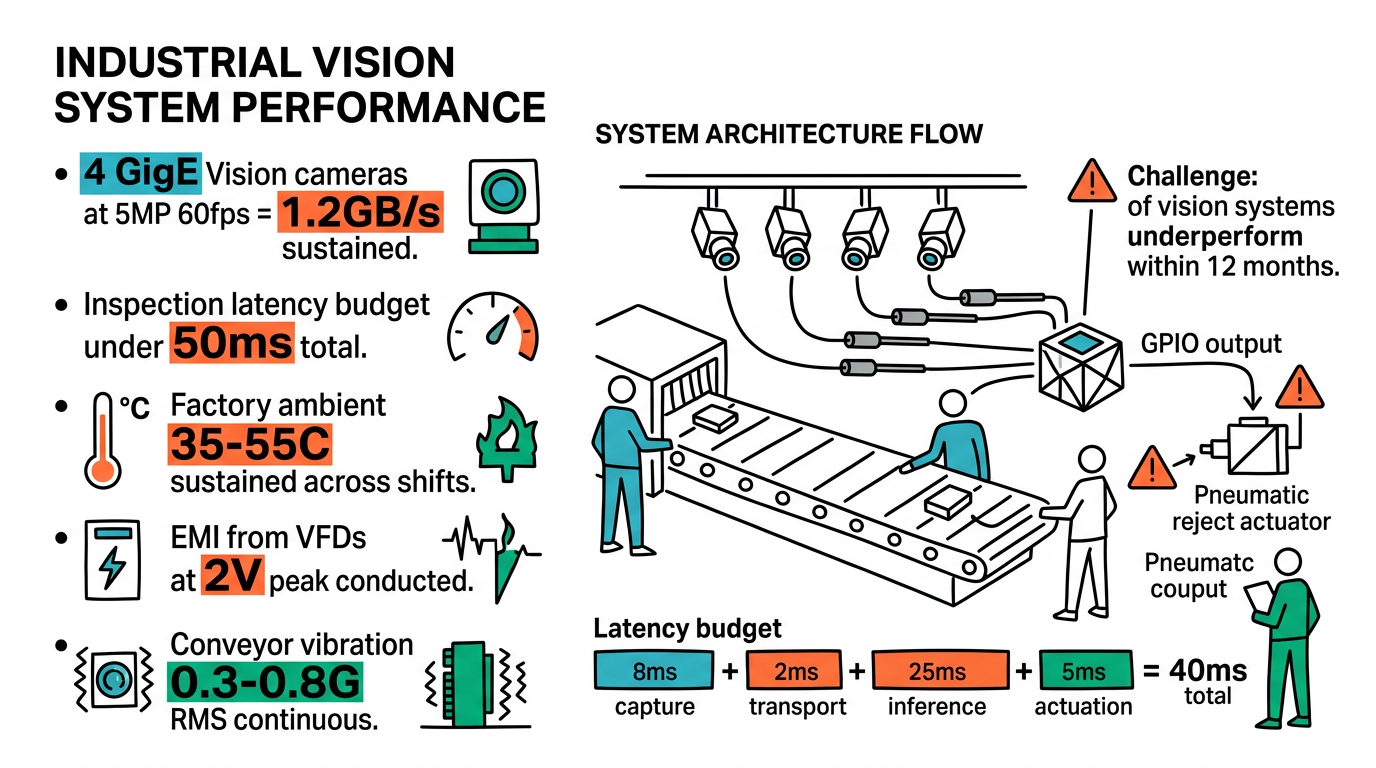
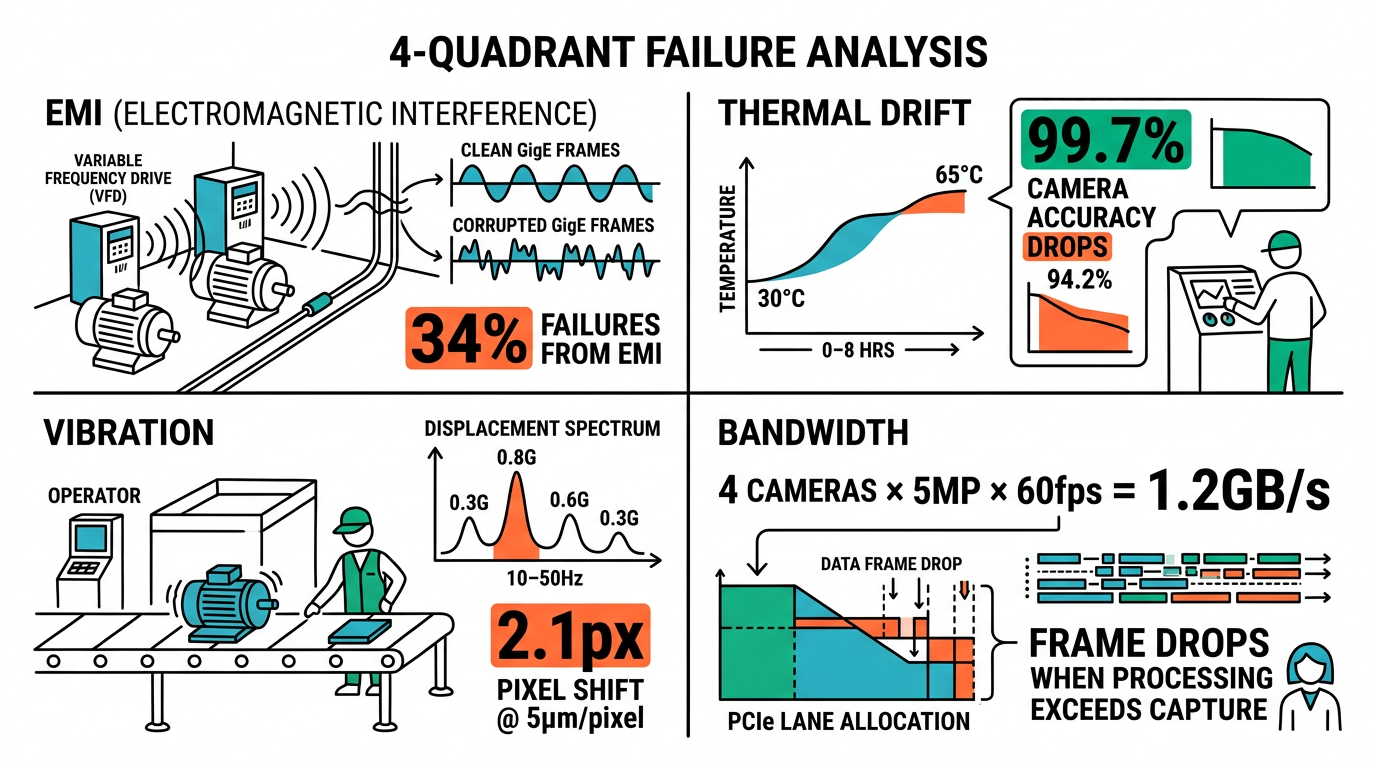
Automated optical inspection (AOI) has become table stakes for manufacturing quality assurance, yet 43% of deployed vision systems underperform within 12 months due to environmental degradation, bandwidth bottlenecks, or thermal-induced accuracy drift. The gap between lab-validated algorithms and production-floor reality costs manufacturers an estimated $2.1M annually per line in false rejects and escaped defects. Factory machine vision operates in hostile RF environments with variable-frequency drives generating conducted EMI up to 2V peak, ambient temperatures cycling 35–55°C across shifts, and continuous vibration from conveyors and servo motors at 0.3–0.8G RMS. As explored in our MIL-STD-810G certification guide, environmental resilience is not optional for production equipment.
System Architecture
A robust machine vision system comprises four subsystems: image acquisition, data transport, GPU inference, and actuation output. Each subsystem has specific bandwidth, latency, and environmental requirements that must be budgeted holistically.
| Subsystem | Component | Specification | Latency Budget |
|---|---|---|---|
| Image Acquisition | 4× GigE Vision cameras (5MP, 60fps) | 300MB/s per camera, 1.2GB/s total | 8ms exposure + transfer |
| Data Transport | Shielded Cat6A, M12 connectors | PoE+ (25.5W/port), 15–30m runs | 2ms network stack |
| GPU Inference | NVIDIA RTX GPU (130W TDP) | FP16 inference, 8GB VRAM | 25ms per 4-frame batch |
| Actuation Output | Isolated GPIO → pneumatic reject | 24VDC isolated, 5ms response | 5ms signal + mechanical |
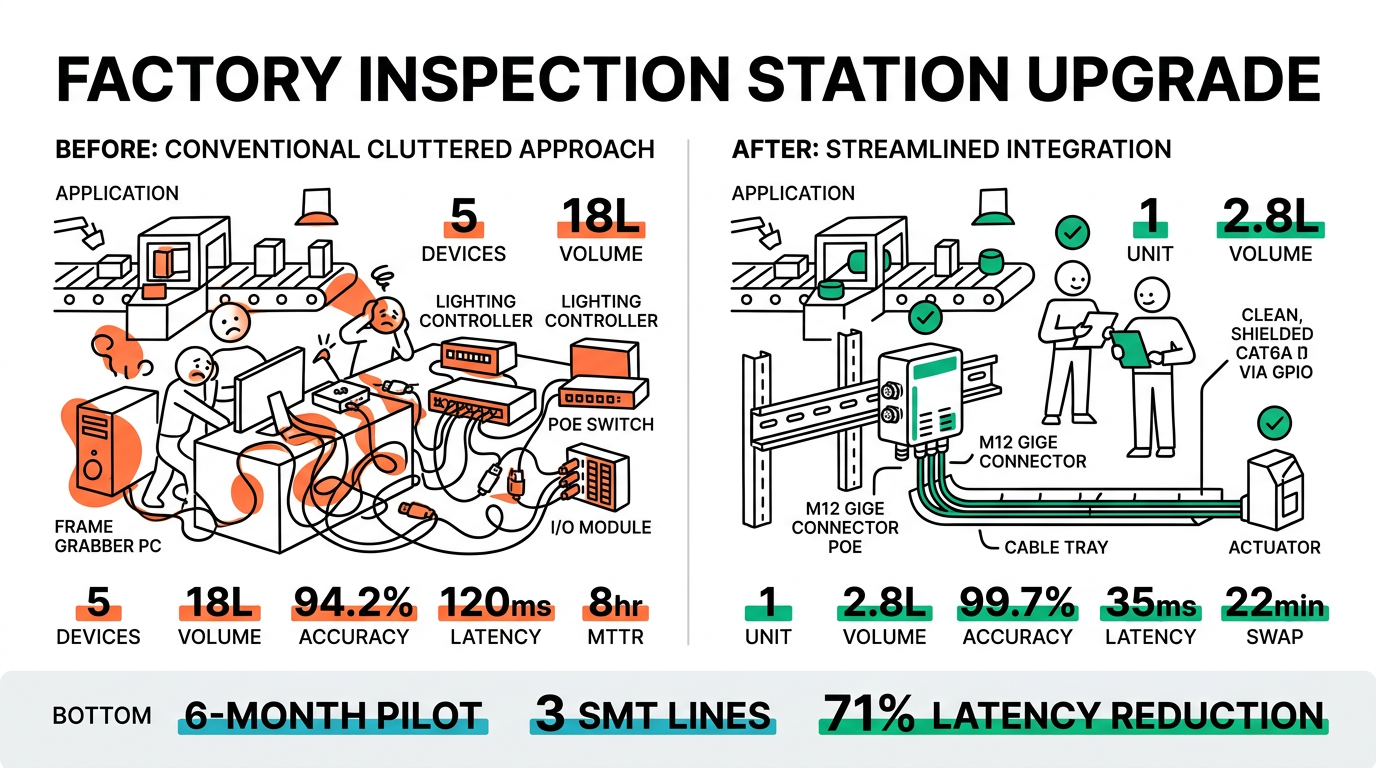
Total system latency: 40ms typical, well within the 50ms rejection window at 200 parts/minute conveyor speed. The Nuvo-9160GC supports one 130W GPU with 4× GigE PoE+ ports in a fanless 2.8L chassis, while the Nuvo-10208GC accommodates dual GPUs for 8-camera deployments requiring parallel inference streams.
Environmental Design Factors
Factory environments impose constraints that laboratory testing rarely captures. Engineers must design for worst-case sustained conditions, not nominal values.
| Parameter | Design Value | Impact on Vision System |
|---|---|---|
| Ambient Temperature | 35–55°C sustained | GPU throttles above 83°C junction; fanless design eliminates filter maintenance |
| Vibration | 0.3–0.8G RMS, 10–50Hz | Camera pixel shift at 5μm/pixel; M12 locking connectors prevent disconnect |
| EMI | 2V peak conducted, VFD harmonics | Shielded cables + isolated I/O prevent GigE packet corruption |
| Particulate | Oil mist, metal dust, flux residue | IP50+ ingress protection; fanless = no internal contamination |
| Power Quality | ±10% voltage sag, microsecond transients | Wide-range 8–48VDC input absorbs factory power events |
The Nuvo-9160GC operates at -25°C to 60°C with a 130W GPU under full load using heat-pipe thermal architecture — no fans, no filters, no scheduled cleaning. Similar to the fleet computing approach for transit vehicles, eliminating moving parts is the single highest-impact reliability decision.
Integration Notes
I/O Allocation: Reserve 4× GigE for cameras (PoE-powered), 2× USB 3.2 for trigger encoders and lighting controllers, 4× isolated DIO for reject actuators and line interlock signals. The Nuvo-10208GC adds 10GbE for high-frame-rate line-scan cameras exceeding 1Gbps per channel.
Mounting: DIN-rail or panel-mount inside the machine enclosure, within 15m cable run of cameras. Avoid mounting directly on conveyor frame — use vibration-isolated brackets (Shore 40A rubber) to attenuate motor harmonics below the camera Nyquist frequency.
Software Stack: GigE Vision SDK (Aravis or Stemmer CVB) → OpenCV preprocessing → TensorRT inference on NVIDIA GPU → GPIO actuation via Linux sysfs or Neousys GPIO SDK.
Validation Checklist
Before production deployment, verify these parameters under full thermal and vibration load simultaneously:
- Camera-to-GPU round-trip latency under 40ms at maximum frame rate
- Zero GigE packet drops over 24-hour continuous run (check NIC error counters)
- GPU junction temperature stable below 83°C at 55°C ambient
- Reject actuator fires within 5ms of GPIO assertion
- Inspection accuracy holds above 99.5% after 8-hour thermal soak
- All M12 connectors torqued to spec and vibration-tested at 0.8G for 2 hours
- Power supply ride-through tested with 50ms voltage sag to 80% nominal
Conclusion
Machine vision reliability starts with environmental design, not algorithm tuning. By budgeting bandwidth, hardening against EMI and thermal drift, and eliminating fan-dependent cooling, engineers can sustain 99.7% inspection accuracy across production shifts. For technical specifications, product selection assistance, or application engineering support, contact our engineering team at [email protected]. Visit www.neteon.net for detailed datasheets and technical documentation.
To compare specific GPU classes side-by-side (RTX vs Tesla vs Jetson Orin), read our GPU Computing for Edge Inference: RTX vs Tesla vs Jetson Orin in 2026.
For the power side of a camera build, see our guide to PoE and PoE++ power budgets for edge AI cameras.
FAQs
How many cameras can the Nuvo-9160GC support simultaneously?
The Nuvo-9160GC supports up to 4 GigE Vision cameras via built-in PoE+ ports, delivering 25.5W per port for direct camera power. Total sustained bandwidth reaches 1.2GB/s across all four channels.
What GPU options are available for machine vision inference?
The Nuvo-9160GC accommodates one GPU up to 130W TDP (e.g., NVIDIA RTX A2000 or RTX 4060). The Nuvo-10208GC supports dual GPUs for 8-camera deployments requiring parallel inference streams.
Can the system operate in oil mist or dusty factory environments?
Yes. Both the Nuvo-9160GC and Nuvo-10208GC use fanless thermal architecture with no intake vents, preventing oil mist and particulate ingress. No filter maintenance is required.
What inspection latency should I budget for real-time rejection?
A typical 4-camera system achieves 40ms camera-to-actuator latency: 8ms capture/transfer, 2ms network stack, 25ms GPU inference, 5ms GPIO actuation. This supports 200+ parts/minute conveyor speeds.
How do I prevent EMI-induced GigE Vision packet loss?
Use shielded Cat6A cables with M12 locking connectors, maintain 30cm separation from VFD power cables, and route signal cables in separate cable trays. The Nuvo-9160GC isolated I/O prevents ground loop interference.
For a robotic-arm version of the same camera-to-inference pattern, see Nuvo-11531 robotic arm path planning case study.
Related: IP67 Edge Computing Design Guide for Water Treatment Plant Monitoring
For a worked example of these design principles in a hot strip mill environment, see our case study on steel mill hot strip surface inspection with Nuvo-10208GC.
Related reading: What is OPC-UA and Why Your Edge AI Deployment Needs It — a protocol explainer on how OPC-UA preserves data context for industrial AI inference.
Sources and further reading
OSHA industrial robot systems safety guidance.
Neousys rugged computer product catalog.
Related Neteon guides
EMC and Surge Protection for Industrial Edge AI Computers.
Rugged Edge AI for Outdoor Energy and Telecom.
Browse the design guide topic hub for more deployment guidance.
Recommended next: NRU-220 Inline Semiconductor Inspection Architecture.