
TLDR
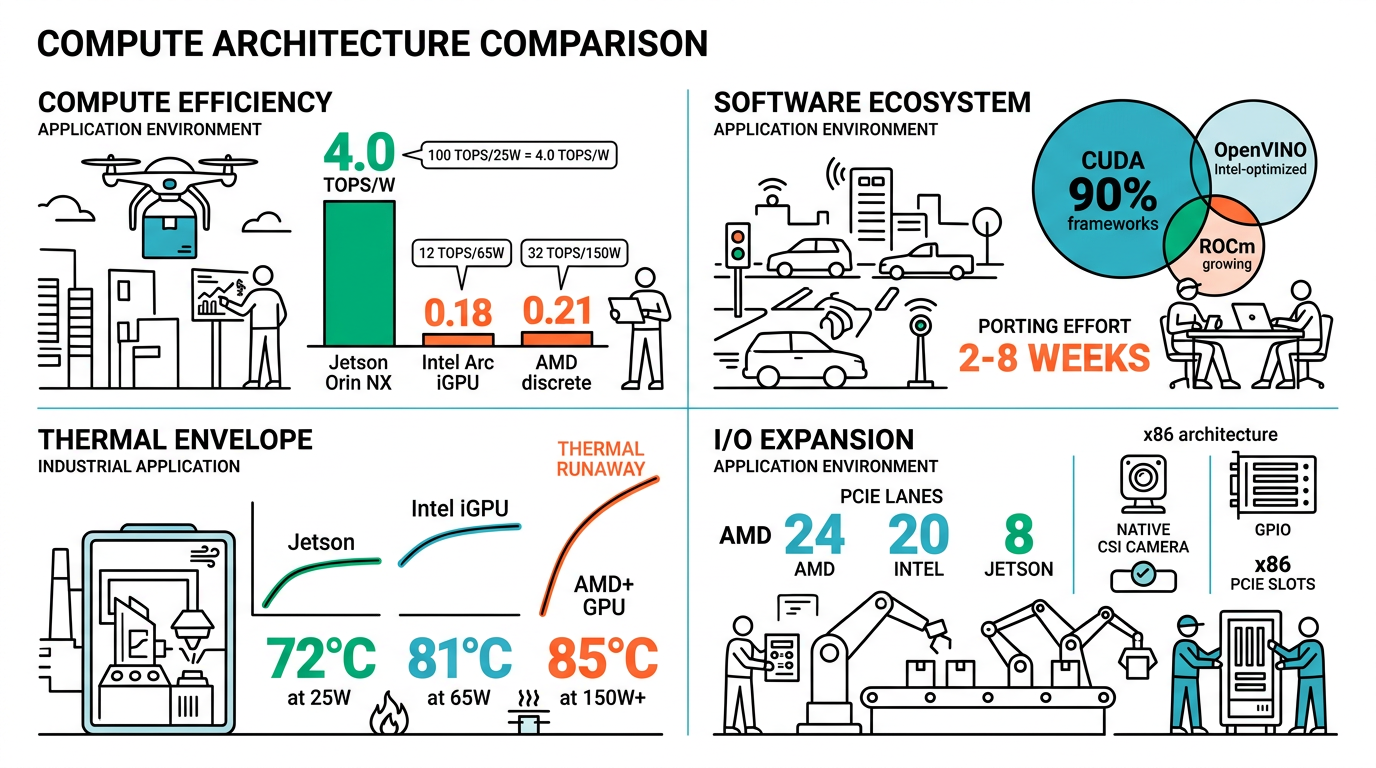
Intel, AMD, and NVIDIA Jetson represent fundamentally different approaches to edge AI inference. Intel Core + Arc iGPU delivers 12 TOPS at 65W with the broadest ISV ecosystem. AMD Ryzen + discrete GPU pushes 32 TOPS at 150W for multi-stream analytics. NVIDIA Jetson Orin achieves 100 TOPS at 25W — 20× the compute efficiency — but within a constrained I/O envelope. Platform selection depends on power budget, thermal constraints, and software ecosystem requirements, not raw benchmark scores.
Overview
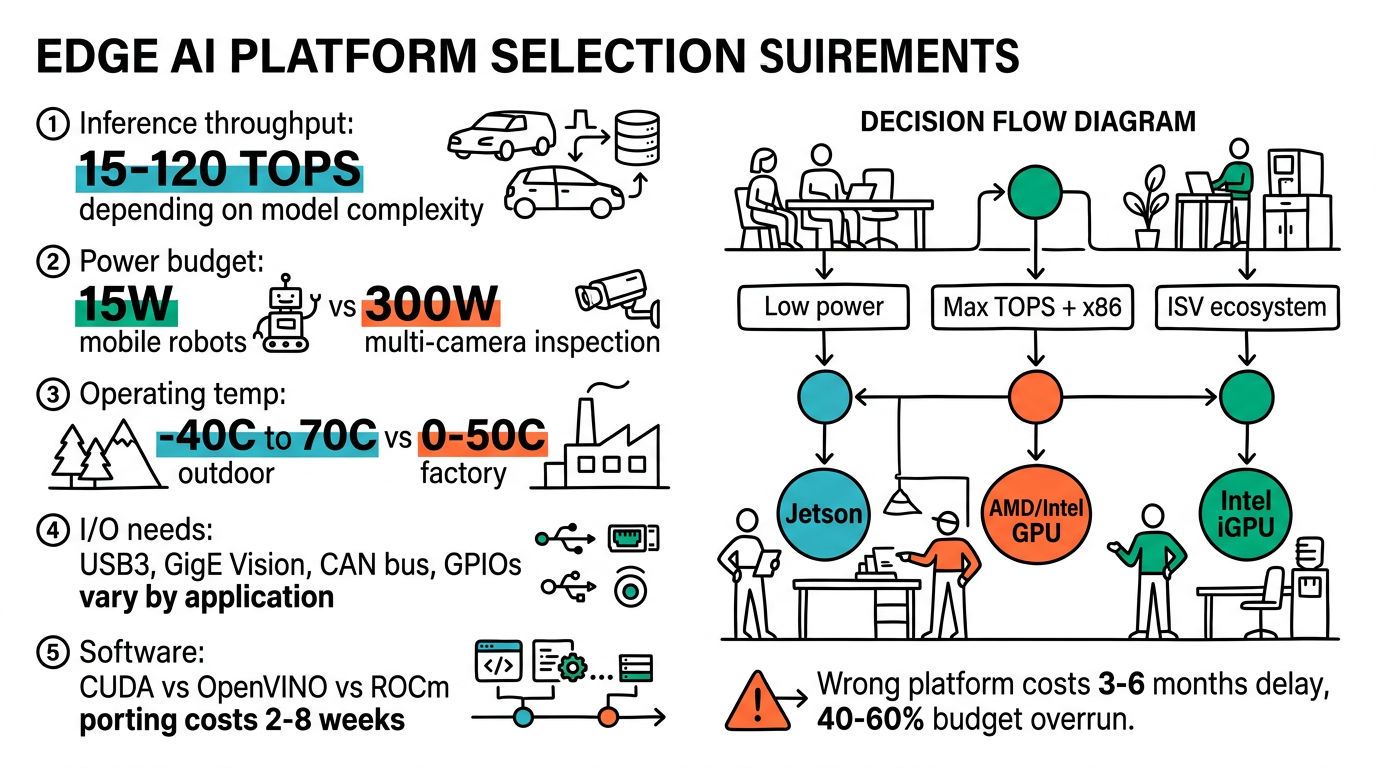
Edge AI deployments are accelerating across manufacturing, logistics, and autonomous systems — yet platform selection remains the most consequential early decision. The wrong choice costs 3-6 months in replatforming and 40-60% budget overruns. Unlike datacenter GPU procurement where NVIDIA dominates, edge deployments face unique constraints: sealed fanless enclosures limit thermal dissipation, remote sites restrict power budgets, and ruggedized form factors constrain PCIe expansion. The MIL-STD-810G certification standard adds another dimension — not all platforms survive the shock and vibration profiles required for vehicle-mounted or field-deployed systems. For procurement guidance, see our Taiwan sourcing guide for rugged PCs.
For a structured approach to evaluating rugged platforms, see our 10-Point Checklist for Choosing a Rugged Edge AI Computer.
Head-to-Head Comparison
| Dimension | Intel Core + Arc iGPU | AMD Ryzen + dGPU | NVIDIA Jetson Orin NX |
|---|---|---|---|
| AI Inference (TOPS) | 12 TOPS (INT8) | 32 TOPS (INT8) | 100 TOPS (INT8) |
| TDP Envelope | 65W (CPU+iGPU) | 150W+ (CPU+dGPU) | 25W (SoM) |
| TOPS/Watt | 0.18 | 0.21 | 4.0 |
| PCIe Lanes | 20 | 24 | 8 |
| AI Framework | OpenVINO, ONNX | ROCm, ONNX | CUDA, TensorRT |
| Camera Interface | USB3, GigE Vision | USB3, GigE Vision | CSI-2 native + USB3 |
| Max Operating Temp | -40°C to 70°C | 0°C to 50°C (typical) | -25°C to 80°C |
| Fanless Feasibility | Yes (65W) | Challenging (>120W) | Yes (25W) |
When Intel wins: Broad ISV compatibility, vPro remote management, simultaneous vision + fleet management workloads, and environments where OpenVINO-optimized models already exist. The POC-700 Cuts Fleet PC Failures 94% article demonstrates Intel's reliability advantage in vehicle-mounted deployments.
When AMD wins: Multi-stream 4K video analytics requiring discrete GPU horsepower, workstation-class inference with PCIe 4.0 bandwidth, and applications where 8+ camera feeds require parallel decode.
When Jetson wins: Power-constrained mobile platforms (AMRs, drones, autonomous vehicles), battery-backed systems, and applications requiring native CSI camera interfaces with sub-10ms latency.
Use Case Mapping
| Application | Recommended Platform | Neousys Product | Key Reason |
|---|---|---|---|
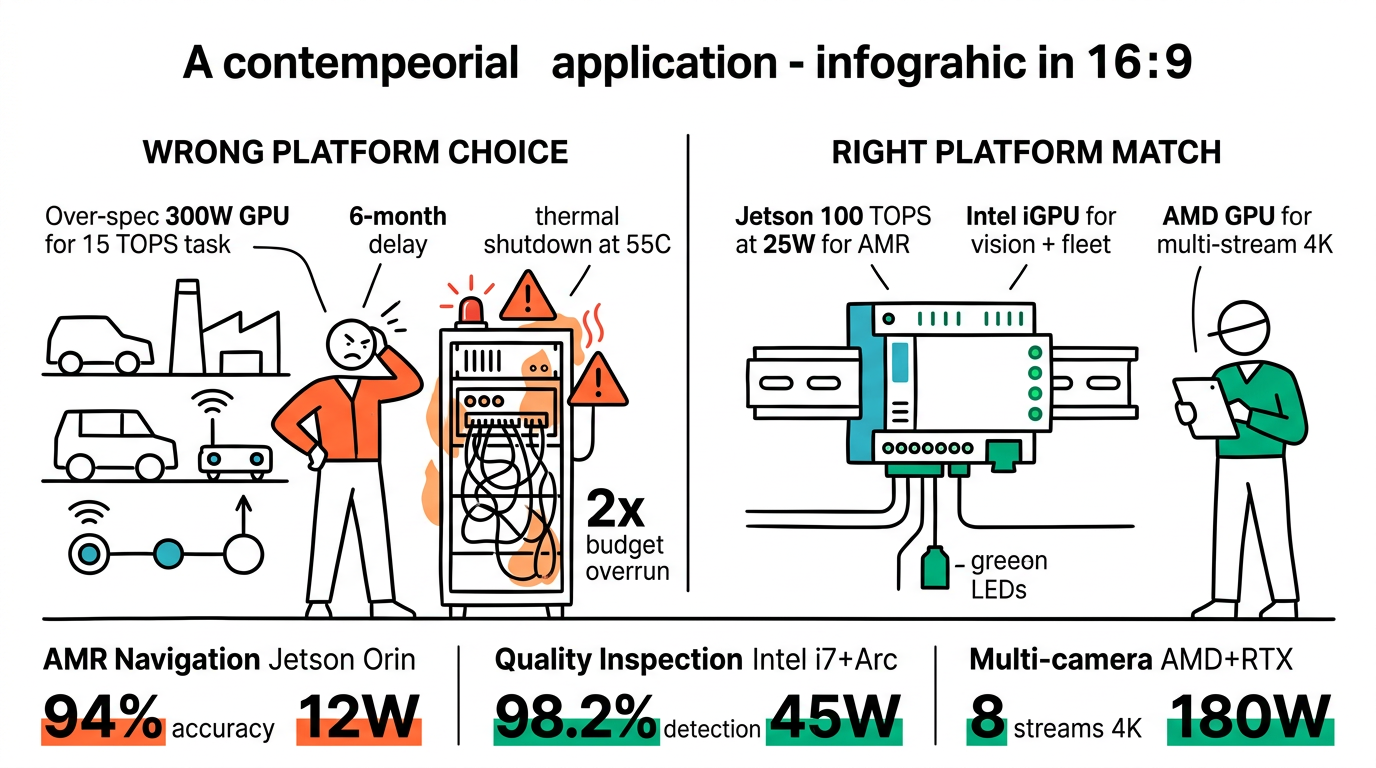
| AMR Navigation | Jetson Orin NX | [NRU-220](https://neousys.neteon.net/rugged-edge-ai-computers/nvidia-accelerated-computing-platform/jetson-edge-ai-computers-nru-220-series/) | 100 TOPS at 25W, native CSI for stereo cameras |
| Multi-Camera QA Inspection | Intel Core i7 + Arc | [Nuvo-10108GC](https://neousys.neteon.net/nuvo-10108gc-i7ic-65w-ds-ne/) | OpenVINO ecosystem, GigE Vision PoE, 65W fanless |
| 8-Stream 4K Analytics | AMD + RTX GPU | [Nuvo-10208GC](https://neousys.neteon.net/nuvo-10208gc-i7ic-65w-ds-ne/) | Dual GPU slots, PCIe 4.0 x16, high decode throughput |
| Vehicle Telematics + AI | Intel Core i5 | POC-700 | Ultra-compact 0.57L, ignition power, -25°C to 70°C |
| Outdoor Surveillance | Jetson Orin | NRU-220 | 25W solar-compatible, IP67-ready with POC-766AWP |
Migration Considerations
Switching platforms mid-project typically adds 2-8 weeks for model optimization alone. CUDA models require OpenVINO Model Optimizer or ONNX export for Intel deployment. ROCm compatibility varies by AMD GPU generation — verify against the specific Radeon or Instinct SKU. TensorRT quantization from PyTorch typically yields 2-3× speedup on Jetson but requires INT8 calibration datasets.
For a hands-on comparison of how these platforms perform in specific food processing workloads, see Nuvo-9160GC vs Nuvo-10108GC: Selecting GPU Edge AI for Food Processing Line Inspection.
Conclusion
Platform selection is an engineering constraint optimization — not a brand preference. Match thermal envelope, I/O requirements, and software ecosystem to the deployment environment before evaluating raw TOPS. For more insights on edge AI platform selection, follow Neteon on LinkedIn. To discuss your edge computing requirements, contact us at www.neteon.net or email [email protected].
FAQs
Can I run CUDA models on Intel or AMD platforms?
Not natively. CUDA is exclusive to NVIDIA GPUs. For Intel, export models to ONNX and optimize with OpenVINO. For AMD, use ROCm (limited framework support). Model porting typically takes 2-8 weeks depending on complexity.
Which platform has the lowest power consumption for edge AI?
NVIDIA Jetson Orin NX achieves 100 TOPS at just 25W TDP — approximately 20× more compute-efficient than x86 + discrete GPU combinations. This makes it ideal for battery-powered or solar-powered deployments.
Is fanless operation possible with AMD discrete GPUs?
Challenging above 120W TDP in sealed enclosures. AMD discrete GPUs typically require 150W+, which exceeds passive cooling limits in compact fanless chassis. The Nuvo-10208GC supports up to 2× 130W GPUs with its advanced thermal architecture.
How do I choose between Nuvo-10108GC and NRU-220?
The Nuvo-10108GC (Intel + GPU) suits fixed-station deployments needing GigE Vision cameras and broad ISV support. The NRU-220 (Jetson Orin) suits mobile platforms needing maximum TOPS-per-watt with native CSI camera interfaces.
What operating temperature range do these platforms support?
Intel-based Neousys systems like the POC-700 operate from -25°C to 70°C (extended: -40°C to 85°C). Jetson-based NRU-220 supports -25°C to 80°C. AMD platforms with discrete GPUs are typically rated 0°C to 50°C without additional thermal management.
See how the Intel-powered Nuvo-10208GC performs in open-pit mining collision avoidance: Nuvo-10208GC Reduces Open-Pit Mine Collision Incidents 78% with Dual-GPU Proximity Detection