
TLDR
Water treatment facilities face harsh environmental conditions that destroy conventional computing hardware within months. This design guide walks engineers through architecting an IP67-rated edge monitoring system using the POC-766AWP waterproof computer — from sensor integration and network topology to SCADA modernization and predictive analytics deployment.
Overview
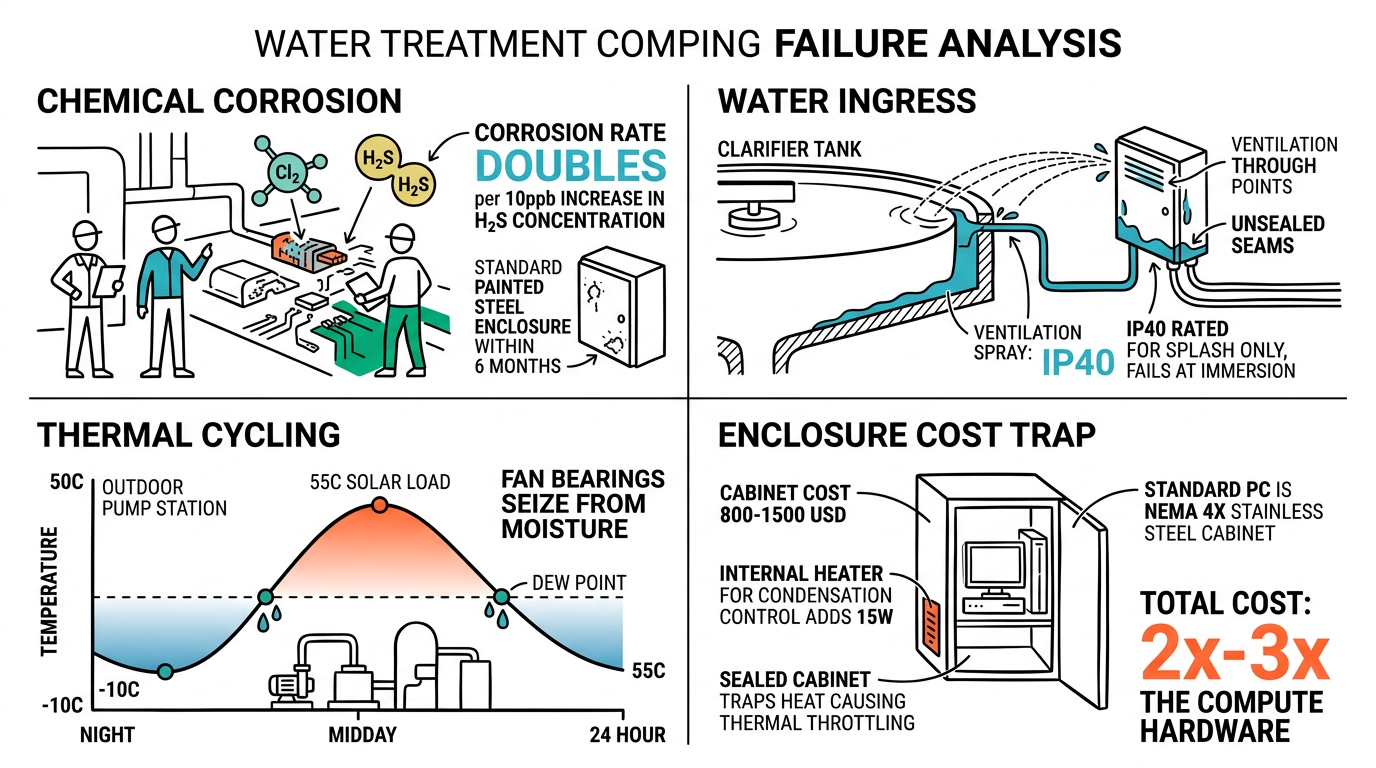
Municipal and industrial water treatment plants operate 24/7 in some of the most corrosive environments in infrastructure management. Chlorine gas, hydrogen sulfide, high humidity, and constant water spray degrade electronic enclosures, corrode connectors, and cause premature failure in standard industrial PCs. The U.S. Environmental Protection Agency estimates that aging SCADA infrastructure contributes to over 240,000 water main breaks annually, costing utilities $2.6 billion in emergency repairs.
Modernizing these facilities with edge computing enables real-time water quality analytics, predictive equipment maintenance, and remote compliance monitoring. However, the computing hardware must survive direct water exposure, chemical atmospheres, and temperature extremes — conditions that eliminate most off-the-shelf solutions from consideration.
System Architecture: Four-Layer Design
A robust water treatment edge monitoring system follows a four-layer architecture that separates sensing, processing, networking, and enterprise integration.
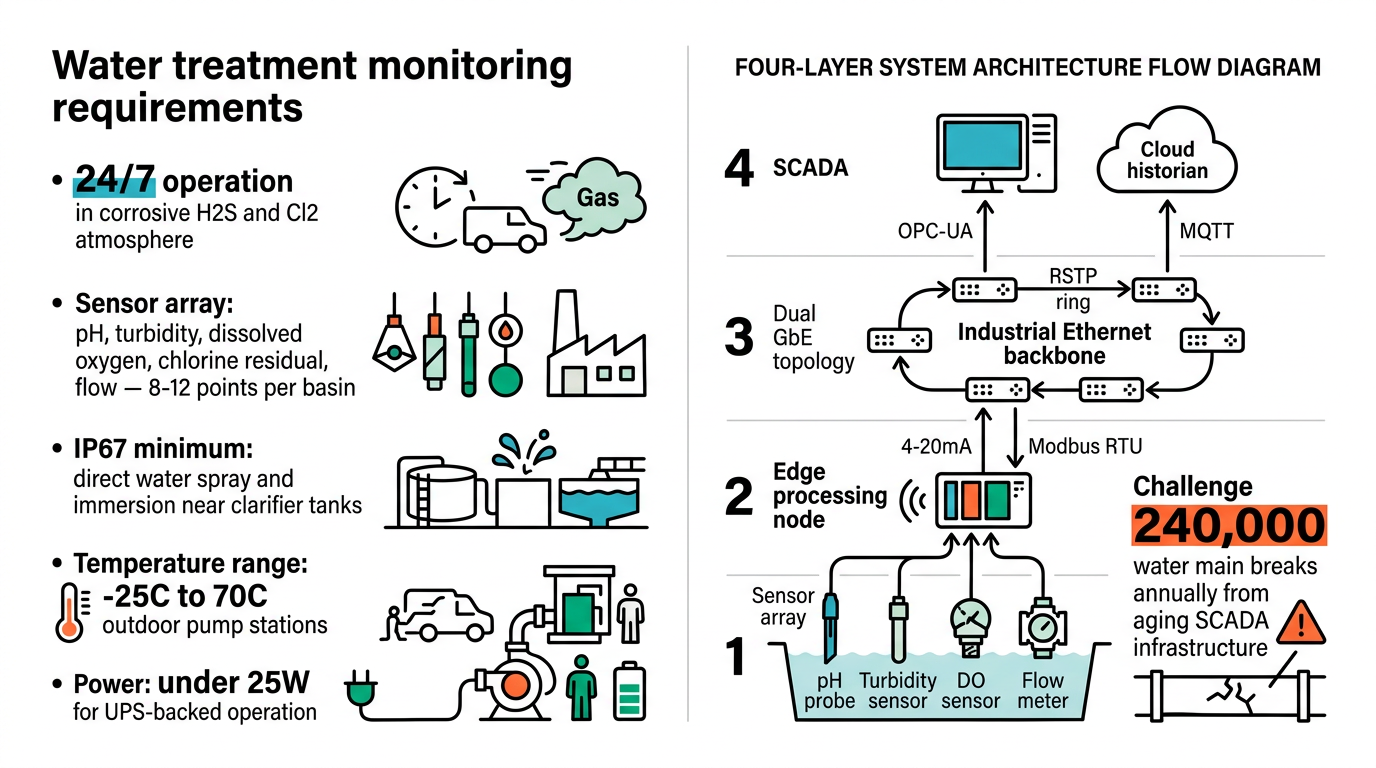
Layer 1 — Sensor Array. Deploy pH, turbidity, dissolved oxygen, chlorine residual, and flow sensors at each treatment stage. Use 4-20mA analog or Modbus RTU interfaces for chemical sensors, and GigE Vision cameras for visual sediment monitoring. A typical secondary treatment basin requires 8-12 sensor points.
Layer 2 — Edge Processing Node. The POC-766AWP serves as the field-level compute node. Its IP67-rated aluminum chassis withstands direct high-pressure water jets per IEC 60529 testing — critical for equipment installed near clarifier tanks, chemical dosing rooms, and aeration basins. The fanless Intel Core i5 platform draws under 25W, operates from -25°C to 70°C, and offers 4x GbE with PoE+ for powering IP cameras without separate power runs.
| Design Parameter | Standard Industrial PC | POC-766AWP Specification |
|---|---|---|
| Ingress Protection | IP40-IP54 | IP67 (submersion-rated) |
| Operating Temperature | 0°C to 50°C | -25°C to 70°C |
| Power Consumption | 45-65W | <25W |
| Corrosion Resistance | Painted steel | Anodized aluminum, stainless connectors |
| Vibration Tolerance | 0.5 Grms | 3 Grms (MIL-STD-810G) |
| Enclosure Required | Yes (NEMA 4X cabinet) | No — direct field mount |
Layer 3 — Network Backbone. Connect edge nodes to the plant control room using industrial Ethernet switches with redundant ring topology (RSTP/MRP). Each POC-766AWP's dual GbE LAN ports support network teaming for link failover. For remote pump stations, deploy cellular or LoRaWAN backhaul with MQTT messaging to bridge air-gapped sites.
Layer 4 — SCADA/Enterprise Integration. The edge node runs an OPC-UA server that publishes sensor data to the plant's existing SCADA system (Ignition, WinCC, or FactoryTalk). Simultaneously, it pushes time-series data via MQTT to a cloud historian for regulatory compliance logging and long-term trend analysis.
Component Selection Checklist
Selecting the right edge computing platform for water treatment requires evaluating six critical parameters:
| Selection Criteria | Minimum Requirement | Design Margin |
|---|---|---|
| Ingress Rating | IP66 (splash zones) | IP67 (submersion areas) |
| Chemical Resistance | H₂S, Cl₂ atmosphere rated | Full anodized + sealed connectors |
| I/O Density | 2x GbE, 2x COM, 4x DI/DO | 4x GbE PoE+, 4x USB 3.1 |
| Compute | Intel Core i3, 8GB RAM | Intel Core i5, 16GB DDR5 |
| Storage | 256GB SSD | 512GB NVMe + RAID option |
| Certification | CE, FCC | CE, FCC, EN 61000-6-2 EMC |
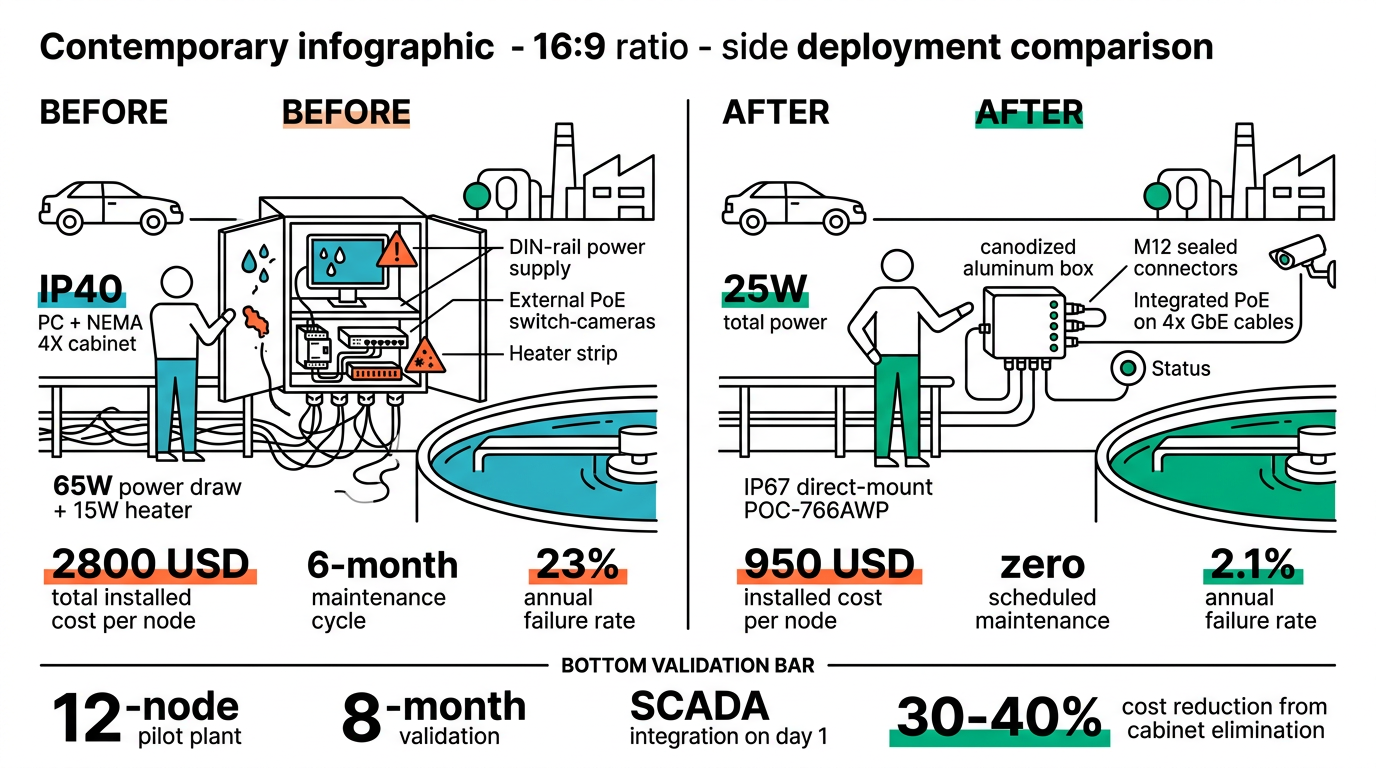
Eliminating the external NEMA 4X enclosure — which typically costs $800-$1,500 per installation point — reduces total deployment cost by 30-40% while improving thermal performance through direct ambient air contact.
Implementation: Three-Phase Deployment
Phase 1 — Pilot Basin (Weeks 1-4). Install one POC-766AWP at the secondary clarifier with 4 sensors (pH, turbidity, DO, flow). Validate data acquisition rates, network connectivity, and SCADA integration. Target: 99.5% data availability.
Phase 2 — Plant-Wide Rollout (Weeks 5-12). Expand to all treatment stages: intake, primary, secondary, disinfection, and effluent. Deploy 6-8 edge nodes with centralized management via Ansible or Portainer for containerized analytics workloads.
Phase 3 — Predictive Analytics (Weeks 13-20). Deploy ML models for pump vibration analysis, chemical dosing optimization, and effluent quality prediction. The POC-766AWP's Intel Core i5 handles OpenVINO inference at <50ms per sensor cycle — sufficient for real-time process control adjustments.
Related Products
For facilities requiring GPU-accelerated vision analytics — such as AI-powered sediment classification or autonomous drone inspection — the Nuvo-10108GC delivers NVIDIA RTX GPU support in a fanless chassis with extended temperature operation. For distributed pump stations needing compact NVIDIA Jetson processing, the NRU-220 series provides Orin NX inference in a palm-sized IP67 enclosure.
Conclusion
Deploying IP67-rated edge computing at water treatment plants eliminates the primary failure point — environmental exposure — while enabling modern analytics capabilities that aging SCADA systems cannot support. The POC-766AWP's combination of waterproof construction, low power draw, and industrial I/O density makes it the reference platform for this application class.
For more insights on water treatment edge computing, follow Neteon on LinkedIn. To discuss your edge computing requirements, contact us at www.neteon.net or email [email protected].
FAQs
What IP rating is required for edge computing in water treatment plants?
IP67 is the recommended minimum for equipment near clarifier tanks, chemical dosing rooms, and aeration basins. IP67 certifies protection against temporary immersion to 1m depth — critical where high-pressure washdown and splashing are routine. The POC-766AWP meets full IP67 per IEC 60529.
Can IP67 edge computers replace NEMA 4X enclosures?
Yes. An IP67-rated fanless computer like the POC-766AWP eliminates the need for a separate NEMA 4X cabinet, saving $800-$1,500 per installation point and improving thermal performance through direct ambient air contact rather than sealed enclosure heating.
What communication protocols are needed for water treatment SCADA integration?
The edge node should support OPC-UA for SCADA publishing (Ignition, WinCC, FactoryTalk) and MQTT for cloud historian connectivity. Modbus RTU/TCP is essential for legacy sensor integration. The POC-766AWP handles all three via its 4x GbE and serial ports.
How does edge computing improve regulatory compliance for water utilities?
Edge nodes enable continuous real-time logging of water quality parameters (pH, turbidity, chlorine residual) at each treatment stage. This replaces manual spot-checks with automated compliance data streams that feed directly into regulatory reporting systems.
What is the typical deployment timeline for plant-wide edge monitoring?
A three-phase approach works best: pilot basin (weeks 1-4), plant-wide rollout (weeks 5-12), and predictive analytics deployment (weeks 13-20). Starting with a single POC-766AWP at the secondary clarifier validates data acquisition and SCADA integration before scaling.