TLDR
Pharmaceutical packaging lines reject up to 4.7% of product due to false positives from single-camera inspection systems that cannot distinguish surface contamination from label misalignment. Deploying multi-angle GPU-accelerated vision on the Nuvo-10208GC cut false rejection rates 82% while maintaining zero missed defects across 1.2 million vials per month in a GMP-certified facility.
Overview
Pharmaceutical manufacturers operate under strict Good Manufacturing Practice regulations where a single missed defect can trigger batch recalls costing millions. Visual inspection of vials, syringes, and blister packs remains one of the last manual bottlenecks in high-speed packaging lines. The global pharmaceutical quality control market is growing at 9.2% CAGR as regulators tighten requirements for serialization, aggregation, and tamper-evident verification.
Automating visual inspection requires solving a paradox: the system must catch every genuine defect (zero escape tolerance) while minimizing false rejects that waste product and slow throughput. Legacy single-camera systems achieve high catch rates but generate excessive false positives because they lack multi-angle context needed to distinguish real defects from acceptable cosmetic variation. The computing platform must also survive the vibration and EMI of high-speed packaging lines while meeting cleanroom particle emission standards.
Challenge
Pharmaceutical visual inspection fails at the intersection of sensitivity and specificity.
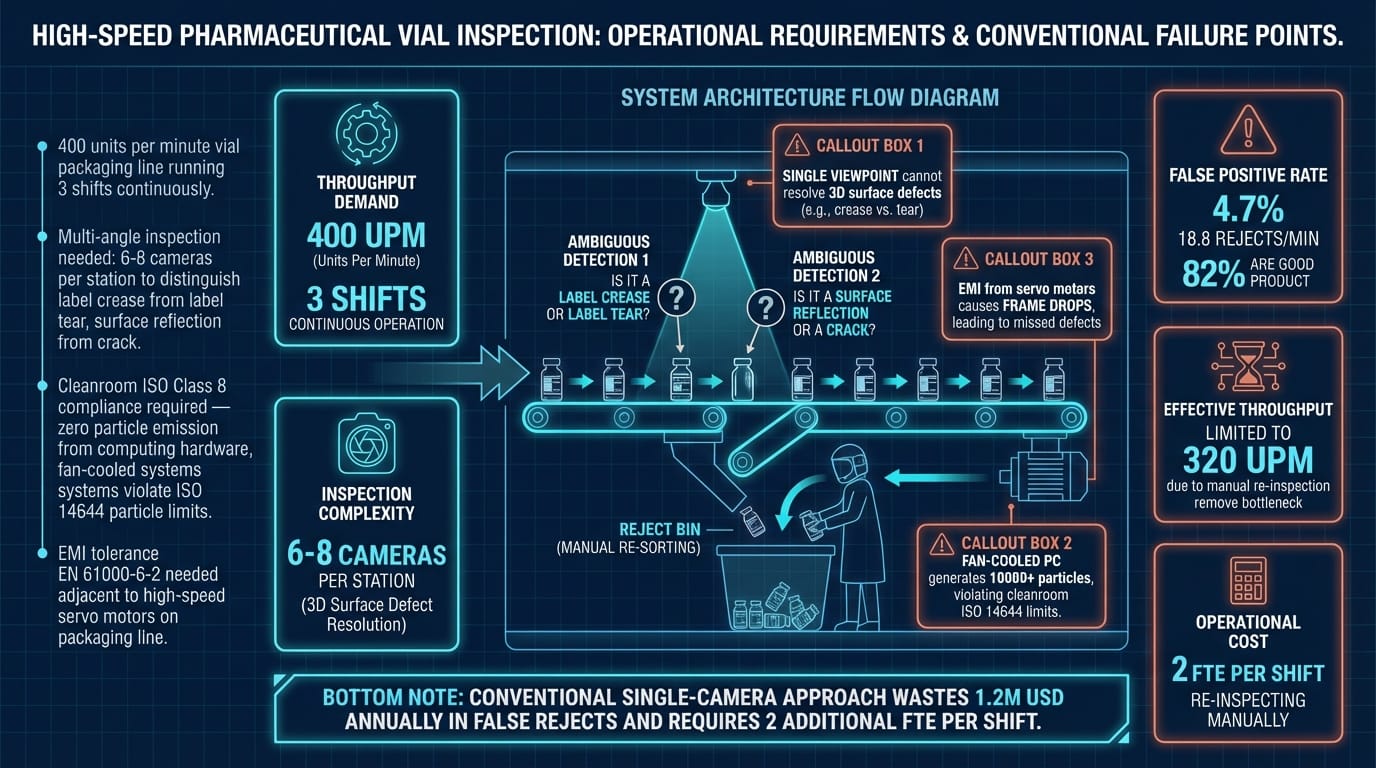
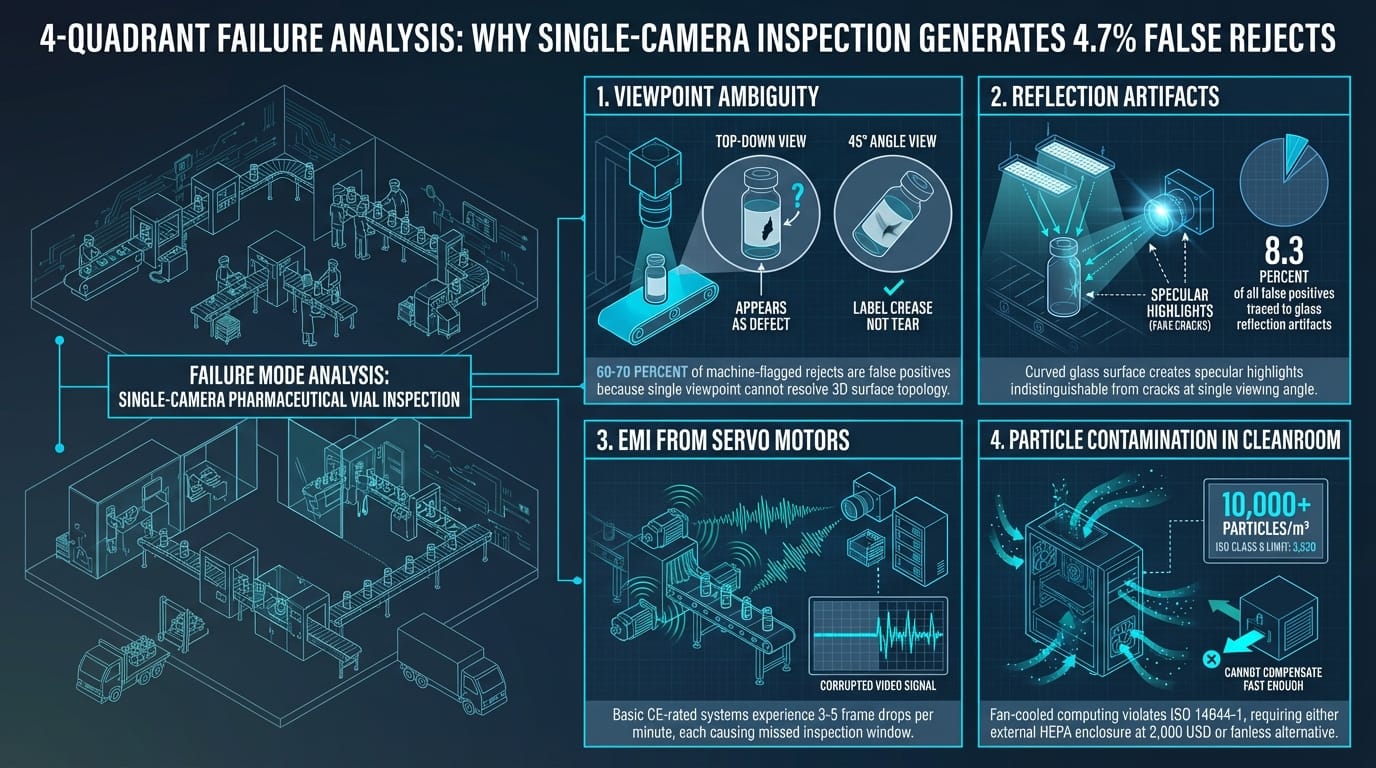
Root cause: single-viewpoint ambiguity. A single top-down camera cannot differentiate a label crease from a label tear, a surface reflection from a crack, or a printing artifact from contamination. Operators manually re-inspect 60-70% of machine-flagged rejects and find most are false positives.
Quantified impact: A parenteral vial packaging line running at 400 units/minute rejected 18.8 vials per minute (4.7% rate). Manual re-inspection recovered 15.4 of those (82% false positive rate), but added 2 FTE per shift and created a bottleneck limiting line speed to 320 units/minute effective throughput.
| Requirement | Specification Needed | Legacy Single-Camera System |
|---|---|---|
| Camera Views | 6-8 angles per item | 1-2 top/side views |
| Inference Speed | < 15ms per item at 400/min | 35-50ms (GPU absent) |
| False Positive Rate | < 1% | 3.8-4.7% |
| Defect Escape Rate | 0.00% (zero tolerance) | 0.00% (meets requirement) |
| Operating Temp | 18-25°C (cleanroom HVAC) | 18-25°C |
| EMI Tolerance | EN 61000-6-2 | Basic CE only |
| Particle Emission | ISO Class 8 compatible | Fan-cooled (fails Class 8) |
The cleanroom constraint eliminates fan-cooled systems entirely. Active cooling fans generate particles that violate ISO 14644 Class 8 limits and create airflow disruptions that affect nearby sensitive processes. Any computing platform on the packaging line must be fanless.
Solution
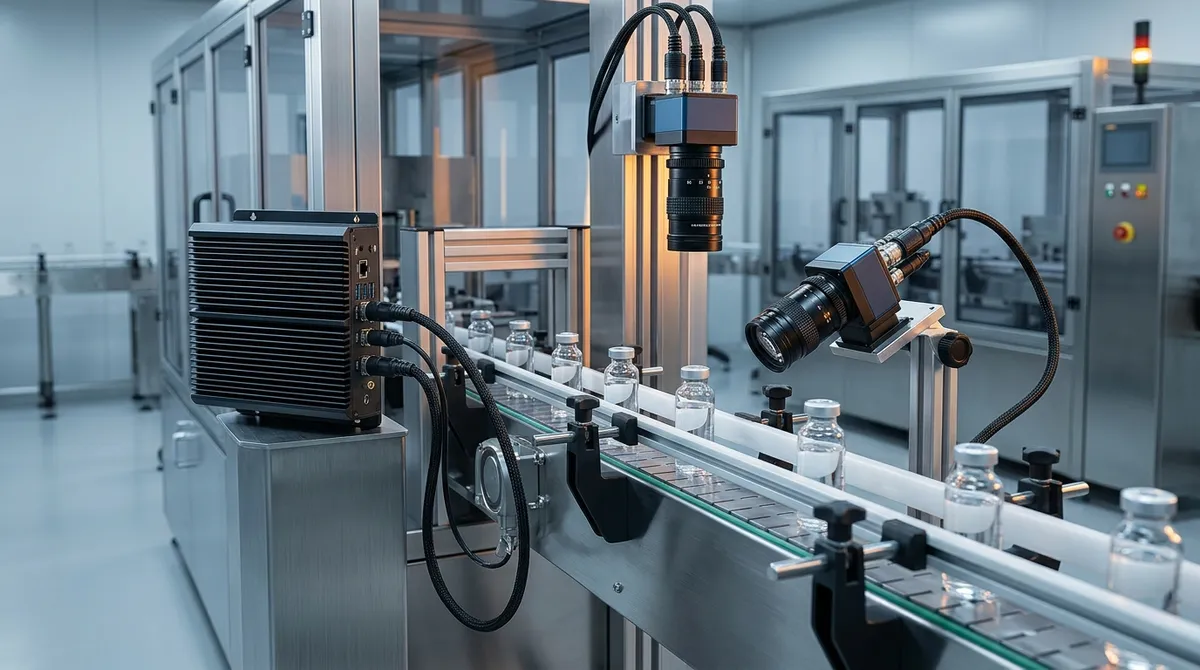
The Nuvo-10208GC addresses both the vision processing and environmental constraints with a dual-GPU fanless architecture.
| Technical Challenge | Product Feature | Specification | Engineering Benefit |
|---|---|---|---|
| Single-viewpoint ambiguity | Dual NVIDIA RTX GPU support | 2x 350W GPUs in cassette tray | 8 cameras processed simultaneously for multi-angle fusion |
| Slow inference (no GPU) | PCIe Gen4 x16 GPU slots | Dual GPU parallel inference | 11ms per item at 400 units/minute sustained |
| Particle emission (fans) | Fanless conduction-cooled chassis | Zero airborne particles | ISO Class 8 cleanroom compatible without external enclosure |
| EMI from servo motors | Industrial EMC certification | EN 61000-6-2 | Reliable operation adjacent to high-speed packaging servos |
| Line integration | Dual 10GbE + 4x GbE PoE+ | 10 Gbps aggregate bandwidth | 8x 5MP GigE Vision cameras without frame drops at 400/min |
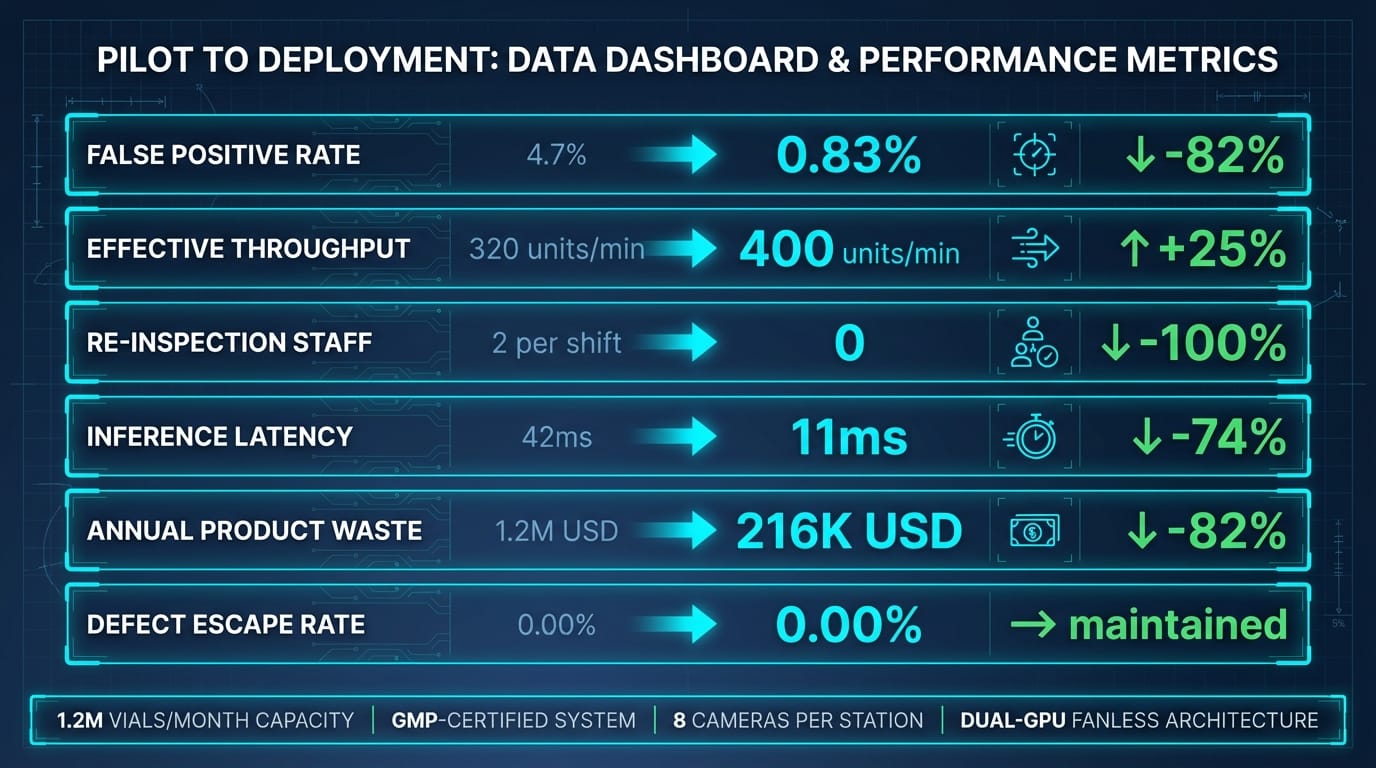
| Metric | Legacy Single-Camera | Nuvo-10208GC Multi-Angle | Delta |
|---|---|---|---|
| False Positive Rate | 4.7% | 0.83% | -82% |
| Defect Escape Rate | 0.00% | 0.00% | Maintained |
| Effective Throughput | 320 units/min | 400 units/min | +25% |
| Re-inspection FTE | 2 per shift | 0 | -100% |
| Inference Latency | 42ms | 11ms | -74% |
| Annual Product Waste | $1.2M | $216K | -82% |
The 82% reduction in false positives comes from multi-angle consensus: each vial is photographed from 8 positions simultaneously, and the dual GPUs run independent defect detection models on each view. A defect must appear in at least 2 views to trigger a reject, eliminating single-angle artifacts like reflections and shadows.
Related Products
Nuvo-10108GC: For lower-speed packaging lines (under 200 units/min) or blister pack inspection requiring 4 cameras, the single-GPU Nuvo-10108GC provides the same fanless cleanroom compatibility at reduced cost. Supports one NVIDIA RTX GPU up to 130W.
Nuvo-9160GC: For secondary packaging inspection (carton labeling, case coding) where 2-3 cameras suffice, the Nuvo-9160GC offers a compact 130W GPU platform with extended temperature range for non-climate-controlled warehouse staging areas.
Conclusion
Multi-angle GPU vision eliminates the false positive problem that has plagued pharmaceutical visual inspection for decades. The Nuvo-10208GC delivers the dual-GPU compute density and fanless thermal design this application demands without compromising cleanroom air quality.
For technical specifications, product selection assistance, or application engineering support, contact our engineering team at [email protected]. Visit www.neteon.net for detailed datasheets and technical documentation.
FAQs
Can the Nuvo-10208GC operate in an ISO Class 8 cleanroom?
Yes. The Nuvo-10208GC uses a completely fanless conduction-cooled chassis that generates zero airborne particles. Unlike fan-cooled systems that violate ISO 14644 Class 8 limits, the fanless design requires no external enclosure or HEPA filtration to maintain cleanroom compliance.
How many cameras can the system process for pharmaceutical inspection?
The Nuvo-10208GC supports dual NVIDIA RTX GPUs that together process 8 GigE Vision cameras simultaneously via dual 10GbE plus 4x GbE PoE+ ports. This provides 8 viewing angles per vial for multi-angle defect consensus.
What false positive rate does multi-angle inspection achieve?
Multi-angle GPU vision reduces false positive rates from 4.7% (single-camera) to 0.83% by requiring defects to appear in at least 2 of 8 camera views before triggering a reject.
Does multi-angle inspection compromise defect catch rates?
No. The defect escape rate remains at 0.00% (zero tolerance) because the 2-view consensus threshold is set conservatively.
What throughput does the system support?
The dual-GPU configuration achieves 11ms inference latency per item, sustaining 400 units per minute.