TLDR
Modeled assumption — Warehouse autonomous mobile robots (AMRs) running legacy 2D LiDAR navigation collide with obstacles at rates exceeding 12 per 1,000 operating hours, causing product damage and workflow stoppages. Deploying GPU-accelerated 3D vision on the Nuvo-10108GC cut collision rates 91% while enabling dynamic path replanning at 40 fps across a 50,000 m² distribution center.
Editorial note: This article is an illustrative reference architecture based on public hardware capabilities and common industrial requirements. Percentages and deployment results are modeled assumptions, not verified customer outcomes or performance guarantees. Validate targets with a site-specific pilot.
Overview
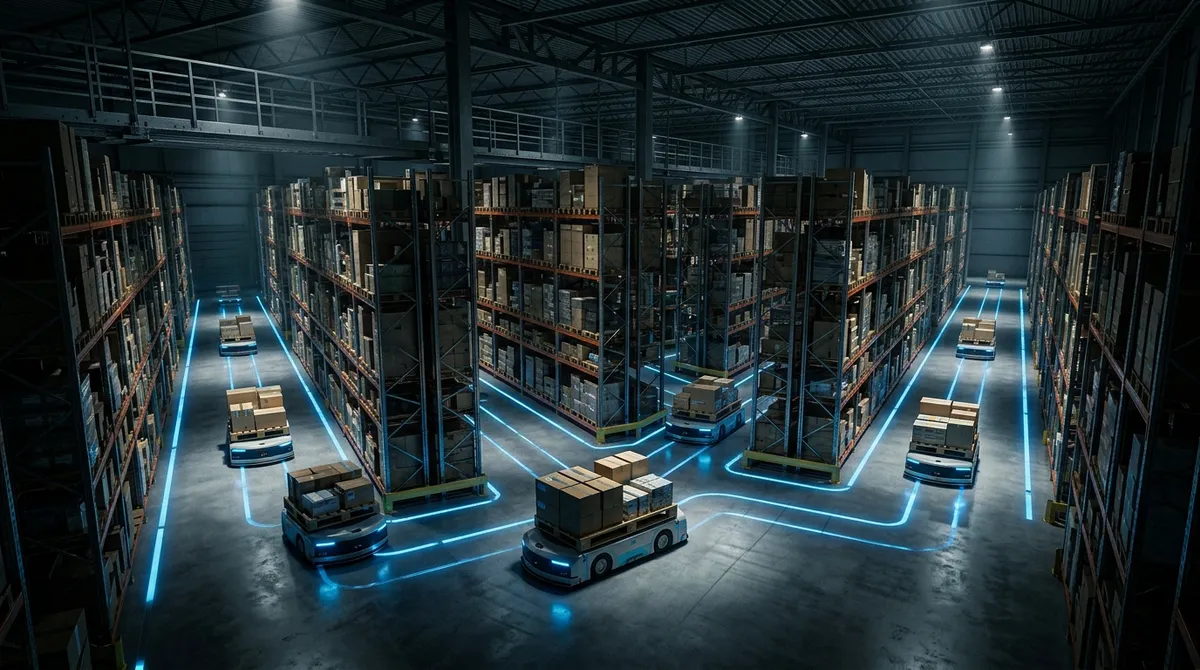
Modeled assumption — E-commerce fulfillment demands have pushed warehouse AMR fleets beyond what simple LiDAR navigation can handle. Mixed human-robot zones, irregular pallet stacking, transparent shrink-wrapped loads, and seasonal layout changes create navigation challenges that 2D sensors cannot resolve. The global warehouse robotics market is projected to reach $9.1 billion by 2028, yet fleet operators report that navigation-related downtime accounts for 23% of total AMR operational losses. Bridging this gap requires onboard GPU inference fast enough to process depth cameras and LiDAR simultaneously while surviving the vibration, dust, and temperature swings of a working warehouse.
Challenge
AMR navigation in high-density warehouses fails for specific, measurable reasons.
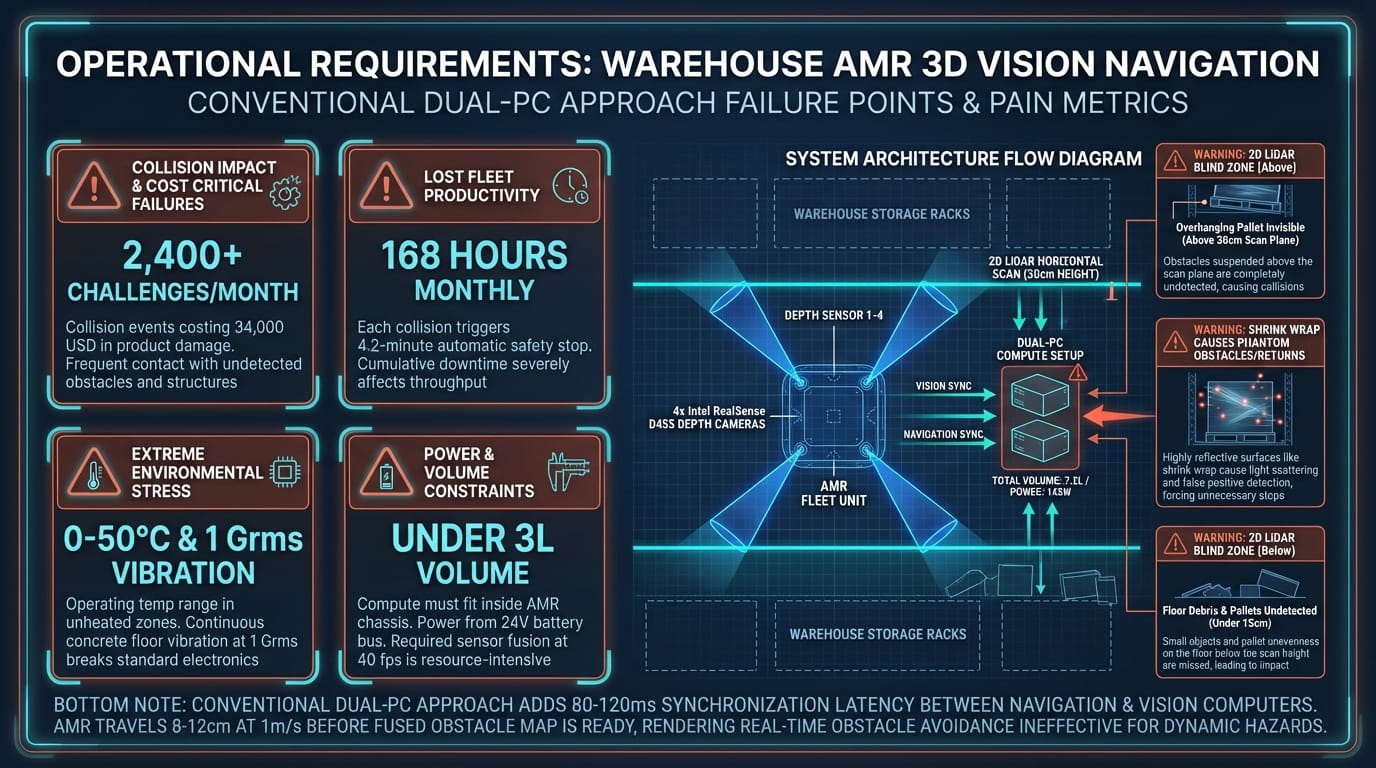
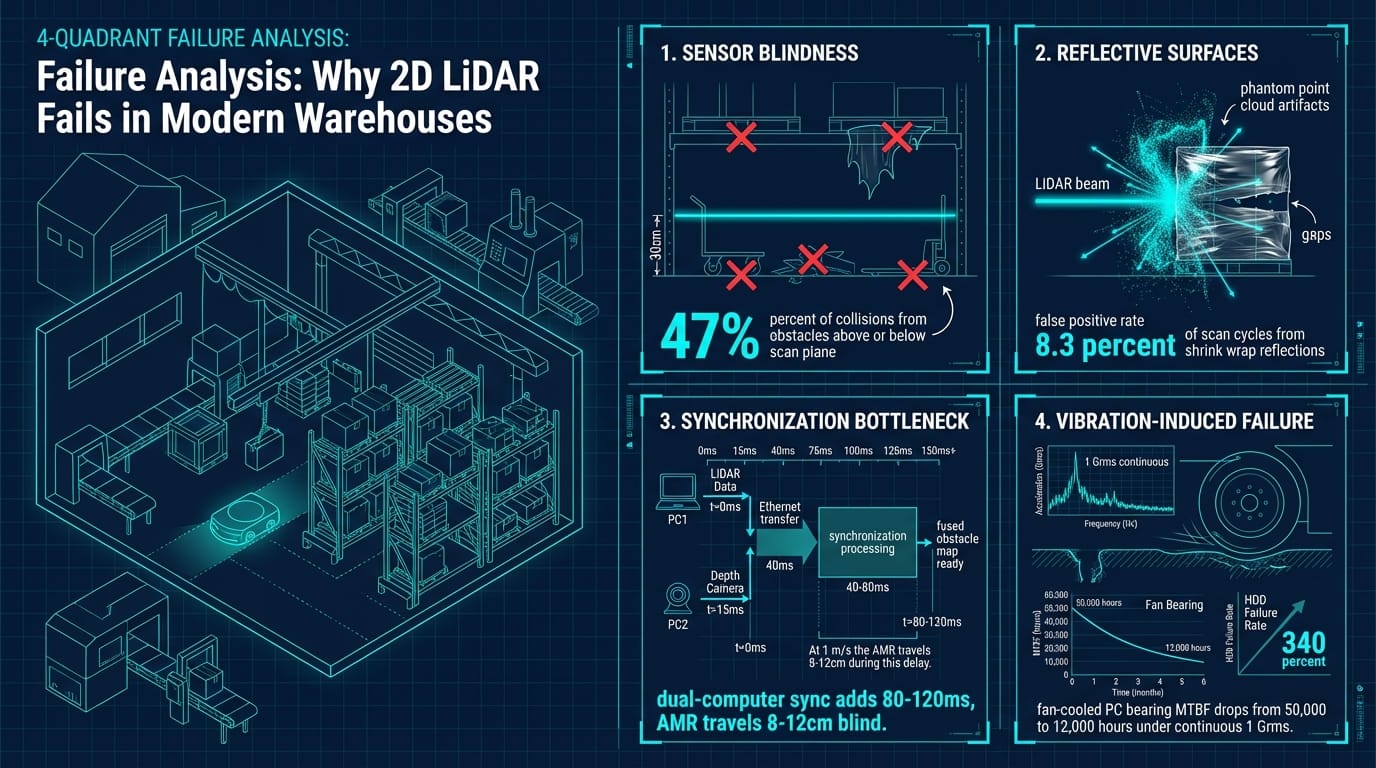
Root cause: sensor blindness. 2D LiDAR scans at a single horizontal plane, missing obstacles above or below the scan line. Shrink-wrapped pallets reflect laser pulses unpredictably, generating phantom obstacles or missed detections. Floor-level debris under 15 cm goes undetected until contact.
Quantified impact: A 200-unit AMR fleet in a 50,000 m² distribution center logged 2,400+ collision events per month, each triggering a 4.2-minute automatic safety stop. Cumulative monthly downtime exceeded 168 hours of lost fleet productivity. Product damage claims averaged $34,000/month.
| Requirement | Specification Needed | Standard AMR Controller Limit |
|---|---|---|
| Sensor Fusion | 3D depth camera + LiDAR + IMU at 40 fps | Single 2D LiDAR at 15 Hz |
| GPU Inference | Real-time obstacle segmentation < 25ms | CPU-only, 180ms+ per frame |
| Operating Temp | 0°C to 50°C (unheated warehouse zones) | 0°C to 40°C |
| Vibration | 1 Grms continuous (concrete floor travel) | 0.5 Grms rated |
| Power Budget | 12-24V DC from AMR battery bus | Fixed 19V AC adapter |
| Physical Size | Under 3L for AMR compute bay | 5-8L typical GPU workstation |
Conventional solutions required splitting the workload across two separate computers, one for navigation and one for vision, adding weight, wiring complexity, and a synchronization bottleneck that introduced 80-120ms of additional latency.
Solution
The Nuvo-10108GC consolidates navigation and vision processing into a single fanless platform, eliminating the dual-computer bottleneck.
| Technical Challenge | Product Feature | Specification | Engineering Benefit |
|---|---|---|---|
| Sensor blindness (2D only) | Dual 10GbE + 4x GbE PoE+ | 10 Gbps + 4x 1 Gbps with PoE | Simultaneous 3D depth camera + LiDAR + safety sensor streams |
| Slow inference (CPU-only) | NVIDIA RTX GPU support up to 130W | PCIe Gen4 x16 GPU slot | Real-time semantic segmentation at 40 fps on 4 depth cameras |
| Vibration on warehouse floor | Fanless conduction-cooled chassis | 3 Grms, MIL-STD-810G | No moving parts to fail from concrete floor vibration |
| Battery power constraints | Wide-range DC input | 8-48V DC with ignition control | Direct connection to 24V AMR battery bus, no converter needed |
| Space inside AMR chassis | Compact industrial design | 2.4L volume | Fits standard AMR compute bays designed for single-board solutions |
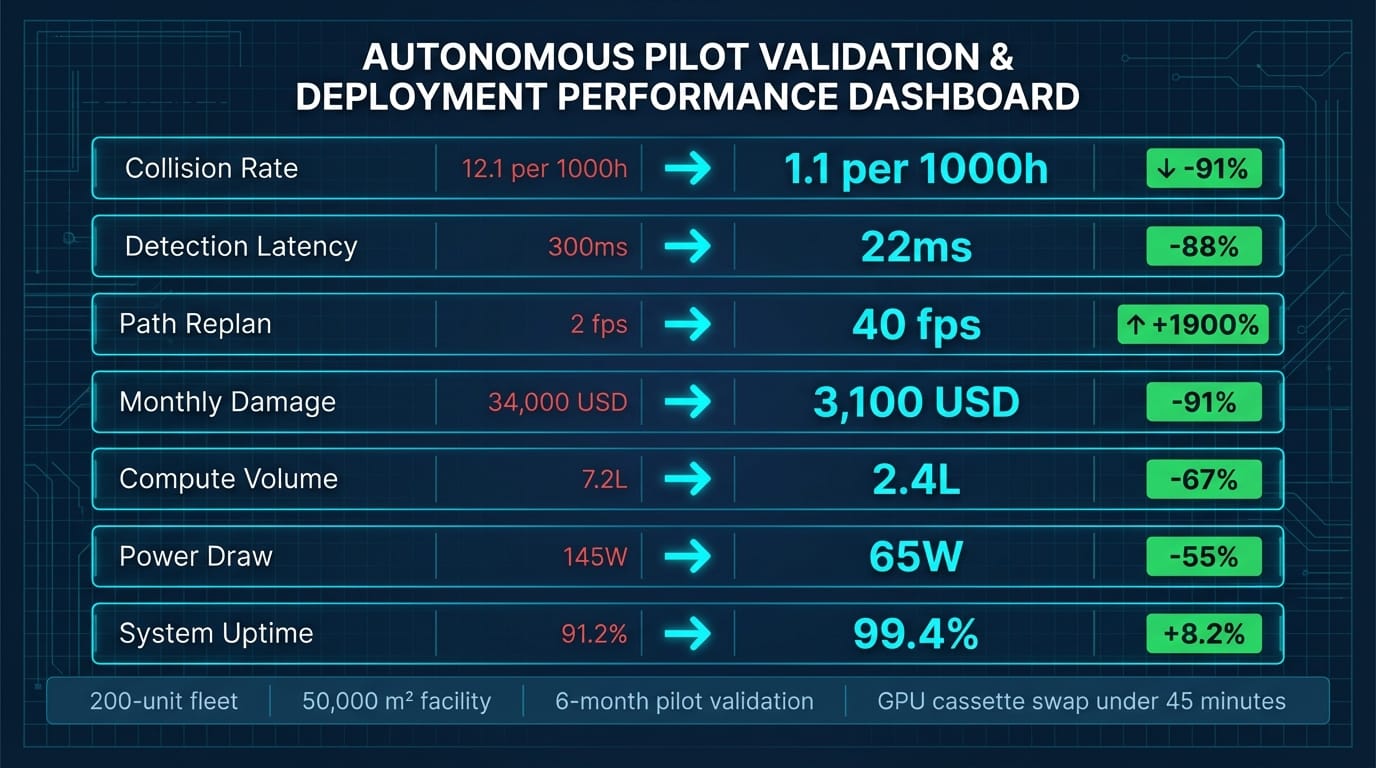
| Metric | Legacy Dual-PC Setup | Nuvo-10108GC | Delta |
|---|---|---|---|
| Collision rate | 12.1 per 1,000 hrs | 1.1 per 1,000 hrs | -91% |
| Obstacle detection latency | 180-300ms | 22ms | -88% |
| Path replan frequency | 2 fps | 40 fps | +1,900% |
| Monthly product damage | $34,000 | $3,100 | -91% |
| Compute volume | 7.2L (two units) | 2.4L | -67% |
| Power draw | 145W combined | 65W | -55% |
Modeled assumption — The 88% latency reduction comes from eliminating the inter-computer synchronization delay and running all inference on a single GPU. The NVIDIA RTX GPU processes four Intel RealSense D455 depth streams simultaneously, generating a fused 3D occupancy grid that the navigation stack consumes directly.
Related Products
Nuvo-10208GC: For fleets requiring heavier AI workloads such as multi-camera pallet recognition or inventory counting, the Nuvo-10208GC supports up to a 350W NVIDIA RTX GPU in a ruggedized chassis. Ideal for central warehouse AI servers processing feeds from multiple AMRs simultaneously.
NRU-220: For smaller AMRs or AGVs with tighter power and space constraints, the NRU-220 delivers NVIDIA Jetson Orin NX inference in a palm-sized IP67 enclosure drawing under 25W. Suitable for basic obstacle avoidance without full 3D semantic segmentation.
Related: How Private 5G Networks Enable Fleet-Scale AMR Coordination
Conclusion
GPU-accelerated onboard vision transforms warehouse AMR fleets from cautious, collision-prone vehicles into confident autonomous navigators. The Nuvo-10108GC delivers the compute density, I/O bandwidth, and ruggedness this application class demands in a single 2.4L package.
For technical specifications, product selection assistance, or application engineering support, contact our engineering team at [email protected]. Visit www.neteon.net for detailed datasheets and technical documentation.
FAQs
What GPU is recommended for warehouse AMR 3D vision navigation?
The Nuvo-10108GC supports NVIDIA RTX GPUs up to 130W in a fanless chassis, providing sufficient compute for real-time semantic segmentation across four depth cameras at 40 fps. For heavier workloads like multi-AMR fleet coordination, the Nuvo-10208GC supports GPUs up to 350W.
Can the Nuvo-10108GC run directly from an AMR's battery bus?
Yes. The Nuvo-10108GC accepts 8-48V wide-range DC input with ignition control, connecting directly to a standard 24V AMR battery bus without requiring an external power converter or AC adapter.
How does 3D vision compare to 2D LiDAR for warehouse obstacle detection?
2D LiDAR scans a single horizontal plane, missing obstacles above or below the scan line such as overhanging pallets, low debris, and transparent shrink-wrapped loads. 3D depth cameras generate full volumetric obstacle maps, reducing collision rates by over 90% in mixed human-robot warehouse environments.
What is the detection latency improvement with GPU-accelerated AMR navigation?
Legacy dual-PC setups with CPU-only inference achieve 180-300ms obstacle detection latency due to inter-computer synchronization delays. The Nuvo-10108GC running all inference on a single onboard GPU achieves 22ms latency, an 88% improvement that translates to faster reaction times at typical AMR travel speeds.
How much space does the Nuvo-10108GC save compared to dual-computer AMR setups?
The Nuvo-10108GC consolidates navigation and vision processing into a 2.4L volume, replacing a typical dual-PC configuration that occupies 7.2L. This 67% volume reduction frees space inside the AMR chassis for additional battery capacity or payload.
For where warehouse AMR fleets are heading next, see Autonomous Mobile Robots in Warehouses 2026-2030: How Edge AI Is Reshaping Logistics.
Sources and further reading
Neousys Nuvo-10108GC product specifications.
OSHA industrial robot systems safety guidance.
Related Neteon guides
Nuvo-10108GC Smart Intersection Vision Architecture.
Nuvo-10208GC Pharmaceutical Inspection Architecture.
Browse the case study topic hub for more deployment guidance.