
TLDR
TLDR: Food processing facilities running visual inspection at 200+ items per minute face a GPU sizing decision that directly impacts detection accuracy and line throughput. The Nuvo-9160GC handles single-line inspection at 130W GPU TDP, while the Nuvo-10108GC supports multi-line or multi-model inference at 350W. Choosing the wrong tier wastes capital or creates bottlenecks.
Overview
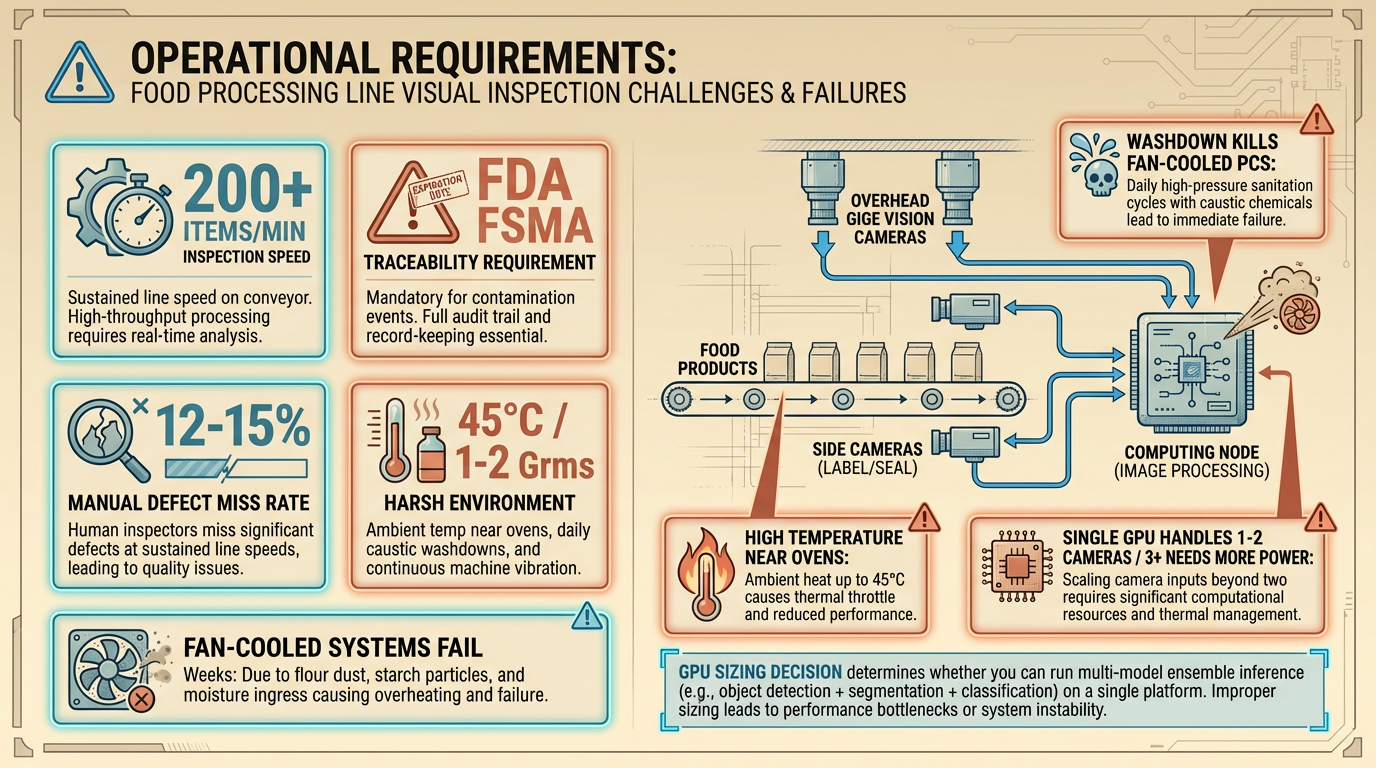
Food processing plants face mounting regulatory pressure to automate visual quality inspection. The FDA's updated FSMA rules now require documented traceability for contamination events, and manual inspection at conveyor speeds above 150 items per minute consistently misses 12–18% of defects according to industry audits. GPU-accelerated edge AI eliminates this gap by running inference models directly on the production floor, but the compute requirements vary dramatically between a single-camera sorting station and a multi-camera, multi-model inspection cell covering color, shape, surface defect, and foreign object detection simultaneously.
The hardware decision is not simply about raw GPU performance. Food processing environments impose specific constraints: washdown exposure from daily sanitation cycles, ambient temperatures reaching 45°C near ovens and fryers, electrical noise from variable-frequency drives on conveyor motors, and 24/7 uptime requirements with zero tolerance for thermal throttling during peak production shifts.
Technical Comparison
The Nuvo-9160GC and Nuvo-10108GC share the same Intel 13th/14th Gen Core platform and Neousys rugged fanless design philosophy but occupy fundamentally different GPU performance tiers.
| Specification | Nuvo-9160GC | Nuvo-10108GC |
|---|---|---|
| GPU TDP Support | Up to 130W | Up to 350W |
| Compatible GPUs | NVIDIA RTX A2000, RTX 4060 | NVIDIA RTX 5080, RTX 4080, A4500 |
| FP32 TFLOPS | 12–15 | 40–52 |
| INT8 Inference | 80–120 TOPS | 200–450 TOPS |
| System Power | 200–280W total | 350–500W total |
| Operating Temp | -25°C to 60°C | -25°C to 50°C |
| GbE Ports | 2× 2.5GbE + optional PoE | 2× 10GbE + 2× 2.5GbE |
When to Choose the Nuvo-9160GC
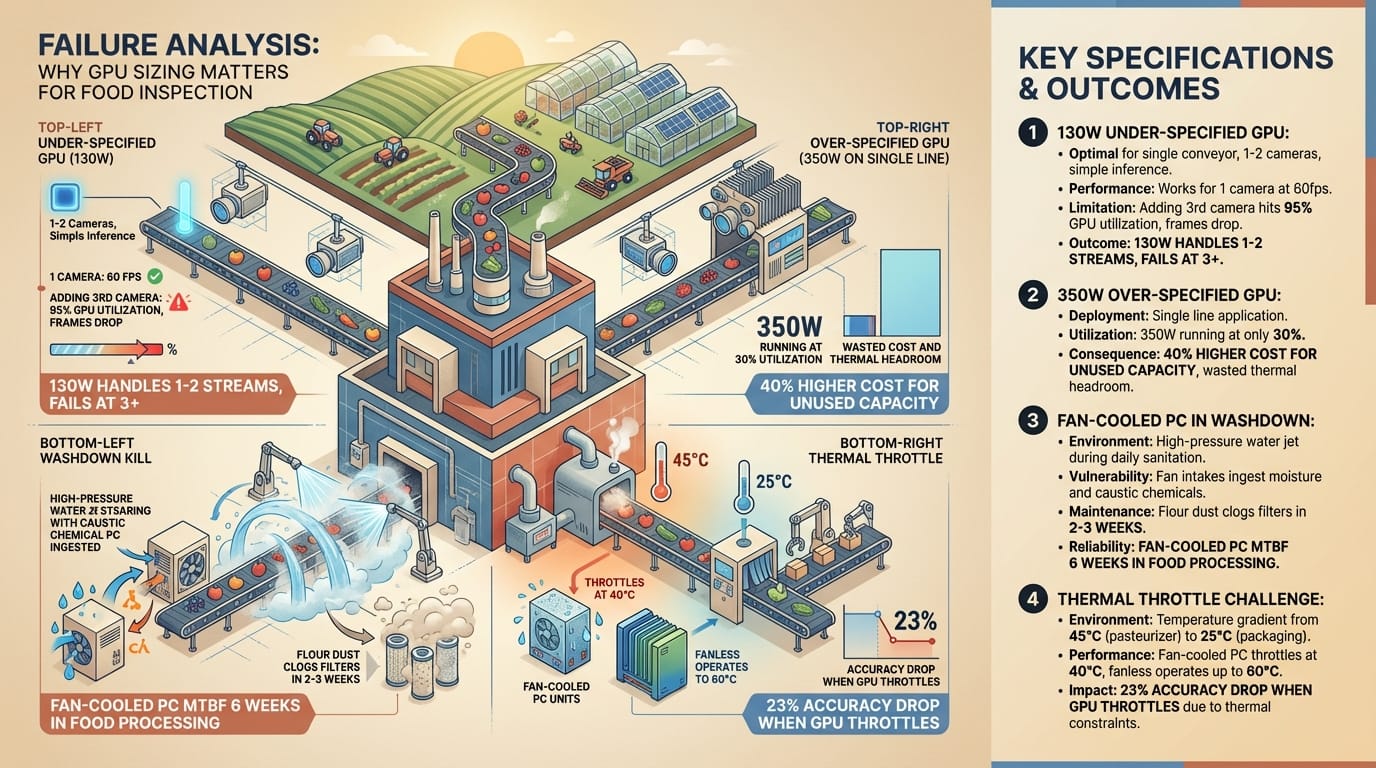
The 130W GPU tier matches single-line inspection workloads where one or two cameras feed a single inference model. A typical deployment: one GigE Vision camera capturing 640×480 frames at 60 fps, running a YOLOv8-medium model for surface defect classification on a produce sorting line. At this resolution and model complexity, an RTX A2000 inside the Nuvo-9160GC delivers consistent sub-15ms inference latency with GPU utilization under 65%.
The 9160GC's smaller footprint (270mm depth) fits inside standard NEMA 4X enclosures mounted adjacent to conveyor frames. Its wider operating temperature ceiling of 60°C provides margin near high-heat zones. For facilities inspecting a single product type on a single line, the 9160GC delivers the required performance at roughly 40% lower system cost and 45% lower power consumption.
When to Choose the Nuvo-10108GC
Multi-line or multi-model inspection requires the 350W tier. Consider a meat processing facility running three inspection stations simultaneously: one for bone fragment detection via X-ray image analysis, one for color grading, and one for package seal integrity. Each station runs a separate model, and the central edge server processes all three streams with different latency requirements.
The Nuvo-10108GC's support for GPUs like the RTX 5080 (52 TFLOPS FP32) enables concurrent multi-model inference without stream prioritization trade-offs. The dual 10GbE ports handle aggregate camera bandwidth exceeding 3 Gbps from multi-camera arrays without frame drops.
| Workload Scenario | Nuvo-9160GC | Nuvo-10108GC | Recommended |
|---|---|---|---|
| Single-line, 1-2 cameras | 12ms, 62% GPU | 12ms, 18% GPU | 9160GC |
| Single-line, dual-model | 28ms, 89% GPU | 14ms, 34% GPU | 9160GC |
| Multi-line, 3+ cameras | Frame drops | 16ms, 71% GPU | 10108GC |
| Ensemble (3 models/frame) | 45ms+, saturated | 19ms, 58% GPU | 10108GC |
Decision Framework
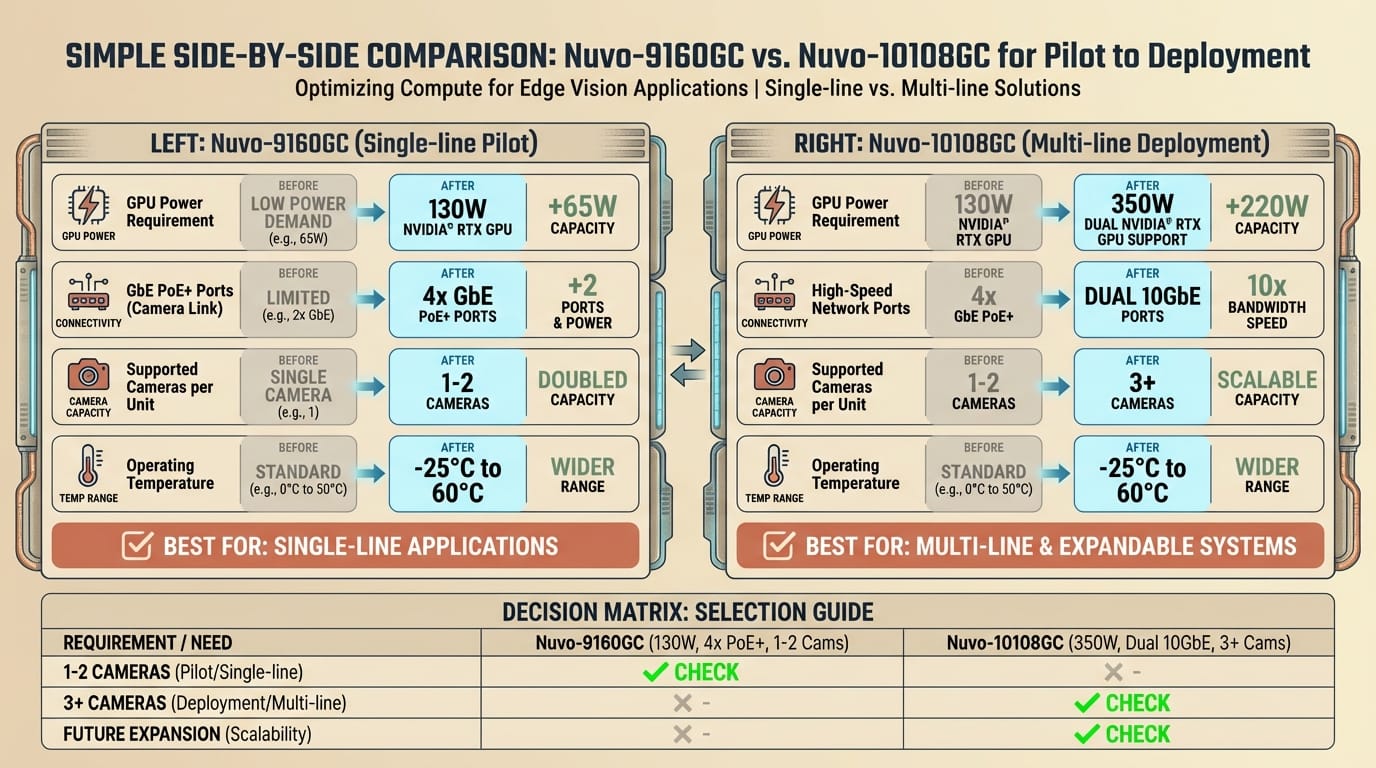
Three factors determine the right platform: stream count, model complexity, and future expansion plans.
Choose the Nuvo-9160GC when: the deployment involves 1–2 camera streams, a single inference model under 50M parameters, operating temperatures may exceed 50°C, and the installation space is limited to compact enclosures. Total system cost including GPU typically runs $3,800–$5,200.
Choose the Nuvo-10108GC when: the deployment involves 3+ camera streams, multiple concurrent models or ensemble inference, 10GbE camera interfaces, or planned expansion to additional inspection stations within 18 months. Total system cost including GPU typically runs $7,500–$11,000.
Related Products
For inspection stations requiring NVIDIA Jetson-based inference at the camera level before aggregation to a central GPU server, the NRU-220 Series provides Jetson Orin edge AI in an IP67 fanless enclosure suited for washdown-zone mounting.
Facilities needing vehicle-mounted inspection for receiving dock quality checks benefit from the Nuvo-11531 Series, which combines Intel Core Ultra 200 with ignition power control for forklift-mounted deployments.
Conclusion
GPU edge AI platform sizing for food processing inspection is a capacity planning exercise, not a performance competition. The Nuvo-9160GC delivers the right performance-per-watt for single-line deployments, while the Nuvo-10108GC handles the multi-stream, multi-model workloads that define modern automated food safety lines.
Request a demo configuration from the Neteon solutions team at [email protected] or visit neteon.net. Connect on LinkedIn for the latest rugged edge computing updates.
FAQs
What GPU models are compatible with the Nuvo-9160GC for food processing inspection?
The Nuvo-9160GC supports GPUs up to 130W TDP, including the NVIDIA RTX A2000 (6GB GDDR6, 3328 CUDA cores) and RTX 4060 (8GB GDDR6, 3072 CUDA cores). These GPUs deliver 12–15 TFLOPS FP32 and 80–120 TOPS INT8 inference, sufficient for single-line inspection workloads running models like YOLOv8 at 640×480 resolution with sub-15ms latency.
Can the Nuvo-10108GC handle washdown environments in food processing plants?
The Nuvo-10108GC uses a fanless sealed enclosure designed for industrial environments. For direct washdown exposure, it should be installed inside a NEMA 4X rated cabinet. The system operates at -25°C to 50°C and tolerates the electrical noise from variable-frequency drives common on food processing conveyor lines.
How many camera streams can each platform handle simultaneously?
The Nuvo-9160GC reliably handles 1–2 GigE Vision camera streams with a single inference model. The Nuvo-10108GC, with its dual 10GbE ports and higher GPU TDP ceiling, supports 3–6 simultaneous camera streams running multiple inference models without frame drops or latency spikes.
What is the cost difference between the two platforms?
Including a compatible GPU, the Nuvo-9160GC system typically costs $3,800–$5,200, while the Nuvo-10108GC runs $7,500–$11,000. The 9160GC also consumes 45% less power (200–280W vs 350–500W total system), which reduces ongoing energy costs for 24/7 food processing operations.
When should a food processing facility choose the higher-tier Nuvo-10108GC over the Nuvo-9160GC?
Choose the Nuvo-10108GC when the deployment involves 3 or more camera streams, requires running multiple concurrent inference models (such as simultaneous defect detection, color grading, and foreign object detection), needs 10GbE camera interfaces for high-resolution multi-camera arrays, or has expansion plans to add inspection stations within 18 months.