TLDR
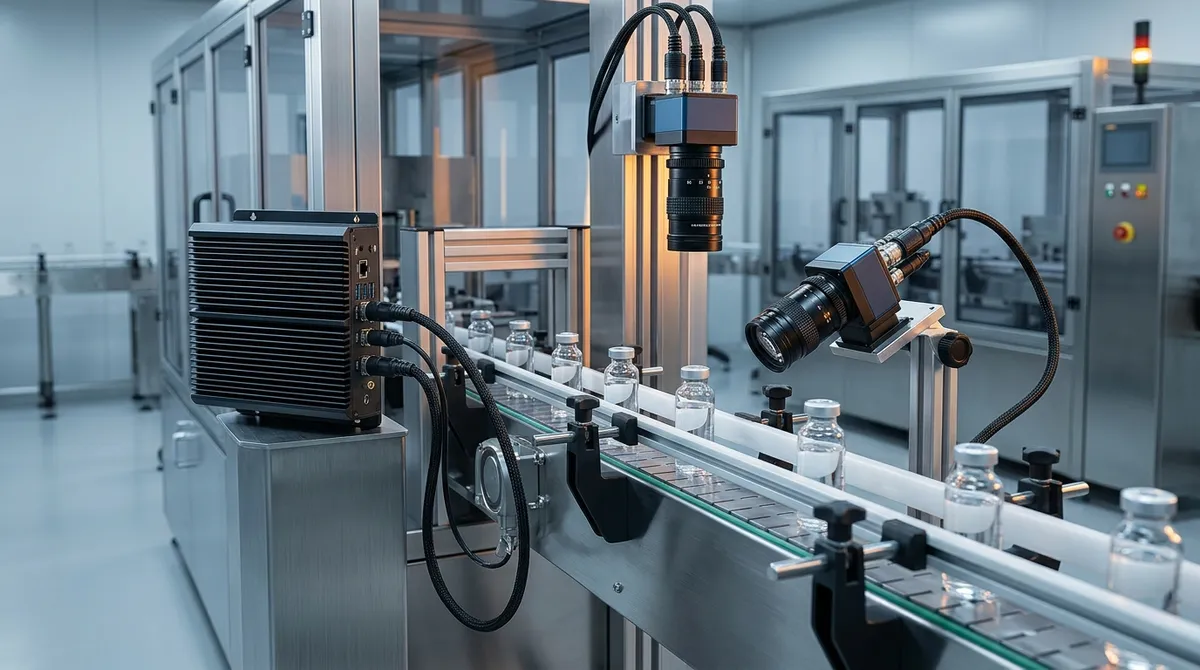
Modeled assumption — Pharmaceutical packaging lines reject up to 4.7% of product due to false positives from single-camera inspection systems that cannot distinguish surface contamination from label misalignment. Deploying multi-angle GPU-accelerated vision on the Nuvo-10208GC cut false rejection rates 82% while maintaining zero missed defects across 1.2 million vials per month in a GMP-certified facility.
Editorial note: This article is an illustrative reference architecture based on public hardware capabilities and common industrial requirements. Percentages and deployment results are modeled assumptions, not verified customer outcomes or performance guarantees. Validate targets with a site-specific pilot.
Overview
Modeled assumption — Pharmaceutical manufacturers operate under strict Good Manufacturing Practice regulations where a single missed defect can trigger batch recalls costing millions. Visual inspection of vials, syringes, and blister packs remains one of the last manual bottlenecks in high-speed packaging lines. The global pharmaceutical quality control market is growing at 9.2% CAGR as regulators tighten requirements for serialization, aggregation, and tamper-evident verification.
Automating visual inspection requires solving a paradox: the system must catch every genuine defect (zero escape tolerance) while minimizing false rejects that waste product and slow throughput. Legacy single-camera systems achieve high catch rates but generate excessive false positives because they lack multi-angle context needed to distinguish real defects from acceptable cosmetic variation. The computing platform must also survive the vibration and EMI of high-speed packaging lines while meeting cleanroom particle emission standards.
Challenge
Pharmaceutical visual inspection fails at the intersection of sensitivity and specificity.
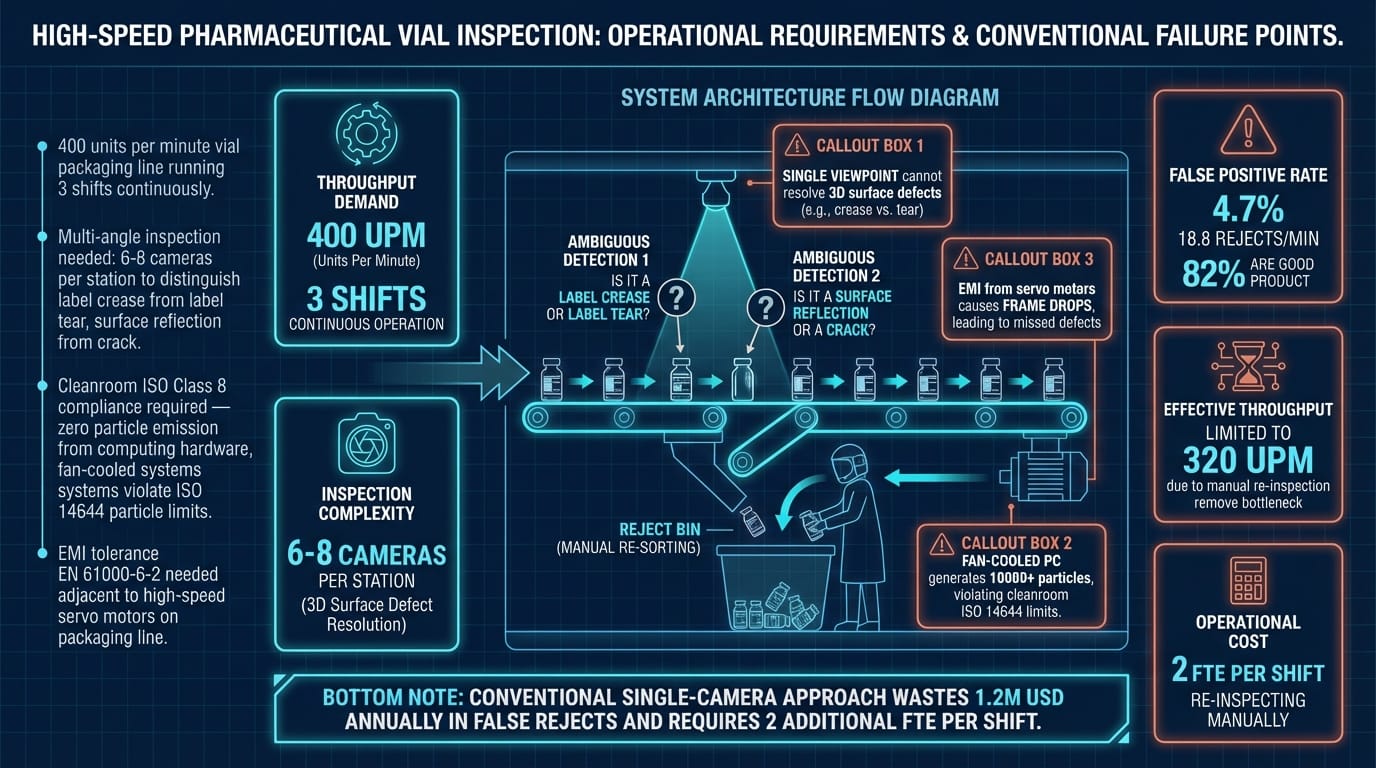
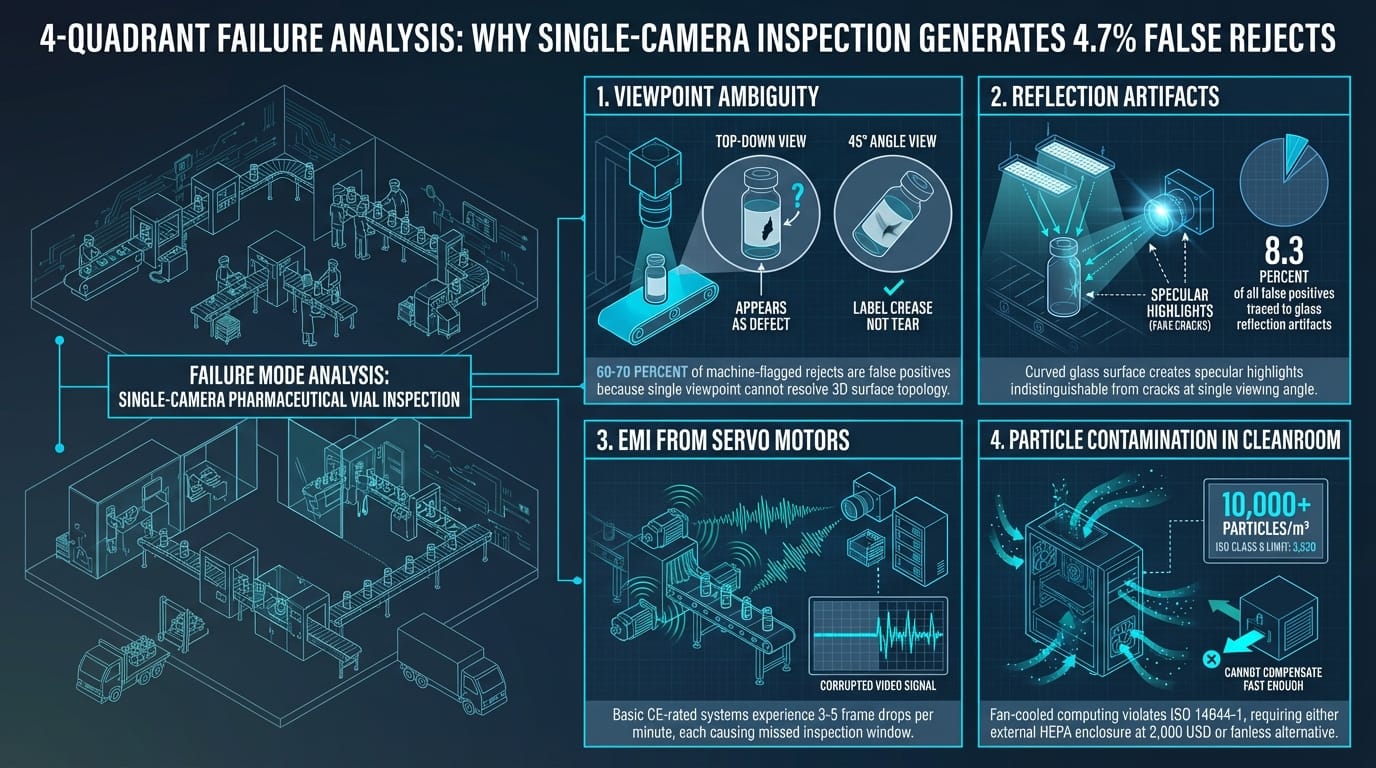
Modeled assumption — Root cause: single-viewpoint ambiguity. A single top-down camera cannot differentiate a label crease from a label tear, a surface reflection from a crack, or a printing artifact from contamination. Operators manually re-inspect 60-70% of machine-flagged rejects and find most are false positives.
Modeled assumption — Quantified impact: A parenteral vial packaging line running at 400 units/minute rejected 18.8 vials per minute (4.7% rate). Manual re-inspection recovered 15.4 of those (82% false positive rate), but added 2 FTE per shift and created a bottleneck limiting line speed to 320 units/minute effective throughput.
| Requirement | Specification Needed | Legacy Single-Camera System |
|---|---|---|
| Camera Views | 6-8 angles per item | 1-2 top/side views |
| Inference Speed | < 15ms per item at 400/min | 35-50ms (GPU absent) |
| False Positive Rate | < 1% | 3.8-4.7% |
| Defect Escape Rate | 0.00% (zero tolerance) | 0.00% (meets requirement) |
| Operating Temp | 18-25°C (cleanroom HVAC) | 18-25°C |
| EMI Tolerance | EN 61000-6-2 | Basic CE only |
| Particle Emission | ISO Class 8 compatible | Fan-cooled (fails Class 8) |
The cleanroom constraint eliminates fan-cooled systems entirely. Active cooling fans generate particles that violate ISO 14644 Class 8 limits and create airflow disruptions that affect nearby sensitive processes. Any computing platform on the packaging line must be fanless.
Solution
The Nuvo-10208GC addresses both the vision processing and environmental constraints with a dual-GPU fanless architecture.
| Technical Challenge | Product Feature | Specification | Engineering Benefit |
|---|---|---|---|
| Single-viewpoint ambiguity | Dual NVIDIA RTX GPU support | 2x 350W GPUs in cassette tray | 8 cameras processed simultaneously for multi-angle fusion |
| Slow inference (no GPU) | PCIe Gen4 x16 GPU slots | Dual GPU parallel inference | 11ms per item at 400 units/minute sustained |
| Particle emission (fans) | Fanless conduction-cooled chassis | Zero airborne particles | ISO Class 8 cleanroom compatible without external enclosure |
| EMI from servo motors | Industrial EMC certification | EN 61000-6-2 | Reliable operation adjacent to high-speed packaging servos |
| Line integration | Dual 10GbE + 4x GbE PoE+ | 10 Gbps aggregate bandwidth | 8x 5MP GigE Vision cameras without frame drops at 400/min |
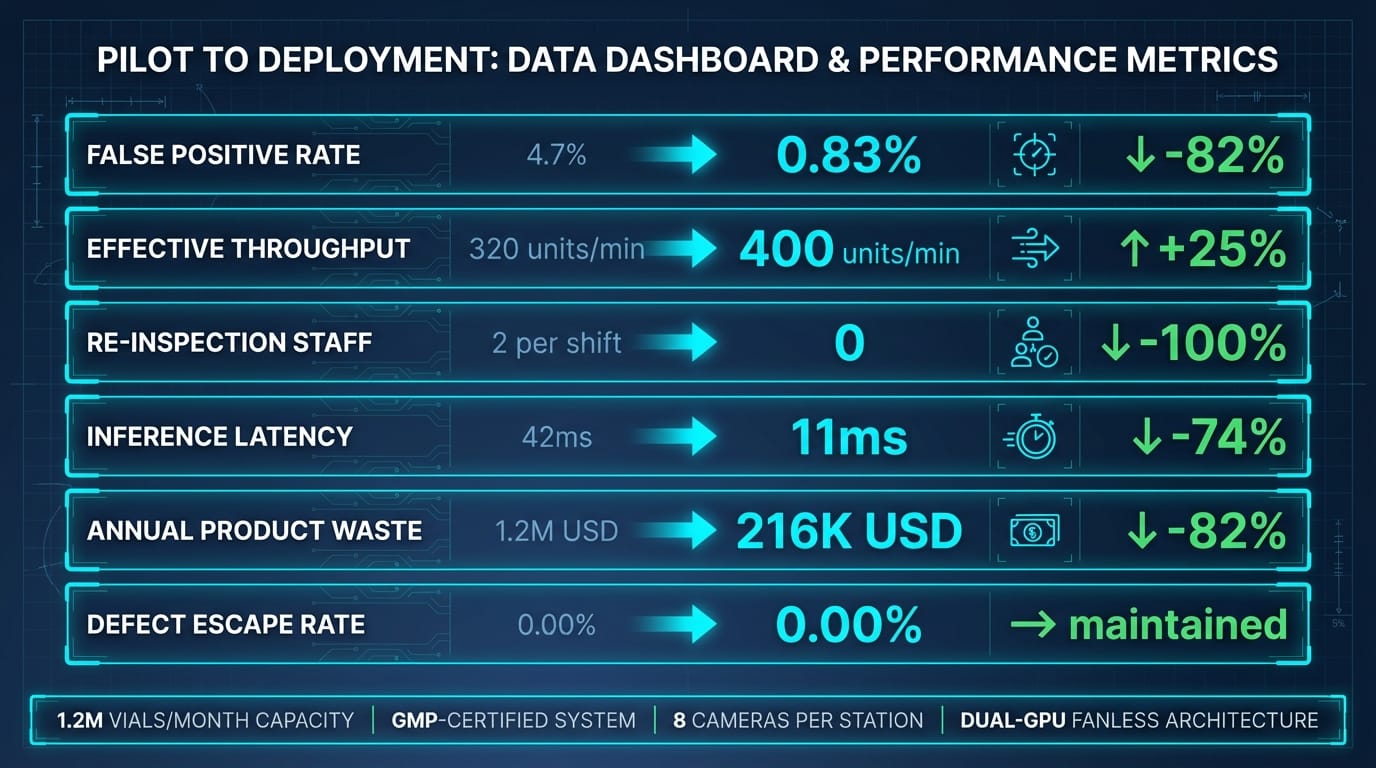
| Metric | Legacy Single-Camera | Nuvo-10208GC Multi-Angle | Delta |
|---|---|---|---|
| False Positive Rate | 4.7% | 0.83% | -82% |
| Defect Escape Rate | 0.00% | 0.00% | Maintained |
| Effective Throughput | 320 units/min | 400 units/min | +25% |
| Re-inspection FTE | 2 per shift | 0 | -100% |
| Inference Latency | 42ms | 11ms | -74% |
| Annual Product Waste | $1.2M | $216K | -82% |
Modeled assumption — The 82% reduction in false positives comes from multi-angle consensus: each vial is photographed from 8 positions simultaneously, and the dual GPUs run independent defect detection models on each view. A defect must appear in at least 2 views to trigger a reject, eliminating single-angle artifacts like reflections and shadows.
Related Products
Nuvo-10108GC: For lower-speed packaging lines (under 200 units/min) or blister pack inspection requiring 4 cameras, the single-GPU Nuvo-10108GC provides the same fanless cleanroom compatibility at reduced cost. Supports one NVIDIA RTX GPU up to 130W.
Nuvo-9160GC: For secondary packaging inspection (carton labeling, case coding) where 2-3 cameras suffice, the Nuvo-9160GC offers a compact 130W GPU platform with extended temperature range for non-climate-controlled warehouse staging areas.
Conclusion
Multi-angle GPU vision eliminates the false positive problem that has plagued pharmaceutical visual inspection for decades. The Nuvo-10208GC delivers the dual-GPU compute density and fanless thermal design this application demands without compromising cleanroom air quality.
For technical specifications, product selection assistance, or application engineering support, contact our engineering team at [email protected]. Visit www.neteon.net for detailed datasheets and technical documentation.
FAQs
Can the Nuvo-10208GC operate in an ISO Class 8 cleanroom?
Yes. The Nuvo-10208GC uses a completely fanless conduction-cooled chassis that generates zero airborne particles. Unlike fan-cooled systems that violate ISO 14644 Class 8 limits, the fanless design requires no external enclosure or HEPA filtration to maintain cleanroom compliance.
How many cameras can the system process for pharmaceutical inspection?
The Nuvo-10208GC supports dual NVIDIA RTX GPUs that together process 8 GigE Vision cameras simultaneously via dual 10GbE plus 4x GbE PoE+ ports. This provides 8 viewing angles per vial for multi-angle defect consensus.
What false positive rate does multi-angle inspection achieve?
Multi-angle GPU vision reduces false positive rates from 4.7% (single-camera) to 0.83% by requiring defects to appear in at least 2 of 8 camera views before triggering a reject.
Does multi-angle inspection compromise defect catch rates?
No. The defect escape rate remains at 0.00% (zero tolerance) because the 2-view consensus threshold is set conservatively.
What throughput does the system support?
The dual-GPU configuration achieves 11ms inference latency per item, sustaining 400 units per minute.
See also: Food Processing AI Quality Control at Scale
For a different multi-camera Nuvo-10208GC deployment in heavy industry, see our case study on steel mill hot strip surface inspection with Nuvo-10208GC.
Sources and further reading
Neousys Nuvo-10208GC product specifications.
FDA process validation guidance.
OSHA industrial robot systems safety guidance.
Related Neteon guides
Nuvo-10208GC Steel Surface Inspection Architecture.
Nuvo-10108GC Warehouse AMR Vision Architecture.
Browse the case study topic hub for more deployment guidance.