

TLDR
Private 5G networks eliminate the latency and reliability barriers that have kept AI inference tethered to centralized servers in industrial environments. By 2030, over 60% of new factory edge AI deployments will run on private 5G backhaul, cutting data-to-decision cycles from 30–50ms to under 2ms and enabling real-time machine vision, autonomous vehicle coordination, and predictive maintenance at scale.
Overview
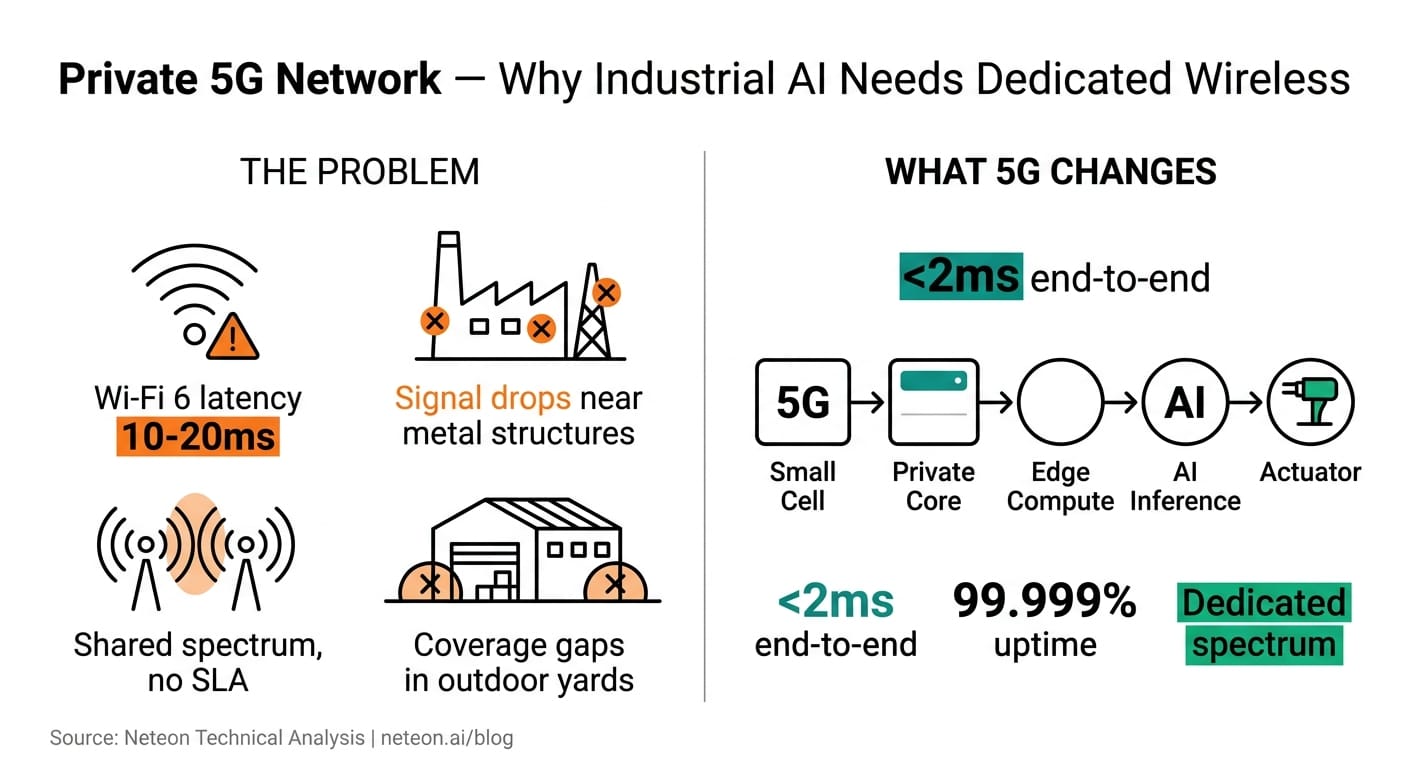
Industrial facilities generated an estimated 3.8 exabytes of machine data daily in 2025, yet the vast majority traveled to cloud servers for processing — introducing latency that made real-time AI-driven decision-making impractical for time-critical operations. Wi-Fi 6 addressed some connectivity gaps, but its shared spectrum, variable latency, and limited range in RF-hostile factory environments left critical applications underserved.
Private 5G changes this equation fundamentally. Dedicated spectrum, deterministic latency under 5ms, and native support for massive device density give industrial operators the network fabric needed to push AI inference directly to the production floor, the wellhead, and the warehouse aisle. The convergence of private 5G infrastructure with ruggedized edge AI compute platforms is reshaping how facilities architect their operational technology stacks.
Key Trends
Deterministic Low-Latency Networks Replace Best-Effort Wi-Fi
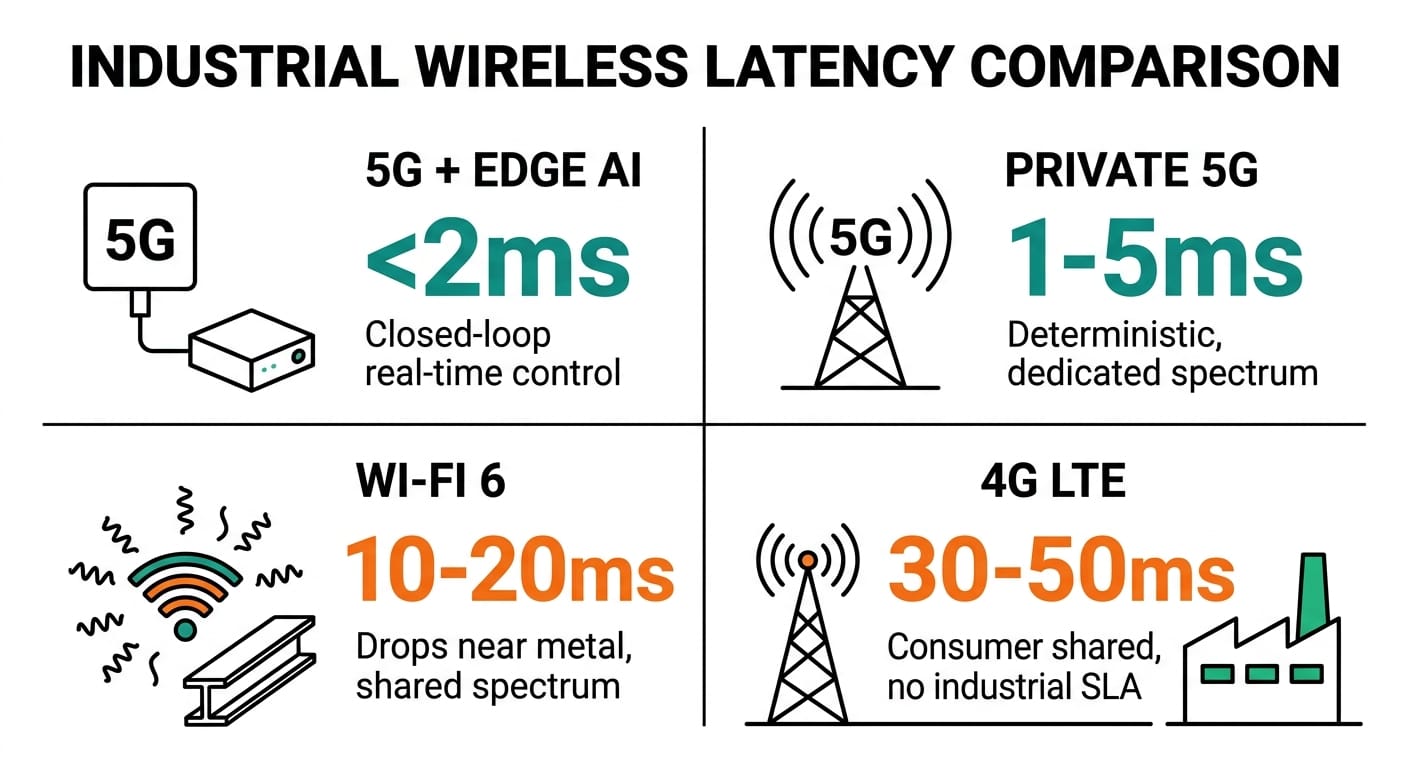
Private 5G delivers 1–5ms end-to-end latency with 99.999% reliability — a step change from Wi-Fi 6's 10–20ms average with periodic dropouts in metal-dense environments. For machine vision systems running defect detection at line speed, this difference determines whether a flawed product gets caught or shipped. Facilities deploying 5G-connected edge AI report inference-to-actuator response times under 2ms, enabling closed-loop quality control that Wi-Fi architectures cannot support.
Edge Compute Moves into Telecom Cabinets
As private 5G base stations proliferate across industrial campuses, edge AI compute hardware increasingly co-locates with radio equipment in outdoor cabinets, rooftop enclosures, and pole-mounted housings. This placement demands compact, fanless systems that tolerate -25°C to 70°C operating ranges, wide-voltage DC input from mixed power sources, and PoE capability to power co-located sensors. Intel Core Ultra 200-based platforms like the Nuvo-11531 Series deliver the integrated NPU, compact footprint, and ruggedized I/O required for these deployments.
Multi-Access Edge Computing Bridges IT and OT
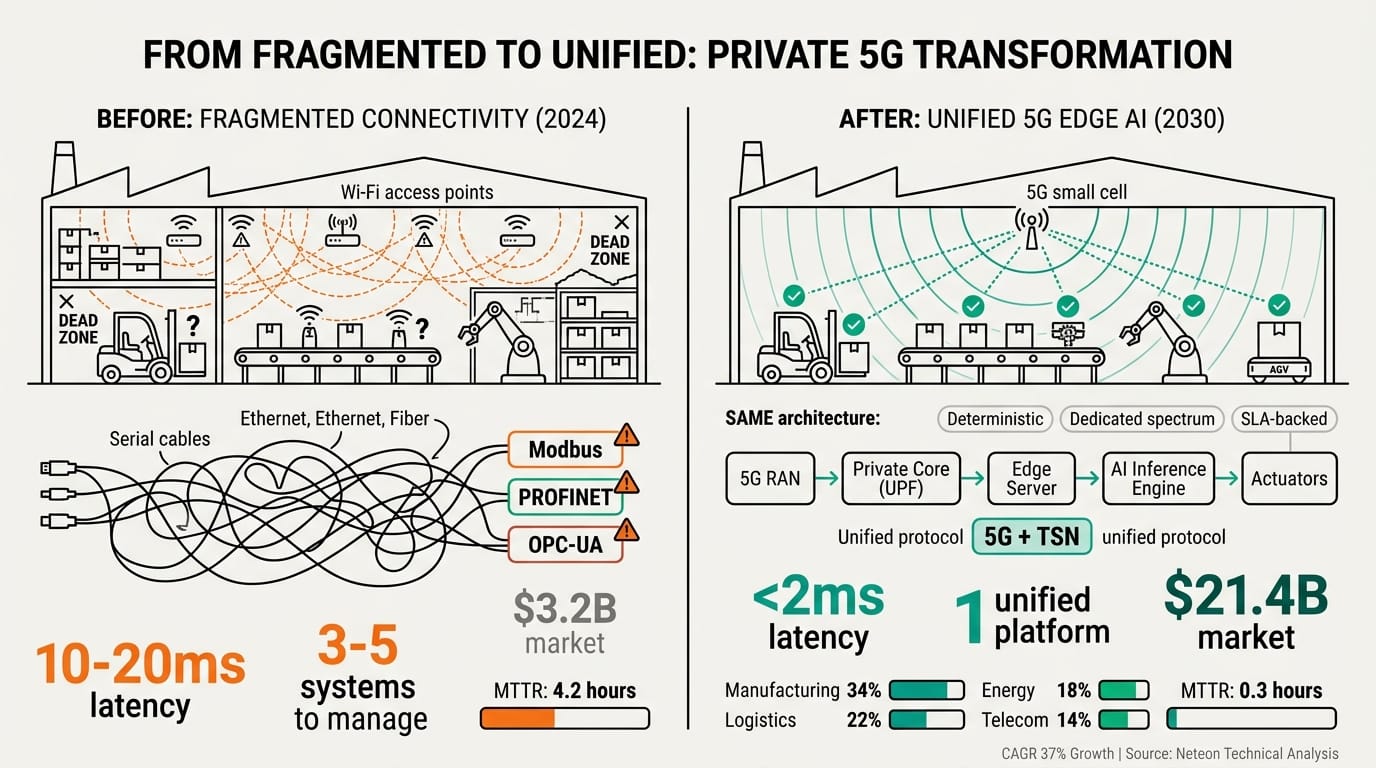
Private 5G eliminates the air gap between information technology and operational technology networks by providing a single, secure transport layer for both enterprise data and real-time control traffic. Edge AI nodes sitting at the 5G network boundary aggregate sensor feeds from programmable logic controllers, machine vision cameras, and autonomous mobile robots over a unified backhaul — replacing the patchwork of Ethernet, serial, and Wi-Fi links that created data silos in legacy architectures.
Autonomous Vehicle Fleets Scale Beyond Wi-Fi Limits
Indoor autonomous mobile robots (AMRs) and outdoor autonomous guided vehicles (AGVs) in warehouses, ports, and mining sites face handoff failures and dead zones with Wi-Fi mesh networks. Private 5G provides seamless mobility across campus-scale facilities with deterministic handoffs under 0ms packet loss. GPU-accelerated edge computers like the Nuvo-10108GC process 3D LiDAR and multi-camera feeds at the network edge, enabling fleet-level path planning that scales from 50 to 500+ vehicles.
Impact on Edge Computing Hardware
The private 5G buildout creates specific hardware requirements that distinguish 5G-edge deployments from traditional factory automation. Edge AI systems must support 2.5GbE or 10GbE interfaces to match 5G backhaul throughput. They need ignition power control and wide-range DC input (8–35V) for deployment in outdoor telecom enclosures with battery-backed power. PoE output enables direct powering of 5G small cells, IP cameras, and environmental sensors from a single platform. And integrated NPU or GPU acceleration must process AI inference locally without cloud round-trips.
| Requirement | Why It Matters for 5G Edge | Neousys Solution |
|---|---|---|
| 2.5GbE / 10GbE | Match 5G backhaul throughput | Nuvo-11531 (optional 10GbE) |
| PoE+ Output (6 ports) | Power 5G small cells and IP cameras | Nuvo-11531-PoE |
| -25°C to 70°C Operation | Outdoor telecom cabinet survival | All Nuvo-11531 variants |
| Ignition Power Control | Battery-backed power management | Nuvo-11531-IGN |
| Integrated NPU | Local AI inference without GPU cost | Intel Core Ultra 200 NPU |
| Compact Form Factor | Fit standard telecom enclosures | Nuvo-11531 (ultra-compact) |
The Nuvo-11531 Series addresses these requirements with Intel Core Ultra 200 processors featuring integrated NPU, up to 6 PoE+ ports, optional 10GbE, ignition power control, and a compact form factor that fits standard telecom outdoor cabinets. For GPU-intensive applications like multi-camera analytics at distribution centers, the Nuvo-9160GC supports 130W discrete GPUs in a fanless chassis rated for extended temperature operation.
What to Watch
Three developments between 2026 and 2030 will determine the pace of private 5G edge AI adoption. First, 3GPP Release 18 and 19 enhancements to URLLC (Ultra-Reliable Low-Latency Communication) will push guaranteed latency below 1ms, opening new classes of real-time robotic control. Second, the convergence of AI inference chips with 5G modem modules on a single SoC will reduce edge node size and power consumption, enabling deployment in increasingly constrained locations. Third, regulatory expansion of CBRS and shared spectrum bands in the US, EU, and Asia-Pacific will lower the cost barrier for mid-size manufacturers to deploy private 5G without carrier dependency.
Conclusion
Private 5G networks are not replacing edge AI — they are removing the last infrastructure barrier to deploying it at industrial scale. Facilities that architect their 5G rollouts with ruggedized, NPU-equipped edge compute at every network boundary will capture the real-time decision-making advantage that separates next-generation operations from legacy automation.
To evaluate compact edge AI platforms for 5G-connected industrial deployments, contact the Neteon solutions team at [email protected] or visit neteon.net. Connect on LinkedIn for the latest edge computing updates.
FAQs
What latency does private 5G achieve compared to Wi-Fi 6 in industrial environments?
Private 5G delivers 1–5ms end-to-end latency with 99.999% reliability in RF-hostile factory environments. Wi-Fi 6 averages 10–20ms with periodic dropouts near metal structures. When paired with edge AI compute, 5G-connected systems achieve inference-to-actuator response times under 2ms, enabling closed-loop quality control and real-time robotic coordination that Wi-Fi cannot reliably support.
What edge computing hardware specifications matter for private 5G deployments?
Private 5G edge nodes require 2.5GbE or 10GbE interfaces to match backhaul throughput, wide-range DC input (8–35V) for outdoor power sources, PoE output to power co-located 5G small cells and sensors, extended temperature operation (-25°C to 70°C) for outdoor cabinets, and integrated NPU or GPU for local AI inference. The Neousys Nuvo-11531 Series addresses all of these in a compact fanless form factor.
How does private 5G differ from public 5G for industrial edge AI?
Private 5G operates on dedicated spectrum (CBRS or licensed bands) controlled by the facility operator, providing guaranteed bandwidth, deterministic latency, and complete data sovereignty. Public 5G shares spectrum with consumer traffic, cannot guarantee latency below 10ms, and routes data through carrier networks. For real-time AI inference in manufacturing and logistics, private 5G is the only viable option.
Which industries will adopt private 5G edge AI fastest by 2030?
Manufacturing leads at approximately 34% of deployments, driven by real-time quality inspection and predictive maintenance. Logistics and warehousing follow at 22%, using 5G-connected AMR fleets. Energy and utilities represent 18%, deploying remote monitoring at wells, substations, and pipelines. Telecom infrastructure accounts for 14%, using edge AI for network optimization and predictive maintenance of cell sites.
Can existing industrial edge AI systems be upgraded for private 5G connectivity?
Yes. Ruggedized edge computers with available PCIe or M.2 slots can add 5G connectivity through modular modem cards. The Nuvo-11531 supports M.2 expansion for 5G modules alongside its native Ethernet ports. However, systems deployed before the 5G buildout may lack the 2.5GbE/10GbE interfaces and PoE output needed to fully leverage 5G backhaul speeds and power co-located small cells.