TLDR
Railway and transit deployments demand edge AI computers that survive constant mechanical shock, operate across extreme temperature swings, and keep running through power surges at engine start. This guide covers the eight selection criteria engineers use to spec onboard and trackside computers — with a comparison table and decision matrix to match the right platform to your use case.
For the wider context, see our complete guide to edge AI in transportation and vehicles.
Overview
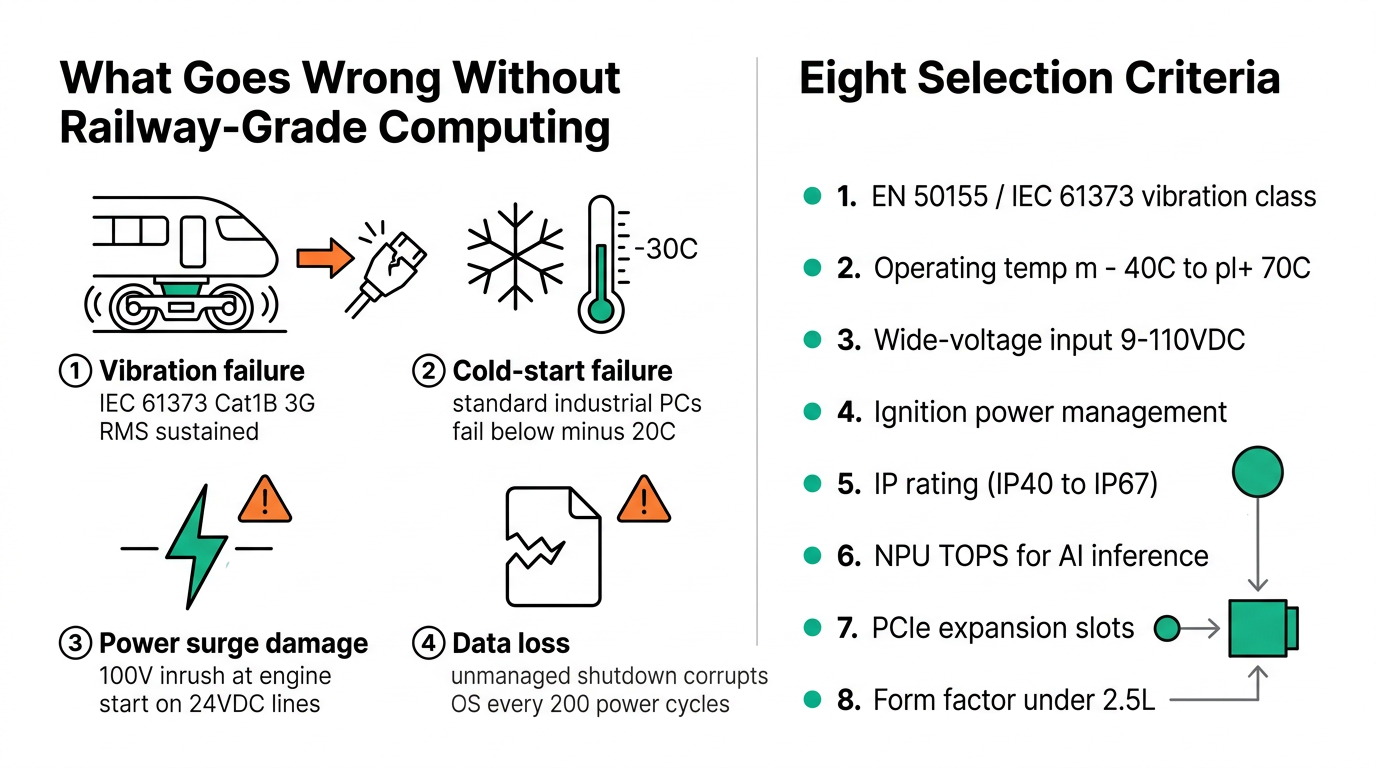
Rolling stock, trackside sensing, and station automation all run mission-critical software that cannot tolerate unplanned reboots. Yet railway environments subject computing hardware to conditions that would degrade a standard industrial PC within months: vibration profiles exceeding 1G RMS, temperature ranges from -25°C to +70°C, and voltage spikes to 100V on 24VDC lines at engine start.
The market has shifted toward AI-augmented operations — real-time passenger counting, automated door-fault detection, predictive track maintenance, and driver assistance systems. These tasks demand CPU/GPU resources well beyond what traditional embedded controllers provided, while still meeting EN 50155, IEC 60945, and MIL-STD-810G ruggedness standards.
This guide helps procurement engineers and system integrators evaluate edge AI platforms for three main railway deployment scenarios: onboard passenger vehicle systems, trackside monitoring, and depot/station edge nodes. Related reading: POC-700 Cuts Fleet Computing Footprint 62% in Urban Transit and NVH & Vibration Design Guide for Vehicle-Mounted Edge Computing.
Key Selection Criteria
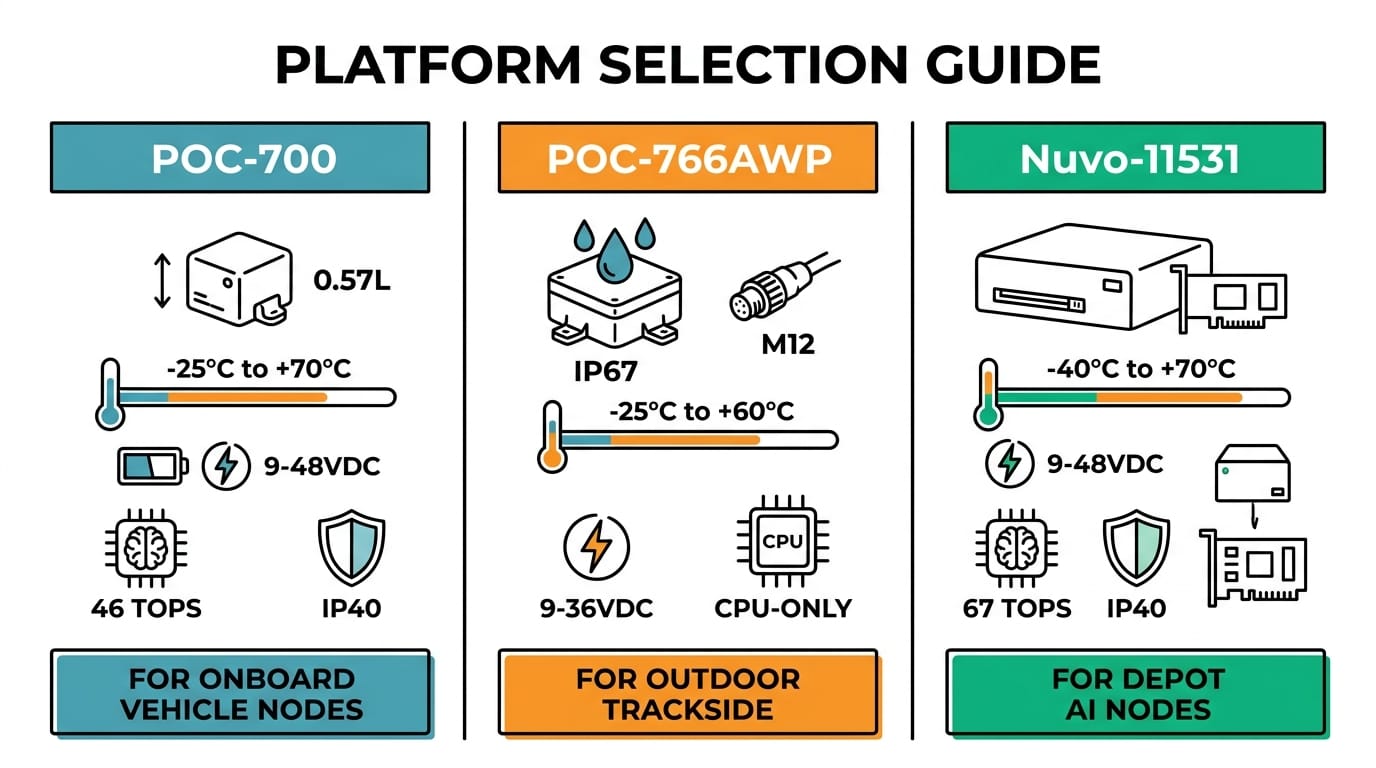
Eight criteria determine suitability for railway deployments. The table below scores three Neousys platforms against each criterion.
| Criterion | POC-700 | POC-766AWP | Nuvo-11531 |
|---|---|---|---|
| EN 50155 vibration (IEC 61373 Cat 1B) | 3G RMS SSD, M.2 screwlock | 3G RMS SSD, M.2 screwlock | 5G RMS SSD, anti-vibration mounts |
| Operating temperature | -25°C to 70°C | -25°C to 60°C | -40°C to 70°C |
| Wide-voltage input | 9–48VDC (ignition lock) | 9–36VDC | 9–48VDC (ignition lock) |
| Ingress protection | IP40 chassis | IP67 full enclosure | IP40 chassis |
| Compute platform | Intel Core Ultra 100 | Intel Core i3-N305 | Intel Core Ultra 200 |
| GPU/NPU for AI inference | Intel Arc GPU (46 TOPS) | None (CPU-only) | Intel Arc GPU (67 TOPS) |
| Expansion (PCIe / M.2) | 1x M.2 2280 only | 1x M.2 2280 only | 2x PCIe x4, 3x M.2 |
| Form factor | 0.57L ultra-compact | 0.43L sealed | 2.5L desktop/rack |
Decision Matrix
Match your deployment scenario to the recommended platform using the matrix below.
| Deployment Scenario | Recommended Platform | Rationale |
|---|---|---|
| Onboard passenger vehicle — AI-based door/seat analytics | Nuvo-11531 | Highest NPU TOPS (67), broadest expansion for multi-camera capture cards, -40°C cold start |
| Onboard vehicle — basic telemetry + diagnostics logging | POC-700 | Sub-0.6L, ignition-locked power, EN 50155 temperature range, lower cost per node |
| Trackside outdoor IP67 sensing (no enclosure) | POC-766AWP | IP67 sealed, M12 waterproof connectors, compact for pole-mount, -25°C capable |
| Depot/station edge node — heavy AI workload | Nuvo-11531 | PCIe expansion for capture cards or 10GbE, Core Ultra 200 handles concurrent streams |
| Retrofit into existing driver cab (space less than 0.5L) | POC-766AWP or POC-700 | Both fit sub-1L enclosures; POC-766AWP adds IP67 for exposed mounting positions |
Common Pitfalls
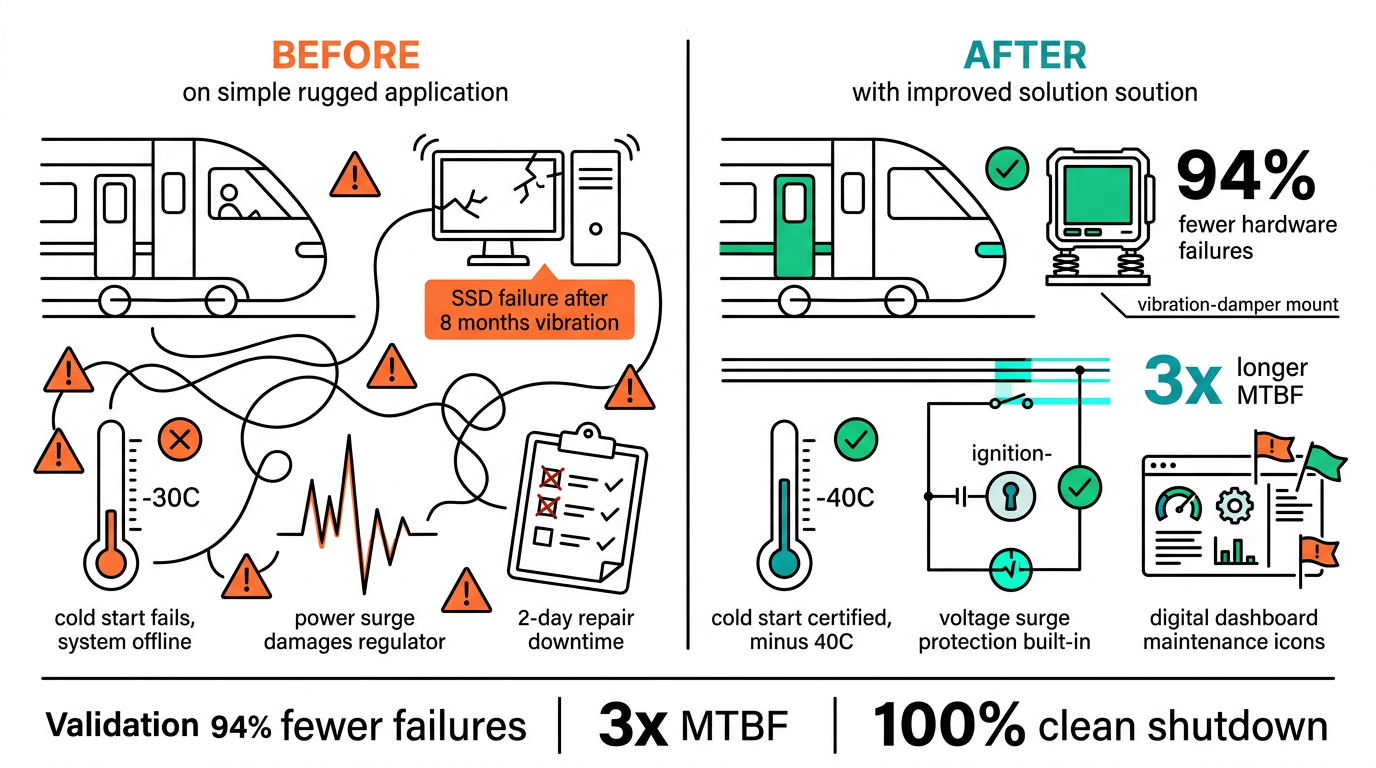
1. Underspecifying vibration tolerance. EN 50155 requires compliance with IEC 61373 Category 1B for bogie-mounted hardware and Category 2 for car-body installations. Using a standard industrial PC without a locked M.2 SSD or shock-mounted HDD leads to NVMe connector wear and data corruption within 6–18 months of operation. All three platforms above use screwlocked M.2 SSDs.
2. Ignoring cold-soak startup. A DMU parked outdoors overnight at -30°C needs a computer that powers up reliably and reaches full operating temp within spec. Standard industrial ranges start at -20°C; the Nuvo-11531 extends to -40°C for arctic or high-altitude routes. See also: Fanless vs Fan-Cooled Industrial PCs for thermal design tradeoffs.
3. Skipping ignition power management. Train auxiliary power lines experience inrush spikes at engine start. The POC-700 and Nuvo-11531 include software-configurable ignition lock with programmable delay and delayed off — preventing both startup transient damage and mid-shutdown data loss when the vehicle powers down.
4. Treating IP rating as a binary checkbox. IP67 is relevant for exposed trackside enclosures but adds cost and volume penalties onboard where a sealed IP40 chassis inside a proper ATC cabinet is sufficient. Match IP requirement to actual installation environment, not a blanket spec.
5. Ignoring thermal budget at system level. Fanless designs dissipate heat through chassis walls. Confirm that the mounting surface (vehicle wall, rack, cabinet door) provides adequate thermal mass and ambient airflow. A fanless computer mounted to a foam-insulated composite wall will throttle; the same unit on a metal backplate will not.
For the deeper standards-stack view of what auditors actually require on rolling stock, see our EN 50155 compliance guide for railway edge AI.
Conclusion
Railway and transit edge AI procurement comes down to three dimensions: ruggedness (vibration, temperature, IP rating), compute density (NPU TOPS for AI, PCIe lanes for expansion), and power management (wide-voltage input, ignition lock). The POC-700 is the correct choice for space-constrained onboard telemetry nodes. The POC-766AWP covers trackside installations where IP67 sealing is non-negotiable. The Nuvo-11531 handles multi-camera AI workloads where compute performance and expansion take priority.
For application-specific sizing and compliance documentation, follow Neteon on LinkedIn or contact www.neteon.net / [email protected].
FAQs
What EN 50155 compliance does the POC-700 meet?
The POC-700 meets EN 50155 temperature class OT4 (-25 to +70 degrees C) and vibration class 2 per IEC 61373 Category 2 (car-body mounted). For IEC 61373 Category 1B (bogie-mounted), the Nuvo-11531 anti-vibration mounts provide additional margin.
Can POC-766AWP handle outdoor trackside installations without an enclosure?
Yes. The POC-766AWP is IP67 rated and uses M12 circular connectors, making it suitable for pole-mount or undercarriage installations without an additional weather enclosure. Operating temperature range is -25 to +60 degrees C.
Does the POC-700 support 72VDC or 110VDC train battery systems?
The POC-700 standard input range is 9 to 48VDC. For 72V or 110VDC vehicle power systems, an external DC/DC converter (isolated, EN 50155 compliant) must be used to step down to the POC-700 input range.
What is ignition lock and why does it matter for railway applications?
Ignition lock delays system boot until the vehicle electrical system has stabilized after engine start, and delays shutdown to allow the OS to complete a clean write cycle before power drops. This prevents data corruption and extends SSD lifespan in applications where power cycling is frequent and uncontrolled.
How do I compare NPU TOPS between the POC-700 and Nuvo-11531?
The POC-700 (Intel Core Ultra 100 Series) provides approximately 46 TOPS via the integrated Arc GPU + NPU. The Nuvo-11531 (Intel Core Ultra 200 Series) delivers 67 TOPS. For concurrent multi-camera inference (4+ streams at 30fps), 67 TOPS provides headroom without frame drops.
Related reading: onboard pantograph monitoring on the rail-certified DX-1300.
Sources and further reading
Federal Railroad Administration safety resources.
Neousys rugged computer product catalog.
Related Neteon guides
Custom vs Off-the-Shelf Industrial PCs.
EN 50155 Guide for Railway Edge AI.
Browse the buyers guide topic hub for more deployment guidance.