TL;DR
Fanless industrial PCs eliminate moving parts to maximize reliability in dusty, vibration-heavy environments, while fan-cooled systems handle higher thermal loads from GPUs and multi-core processors. This comparison examines where each cooling architecture fits based on TDP limits, ambient temperature ranges, and deployment conditions across manufacturing, energy, and transportation applications.
Overview
Selecting cooling architecture for an edge computing deployment is an engineering constraint, not a preference. The decision affects mean time between failures (MTBF), acoustic output, ingress protection ratings, and maximum sustained compute performance. Engineers working in pharmaceutical clean rooms, offshore energy platforms, and vehicle-mounted fleet systems face different tradeoffs. This guide provides a structured comparison between fanless and fan-cooled industrial PCs using Neousys platforms as reference designs.
Head-to-Head Specifications
| Parameter | Fanless (Nuvo-11000) | Fan-Cooled (Nuvo-9160GC) |
|---|---|---|
| CPU Support | Intel Core Ultra 200 (up to 35W TDP) | Intel 12th/13th Gen (up to 65W TDP) |
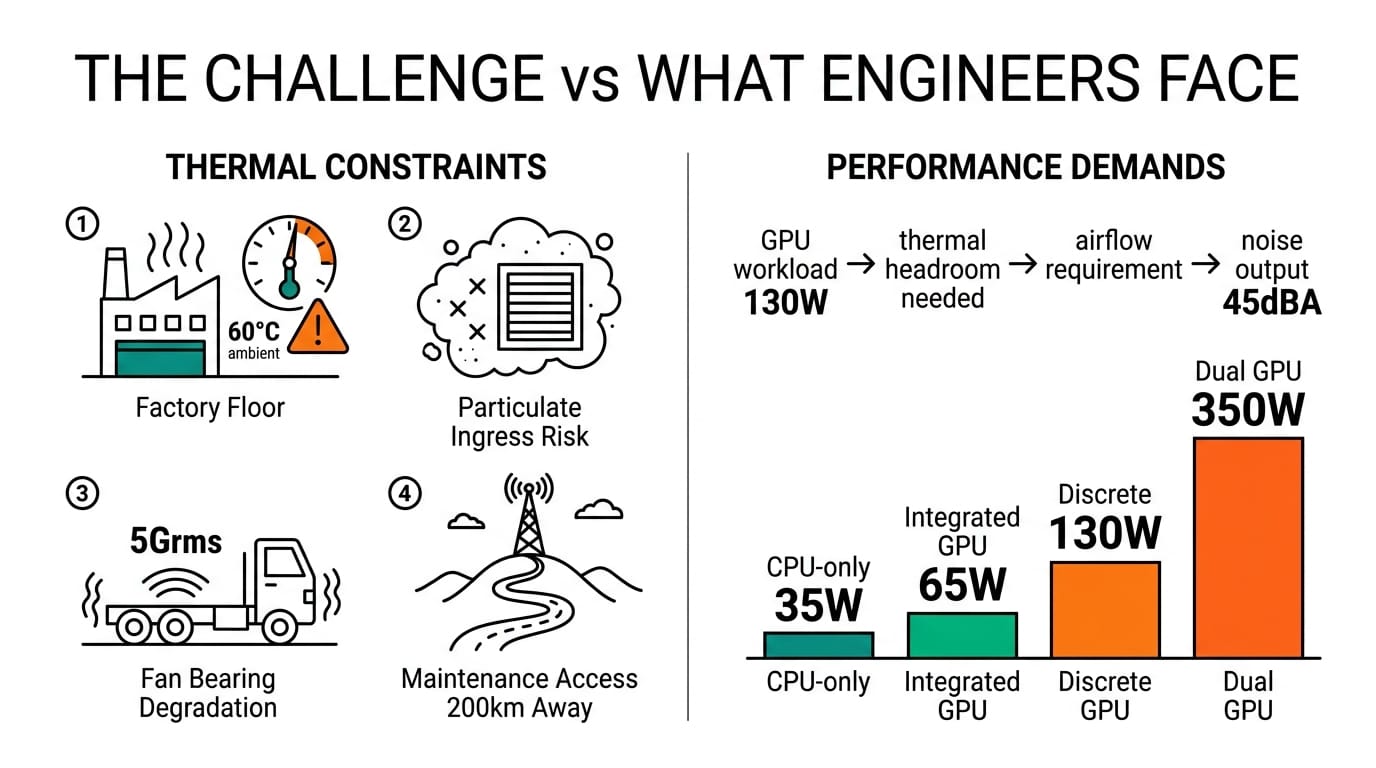
| GPU Support | Integrated Intel Arc GPU | Discrete GPU up to 130W (RTX A2000–class) |
| Max System TDP | ~65W | ~200W+ |
| Operating Temp | -25°C to 60°C | -25°C to 60°C (with fan assist) |
| Cooling Method | Passive heatsink, conduction chassis | Active fan + heatsink fins |
| Ingress Protection | Dust-tight enclosure capable | Ventilated chassis (IP20 typical) |
| MTBF Impact | No fan bearing wear; higher long-term MTBF | Fan replacement every 30,000–50,000 hours |
| Acoustic Output | 0 dBA (silent) | 35–45 dBA under load |
| Shock/Vibration | MIL-STD-810G rated (50G shock, 5Grms vibration) | Reduced vibration tolerance due to fan assembly |
| Typical Volume | 2–4 liters | 4–8 liters |
Use Case Mapping
| Deployment Scenario | Recommended Architecture | Reason | Reference Platform |
|---|---|---|---|
| Vehicle-mounted fleet telematics | Fanless | Vibration immunity, compact form factor | POC-700 |
| Outdoor IP67 sensor gateway | Fanless | Sealed enclosure, no air intake needed | POC-766AWP |
| Factory GPU vision inference | Fan-cooled | 130W+ GPU requires active airflow | Nuvo-9160GC |
| Multi-camera AI at 350W GPU | Fan-cooled | High TDP demands forced convection | Nuvo-10108GC |
| Cleanroom / semiconductor fab | Fanless | Zero particle generation from fan turbulence | Nuvo-11000 |
| Control room with noise limits | Fanless | Silent operation under 0 dBA | Nuvo-11531 |
| Warehouse AMR navigation | Fan-cooled | GPU-accelerated 3D mapping requires active cooling | Nuvo-10108GC |
| Mining haul truck analytics | Fanless | Extreme dust, continuous vibration | Nuvo-10000 |
Engineering Considerations
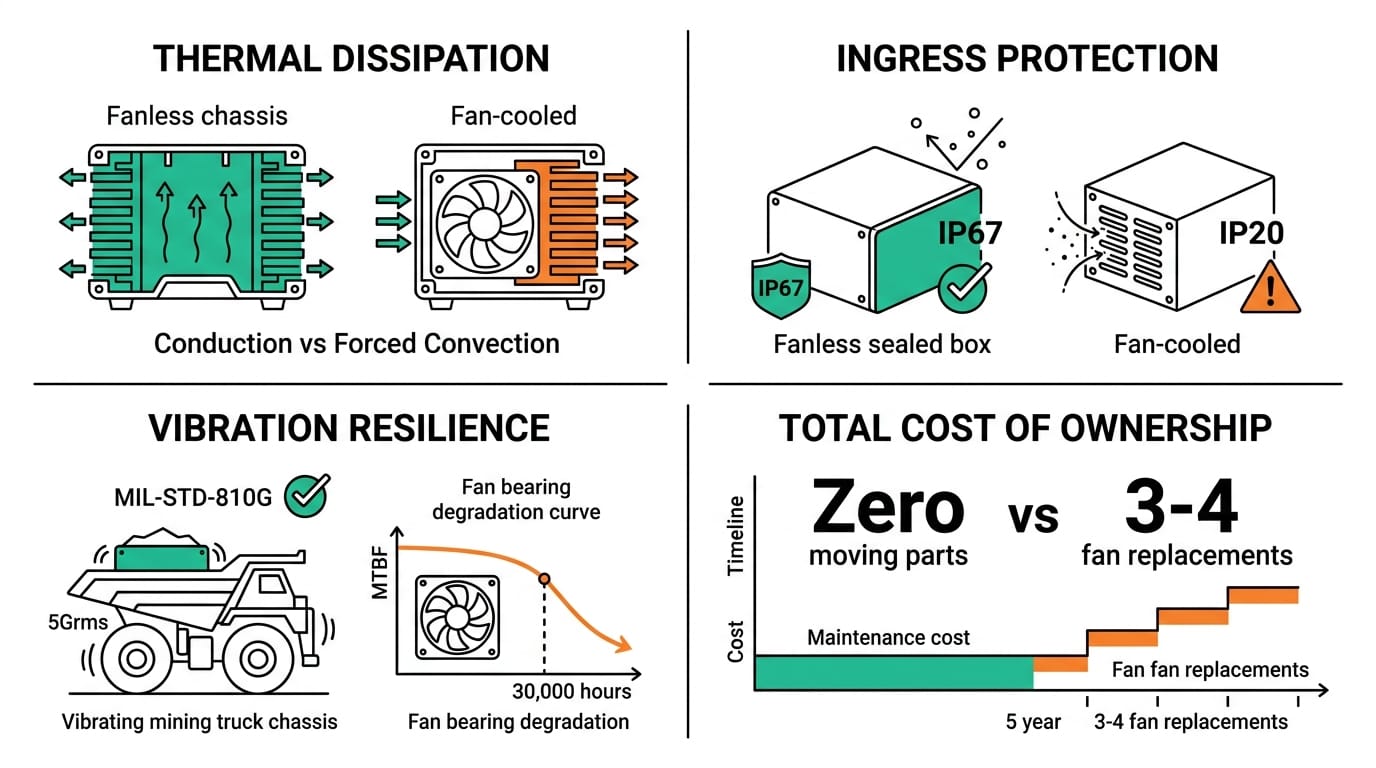
Thermal headroom is the primary differentiator. Fanless systems dissipate heat through chassis conduction and radiation, which limits total system TDP to roughly 65W in a standard-sized enclosure. Fan-cooled systems push air across heatsink fins and can sustain 200W+ thermal loads, making them necessary for discrete GPUs running inference workloads above 100 TOPS.
Ingress protection correlates directly with cooling method. Fanless designs seal completely against dust and moisture because no air exchange is required. Fan-cooled systems need intake and exhaust vents, restricting them to IP20 environments unless filtered enclosures are added—which increases cost and maintenance.
Vibration tolerance matters in mobile and field deployments. Fan bearings degrade under sustained vibration (3–5 Grms), a condition common in mining trucks, agricultural machinery, and rail vehicles. Fanless systems rated to MIL-STD-810G specification handle these loads without mechanical wear.
Total cost of ownership favors fanless designs in remote or hard-to-access installations. Eliminating fan replacements reduces site visits. For GPU-intensive applications, the performance gain from active cooling outweighs maintenance overhead in accessible factory environments.
Conclusion
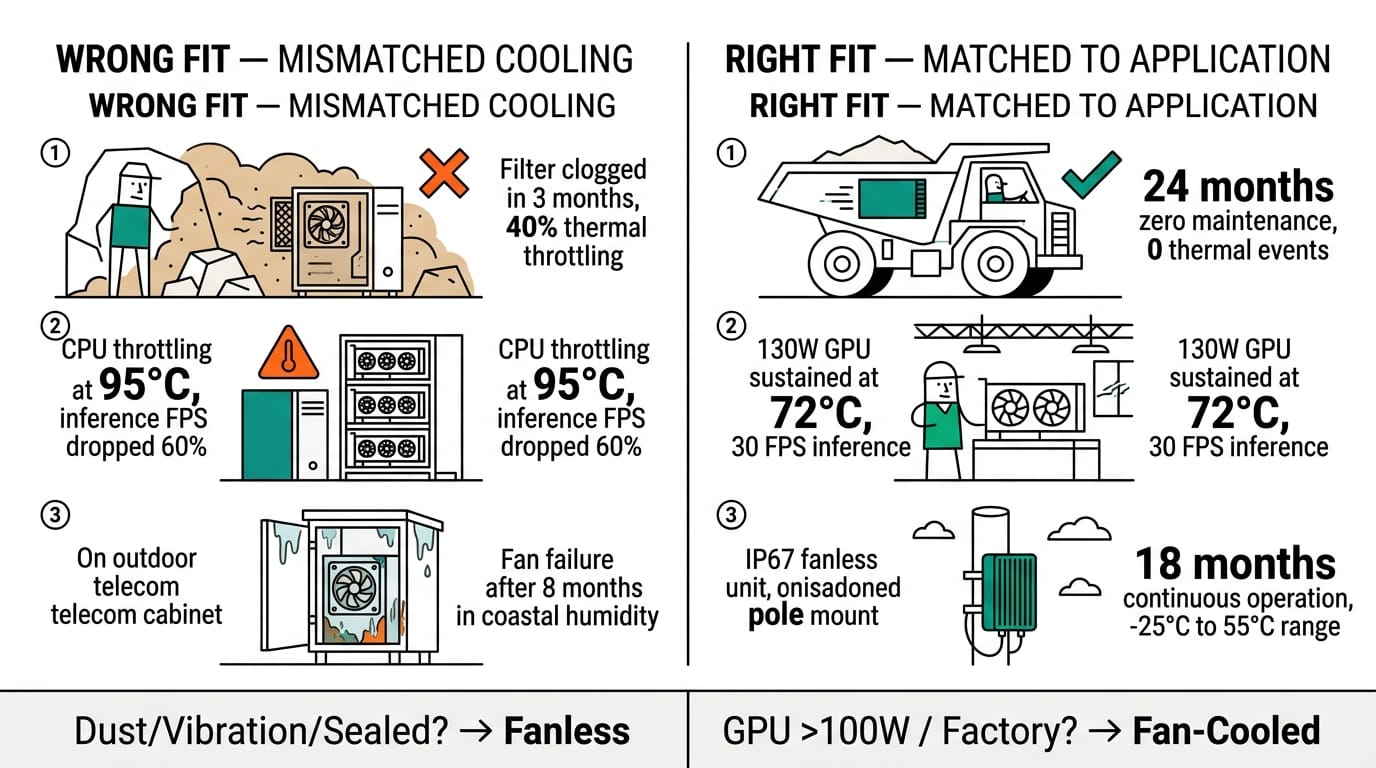
Choose fanless when the deployment involves dust, vibration, noise restrictions, or limited maintenance access—and when integrated GPU or CPU-only inference provides sufficient compute. Choose fan-cooled when the workload demands discrete GPU acceleration above 100W TDP in a controlled or semi-controlled environment.
For product specifications and configuration options, contact [email protected] or visit www.neteon.net. Follow Neteon on LinkedIn for the latest edge computing insights.
For a real-world example of fanless design reliability, see how a Nuvo-11531 survived 12 months of desert construction site conditions with zero hardware failures — while consumer NVRs failed within weeks from concrete dust and heat.
FAQs
What is the main difference between fanless and fan-cooled industrial PCs?
Fanless systems use passive conduction cooling through the chassis, eliminating moving parts. Fan-cooled systems use active airflow to dissipate higher thermal loads from discrete GPUs and high-TDP processors. The choice depends on your environment and compute requirements.
Can fanless industrial PCs run GPU workloads?
Fanless PCs support integrated GPUs with TDPs up to about 65W, suitable for lightweight inference and sensor fusion tasks. For discrete GPU workloads above 100W such as multi-camera vision or 3D mapping, fan-cooled platforms like the Nuvo-9160GC or Nuvo-10108GC are required.
How does dust affect fan-cooled industrial computers?
Fan-cooled systems pull air through intake vents, drawing in dust, fibers, and particulates that accumulate on heatsinks and circuit boards. In environments like mining, agriculture, or food processing, this leads to thermal throttling and potential component failure within months without filtered enclosures.
What industries benefit most from fanless edge computers?
Industries with extreme dust, vibration, or noise constraints benefit most: mining and construction (vibration and dust), semiconductor fabs (particle-free requirements), healthcare and control rooms (noise limits), and outdoor energy or telecom installations (sealed IP67 deployment).
How do I decide between fanless and fan-cooled for my application?
Start with your thermal budget: if your workload stays under 65W TDP, fanless is viable. Then evaluate environment—dusty, vibrating, or sealed requirements point to fanless. If you need discrete GPU power above 100W in a reasonably clean indoor environment, choose fan-cooled.