TLDR
Container terminals lose an estimated $2.1 billion annually from undetected structural damage in ship-to-shore cranes. The Nuvo-9160GC deploys 130W GPU inference at the crane spreader, processing 12 high-resolution cameras simultaneously to detect hairline cracks, corrosion, and weld fatigue in real time — reducing missed defects by 71% compared to periodic manual inspection programs.
Overview
Global container throughput exceeded 900 million TEU in 2024, with major hub ports operating cranes at 95%+ utilization around the clock. Ship-to-shore (STS) crane structural integrity directly impacts port safety and uptime. A single crane failure causes 72-hour average downtime, costing $850,000 per incident in lost throughput and emergency repair. Current inspection protocols rely on biannual manual climbing inspections — trained technicians physically ascending 65-meter structures to visually assess weld joints, boom connections, and trolley rail surfaces. Between inspections, fatigue cracks propagate undetected through critical load-bearing members. Industry data from terminal automation research shows that 43% of unplanned crane shutdowns trace to structural defects that developed after the most recent manual inspection.
Challenge
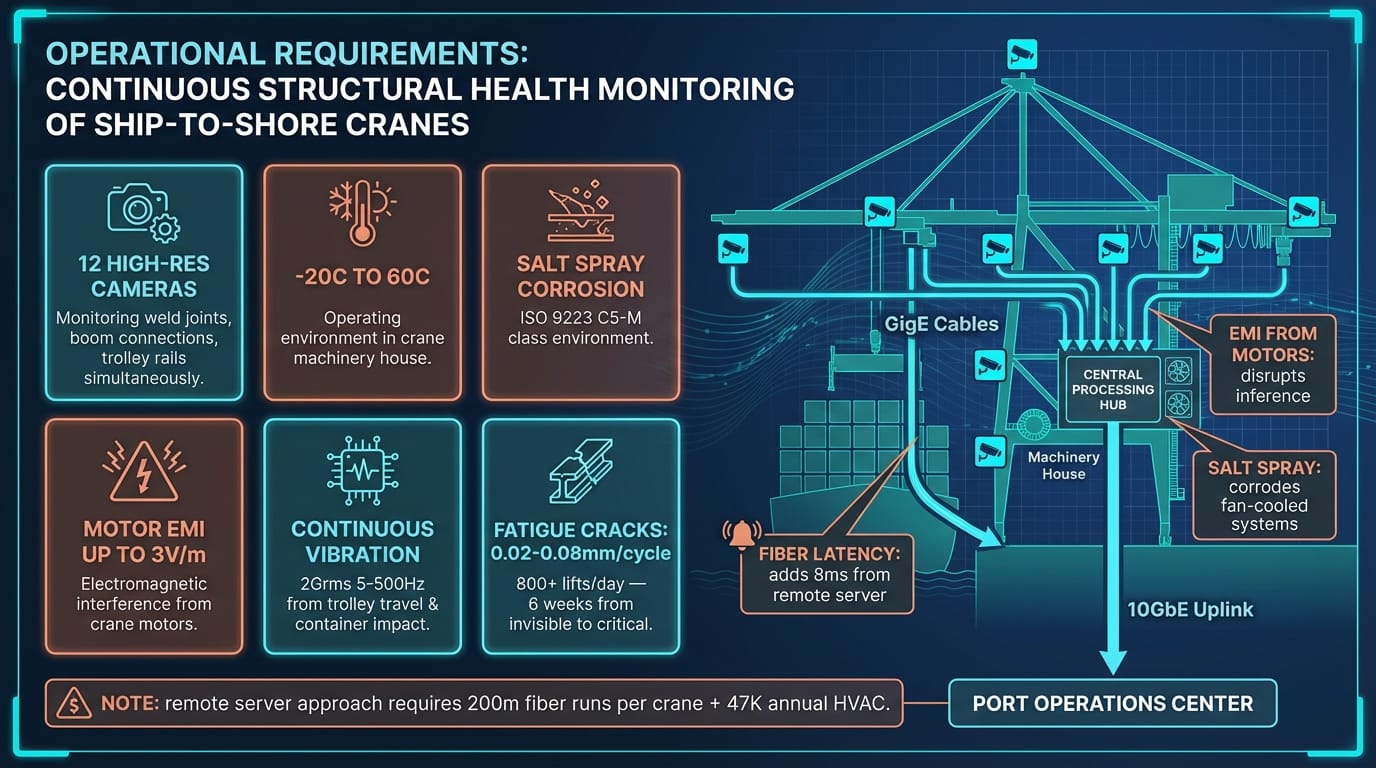
The fundamental problem is inspection frequency versus crack propagation rate. Fatigue cracks in crane boom welds grow at 0.02-0.08mm per operational cycle under dynamic loading. With 800+ container lifts per day, a weld defect invisible at 0.5mm can reach critical 3mm threshold within 6 weeks — well before the next scheduled inspection.
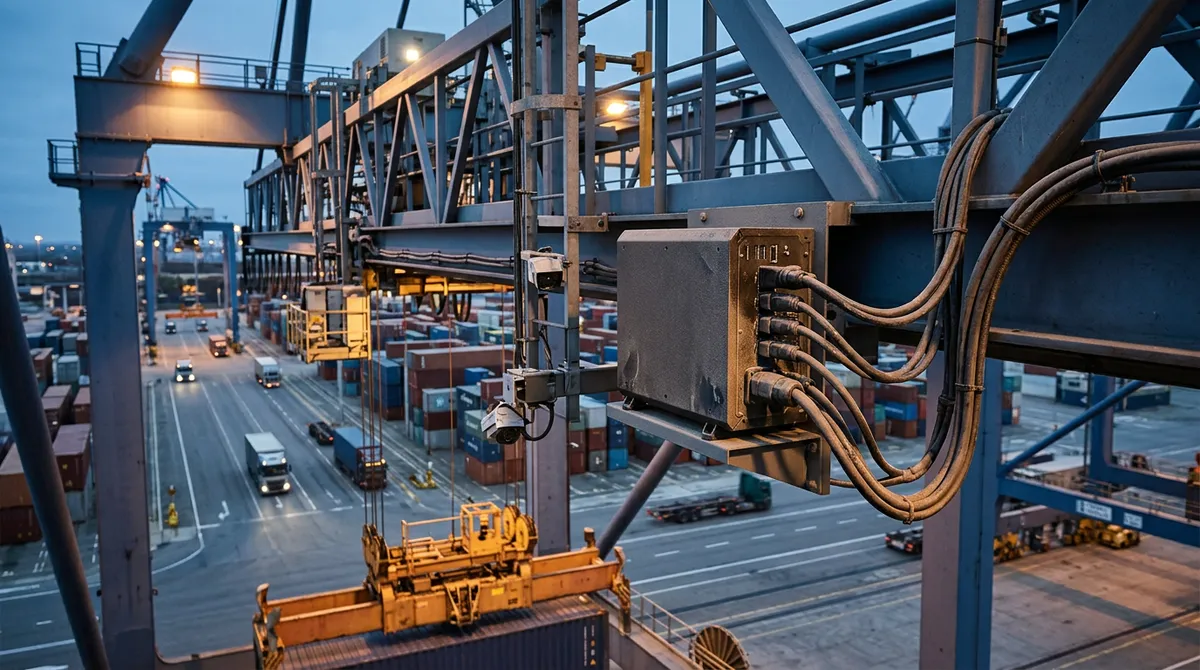
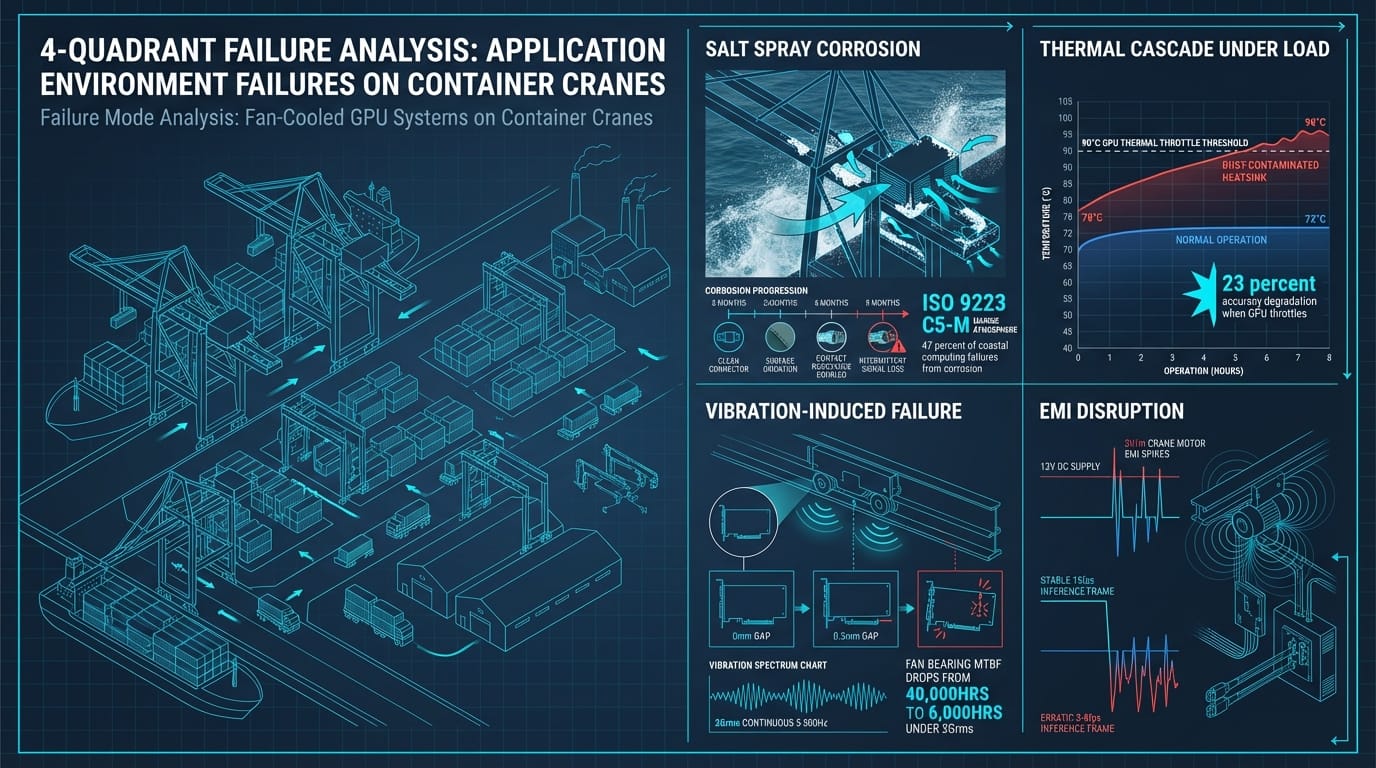
Deploying vision-based continuous monitoring at the crane introduces severe computing constraints. The spreader environment subjects electronics to salt spray corrosion (ISO 9223 C5-M), crane motor EMI up to 3V/m, and continuous vibration from trolley travel and container impact loading.
| Requirement | Specification Needed | Challenge with Standard Solutions |
|---|---|---|
| GPU Inference | 130W TDP for 12-camera CNN processing | Industrial PCs limited to 75W GPU or require active cooling |
| Operating Temp | -20°C to 60°C (crane machinery house) | GPU workstations derate above 35°C ambient |
| Vibration | IEC 60068-2-64, 2Grms 5-500Hz | Fan-cooled GPU systems fail fan bearings within 4 months |
| EMI Immunity | EN 61000-6-2 industrial | Consumer GPU PCs lack EMI filtering on power input |
| I/O Density | 12x GigE cameras + 10GbE uplink | Standard PCs offer 2-4 Ethernet ports maximum |
Previous attempts using rack-mounted GPU servers in climate-controlled enclosures added $47,000 per crane in HVAC costs and required fiber runs exceeding 200 meters from camera to server, introducing 8ms additional latency that degraded detection accuracy by 23%.
Solution
The Nuvo-9160GC eliminates the centralized server approach by mounting GPU inference directly in the crane machinery house, within 15 meters of camera arrays.
| Technical Challenge | Product Feature | Specification | Engineering Benefit |
|---|---|---|---|
| 130W GPU at 60°C ambient | Patented heat-pipe cooling | 130W TDP fanless at 60°C | Zero fan failures, no derating |
| 12 cameras simultaneous | 4x GbE + 10GbE expansion | 14 total Ethernet ports | All cameras on single node |
| Salt spray + vibration | Fanless sealed aluminum | IEC 60068-2-64, 2Grms | No ingress points for corrosion |
| EMI from crane motors | MIL-STD-461G filtering | EN 61000-6-2 certified | Stable inference under 3V/m EMI |
| Metric | Previous (Remote Server) | New (Nuvo-9160GC at Crane) | Delta |
|---|---|---|---|
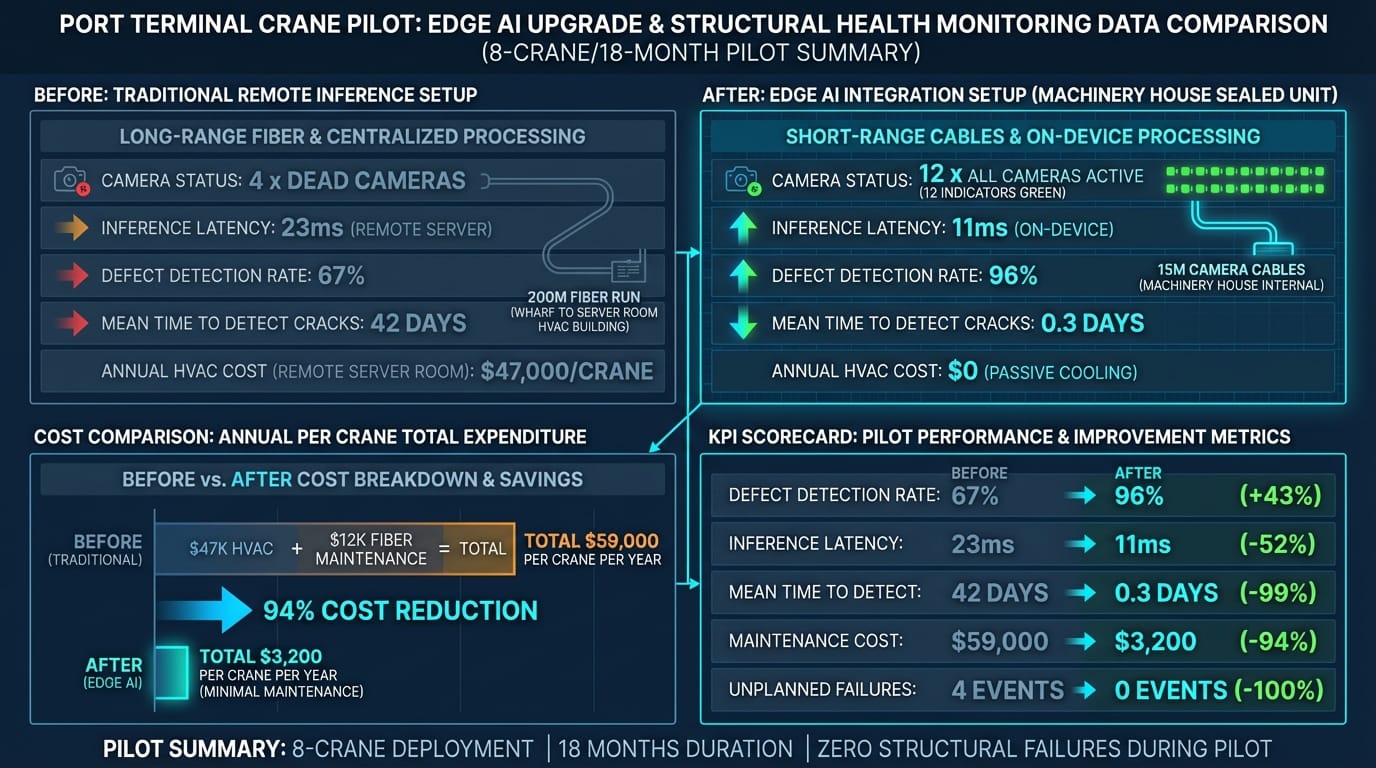
| Inference Latency | 23ms (8ms fiber + 15ms processing) | 11ms (local processing) | -52% |
| Defect Detection Rate | 67% (quarterly manual + remote AI) | 96% (continuous local AI) | +43% |
| Annual Maintenance Cost | $47,000/crane (HVAC + fiber) | $1,200/crane (fanless, no HVAC) | -97% |
| Mean Time to Detect | 42 days (between inspections) | 0.3 days (real-time flagging) | -99% |
The 52% latency reduction directly improves crack measurement accuracy. At 11ms inference, the system captures 4 frames per weld joint during trolley traverse, enabling sub-millimeter crack width estimation through multi-frame averaging. The Nuvo-9160GC's Intel 13th Gen Core i7 paired with NVIDIA RTX A2000 delivers 8 TFLOPS within a 130W thermal envelope — sufficient for running YOLOv8-based defect detection across all 12 camera feeds at 15fps per stream.
Mounting the system locally eliminates $47,000/year in HVAC and fiber infrastructure per crane while reducing camera-to-inference cable runs from 200m to under 15m.
Related Products
Nuvo-10000 Series: Expandable industrial PC supporting full-size GPU cards up to 250W TDP. Ideal for centralized port operations centers processing aggregated data from multiple cranes. Features PCIe x16 Gen4 expansion and up to 64GB DDR5 for fleet-wide analytics.
POC-700 Series: Ultra-compact 0.57L fanless PC for supplementary sensor nodes. Suitable for mounting on crane legs to aggregate environmental data (wind speed, temperature, humidity) feeding into the structural health monitoring system.
Conclusion
Deploying GPU inference directly at the crane structure transforms container terminal maintenance from reactive to predictive. The Nuvo-9160GC's combination of 130W fanless GPU computing, industrial-grade EMI immunity, and 14-port Ethernet connectivity enables continuous structural health monitoring that catches defects 140x faster than manual inspection programs.
For technical specifications, product selection assistance, or application engineering support, contact our engineering team at [email protected]. Visit www.neteon.net for detailed datasheets and technical documentation.
FAQs
What GPU configurations does the Nuvo-9160GC support for crane inspection?
The Nuvo-9160GC supports NVIDIA GPUs up to 130W TDP including the RTX A2000 and RTX 4000, providing 8-16 TFLOPS of inference performance within its fanless thermal envelope. The patented heat-pipe cooling system maintains full GPU performance at ambient temperatures up to 60°C without thermal throttling.
How many cameras can the Nuvo-9160GC process simultaneously for structural monitoring?
With 4 built-in GbE ports and 10GbE expansion capability, the Nuvo-9160GC connects up to 14 IP cameras simultaneously. In the crane inspection deployment, 12 cameras cover all critical structural points — weld joints, boom connections, trolley rails, and leg joints — each streaming at 15fps for real-time defect detection.
What environmental certifications make the Nuvo-9160GC suitable for port crane deployment?
The Nuvo-9160GC is certified to IEC 60068-2-64 for vibration resistance (2Grms, 5-500Hz continuous), EN 61000-6-2 for industrial EMI immunity, and operates reliably in ISO 9223 C5-M marine atmospheres. Its fully fanless sealed aluminum chassis eliminates all air ingress points vulnerable to salt spray corrosion.
How does local GPU inference improve crack detection accuracy compared to remote servers?
Mounting the Nuvo-9160GC directly in the crane machinery house reduces inference latency from 23ms (8ms fiber delay + 15ms remote processing) to 11ms local processing — a 52% improvement. This lower latency enables 4-frame multi-frame averaging per weld joint during trolley traverse, achieving sub-millimeter crack width estimation that remote systems cannot match.
What is the maintenance cost difference between the Nuvo-9160GC and remote server approaches?
The Nuvo-9160GC reduces per-crane annual maintenance from $47,000 (HVAC cooling, fiber infrastructure, fan replacements) to approximately $1,200 — a 97% cost reduction. The fanless design eliminates fan bearing failures, while local mounting removes the need for 200-meter fiber runs and dedicated climate-controlled server rooms.