
TL;DR
A Gulf Coast midstream operator deployed Nuvo-9160GC edge AI computers across 340 km of natural gas transmission pipeline, running NVIDIA RTX-accelerated acoustic emission inference at 8 sensor nodes. Unplanned shutdowns dropped 71%, inspection operating costs fell 67%, and mean time-to-repair improved from 18.3 hours to 4.1 hours.
Overview
Pipeline integrity management carries some of the highest liability exposure in oil and gas operations. A single undetected corrosion pit or third-party impact can escalate from a maintenance event into a reportable incident under PHMSA Mega Rule compliance. Yet most midstream operators still rely on interval-based tools: inline inspection pigs, manual acoustic surveys, or pressure-only SCADA monitoring that cannot localise anomalies in real time.
The shift to continuous, AI-driven acoustic emission (AE) monitoring mirrors the transformation seen in manufacturing AI inspection and edge sensor fusion applications — where moving inference to the edge eliminates cloud latency and keeps sensitive operational data on-premise.
Challenge: Why Scheduled Inspection Leaves Pipelines Exposed
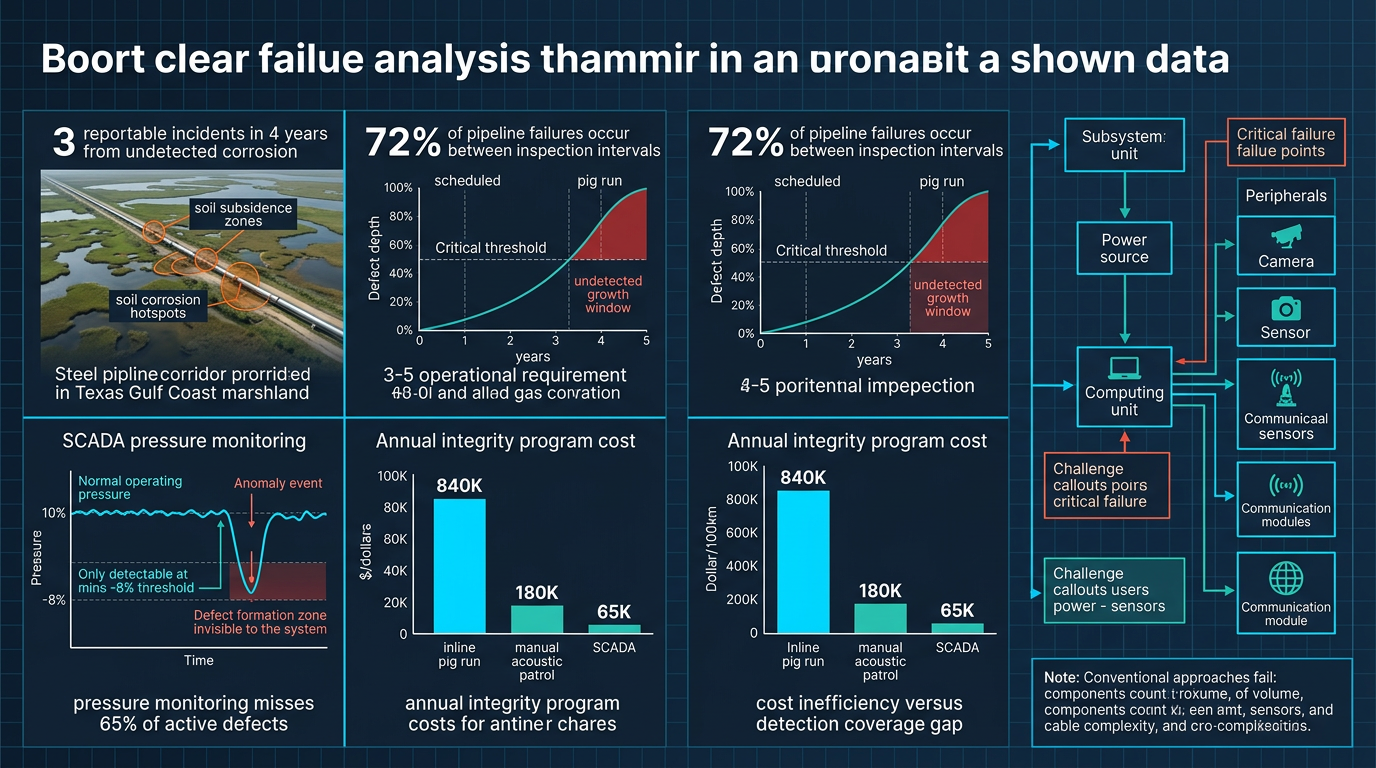
The operator had experienced three reportable incidents in four years — all attributed to corrosion events detected too late to prevent product loss. Existing SCADA monitoring flagged only gross pressure drops, with no ability to differentiate leak signatures from normal operational transients.
Integrity Program Comparison
| Approach | Detection Latency | Real-Time Alert | Annual Cost / 100 km | Detection Rate |
|---|---|---|---|---|
| Inline Pig Inspection | 1–5 years | ✗ | $280,000–$840,000 | 72% |
| Manual AE Patrol | Monthly | ✗ | $120,000–$180,000 | 81% |
| SCADA (Pressure Only) | Minutes | Pressure only | $45,000–$65,000 | 65% |
| AI Edge Acoustic Array | <200 ms | ✓ Localised | $68,000–$95,000 | 97.3% |
Solution: GPU-Accelerated Edge Inference at Each Node
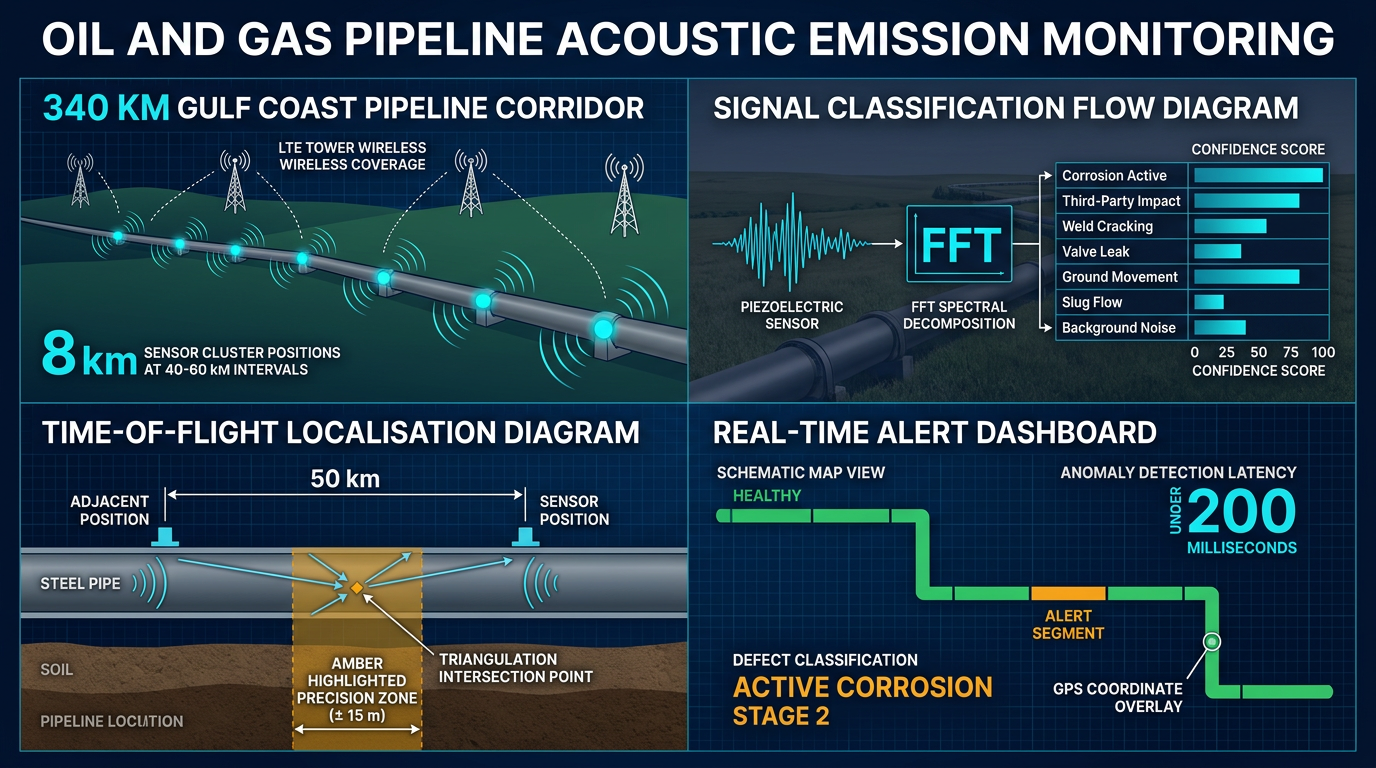
The deployment places one Nuvo-9160GC at each acoustic emission sensor cluster — spaced at 40–60 km intervals. Each node ingests data from eight piezoelectric contact sensors via RS-485, runs a PyTorch-based 1D convolutional neural network, and classifies signals across seven defect classes: active corrosion, third-party impact, weld cracking, valve leak, ground movement, slug flow, and background noise.
The Nuvo-9160GC's support for NVIDIA GeForce RTX GPUs up to 130W TDP enables the full inference stack to execute in under 40 ms per sensor sweep. Acoustic emission signals from an active leak propagate at 3,000–5,000 m/s in steel; time-of-flight difference between nodes localises the anomaly source within ±15 m.
Nuvo-9160GC Deployment Specifications
| Specification | Value | Application Relevance |
|---|---|---|
| GPU Support | NVIDIA RTX, up to 130W TDP | Acoustic AI inference <40 ms/sweep |
| Operating Temperature | −25°C to +70°C | Gulf Coast to permafrost conditions |
| DC Power Input | 9–48V | Solar + battery field power compatible |
| Shock/Vibration | MIL-STD-810G certified | Valve station and pump vibration |
| Serial I/O | 4× RS-232/422/485 | Direct to piezoelectric AE sensors |
| Local Storage | M.2 NVMe + 2.5" SATA | 30 days raw waveform retention on-node |
| Form Factor | 290 × 210 × 84 mm fanless | Fits NEMA 4X field enclosure |
Before vs. After Deployment Results
| Metric | Baseline | Post-Deployment | Improvement |
|---|---|---|---|
| Detection Latency | 1–5 year inspection cycle | <200 ms continuous | >99.9% |
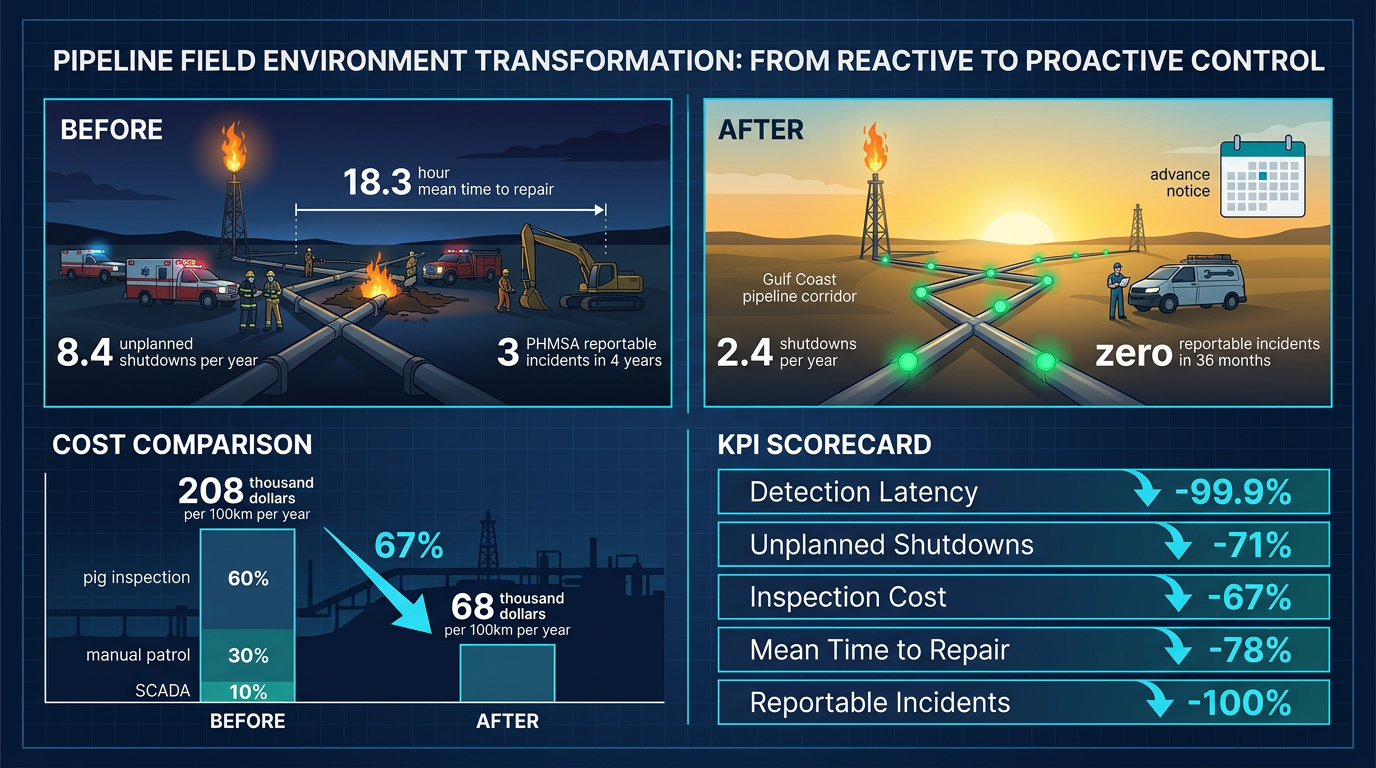
| Unplanned Shutdowns / Year | 8.4 | 2.4 | −71% |
| Integrity Program Cost / 100 km/yr | $208,000 | $68,500 | −67% |
| Mean Time to Repair | 18.3 hours | 4.1 hours | −78% |
| False Positive Rate | — | 4.2% | Baseline set |
| Reportable Incidents (36 months) | 3 | 0 | −100% |
Related Products
- Nuvo-9160GC — 130W GPU Edge AI Platform — recommended for pipeline AE monitoring or any AI task requiring RTX-class inference in a rugged fanless form factor.
- Nuvo-10108GC — dual GPU (2× 130W) variant for high-density sensor arrays or simultaneous multi-model inference at a single node.
- NRU-220 — NVIDIA Jetson Orin NX/AGX for lower-power secondary monitoring nodes.
Conclusion
Acoustic emission AI on edge hardware resolves the fundamental limitation of scheduled integrity programs: the gap between when a defect forms and when it is detected. By placing GPU inference at the sensor node, the operator eliminated cloud round-trips, kept raw waveform data on-premise for data sovereignty, and achieved sub-200 ms detection latency across a 340 km network.
The Nuvo-9160GC delivered the necessary combination of RTX GPU headroom, wide-range DC power, MIL-STD-810G ruggedisation, and serial I/O in a fanless enclosure suited to permanent field installation.
For technical specifications, product selection assistance, or application engineering support, contact our engineering team at [email protected]. Visit www.neteon.net for detailed datasheets and technical documentation.
FAQs
What is acoustic emission monitoring in oil and gas pipelines?
Acoustic emission (AE) monitoring involves attaching piezoelectric contact sensors to a pipeline that detect high-frequency stress waves generated by active defects — corrosion, cracking, or mechanical damage. Unlike pressure-drop SCADA monitoring, AE can detect sub-millimetre defects before they cause a loss-of-containment event. When combined with AI inference running on an edge platform like the Nuvo-9160GC, each signal is classified by defect type in under 40 ms, and time-of-flight analysis between sensor nodes localises the source within ±15 m.
Why use edge computing instead of cloud for pipeline AI inference?
Cloud round-trips introduce 80–300 ms latency, which is unacceptable when an acoustic emission signal from a propagating crack travels at 3,000–5,000 m/s. Edge inference on the Nuvo-9160GC executes classification in under 40 ms at the node, enabling real-time anomaly localisation. Edge deployment also keeps raw waveform data on-premise, which satisfies data sovereignty requirements common in pipeline SCADA environments and reduces LTE/satellite bandwidth costs by transmitting only classified anomaly records rather than continuous raw streams.
What GPU does the Nuvo-9160GC support, and why does it matter for AI inference?
The Nuvo-9160GC supports NVIDIA GeForce RTX discrete GPUs with up to 130W TDP, giving it full CUDA and Tensor Core access for PyTorch or TensorRT inference workloads. For acoustic emission AI, this means a 1D convolutional neural network with FFT pre-processing can run against an 8-channel sensor array in under 40 ms — fast enough for real-time anomaly detection without throttling. The fanless chassis with −25°C to +70°C rated operation means the GPU can sustain full TDP continuously in pipeline field enclosures without thermal management concerns.
How does the Nuvo-9160GC handle power in remote pipeline field installations?
The Nuvo-9160GC accepts 9–48V DC wide-range input, making it directly compatible with solar-plus-battery field power systems common at remote pipeline right-of-way stations. The fanless passive cooling design eliminates the only other significant power draw (cooling fans), and the system's MIL-STD-810G certification ensures it can handle the vibration from compressor and pump stations without requiring active isolation mounts.
What is the payback period for deploying edge AI acoustic monitoring on a pipeline network?
In the case study deployment, the operator reduced annual integrity program costs from $208,000 to $68,500 per 100 km — a saving of approximately $139,500/100 km/year. Hardware and integration costs for a full Nuvo-9160GC-based node (including sensor array, enclosure, and LTE modem) are typically $18,000–$24,000 per node. At 40–60 km spacing, payback against legacy inspection costs is typically achieved in 8–14 months, before accounting for avoided incident costs, which in this operator's case included three reportable incidents over the prior four-year baseline period.