Key points
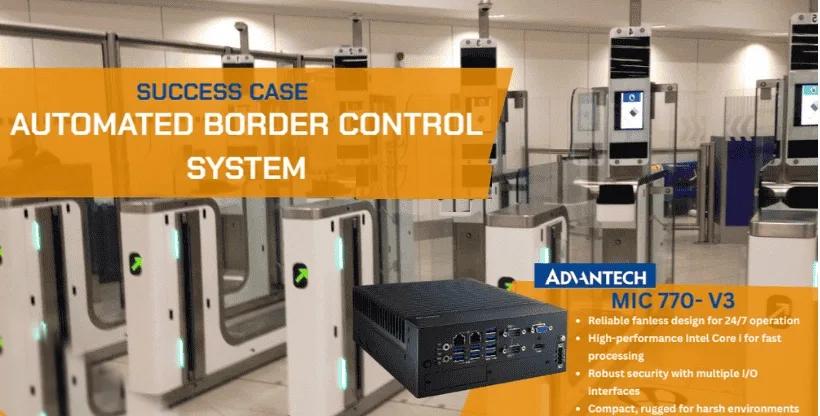
- 45 Advantech MIC-770 V3 systems run the airport's e-gate network. Amplicon Middle East supplied and integrated them.
- Each gate handles facial recognition, fingerprint scanning and passport verification on live camera streams as passengers walk through.
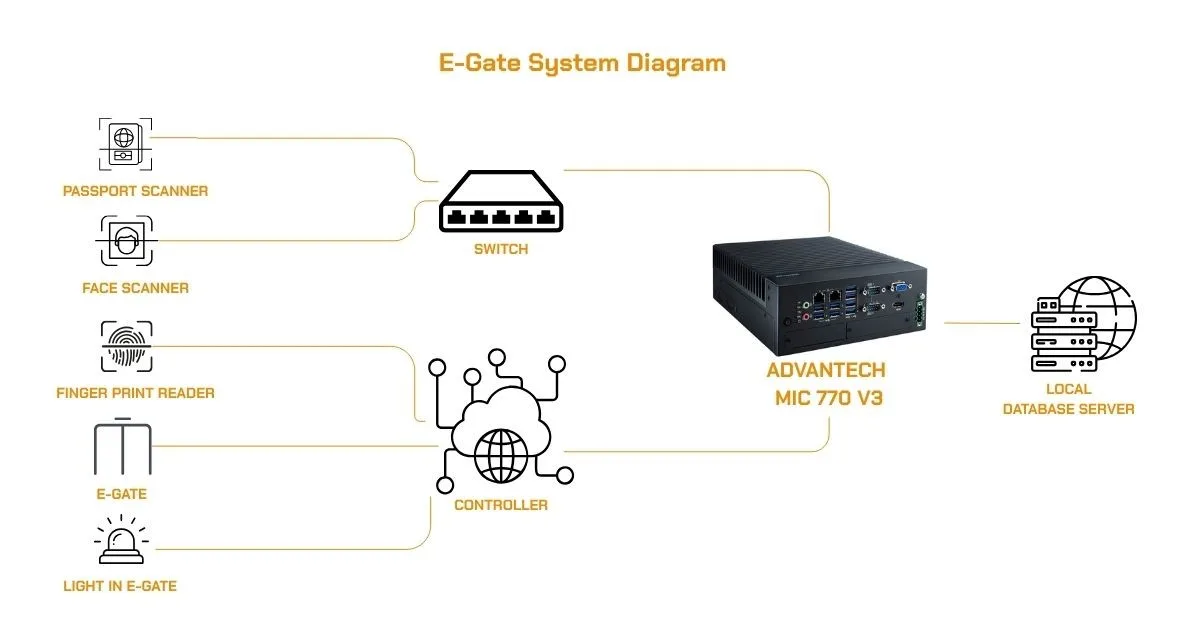
- IP cameras connect over Ethernet. Fingerprint, facial recognition, passport and RFID readers connect over USB or Ethernet.
- The airport replaced its previous platform because of stretched processing capacity, supply delays and tight gate housings. The source gives no measured wait-time, uptime or ROI figures.
Deployment Takeaway
An airport e-gate places identity verification, video capture, and gate control inside one compact enclosure. Its computer has to process real-time video and biometric data, connect to scanners and readers, and fit the space available inside the gate housing.
Application Snapshot
Application: Automated e-gates for immigration and border control.
Location: A leading Middle Eastern airport (not named in the source).
System integrator: Amplicon Middle East, working with Advantech.
Deployment scale: 45 Advantech MIC-770 V3 embedded systems across the airport's e-gate network.
Core workflow: Capture passenger video, verify biometrics and passports, and exchange data with local and central servers for access management.
Application source: Advantech's airport e-gate case study.
Why the Airport Upgraded
According to Advantech, the airport's previous e-gate computing platform was limiting operations. Processing capacity was stretched when the gates handled simultaneous high-resolution video streams and peripheral devices. Supply delays from the previous hardware vendor slowed deployment and maintenance, and the tightly confined e-gate housings left little room for larger systems.
What the E-Gate System Needed
1. Real-time processing for identity checks
Each gate handles facial recognition, fingerprint scanning, and passport verification as passengers move through. The computer needs enough processing headroom to work with live camera streams and biometric data without slowing the checkpoint.
2. Connections for cameras, readers, and servers
In Advantech's architecture, IP cameras connect over Ethernet, while fingerprint, facial recognition, passport, and RFID readers connect through USB or Ethernet. Network switches and local data servers relay information to a central control server for access management, authentication, and logging.
3. A compact system for an enclosed housing
The computer has to fit inside the e-gate enclosure and remain serviceable after installation, because gates in a busy terminal are expected to stay in operation.
Why the MIC-770 V3 Fit
Advantech cites four reasons the platform fit:
- Real-time performance: High-speed processing for facial recognition, fingerprint scanning, and passport verification.
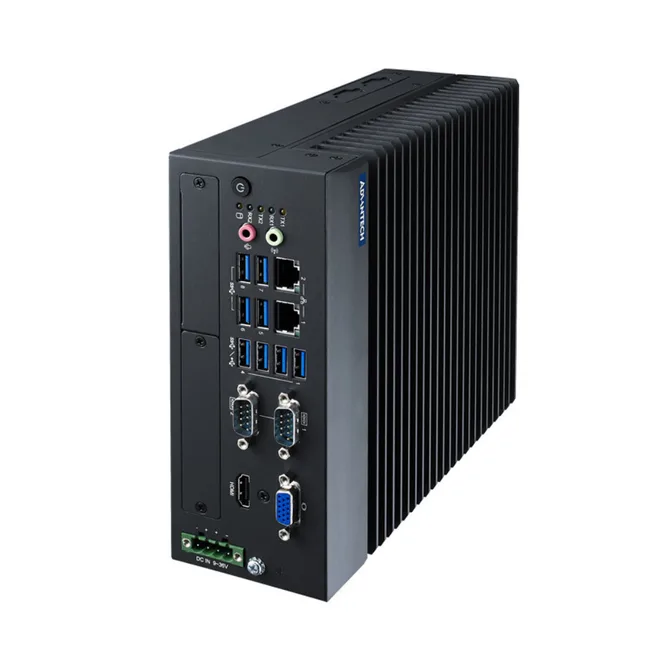
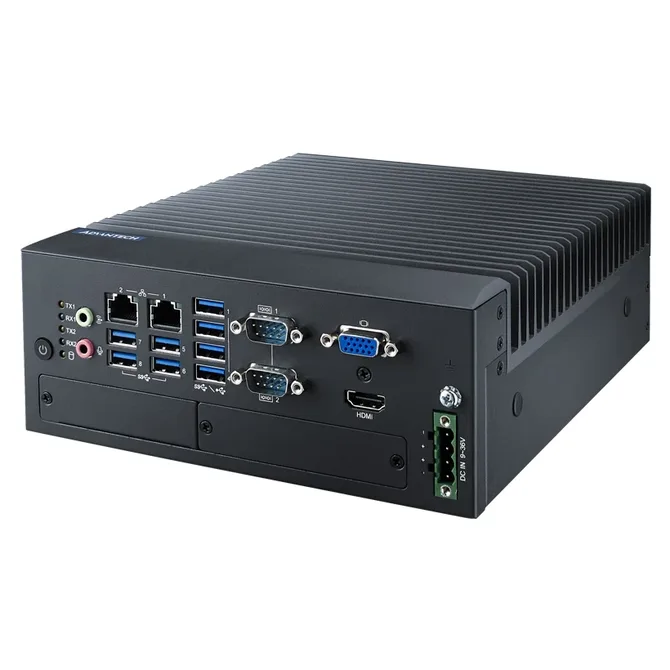
- Compact, rugged design: The system fits inside e-gate housings for a space-efficient installation.
- Peripheral integration: It connects with IP cameras, biometric scanners, RFID readers, and document-verification devices.
- Reliable supply: On-time delivery supported deployment and reduced operational interruptions.
The MIC-770 V3 is a modular industrial PC for 12th to 14th Gen Intel Core LGA1700 processors, with customizable I/O that lets integrators match interfaces to the peripherals in each project.
Resulting Value
Advantech reports that all 45 e-gates in the airport's network now run on MIC-770 V3 systems supplied and integrated by Amplicon Middle East. The case describes faster passenger processing, improved system uptime with dependable hardware supply, simpler maintenance through a service-friendly design, and infrastructure ready for future biometric and security technologies. The source does not publish measured wait-time, uptime, or ROI figures.
For airport and security teams, the takeaway is to specify the e-gate computer as part of the complete workflow: camera and reader interfaces, processing headroom, enclosure dimensions, network architecture, and long-term hardware supply.
How Neteon Supports Similar Projects
Neteon helps transportation, security, and system-integration teams compare industrial computing platforms and review the configuration around the application. Share your camera and reader count, interface needs, enclosure dimensions, and environmental conditions with our IPC team before finalizing the hardware.
Explore MIC-770V3H-E0A1 at Neteon, or contact Neteon to discuss your project.
Manufacturer application story based on Advantech's published case study. The documented deployment was delivered by Amplicon Middle East with Advantech. Neteon offers related hardware selection and configuration support. Images courtesy of Advantech and Amplicon Middle East.