
TL;DR
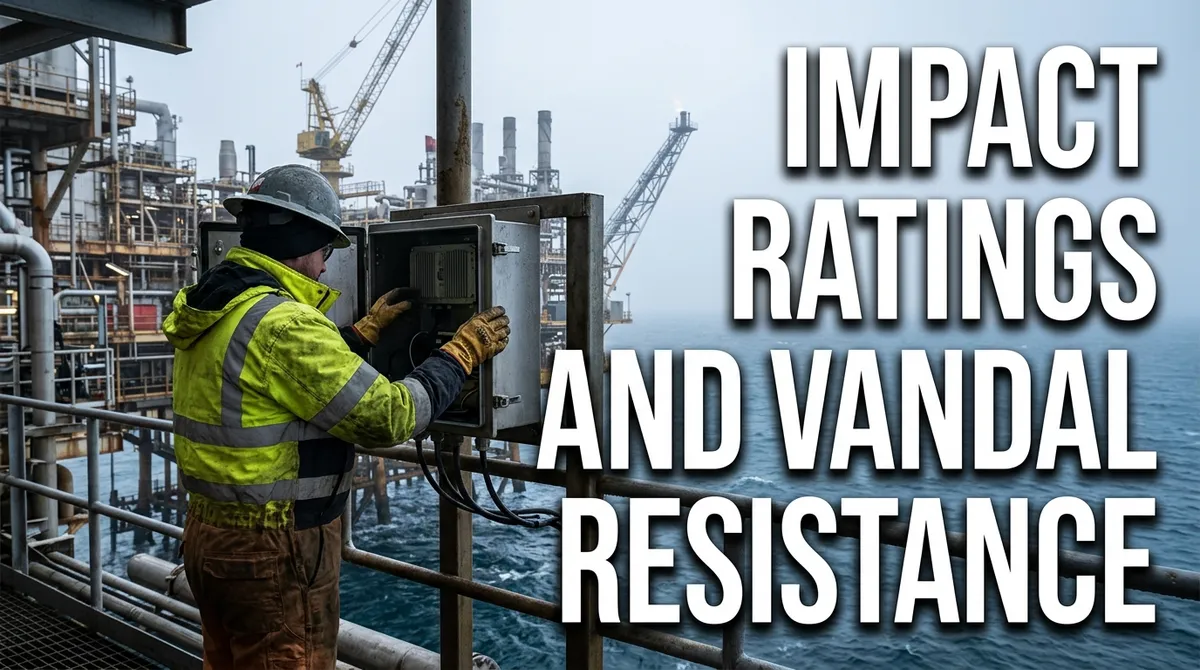
IK ratings, defined by IEC 62262, grade how much physical impact an enclosure can take before it fails, on a scale from IK00 to IK11. For outdoor edge AI, the number that matters most sits between IK08 (5 joules) and IK10 (20 joules). IP sealing keeps water out; the IK rating tells you whether a thrown rock, a swinging pallet, or a vandal with a hammer will crack the box open first. This guide explains what the IK scale measures, where it stops being useful, and how sealed metal computers like the POC-766AWP hold up when the enclosure itself becomes the failure point.
Overview
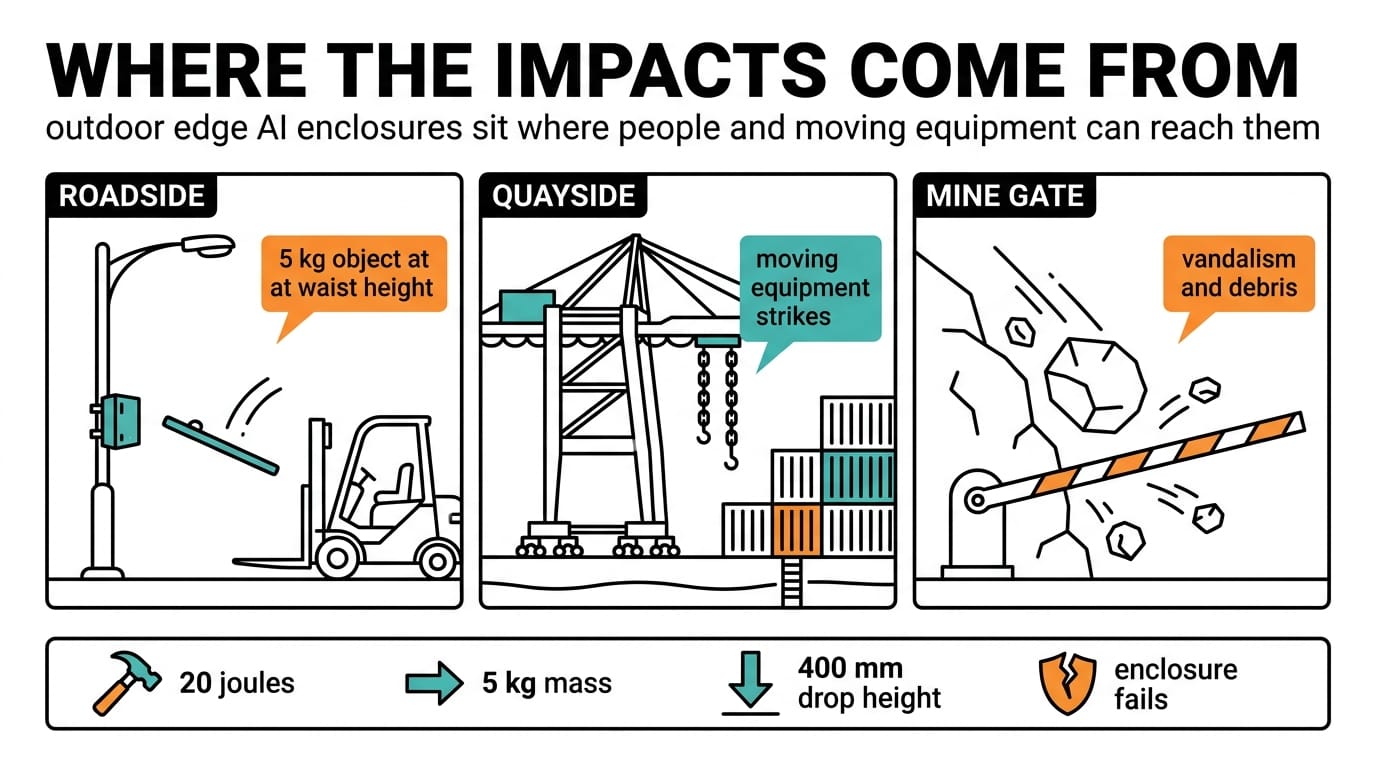
An edge AI computer bolted to a light pole, a mine gate, or a quayside crane lives somewhere people can reach it. Rain and dust are covered by the IP rating, and we walked through those thresholds in our ruggedness and compliance reference. But IP67 says nothing about a forklift clipping the housing or a kid throwing a brick at a roadside cabinet. That is what IK measures, and it gets skipped on most spec sheets.
The confusion usually starts with mixing up sealing and impact. Our post on MIL-STD-810G, IP67, and IP69K covers the water and shock side. IK is the third leg, and outdoor deployments need all three. If you are specifying hardware for an unattended site, read this alongside our outdoor deployment design guide.
What the IK rating actually measures
IEC 62262 defines a repeatable drop test. A hammer of a known mass falls from a known height onto the enclosure, and the impact energy in joules sets the rating. Higher number, harder hit survived. The steps are not linear, so the jump from IK08 to IK10 is a fourfold increase in energy, not a small one.
| IK code | Impact energy | Test hammer (mass / drop height) | What it survives |
|---|---|---|---|
| IK07 | 2 J | 0.5 kg from 400 mm | Hand tools, minor knocks |
| IK08 | 5 J | 1.7 kg from 300 mm | Dropped equipment, cart bumps |
| IK09 | 10 J | 5 kg from 200 mm | Heavy tool strikes |
| IK10 | 20 J | 5 kg from 400 mm | Deliberate vandalism, thrown objects |
| IK11 | 50 J | Beyond the standard hammer scale | Extreme industrial impact |
For context, IK10 is roughly a 5 kg mass dropped from waist height, the threshold most public infrastructure and roadside enclosures are written to.
Impact survival comes down to enclosure construction
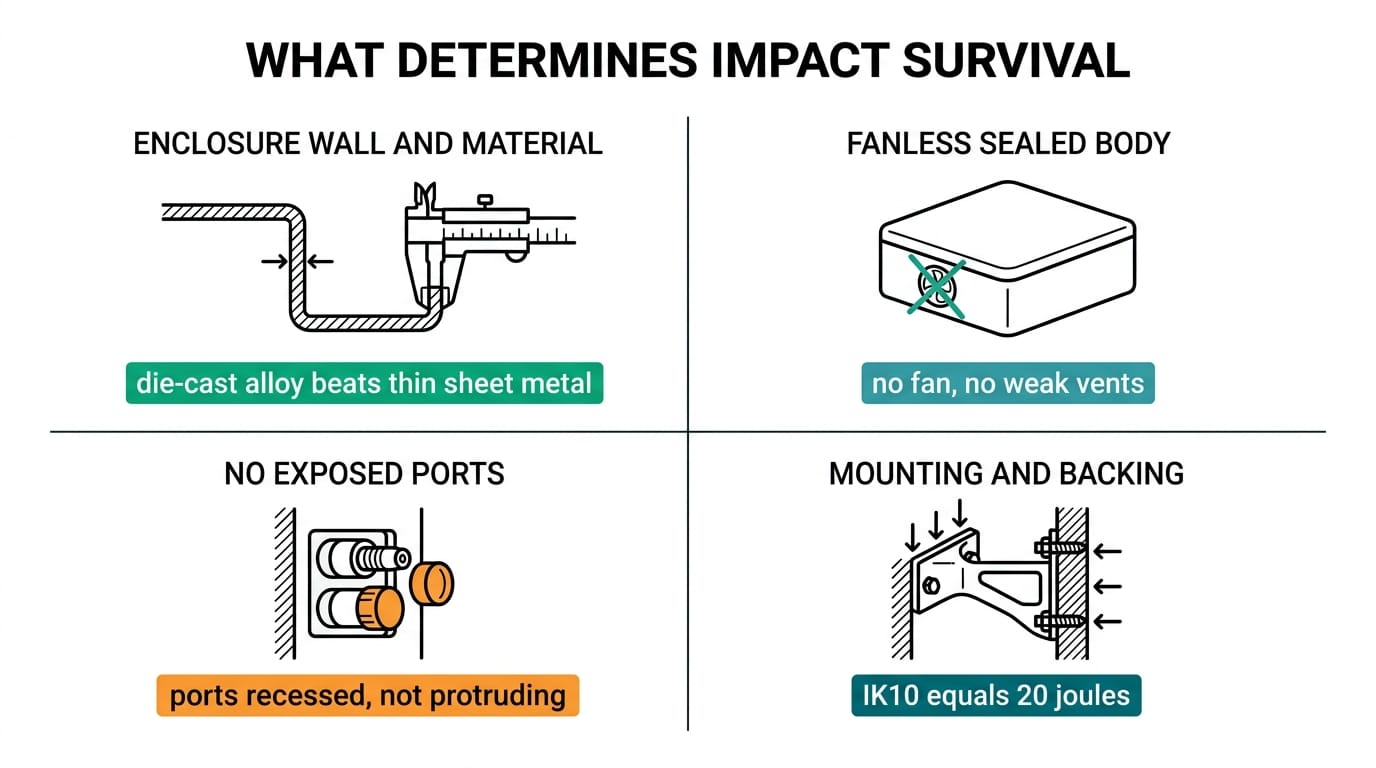
The catch: compact rugged computers are rarely marketed with a formal IK number, because the rating applies to the installed enclosure, not the raw box. What decides whether a unit shrugs off a strike is its construction, the metal, the wall thickness, the sealing method, and whether a vent or fan opening is waiting to be smashed. The table below maps how Neteon's sealed platforms are built against what each IK level demands. None carry a published IK certificate, so treat it as an engineering comparison, not a compliance claim.
| Attribute | POC-766AWP | POC-700 | Nuvo-9160GC | NRU-220 |
|---|---|---|---|---|
| Enclosure | Stainless steel + aluminum | Die-cast aluminum | Extruded aluminum | Aluminum alloy |
| Sealing | IP67 (M12 locking I/O) | Dust and splash rated | Panel/cabinet install | Panel/cabinet install |
| Vents or fan openings | None (fully sealed) | None (fanless) | None (fanless) | None (fanless) |
| Connector locking | M12 X-coded, screw-locked | Standard industrial | Standard industrial | Standard industrial |
| Operating range | -25 to 70 C | Wide-temp | Wide-temp | Wide-temp |
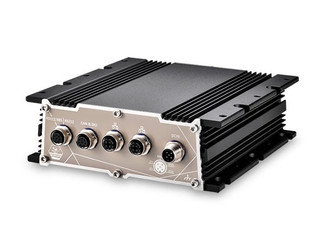
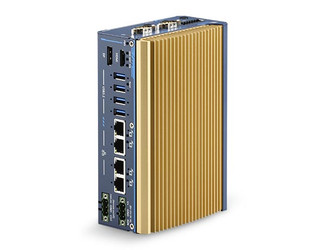
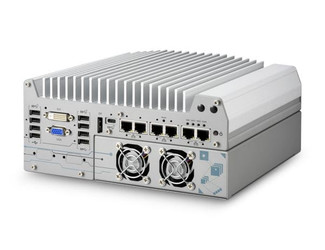
The POC-766AWP is the clearest example. It runs an Intel Core i3-N305 with no fan and no external ports left exposed, using M12 X-coded 2.5GbE connectors that thread and lock instead of clipping in. A sealed stainless and aluminum shell with no vent slots has no obvious weak point for an impact to find, which is exactly what a high IK level rewards. For sites that also need GPU vision, the Nuvo-9160GC and the Jetson-based NRU-220 move into a cabinet, so their impact protection comes from the housing they sit in rather than the chassis alone.
What this means in the field
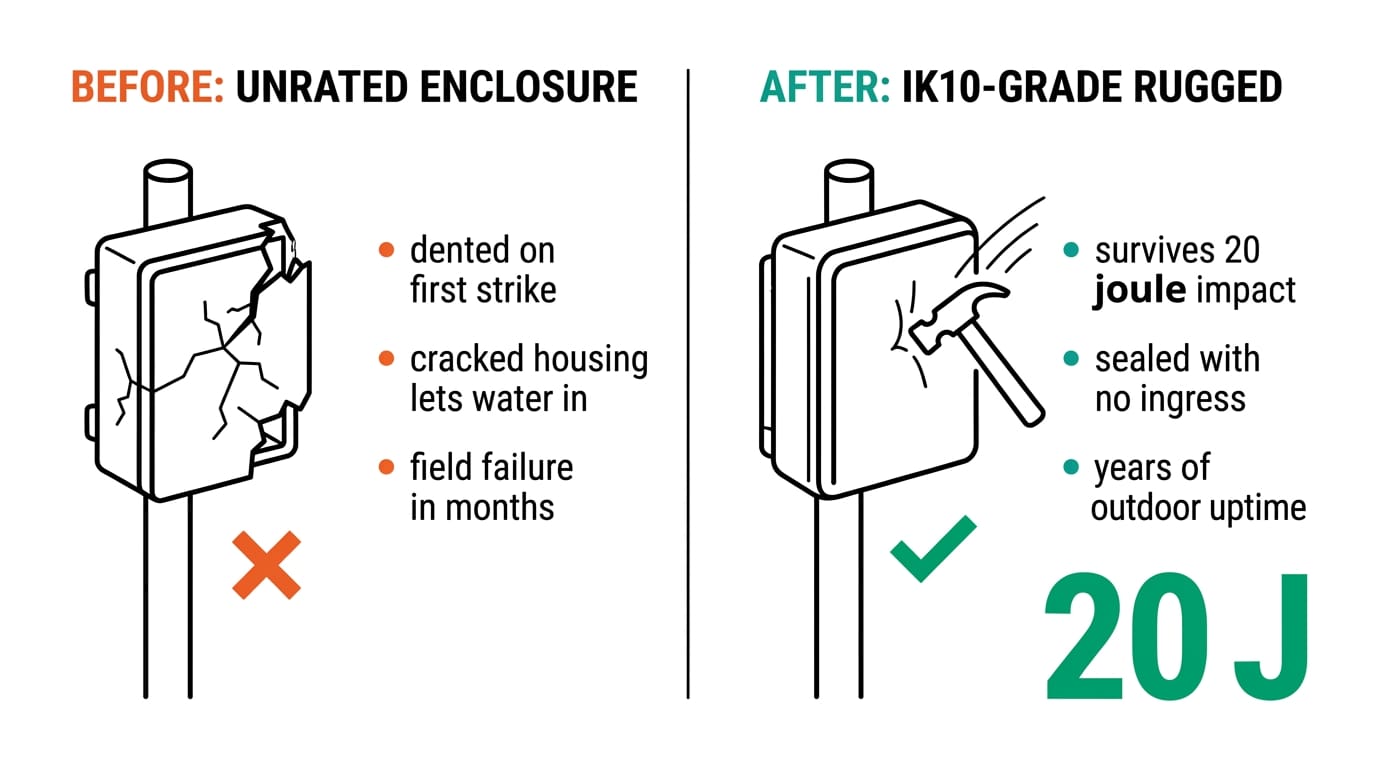
Specify IK when the computer is reachable by people or moving equipment and cannot be locked behind a fence. A tolling gantry, an EV charging bay, a parking enforcement camera, or a substation perimeter box all qualify. For those, target IK10 at the enclosure level and put the electronics inside a sealed metal computer so a cracked outer door does not expose live boards.
Skip the IK obsession when the unit lives in a locked control room or a driver cab. There, thermal and vibration ratings matter far more than impact. The mistake we see is teams paying for an armored outdoor cabinet, then filling it with a vented desktop PC whose fan grille fails at the first serious knock. Match the inner computer to the outer enclosure. A fanless sealed unit like the POC-766AWP or POC-700 keeps the whole assembly honest, because there is no soft spot inside the hard shell.
If your risk assessment involves anything heavier or faster than a 5 kg object at waist height, you are past the standard hammer and into custom housing territory.
Conclusion
IK ratings answer a question IP and MIL-STD leave open: what happens when something hits the box. For outdoor and public edge AI, pair an IK10 enclosure with a sealed, fanless computer so the electronics survive even if the outer shell takes damage. Follow Neteon on LinkedIn for more field-tested engineering breakdowns, or reach us at [email protected] or www.neteon.net to spec a rugged edge AI build for your site.
Related Products

FAQs
What is an IK rating?
An IK rating, defined by IEC 62262, grades how much physical impact an enclosure can withstand, on a scale from IK00 (no protection) to IK11 (50 joules). A higher number means the enclosure survives a harder hit.
What is the difference between IP and IK ratings?
IP ratings such as IP67 measure sealing against dust and water. IK ratings measure resistance to mechanical impact. Outdoor edge AI deployments usually need both, because sealing does nothing to stop a physical strike.
What IK rating do outdoor edge AI computers need?
For public or reachable installations, target IK10 (20 joules) at the enclosure level. That corresponds to a 5 kg mass dropped from 400 mm, which maps to deliberate vandalism or a thrown object.
Does the POC-766AWP have a published IK rating?
Neousys does not publish a formal IK number for the POC-766AWP. Its IP67 sealed stainless-and-aluminum body with no vents or fan openings, plus M12 locking connectors, gives it strong impact-relevant construction even without a certified IK figure.
How much impact energy does IK10 represent?
IK10 equals 20 joules, tested with a 5 kg hammer dropped from 400 mm, roughly waist height. Any risk heavier or faster than that is past the standard hammer scale and needs custom protective housing.
Sources and further reading
IEC 62262 enclosure impact protection (IK Code).
Neousys rugged computer product catalog.
Related Neteon guides
MIL-STD-810G vs IP67 vs IP69K Ratings.
EN 50155 Guide for Railway Edge AI.
Browse the poc 766awp topic hub for more deployment guidance.
About the author and technical review
Author: Olivia Parker covers product-to-market strategy for edge AI, AIoT, and embedded systems.
Technical review: Neteon Industrial Computing Editorial Team. Reviewed August 5, 2026 for source quality, product-specification links, standards references, and clear separation of measured results from reference-architecture assumptions.
Evidence note: Unless a linked primary source explicitly identifies measured field results, performance figures and system outcomes in this article are design targets or planning estimates, not guaranteed results.