
Key takeaways
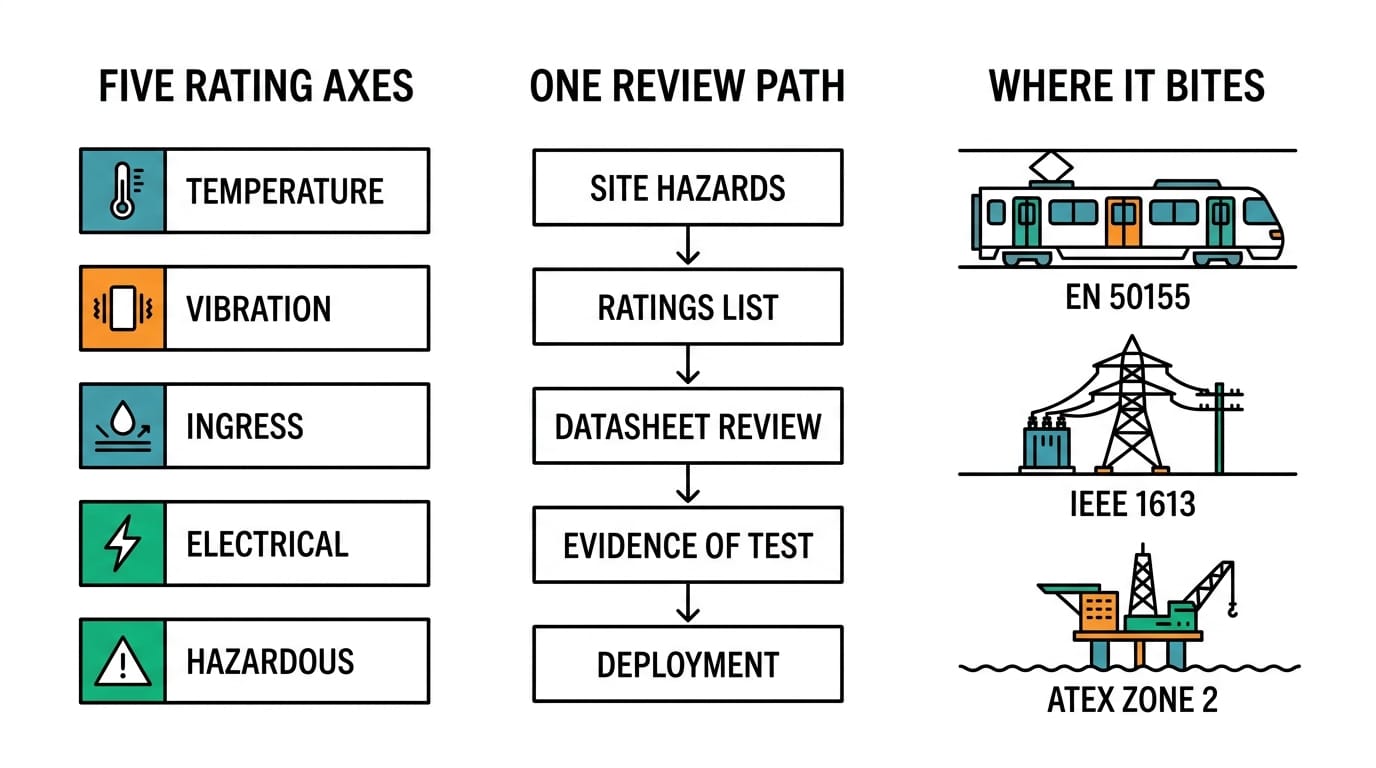
- Industrial ruggedness is not one rating. It is a stack of independent ratings covering temperature, vibration and shock, ingress, electrical stress, and location-specific certification. A system only needs the ones its environment actually demands.
- The word "industrial" on a datasheet means nothing by itself. Every hazard in the deployment should map to a named standard that the datasheet states explicitly.
- Ingress protection is defined by IEC 60529 (the IP code). Environmental durability is tested under MIL-STD-810G. These are different things and they get confused constantly.
- Certification follows the application: EN 50155 for railway, ATEX or Class I Division 2 for hazardous areas, IEEE 1613 for substations.
- Work hazard by hazard. List the real conditions of the site first, then require the matching ratings. Do not put a defense-grade box in a clean factory, and do not put an IP40 box on a pole.
What "industrial ruggedness" actually means
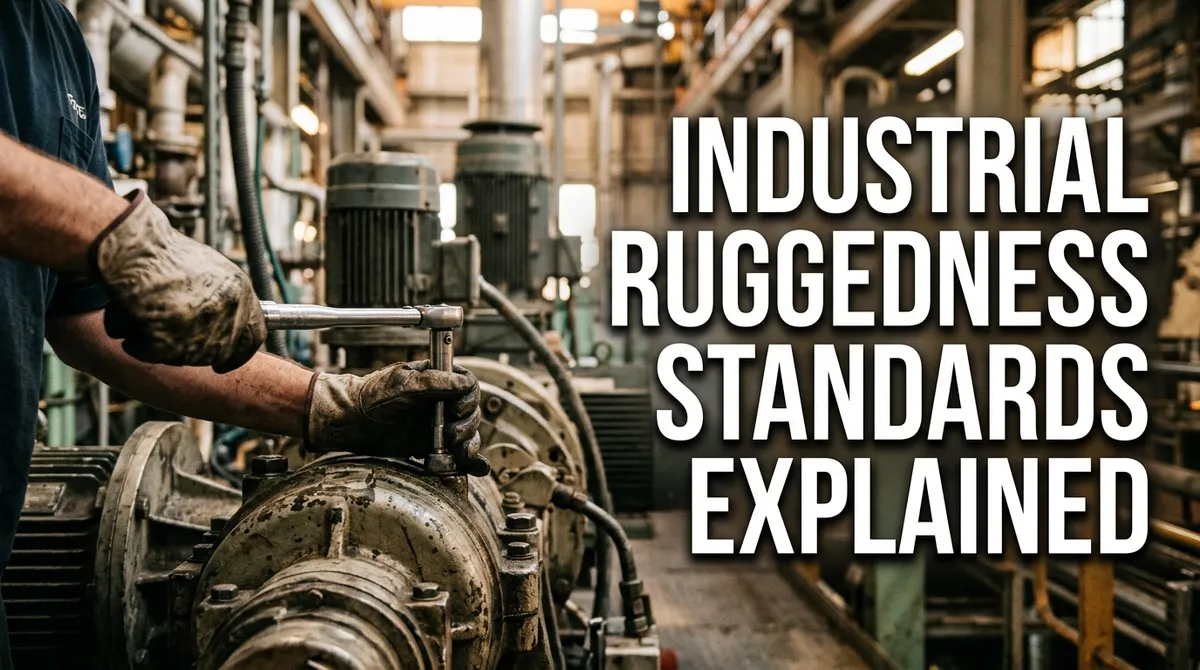
Industrial ruggedness is the measurable ability of a computing system to keep running under environmental stress (heat, cold, vibration, shock, dust, water, and electrical noise) for years of continuous duty. It is not a marketing label. It is a set of independent, testable ratings, each governed by a specific standard. For how impact and vandal resistance are graded, see our guide to IK ratings and vandal resistance for outdoor edge AI.
The electrical side of ruggedness has its own design guide: EMC and surge protection for industrial edge computers.
A system can be excellent on one axis and unfit on another. A unit rated to −40°C may have no meaningful ingress protection at all. A sealed IP69K enclosure may have never been tested for railway vibration. The two facts live in different sections of the datasheet and neither implies the other.
This is why "rugged" or "industrial-grade" on its own is not a specification. The useful question is always which ruggedness, to what level, verified against which standard. The rest of this reference breaks the stack into its parts and links to a focused guide for each one. If you are earlier in the process and still choosing a platform rather than a rating, start with the complete guide to choosing an industrial edge AI computer and come back here once the environment is defined.
How to choose the right ruggedness ratings
Choose ruggedness ratings by listing the deployment's real environmental hazards, then requiring the specific standard that addresses each one, in writing, on the datasheet.
The temptation is to reach for the toughest-sounding system and call it safe. That is expensive and often counterproductive. Over-specification adds size, weight, thermal mass, and cost, and it can rule out the I/O or GPU capacity the application actually needs. Under-specification is worse: it guarantees field failures that cost far more than the hardware ever did, because the failure happens in a substation or on a moving train, not on a bench.
The three most-confused ratings are environmental durability, dust and water ingress, and washdown resistance. They are compared directly in the spoke guide on MIL-STD-810G vs. IP67 vs. IP69K. If you only read one supporting article, read that one. A condensed version of the same discipline, framed as a procurement checklist, is in the 10-point checklist for choosing a rugged edge AI computer.
The sections below take each rating category in turn.
Temperature: operating range vs. storage range
Temperature is the rating most often misread, because datasheets list two different ranges and only one of them matters for operation.
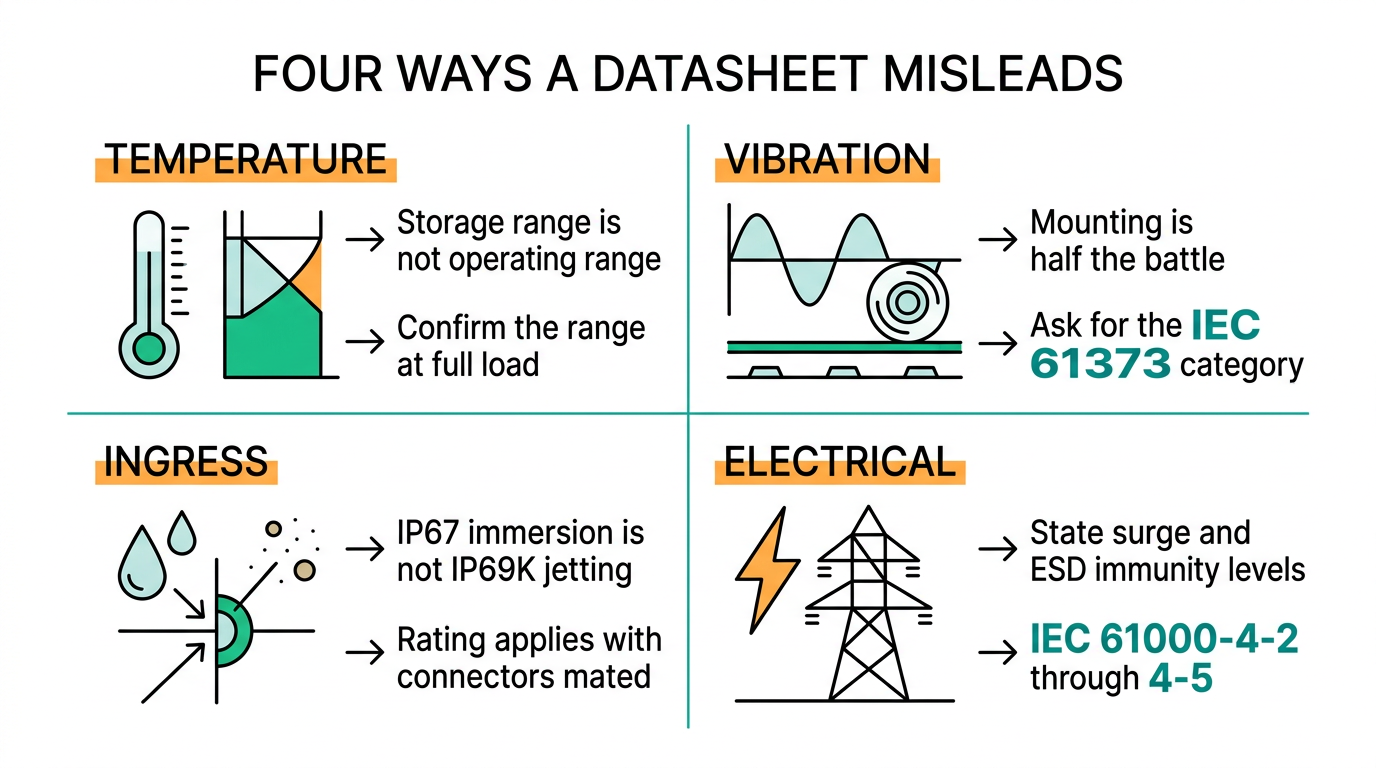
The storage range is how cold or hot the unit can sit when powered off. The operating range is what governs behavior under load, and it is always the narrower, more important number. A system advertised at "−40°C to 85°C" is frequently quoting storage. The operating range under sustained GPU load can be considerably tighter, and that is the number the deployment lives or dies on.
There is a second trap underneath the first. Two systems can quote the same headline operating range and behave completely differently at the top of it. A unit that holds rated clock speed at 60°C ambient is a different class of machine from one that thermally throttles at 50°C, even though both datasheets say 60°C. Throttling is not failure, so it does not violate the spec, but an inference pipeline that silently drops from 30 FPS to 11 FPS on a hot afternoon is a broken deployment regardless of what the paperwork says.
So confirm the operating range at full load, not at idle, and ask what happens at the top of the range rather than whether the range is met. For fanless systems the answer depends on conduction path and mounting: the same chassis bolted to a hot metal cabinet wall performs differently from one with airflow around its fins. Cold matters too. Systems deployed outdoors in winter may need a heater or a low-temperature startup rating, because a unit that runs fine at −30°C once running may not reliably boot at −30°C from cold.
Vibration and shock
Vibration and shock matter wherever a system is mounted on a vehicle, a rail car, or a heavy machine.
Sustained vibration is a slow, cumulative attack. It loosens connectors, fatigues solder joints, and destroys spinning storage. This is why rugged systems use soldered-down memory instead of DIMMs in sockets, solid-state storage instead of hard drives, and conduction-based cooling instead of fans. A fan is a moving part with a bearing, and a bearing in a vibration environment is a scheduled failure.
Environmental durability, which covers vibration along with shock, temperature cycling, humidity, and altitude, is tested under MIL-STD-810G, a US Department of Defense standard that industrial computing borrowed and now references widely. What each of its test methods actually proves is covered in the MIL-STD-810G certification guide. It is worth understanding that MIL-STD-810G is a family of test methods rather than a single pass/fail badge, so "MIL-STD-810G tested" is only meaningful when the datasheet names the methods and levels.
Mounting is half the battle and it is the half nobody specifies. For vehicle and rail installations, the mounting bracket, the damping, and the cable strain relief determine whether a system survives years of road or track input. A perfectly rated computer bolted rigidly to a chassis rail with an unsupported cable harness will still fail, and it will fail at the connector. These mechanical choices are worked through in the NVH and vibration design guide for vehicle-mounted edge computing.
Railway carries its own mechanical standard. IEC 61373 defines shock and vibration categories for rolling-stock equipment by mounting location, because equipment bolted to a bogie sees a very different spectrum from equipment in a passenger cabin. Underground mining is the other environment where vibration and ingress arrive together and neither can be traded away; the specific compute requirements there are covered in the buyer's guide for underground mining.
Ingress protection: reading the IP code
Ingress protection describes how well an enclosure keeps solids and liquids out. It is defined by IEC 60529 as a two-digit IP code.
The first digit rates protection against solids and dust on a 0 to 6 scale. The second rates protection against water on a 0 to 9K scale. The two digits are independent. This is the single most important thing to understand about IP codes, and it is why "waterproof" is not a useful word: IP65 and IP67 both begin with a 6 (fully dust-tight) but protect against completely different water events, and a device can be excellent against dust while being rated for nothing more than a light spray.
Three bands cover most industrial edge deployments:
- IP54 to IP65: protection against dust and low-pressure water jets. Suitable for many indoor industrial and light outdoor uses.
- IP67: fully dust-tight and protected against temporary immersion. The right answer for most outdoor and wet environments.
- IP69K: dust-tight and resistant to high-pressure, high-temperature washdown. Required in food, beverage, pharmaceutical, and sanitation environments.
Note that the scale is not strictly cumulative at the top. IP67 (temporary immersion) and IP69K (high-pressure hot washdown) test different failure modes, and a device may be rated for one and not the other. Where both matter, both need to be on the datasheet.
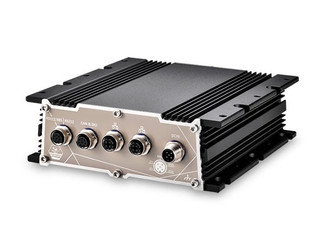
How these map to a real wet deployment is worked through in the IP67 edge computing design guide for water treatment plant monitoring. A sealed, fanless platform such as the POC-766AWP is built for the high-ingress, outdoor end of this range.
One practical warning: an IP rating applies to the enclosure as tested, with its connectors mated and its glands fitted. Leave one cable gland loose, swap a sealed connector for a standard one, or drill the enclosure for an extra antenna, and the rating is void. Ingress protection is a property of the installed system, not of the part number.
Electrical stress: EMC, surge, and transients
Environmental ruggedness gets the attention. Electrical ruggedness is what actually kills equipment in substations, on factory floors near variable-frequency drives, and on vehicles with inductive loads.
The hazards come in several forms. Electromagnetic interference is continuous noise coupling into cables and circuits. Electrostatic discharge is a fast, high-voltage event from a person or a tool. Surge is energy arriving on power or signal lines from switching events or lightning. Power-supply transients, common on vehicles and rolling stock, include voltage dips, interruptions, and load-dump spikes when a large load disconnects.
The standards that matter here sit in the IEC 61000 family, with IEC 61000-4-2 covering ESD immunity, 61000-4-4 covering electrical fast transients, and 61000-4-5 covering surge. Vehicle and rail systems layer their own supply requirements on top. This is why a wide-range DC input with proper isolation and ignition control is not a convenience feature on a vehicle computer, it is the thing standing between the computer and the alternator.
For any deployment near heavy switching equipment, ask for the immunity levels explicitly rather than accepting "EMC compliant," which usually means the device passes emissions limits (it does not interfere with others) and says nothing about whether it survives being interfered with.
Hazardous locations: ATEX and Class I Division 2
Hazardous-location ratings apply wherever flammable gas, vapor, or dust may be present: oil and gas, chemical processing, mining, grain handling, and paint or solvent areas.
The requirement here is different in kind from every other rating in this guide. Elsewhere the goal is to protect the equipment from the environment. In a classified area the goal is to protect the environment from the equipment. The system must not become a source of ignition, which constrains maximum surface temperature, enclosure design, and the electrical energy available at any exposed point.
Two regulatory schemes dominate. ATEX (EU Directive 2014/34/EU) governs equipment for potentially explosive atmospheres in Europe. The North American scheme, Class I Division 2, is defined by Article 500 of the US National Electrical Code. They use different vocabulary (zones vs. divisions) and are not interchangeable, so a system certified for one is not automatically acceptable under the other.
What these classifications require of an edge AI system, and how to read the zone and division markings, is covered in the guide to ATEX and C1D2 hazardous-location computing. A deployment in a classified area must require the specific zone or division rating on the datasheet. A general "rugged" claim is not just insufficient here, it is a compliance failure.
Railway: EN 50155
Railway rolling stock has the most comprehensive certification regime in industrial computing, and for a good reason: onboard electronics have to tolerate vibration, wide temperature swings, unstable supply voltage, EMC constraints, and fire-safety requirements at the same time, for a service life measured in decades.
The governing standard is EN 50155 (CENELEC), which is less a single test than an umbrella that references a family of related standards. It defines temperature classes for different mounting positions, specifies how the equipment must behave through supply interruptions and voltage fluctuations, and pulls in IEC 61373 for shock and vibration plus separate EMC and fire-safety requirements.
The supply-interruption behavior deserves particular attention because it is where general industrial hardware quietly fails. Train power is not clean, and EN 50155 requires the equipment to ride through defined interruptions without rebooting. An edge AI system that reboots on every dip is useless onboard regardless of how well it handles vibration.
The full set of onboard requirements is detailed in the EN 50155 compliance guide for railway edge AI. Compact fanless systems in the POC-700 series are positioned for onboard transit and rail mounting.
Substations and grid: IEEE 1613
Electrical substations combine intense electromagnetic interference with wide temperature ranges and, frequently, no climate control at all. Equipment installed there follows IEEE 1613, which defines environmental and testing requirements for communications networking devices in electric power substations.
IEEE 1613 is usually paired with IEC 61850-3, which covers the general requirements for communication networks and systems in power utility automation. The pairing matters because IEEE 1613 has a stricter view of what counts as acceptable behavior during an EMI event: it distinguishes between equipment that may suffer temporary degradation and equipment that must keep operating with no errors at all. For protection and control functions, only the latter is acceptable.
For grid-edge and utility deployments, these are the ratings that separate suitable equipment from general industrial hardware, and they are not optional. The compute selection process for this environment is covered in the buyer's guide for substation and smart grid monitoring.
Outdoor and washdown environments
Outdoor deployments stack several hazards at once: temperature extremes, solar gain, moisture, dust, and often vibration or constrained remote power. Solar load is the one most often missed. An enclosure in direct sun can sit 20°C or more above ambient air temperature, which means a 45°C summer day is a 65°C problem for the box on the pole.
The design response combines a wide operating temperature range, a high IP rating, conduction cooling with no fan to clog, and surge-protected I/O. How these requirements combine in the field is covered in the guide to designing rugged edge AI for outdoor energy and telecom deployment.
Washdown environments (food, beverage, pharmaceutical) add a specific and unforgiving requirement: resistance to high-pressure, high-temperature cleaning, which is the IP69K rating. Here the enclosure design, connector sealing, and surface finish matter as much as the IP digit itself. Crevices that trap water or product are a sanitation failure even when the electronics survive, which is why washdown-rated equipment tends toward smooth stainless surfaces and sloped tops.
How to read a ruggedness datasheet
A short checklist for the specification review, in the order the mistakes usually happen:
- Find the operating temperature range and confirm it is not the storage range. Then find whether it is quoted at full load.
- For any MIL-STD-810G claim, find the named test methods and levels. "Tested to MIL-STD-810G" without methods is not a specification.
- Read both IP digits separately. Confirm the rating covers the actual water event on site (spray, immersion, or washdown), not just "outdoor."
- For vibration, check whether the rating matches the mounting location, not just the vehicle type. IEC 61373 categorizes by position for exactly this reason.
- For any classified area, require the zone or division marking. No exceptions, no substitutions.
- For EMC, separate emissions from immunity and ask for immunity levels.
- Confirm the ratings apply to the system as configured. Added antennas, swapped connectors, and expansion cards can void an ingress rating.
Ruggedness selection matrix
Map the environment to the ratings, then require them by name on the datasheet.
| Environment | Temperature | Ingress (IEC 60529) | Vibration / shock | Certification |
|---|---|---|---|---|
| Indoor factory floor | Standard industrial | IP40–IP54 | Light | — |
| Outdoor / energy / telecom | Wide operating range | IP65–IP67 | Moderate | — |
| Washdown (food / pharma) | Standard | IP69K | Light | — |
| Vehicle / mobile | Wide operating range | IP54–IP67 | High (MIL-STD-810G) | — |
| Railway rolling stock | Temperature class | IP54+ | High (IEC 61373) | EN 50155 |
| Hazardous area | Application-specific | Sealed | Moderate | ATEX / Class I Div 2 |
| Electrical substation | Wide operating range | IP54+ | Moderate | IEEE 1613 / IEC 61850-3 |
Standards referenced in this guide
| Standard | Body | What it covers |
|---|---|---|
| IEC 60529 | IEC | Degrees of protection provided by enclosures (the IP code) |
| MIL-STD-810G | US Department of Defense | Environmental engineering considerations and laboratory test methods |
| IEC 61373 | IEC | Railway rolling stock equipment: shock and vibration tests |
| EN 50155 | CENELEC | Electronic equipment used on railway rolling stock |
| ATEX (2014/34/EU) | European Union | Equipment for use in potentially explosive atmospheres |
| Class I, Division 2 | US NEC, Article 500 | Hazardous (classified) locations |
| IEEE 1613 | IEEE | Environmental and testing requirements for networking devices in substations |
| IEC 61850-3 | IEC | Communication networks and systems for power utility automation |
| IEC 61000-4-2 / -4-4 / -4-5 | IEC | ESD immunity, electrical fast transients, and surge immunity |
Conclusion
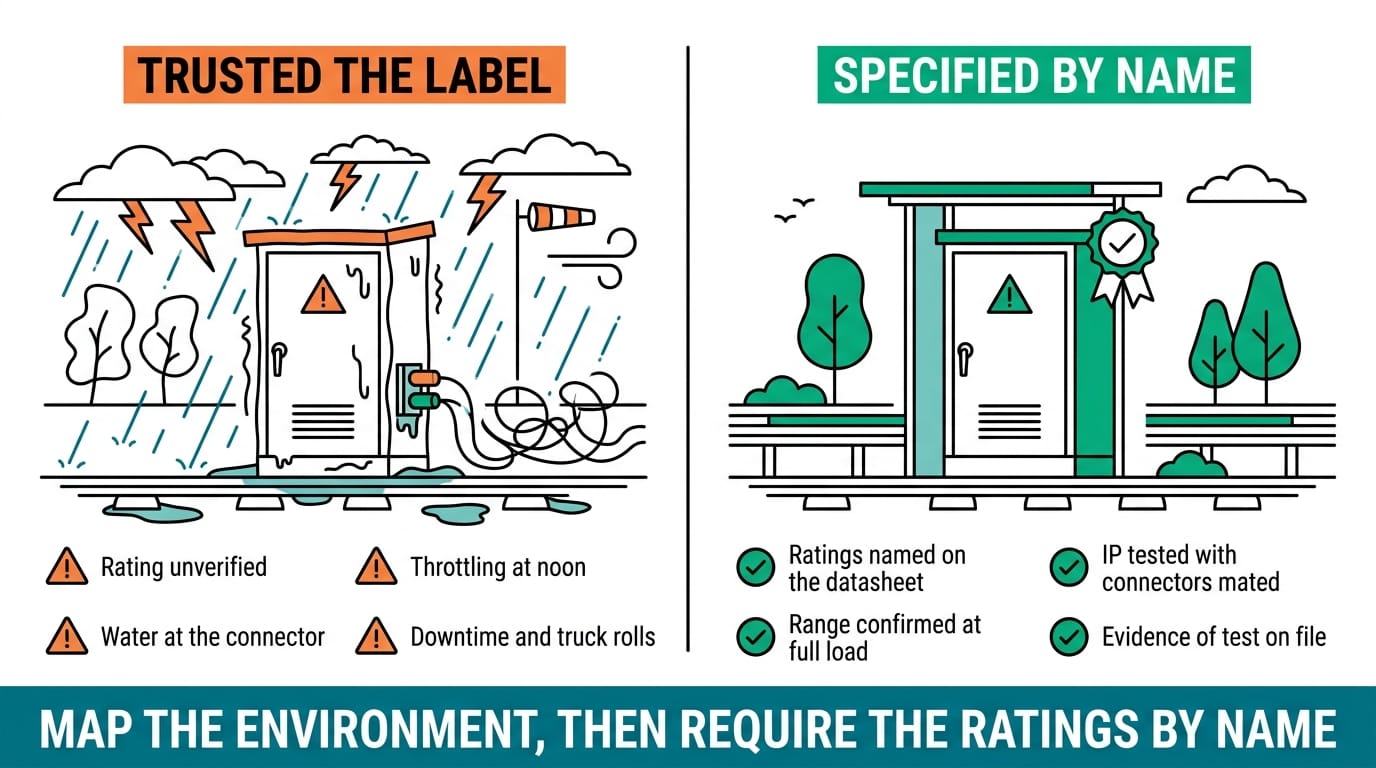
Ruggedness is a stack, not a score. Temperature, vibration, ingress, electrical immunity, and location certification are separate axes, and a system that is outstanding on four of them and blank on the fifth will fail on the fifth. The work is unglamorous: list the hazards, name the standards, read both IP digits, and check that the rating survives the way the system is actually installed. Get it wrong and you find out in a substation at 2 a.m., not in the lab.
Follow Neteon on LinkedIn for more deep dives, or reach us at [email protected] or www.neteon.net to talk through the ruggedness requirements for a specific deployment.
Related Products

FAQs
What is the difference between MIL-STD-810G and an IP rating?
MIL-STD-810G is a US Department of Defense standard for environmental durability testing, covering vibration, shock, temperature, humidity, and altitude. An IP rating, defined by IEC 60529, describes only resistance to solids and liquids. A system can pass MIL-STD-810G yet have a low IP rating, or the reverse, so both must be checked independently.
What does an IP rating actually mean?
An IP rating is a two-digit code from IEC 60529. The first digit rates protection against solids and dust (0-6); the second rates protection against water (0-9K). IP67 means fully dust-tight and protected against temporary immersion, while IP69K adds resistance to high-pressure, high-temperature washdown. The digits are independent and must be read separately.
Which ruggedness standard do I need for a railway deployment?
Railway rolling-stock electronics follow EN 50155, which references related standards for temperature class, power-supply behavior, EMC, and fire safety. Mechanical shock and vibration are covered by IEC 61373, which categorizes requirements by mounting location. A railway deployment should require EN 50155 compliance explicitly.
What rating is required for hazardous or explosive environments?
Hazardous areas require an ATEX rating (EU Directive 2014/34/EU) or a North American Class I, Division 2 rating (US National Electrical Code Article 500), depending on the region. The specific zone or division marking must appear on the datasheet. A general rugged claim is not sufficient and is a compliance failure.
Is a wider operating temperature range always better?
No. Specify the operating range that matches the worst-case ambient at full load, and confirm it is the operating range rather than the storage range. A wider range than the deployment needs adds cost without benefit, while a system that thermally throttles at the real ambient under-delivers regardless of its headline numbers.
Related reading: rugged onboard pantograph monitoring with the Cincoze DX-1300.
Sources and further reading
U.S. DoD ASSIST: MIL-STD-810 environmental testing.
Neousys rugged computer product catalog.
Related Neteon guides
How to Choose an Industrial Edge AI Computer.
IK Impact Ratings and Vandal Resistance for Outdoor Edge AI.
Browse the edge ai topic hub for more deployment guidance.
About the author and technical review
Author: Olivia Parker covers product-to-market strategy for edge AI, AIoT, and embedded systems.
Technical review: Neteon Industrial Computing Editorial Team. Reviewed August 5, 2026 for source quality, product-specification links, standards references, and clear separation of measured results from reference-architecture assumptions.
Evidence note: Unless a linked primary source explicitly identifies measured field results, performance figures and system outcomes in this article are design targets or planning estimates, not guaranteed results.