
TLDR
Electromagnetic interference and voltage surges cause more field failures in industrial edge AI than heat or vibration, yet they get the least design attention. This guide covers the four coupling paths that put an edge computer at risk, the IEC 61000-4 immunity levels worth designing to, and a wiring and grounding approach that holds up in substations, trackside cabinets, and factory floors. Products referenced: Nuvo-9160GC, POC-766AWP, Nuvo-11000, POC-700. For how impact and vandal resistance are graded, see our guide to IK ratings and vandal resistance for outdoor edge AI.
For the heat side of rugged enclosure design, see our guide to thermal design for fanless edge AI in high-ambient environments.
Overview
Most edge AI deployments die in the same boring way. A relay coil switches, a variable frequency drive ramps, lightning hits a line half a mile off, and the computer reboots or corrupts a frame mid-inference. Nobody wrote it down as an EMC failure because the log just shows a watchdog reset.
Ruggedness specs get all the marketing, but ingress and shock ratings say nothing about whether a box survives a 2 kV burst on its power line. For the environmental side of the picture, our complete reference on industrial ruggedness and compliance standards covers IP, MIL-STD, and temperature. This guide handles the electrical half: interference coupling in, and transient energy that has to be shunted before it reaches the CPU. If you are still choosing between ratings, our breakdown of MIL-STD-810G vs IP67 vs IP69K is a useful companion, and the design patterns here extend the outdoor approach in our rugged energy and telecom deployment guide.
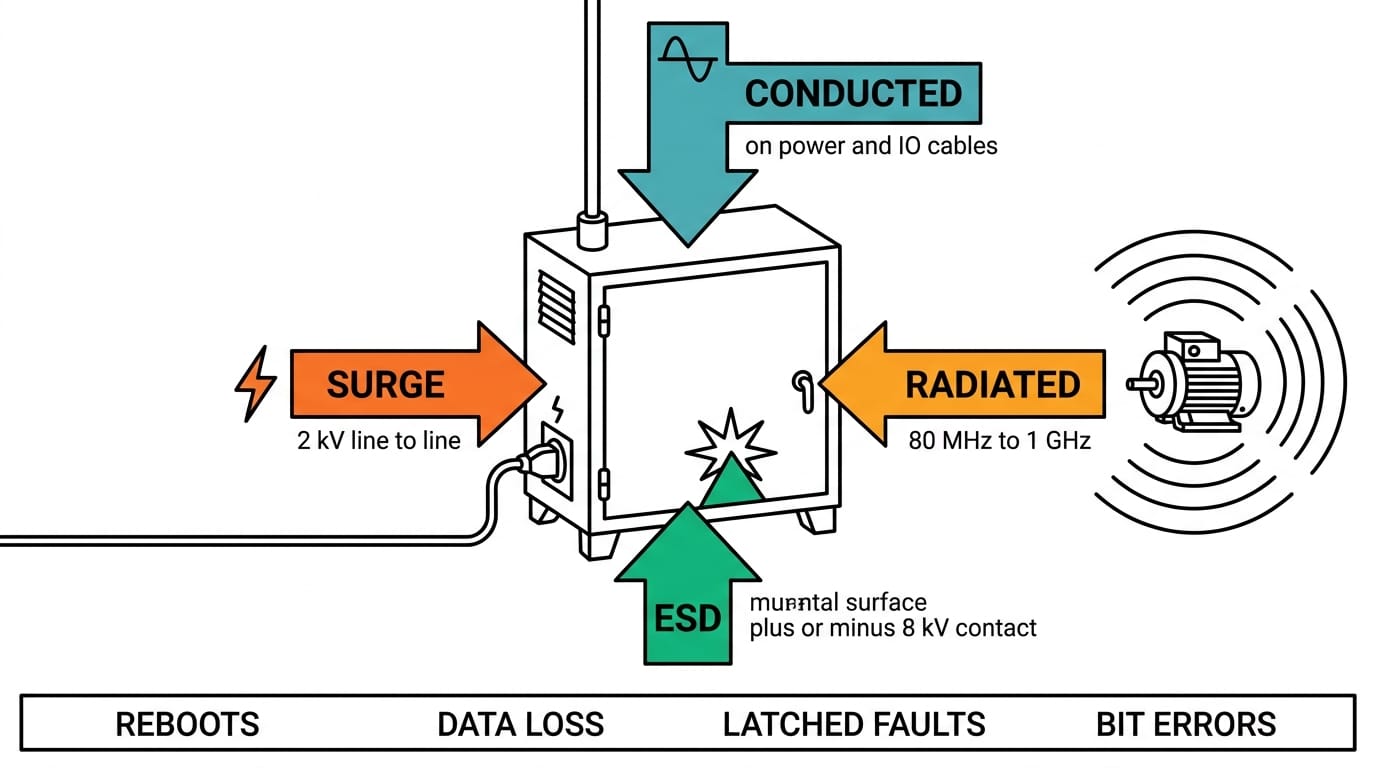
System architecture
Interference reaches an edge computer through four paths. Design against each one at a specific point in the system, not with a single fix.
| Coupling path | Typical source | Test standard | Where you stop it |
|---|---|---|---|
| Conducted transient on DC power | Inductive load switching, motor drives | IEC 61000-4-4 (EFT), IEC 61000-4-5 (surge) | TVS and MOV at the power entry, isolated DC input |
| Electrostatic discharge | Operators, moving material, dry air | IEC 61000-4-2 | Chassis bonding, isolated front-panel I/O |
| Radiated RF field | Radios, VFDs, nearby transmitters | IEC 61000-4-3 | Metal enclosure, shielded cable, gasketed seams |
| Conducted RF on signal lines | Long camera and sensor runs | IEC 61000-4-6 | Shielded cabling, common-mode chokes, single-point ground |
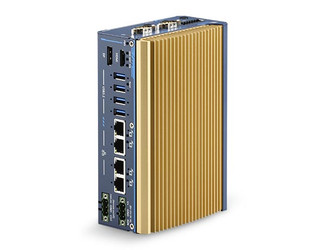
A GPU platform like the Nuvo-9160GC already carries isolated digital I/O and a wide-range 8 to 48V DC input, so the two hardest paths, power transients and front-panel ESD, are handled at the chassis rather than on your carrier board. That is the pattern to copy even when you integrate your own I/O.
Environmental design factors
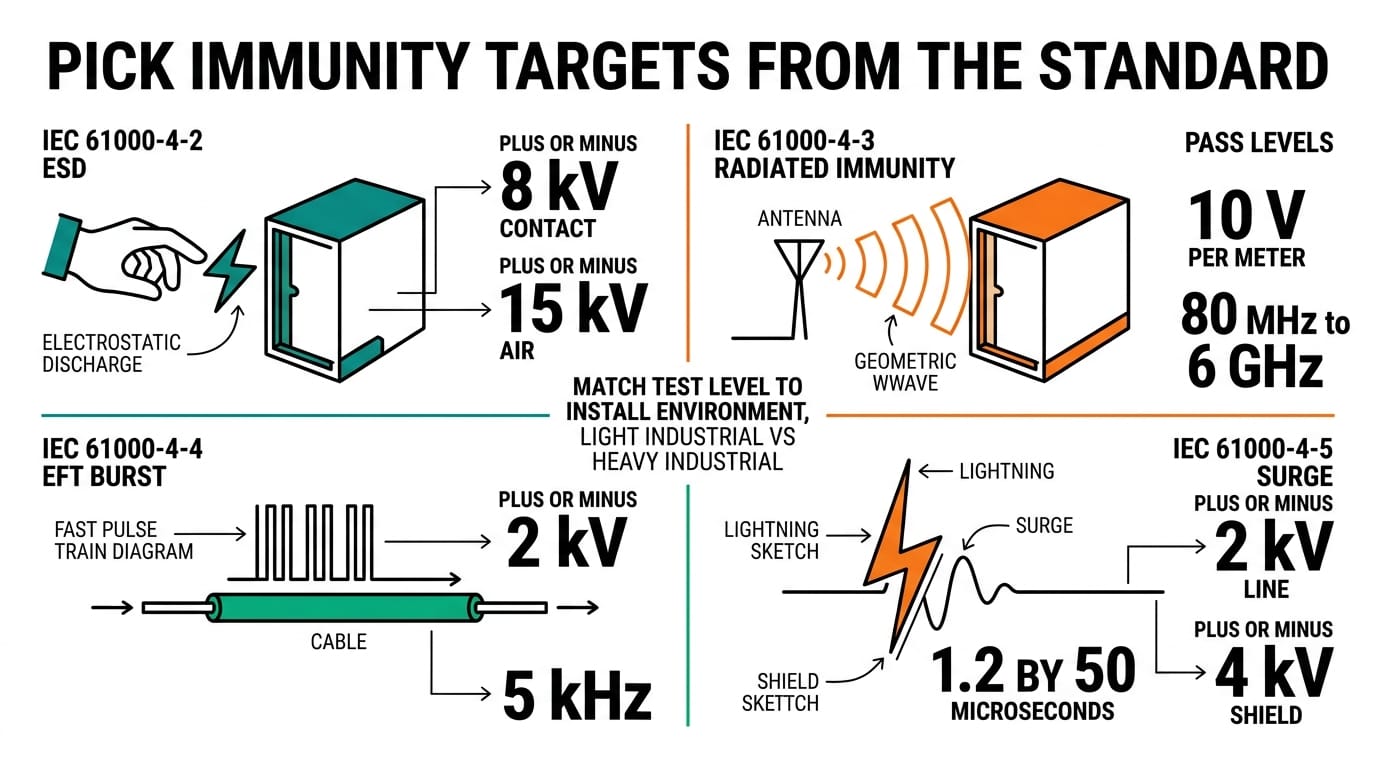
Pick immunity targets from the environment, not from a generic datasheet line. A bench next to an office is not a traction substation.
| Parameter | General factory | Substation / trackside | Design note |
|---|---|---|---|
| Surge immunity (power) | 1 kV line-to-line | 2 to 4 kV line-to-ground | IEC 61000-4-5; substations follow IEC 61850-3 / IEEE 1613 |
| EFT / burst | 1 kV | 2 kV | IEC 61000-4-4; worst near contactors and drives |
| ESD (contact / air) | 4 kV / 8 kV | 6 kV / 8 kV | IEC 61000-4-2 at every touchable surface |
| Radiated RF immunity | 3 V/m | 10 V/m | IEC 61000-4-3; raise it near two-way radios |
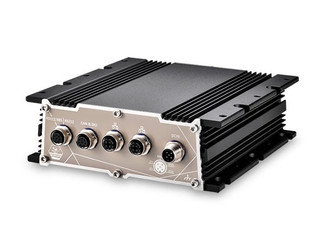
The POC-766AWP is built for the far column. Its IP66 and IP69K sealed body uses M12 connectors that keep shield continuity through the gland, which matters as much for RF immunity as it does for water. The Nuvo-11000 and the compact POC-700 bring the same isolated wide-range power input into smaller cabinet and in-vehicle spots where a surge on the battery bus is the real threat.
Integration notes
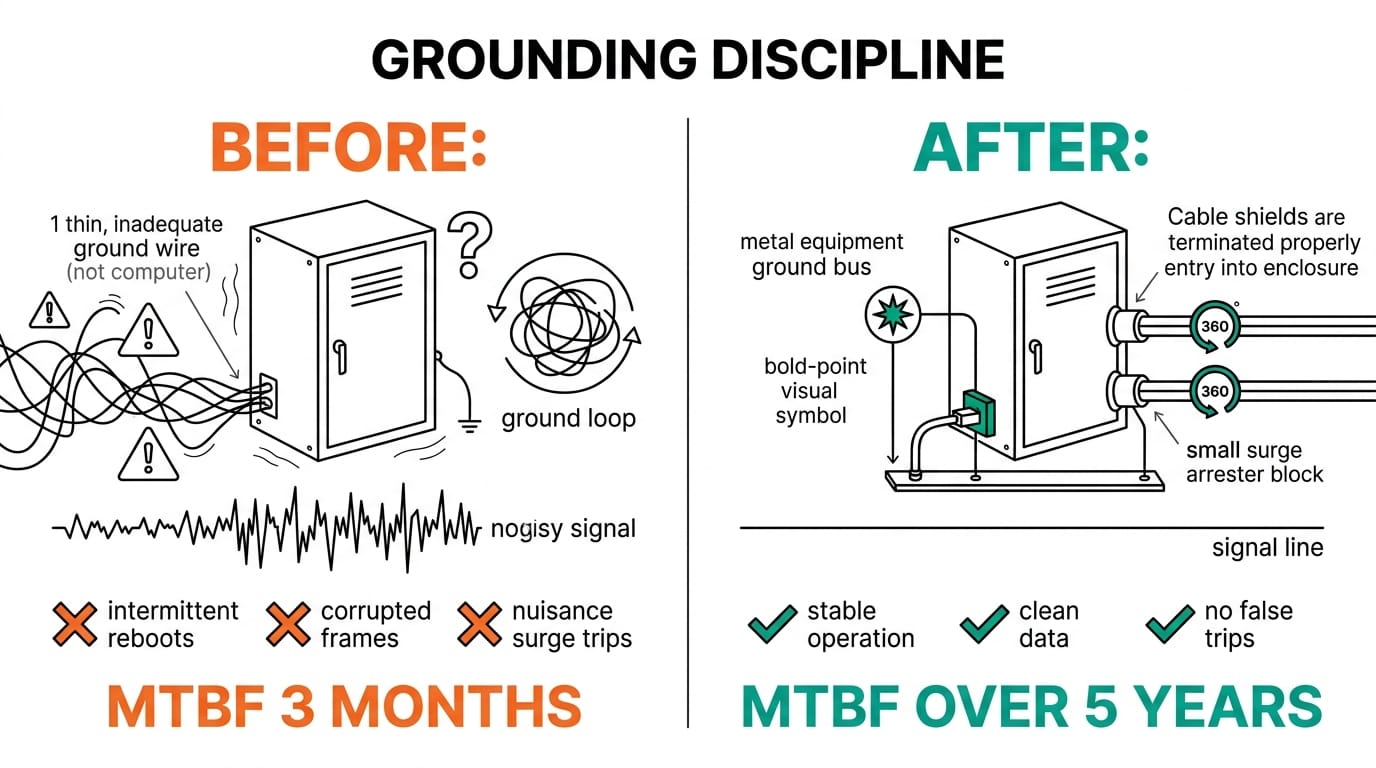
Grounding is where good hardware gets ruined. Bond the chassis to the cabinet ground bar with a short, wide strap, not a thin daisy-chained wire, because impedance at high frequency is about geometry, not DC resistance. Give the system one ground reference. Two grounds at different potentials turn every shielded cable into an antenna and a fault path.
Terminate cable shields at the enclosure entry, not at the CPU board, so transient current drains to the chassis before it reaches logic. On camera and encoder runs over a few meters, add a common-mode choke at the connector. Keep the DC input pair twisted and away from any 400V drive wiring sharing the cabinet. If the site sees frequent switching transients, put an external surge protection device on the incoming DC as a first stage and let the computer's internal TVS clamp the residual. Staged protection beats one big clamp every time.
Validation checklist
Do not assume immunity, measure it. Before a site goes live, confirm each item.
- Chassis bonded to cabinet ground with a strap under 10 cm where possible
- All shields terminated at the enclosure boundary, single-point ground confirmed
- DC input isolation verified, no continuity between field ground and logic ground
- External SPD fitted where surge exposure exceeds the internal clamp rating
- EFT and surge pre-compliance run per IEC 61000-4-4 and 4-5 at the target level
- ESD test at 6 kV contact on every operator-reachable surface
- Camera and sensor lines run separately from drive and contactor wiring
Conclusion
EMC design is not exotic. It is grounding discipline, staged transient protection, and picking immunity levels that match the site. Neousys platforms give you a head start because the isolation and wide-range power that survive dirty DC are already in the box, but the wiring outside it is still yours to get right. Start with the coupling table, set your levels from the environment, and validate before you ship.
Follow Neteon on LinkedIn for more field-focused design guides, contact [email protected], or visit www.neteon.net for datasheets and to talk through an EMC-hardened edge AI build.
Related Products

FAQs
Which is more dangerous to an edge computer, EMI or a power surge?
They fail differently. EMI corrupts data and triggers watchdog resets while the system is running, whereas a surge can destroy the power input outright. Design for both: shielding and grounding against interference, and TVS and MOV clamping plus isolation against surges.
What IEC 61000-4 immunity levels should an industrial edge AI computer meet?
For a general factory, target IEC 61000-4-2 ESD at 4 kV contact, 61000-4-4 EFT at 1 kV, 61000-4-5 surge at 1 kV, and 61000-4-3 radiated immunity at 3 V/m. Substation and trackside sites push surge to 2 to 4 kV and radiated immunity to 10 V/m, often under IEC 61850-3 or IEEE 1613.
Where should I terminate cable shields?
At the enclosure entry, bonded to the chassis, not at the CPU board. That drains transient current to ground before it reaches logic. Use a single ground reference so shielded cables do not become fault paths between two grounds.
Does an isolated DC input remove the need for external surge protection?
No. Isolation breaks ground loops and blocks common-mode noise, but high-energy surges still need clamping. Fit an external surge protection device as a first stage and let the computer's internal TVS handle the residual.
Do Neousys edge computers have built-in EMC protection?
Platforms like the Nuvo-9160GC, Nuvo-11000, and POC-700 include isolated I/O and a wide-range DC input with transient protection at the power entry. The POC-766AWP adds a sealed IP66 and IP69K body with M12 connectors for shield continuity. External wiring and grounding still need proper design.
Sources and further reading
IEC 61000 electromagnetic compatibility series.
Neousys rugged computer product catalog.
Related Neteon guides
MIL-STD-810G vs IP67 vs IP69K Ratings.
Machine Vision Design: Camera to GPU Inference.
Browse the design guide topic hub for more deployment guidance.
About the author and technical review
Author: Olivia Parker covers product-to-market strategy for edge AI, AIoT, and embedded systems.
Technical review: Neteon Industrial Computing Editorial Team. Reviewed August 5, 2026 for source quality, product-specification links, standards references, and clear separation of measured results from reference-architecture assumptions.
Evidence note: Unless a linked primary source explicitly identifies measured field results, performance figures and system outcomes in this article are design targets or planning estimates, not guaranteed results.