
TLDR: EN 50155 is the umbrella standard that governs onboard electronics for trains and trams, but the test pack actually pulls in IEC 61373 (shock and vibration), EN 50121-3-2 (rolling-stock EMC), and EN 45545-2 (fire and smoke). Edge AI computers that pass type approval need wide-temperature operation, voltage-class compliance with hold-up through interruptions, and a chassis that survives sustained mechanical stress. The POC-700 and POC-766AWP are validated against this envelope, which is why most operators use them for cab, saloon, and roof-mounted compute.
What EN 50155 actually covers
This guide is part of a broader complete reference to industrial ruggedness and compliance standards, which maps every rating to the environments that require it.
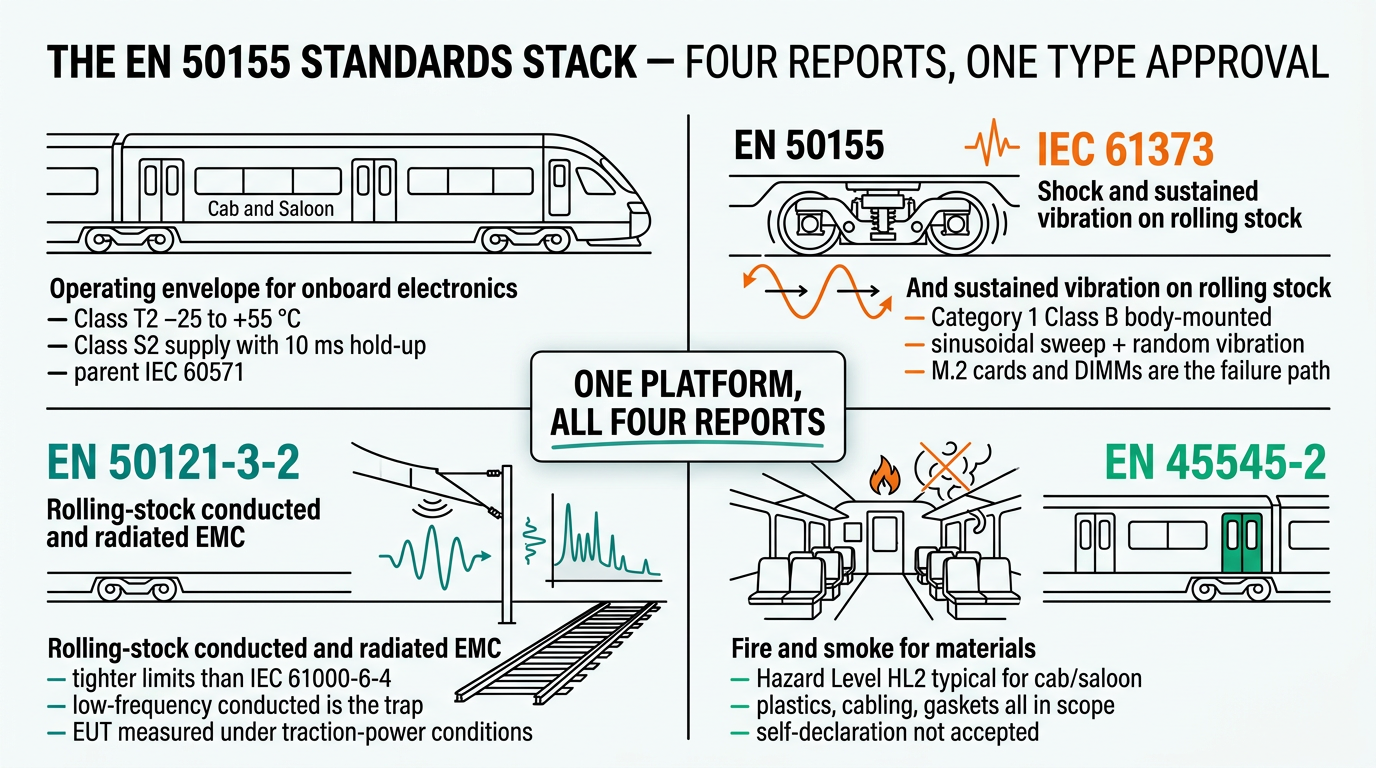
EN 50155 (and its parent IEC 60571) defines the operating envelope for any electronic equipment installed on rail vehicles, from train control units to passenger Wi-Fi gear. The standard is rarely tested on its own. Auditors expect a stack of supporting evidence showing the unit also clears EN 50121-3-2 for EMC, EN 45545-2 for fire and smoke, and IEC 61373 for shock and vibration. Anyone speccing onboard compute should treat EN 50155 as a system of overlapping standards rather than a single report.
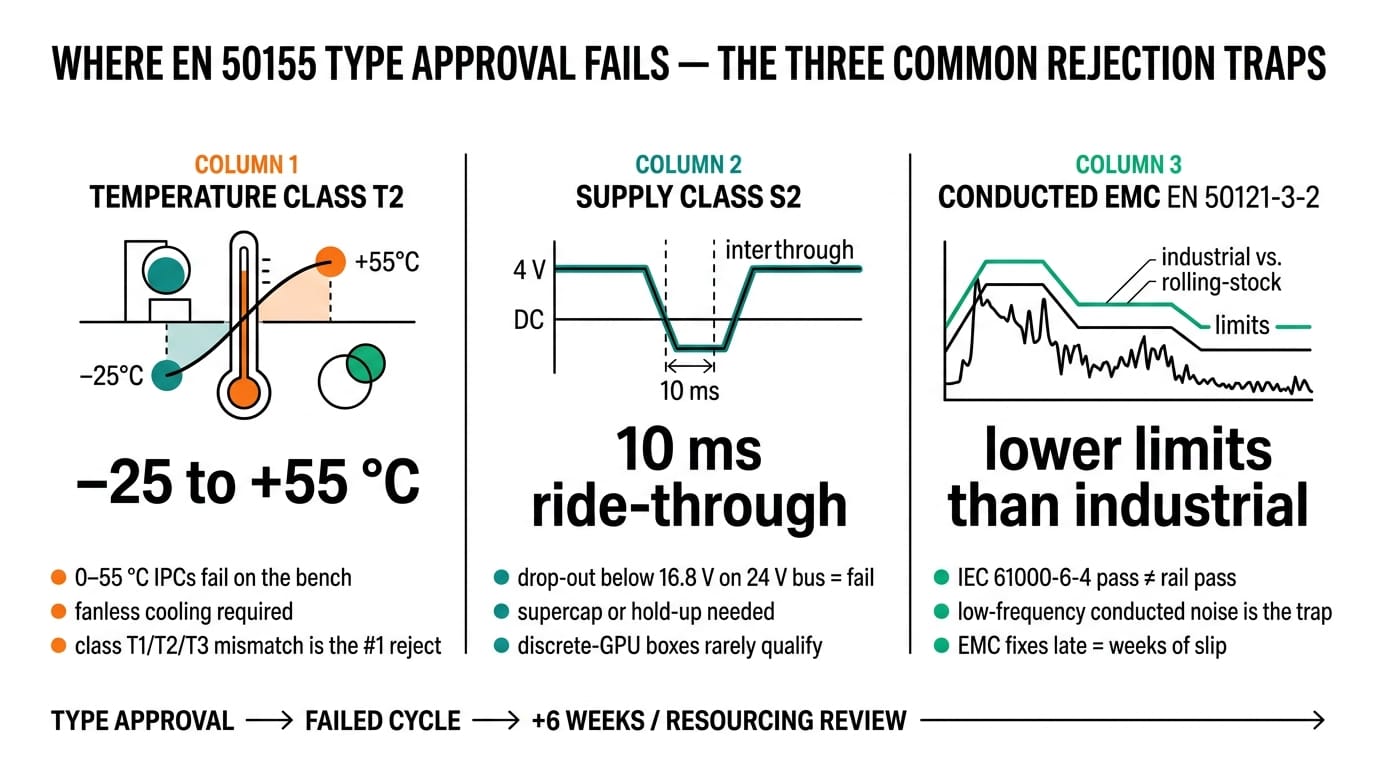
Most type-approval rejections trace back to three places: temperature class, supply class, and conducted EMC. A computer rated only at 0 to 55 °C will fail T2 (–25 to +55 °C) on the bench, no matter what the marketing sheet says. A unit that drops out below 16.8 V on a 24 V nominal bus cannot be certified to S2. And a board that clears industrial conducted-emissions limits will often fail the tighter rolling-stock limits at the low end of the spectrum.
What the standard requires
| EN 50155 area | Test reference | Threshold |
|---|---|---|
| Operating temperature | T1 / T2 / T3 / TX | –25 to +55/+70/+85 °C body |
| Storage temperature | TS1 / TS2 | –40 to +70 / +85 °C |
| Supply voltage | S1 / S2 / S3 | 24 / 36 / 48 / 72 / 110 V nominal |
| Voltage interruptions | Class S2 | 10 ms hold-up minimum |
| Shock and vibration | IEC 61373 Cat 1 Cl B | Body-mounted, sustained vibration |
| Conducted and radiated EMC | EN 50121-3-2 | 150 kHz–6 GHz, train-side limits |
| Fire and smoke (housing and cabling) | EN 45545-2 | Hazard level HL2 minimum |
Each line above is a separate report from an accredited lab. Rail buyers will not accept self-declaration on most of these, and a missing report holds the whole build at the type-approval gate until somebody books another test slot.
Which Neteon products comply
| Product | Temperature class | Supply class | Shock and vibration | Application fit |
|---|---|---|---|---|
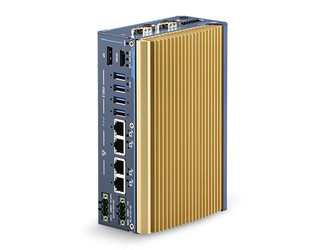
| POC-700 | –25 to +70 °C (T2) | 8–35 V wide input | IEC 61373 Cat 1 Cl B | Onboard CCTV, PIS, driver consoles |
| POC-766AWP | –25 to +70 °C (T2) | 8–35 V wide input | IEC 61373 Cat 1 Cl B | Roof-mounted comms, antenna head end |
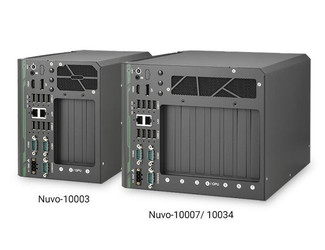
| Nuvo-10000 | –25 to +70 °C (T2) | 8–48 V wide input | IEC 61373 Cat 1 Cl B | Aggregation gateway, train-line server |
Both POC-700 and POC-766AWP ship with M12-X coded power and Ethernet, which lines up with PLANET switches like the IGS-604HPT-M12 and ISW-808PT-M12 for vehicle-bus connectivity. The combined chain — compute, switch, and DIN-rail PSU — is what most operators submit as a single tested assembly.
Real-world implications
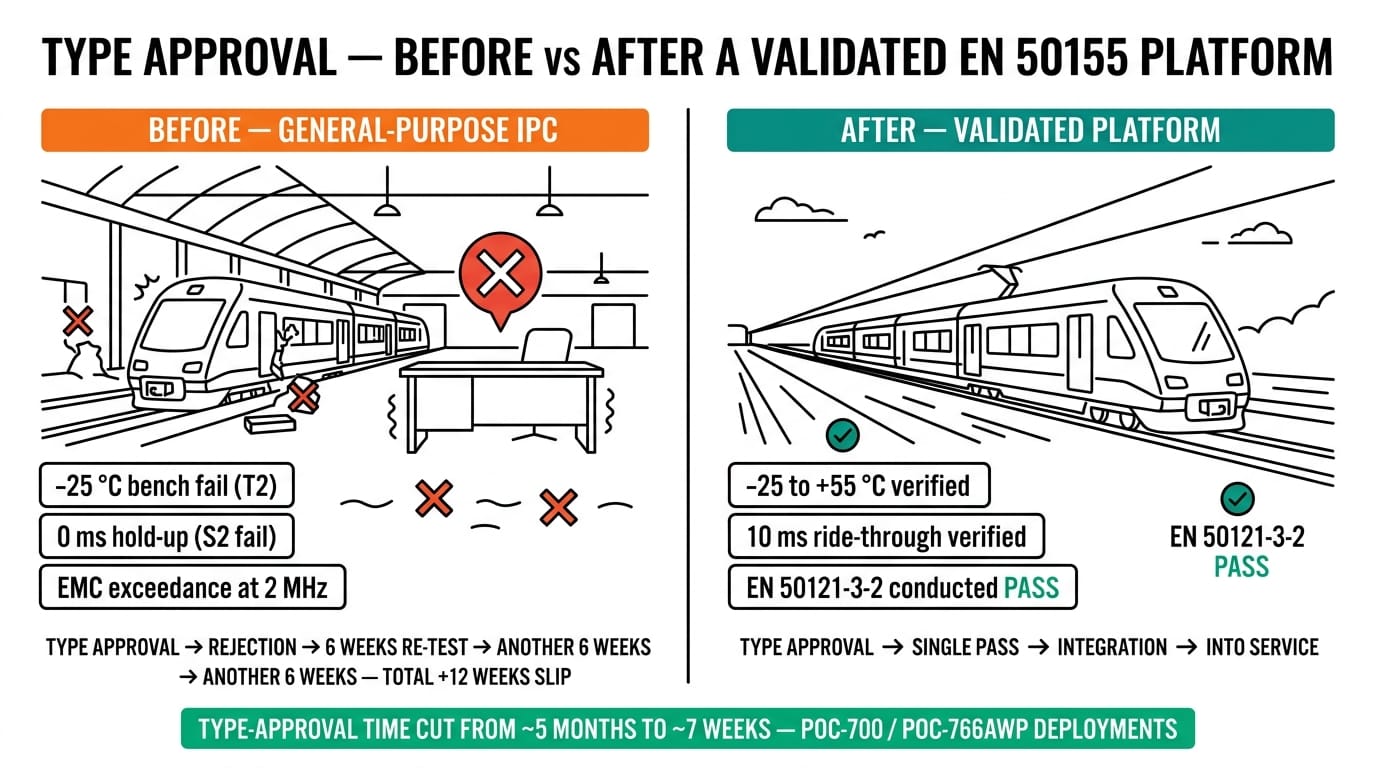
As we noted in our railway and transit buyer's guide, procurement teams routinely underestimate the cost of late-stage compliance failures. A failed test cycle adds weeks of schedule slip per round, and most programmes have at most two attempts before someone calls a sourcing review.
A few implications follow from that.
Vibration is harder than temperature. Sustained sinusoidal vibration to IEC 61373 punishes mechanical fasteners, M.2 cards, and any unsoldered DIMM. Our NVH and vibration design guide walks through the resonance traps that catch out general-purpose IPCs.
Power excursions kill margin. S2 demands the unit ride through a 10 ms full interruption. Most edge platforms with discrete GPUs cannot do that without a supercap or battery interface, which is why POC-700-class fanless designs are favoured for cab and saloon installations over GPU boxes.
EMC is the silent killer of programme schedules. Rolling-stock conducted-emissions limits are tighter than industrial ones. Equipment that passes IEC 61000-6-4 will often fail EN 50121-3-2, and the rework needed to fix conducted noise at that point is expensive enough to matter. For a comparable POC-700 deployment in service, see our case study on how POC-700 cut fleet computing footprint 62 percent in urban transit; much of that benefit traces back to the same EN 50155 envelope.
Related Products

Conclusion
EN 50155 is less a single test than a small set of overlapping standards that all have to clear before a unit can be installed on a vehicle. Specifying a platform like the POC-700 or POC-766AWP that has already been validated across temperature, supply, shock, EMC, and fire pulls weeks out of type approval, and it removes the rejection causes that show up most often in design review.
Follow Neteon on LinkedIn, contact [email protected], visit www.neteon.net for datasheets and EN 50155 test reports.
FAQs
Is EN 50155 the same as IEC 60571?
They are functionally aligned. IEC 60571 is the international parent standard; EN 50155 is the European harmonised version of the same envelope. Most rail buyers in Europe and Asia accept either, but operators almost always specify EN 50155 in tender documents.
What is the difference between Class T1 and T2?
T1 covers -25 to +55 degrees C ambient at the equipment body; T2 extends the upper limit to +70 degrees C. Roof-mounted boxes and any equipment inside an engine bay or unventilated cabinet usually need T2 or higher.
Do I need a separate IEC 61373 test if I have EN 50155?
Yes. EN 50155 references IEC 61373 but does not include the shock and vibration profiles inside its own clauses. Plan for a dedicated IEC 61373 report from an accredited lab; rail buyers will not accept a self-declaration in its place.
Can a fanless POC-700 carry a discrete GPU for onboard AI?
The POC-700 family is designed without discrete GPUs to keep the chassis sealed and the thermal envelope inside class T2. For GPU-accelerated railway workloads such as platform-edge object detection, an EN 50155-compliant rack-mount or expansion-box platform is the right choice.
What supply class do I need for a 110 V battery DC bus?
Class S3 covers 72 V and 110 V nominal under the EN 50155 voltage tolerance bands. Confirm the platform handles both the 0.7 Un to 1.25 Un range and the 10 ms full interruption before signing off the spec; many wide-input boxes rated for 24 V do not meet S3.
Related reading: onboard pantograph monitoring with the Cincoze DX-1300.
Sources and further reading
Federal Railroad Administration safety resources.
Neousys rugged computer product catalog.
Related Neteon guides
MIL-STD-810G vs IP67 vs IP69K Ratings.
Railway and Transit Edge AI Computer Buyer’s Guide.
Browse the poc 700 topic hub for more deployment guidance.