

TLDR
Ruggedness ratings are not interchangeable. MIL-STD-810G validates mechanical and environmental endurance (shock, vibration, altitude, temperature). IP67 certifies dust-tight enclosures that survive 30-minute water immersion at 1m. IP69K certifies survival of high-pressure, high-temperature washdown spray. Pick the wrong rating and deployments fail in the field, even when every other spec looks right. This guide compares the three standards side-by-side, maps them to real deployment scenarios, and shows which Nuvo-9160GC, POC-700, and POC-766AWP configurations meet each requirement. For how impact and vandal resistance are graded, see our guide to IK ratings and vandal resistance for outdoor edge AI.
For how these ratings play out on a wet production line, see our guide to choosing an edge AI computer for IP69K vision inspection.
Ingress and shock ratings say nothing about electrical immunity; for that, see our guide to EMC and surge protection for industrial edge computers.
This guide is part of a broader complete reference to industrial ruggedness and compliance standards, which maps every rating to the environments that require it.
Overview
Procurement teams routinely ask us for "rugged" edge AI computers without specifying against what. MIL-STD-810G, IP67, and IP69K cover entirely different failure modes — a chassis can pass one and fail another in the same physical test cycle.
This article is the Standards Explainer counterpart to our 10-Point Checklist for Choosing a Rugged Edge AI Computer and our earlier MIL-STD-810G Engineering Guide. If your deployment involves outdoor enclosures, washdown environments, or mobile platforms, match the standard to the stress profile before writing the spec — not after a returns report. For wet-environment design trade-offs specifically, see our IP67 Edge Computing Design Guide for Water Treatment Plants.
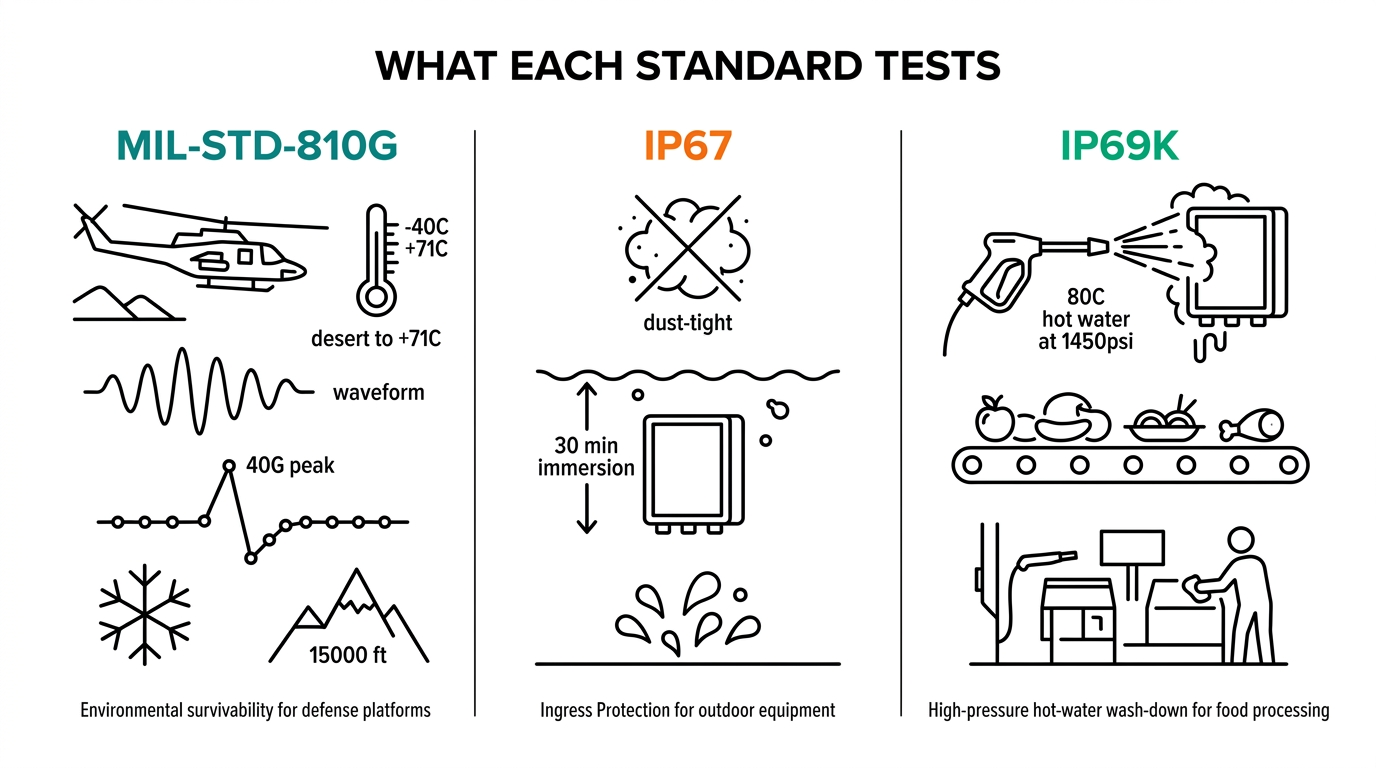
What Each Standard Actually Requires
The three ratings test different things. This table summarizes the test conditions engineers should check against their deployment environment.
| Standard | What It Certifies | Key Tests | Typical Deployment |
|---|---|---|---|
| MIL-STD-810G | Mechanical + environmental endurance | Shock (40G), vibration (3–5 Grms random), altitude (15,000 ft), thermal cycling (-40°C to +70°C), humidity (95% RH) | Vehicle-mounted, airborne, defense, mining |
| IP67 | Dust-tight, 30-min water immersion at 1 m | Dust chamber 8 hr, water tank immersion 30 min | Outdoor cabinets, agriculture, water/wastewater, telecom sites |
| IP69K | High-pressure, high-temp washdown | 80°C water jet at 80–100 bar, 0.25 m nozzle distance, 4 angles, 30 sec each | Food processing, pharma, commercial kitchens, cleanroom equipment |
MIL-STD-810G is a procedure, not a pass/fail certificate. Each test method (e.g., Method 514.6 for vibration) defines parameters but the deployment profile is negotiated between buyer and vendor. IP ratings, by contrast, are IEC 60529 pass/fail with specified water volumes, pressures, and dwell times.
Which Neteon Products Comply
Not every Neteon platform needs every rating. The matrix below maps our current SKU ranges to the three standards so you can match the right product to your threat model.
| Product | MIL-STD-810G | IP67 | IP69K | Best Fit |
|---|---|---|---|---|
| POC-700 | Shock + vibration methods | IP40 chassis only | No | In-vehicle telematics, ITS, rugged fleet |
| POC-766AWP | Shock + vibration methods | IP67 (full chassis) | No | Outdoor enclosures, marine, offshore, wet sites |
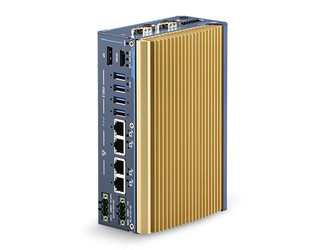
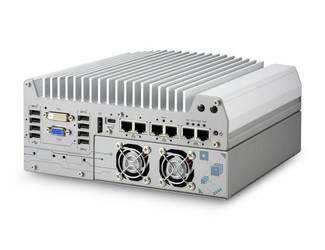
| Nuvo-9160GC | Shock + vibration (wide-temp variant) | IP40 chassis, IP67 via enclosure | No | GPU inference in fanless rugged cabinets |
For IP69K-grade washdown applications (food processing lines, pharma fill/finish rooms), none of the fanless Neousys platforms ship with IP69K certification as a chassis rating; they are typically installed inside an IP69K stainless enclosure with cable glands rated to the same standard. We specify those assemblies on a project basis.
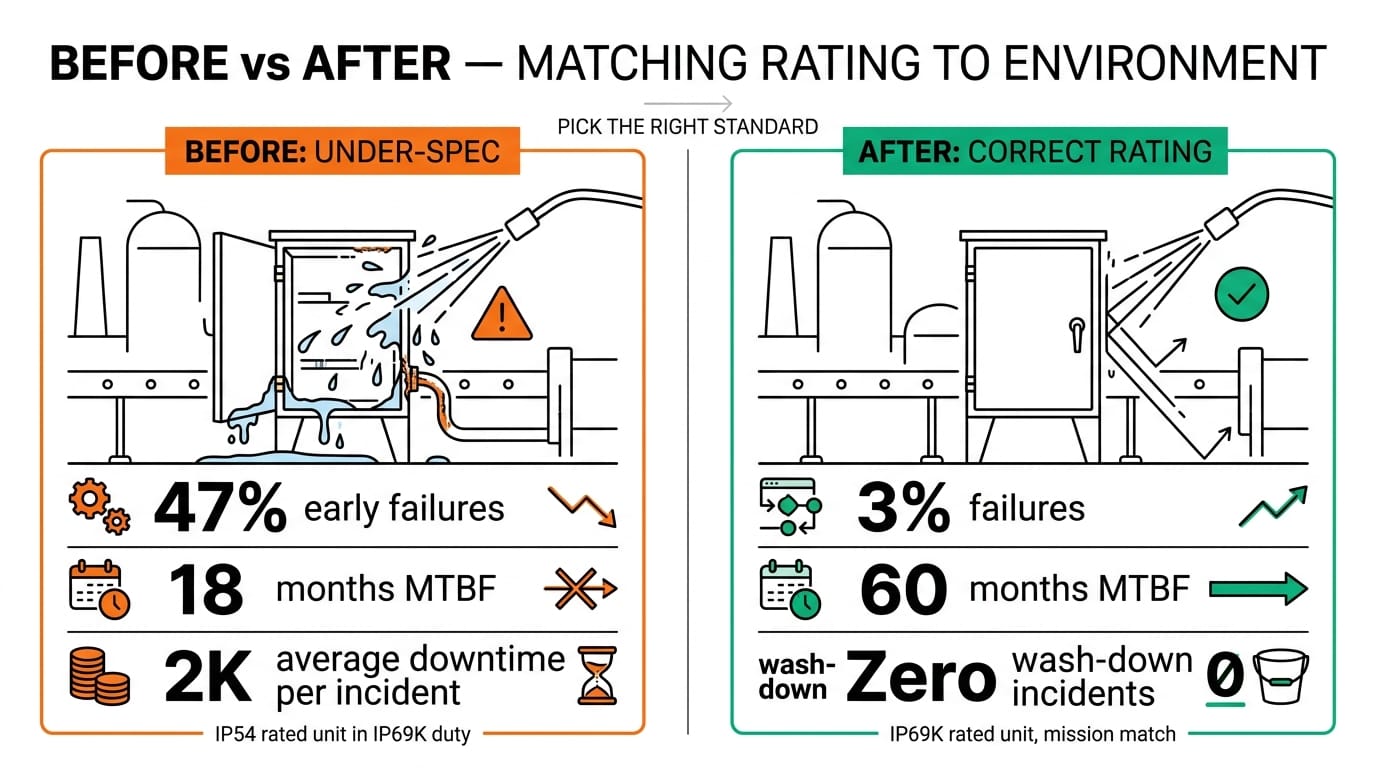
A point often missed: IP67 does not imply IP69K, and IP69K does not imply IP67. They test different water-ingress profiles. A chassis can pass one and fail the other. If your deployment has both static rain exposure and periodic sanitation washdown — common in dairy processing and pharmaceutical packaging — you need both ratings explicitly called out in the bill of materials.
Real-World Implications
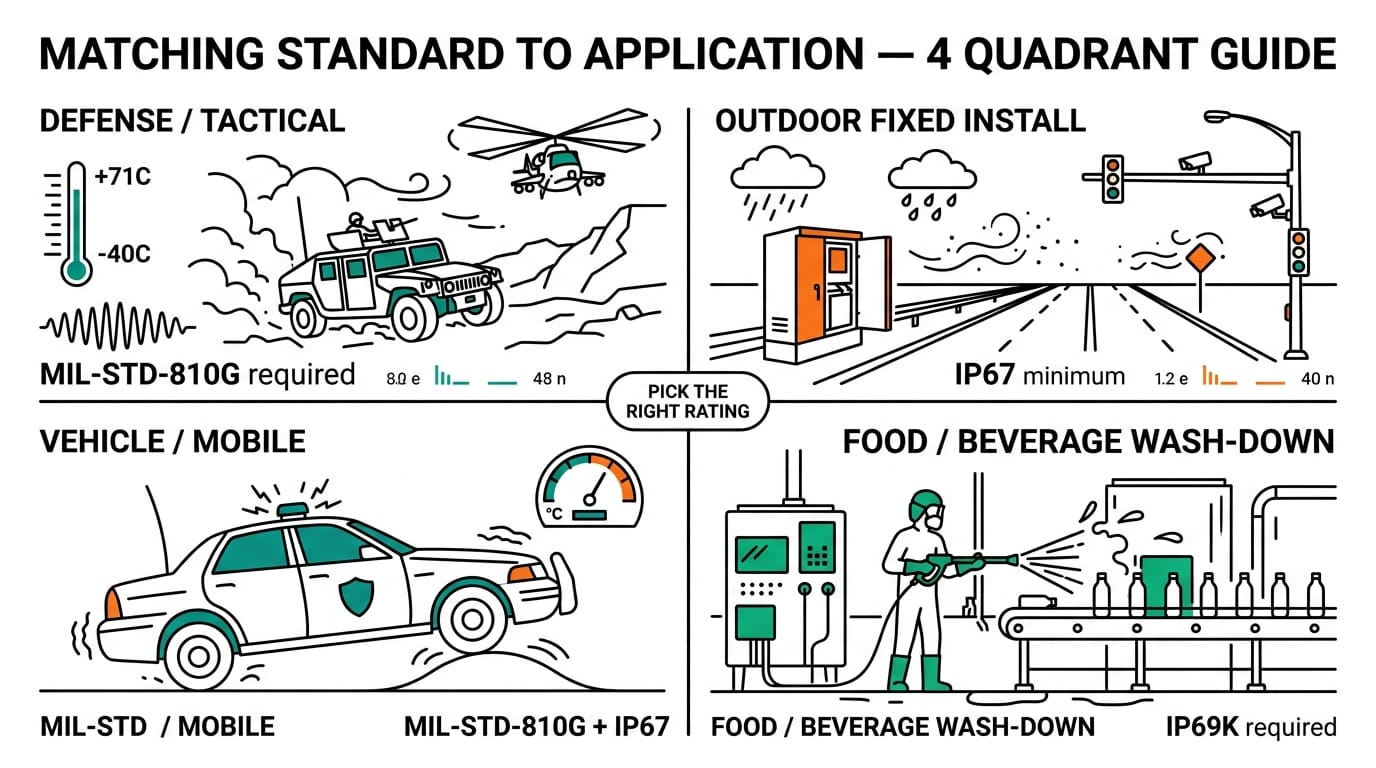
Three deployment patterns we see most often.
Mobile + shock (MIL-STD-810G): Vehicle-mounted deployments — fleet telematics, construction vehicles, rail — fail most often at the connector layer, not the CPU. MIL-STD-810G Method 514 vibration testing exposes loose M.2 modules and cable strain-relief weaknesses before they fail in the field. The POC-700 ships with M12 automotive connectors and IGN power for this exact reason. See our NVH & Vibration Design Guide for the full vibration-profile discussion.
Outdoor + rain (IP67): Telecom sites, offshore platforms, roadside cabinets — IP67 keeps driven rain and condensate out of the chassis over a decade-long deployment. The POC-766AWP is the specific SKU for this: IP67 on the enclosure itself, M12 connectors throughout, -40°C to +70°C operating range. We covered the full design methodology in Designing Rugged Edge AI Systems for Outdoor Energy and Telecom Deployment.
Washdown (IP69K): Food processing and pharma lines run high-pressure sanitation cycles every shift. An IP67 chassis will fail after 20–40 washdowns. IP69K with 316L stainless enclosure and food-grade gaskets is the only reliable path. Spec the enclosure, the cable glands, and the mounting hardware all to IP69K — gaps at any layer compromise the rating.
Related Products

Conclusion
Ruggedness is not a single axis. MIL-STD-810G addresses mechanical endurance, IP67 addresses rain and submersion, IP69K addresses high-pressure sanitation. Mixing them up produces field failures that look like random attrition but trace back to a spec written against the wrong standard.
Before writing your next rugged edge AI computer RFQ, document the deployment stress profile — shock, vibration, dust, liquid, pressure, temperature — then match each stress to the standard that tests it. Neteon's POC-700, POC-766AWP, and Nuvo-9160GC families each target a different profile; we can help you match the SKU to the environment.
Follow Neteon on LinkedIn for more ruggedness deep-dives, or contact [email protected] and www.neteon.net for datasheets and project-specific guidance.
FAQs
Is MIL-STD-810G a pass/fail certification like IP67?
No. MIL-STD-810G is a library of test methods, not a single pass/fail certificate. Each method (shock, vibration, altitude, thermal) defines parameters, but the deployment profile is negotiated between buyer and vendor. IP67 and IP69K, by contrast, are IEC 60529 standards with fixed water volumes, pressures, and dwell times — either the chassis passes or it fails.
Does IP67 certification include IP69K protection?
No. IP67 and IP69K test different water-ingress profiles. IP67 validates 30-minute immersion at 1m depth; IP69K validates high-pressure (80–100 bar), high-temperature (80°C) washdown spray. A chassis can pass one and fail the other. If your deployment involves both outdoor rain exposure and periodic sanitation washdown, you need both ratings explicitly specified in the BOM.
Which Neteon product is IP67-rated for outdoor deployment?
The POC-766AWP is the IP67-rated fanless platform in Neteon's lineup. It ships with an IP67 enclosure, M12 waterproof connectors, and a -40°C to +70°C operating range. It's the preferred SKU for telecom sites, offshore platforms, roadside cabinets, and marine deployments. The POC-700 and Nuvo-9160GC are IP40 chassis and typically deployed inside a separate IP67-rated enclosure when needed.
Does Neousys offer an IP69K-certified chassis for food processing?
None of the standard fanless Neousys platforms ship with IP69K as a chassis rating. For IP69K food processing or pharmaceutical washdown applications, we specify a project-based assembly: the Neousys platform installed inside a 316L stainless steel IP69K enclosure with food-grade gaskets and IP69K cable glands. All layers — enclosure, glands, and mounting hardware — must be IP69K-rated; gaps at any layer compromise the rating.
How does MIL-STD-810G vibration testing affect connector selection?
MIL-STD-810G Method 514 vibration testing exposes weaknesses at the connector layer — loose M.2 modules, unsecured cable strain reliefs, and standard DSUB connectors that back out under vibration. Vehicle-mounted and rail deployments should specify M12 automotive-grade connectors with positive locking, which is why the POC-700 ships with M12 I/O and IGN power as standard.
Sources and further reading
IEC 60529 enclosure protection (IP Code).
U.S. DoD ASSIST: MIL-STD-810 environmental testing.
Related Neteon guides
IK Impact Ratings and Vandal Resistance for Outdoor Edge AI.
Rugged Edge AI for Outdoor Energy and Telecom.
Browse the nuvo 9160gc topic hub for more deployment guidance.
About the author and technical review
Author: Olivia Parker covers product-to-market strategy for edge AI, AIoT, and embedded systems.
Technical review: Neteon Industrial Computing Editorial Team. Reviewed August 5, 2026 for source quality, product-specification links, standards references, and clear separation of measured results from reference-architecture assumptions.
Evidence note: Unless a linked primary source explicitly identifies measured field results, performance figures and system outcomes in this article are design targets or planning estimates, not guaranteed results.