
TLDR: Automakers and fleet operators are moving beyond connected vehicles to embedding edge AI compute directly in cabs, chassis, and trailers. By 2030, industry analysts project over 60% of new commercial vehicles will ship with an onboard edge AI node for driver assistance, predictive maintenance, cargo monitoring, or autonomous operation. For fleet integrators and OEMs, this means sourcing ruggedized, in-vehicle computers that can survive E-Mark shock, wide-temperature swings, and unregulated 12V/24V power — while running GPU-accelerated inference at the edge.
For the wider context, see our complete guide to edge AI in transportation and vehicles.
On the install side, see our guide to vehicle edge AI power design: wide-range DC input and ignition control.
Related reading: an NRU-220 ramp-safety case study at a cargo airport.
Why edge AI is moving inside the vehicle
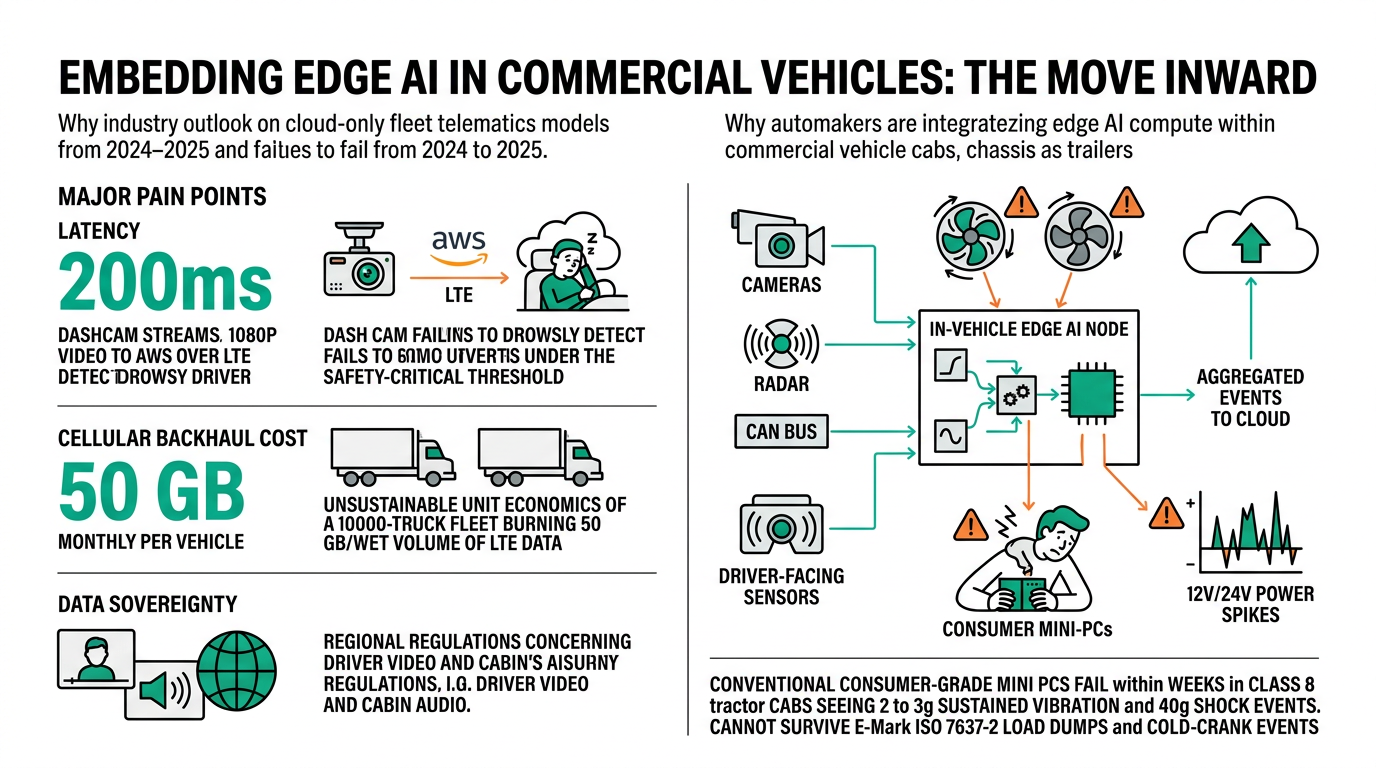
Cloud-only fleet telematics hit three hard walls in 2024–2025: latency, cellular backhaul costs, and data sovereignty. A dashcam streaming 1080p video to AWS over LTE burns roughly 50 GB per vehicle per month. Multiply that across a 10,000-truck fleet and you get unsustainable unit economics — plus you still can't detect a drowsy driver in under 200 ms, which is the safety-critical threshold for driver-monitoring systems.
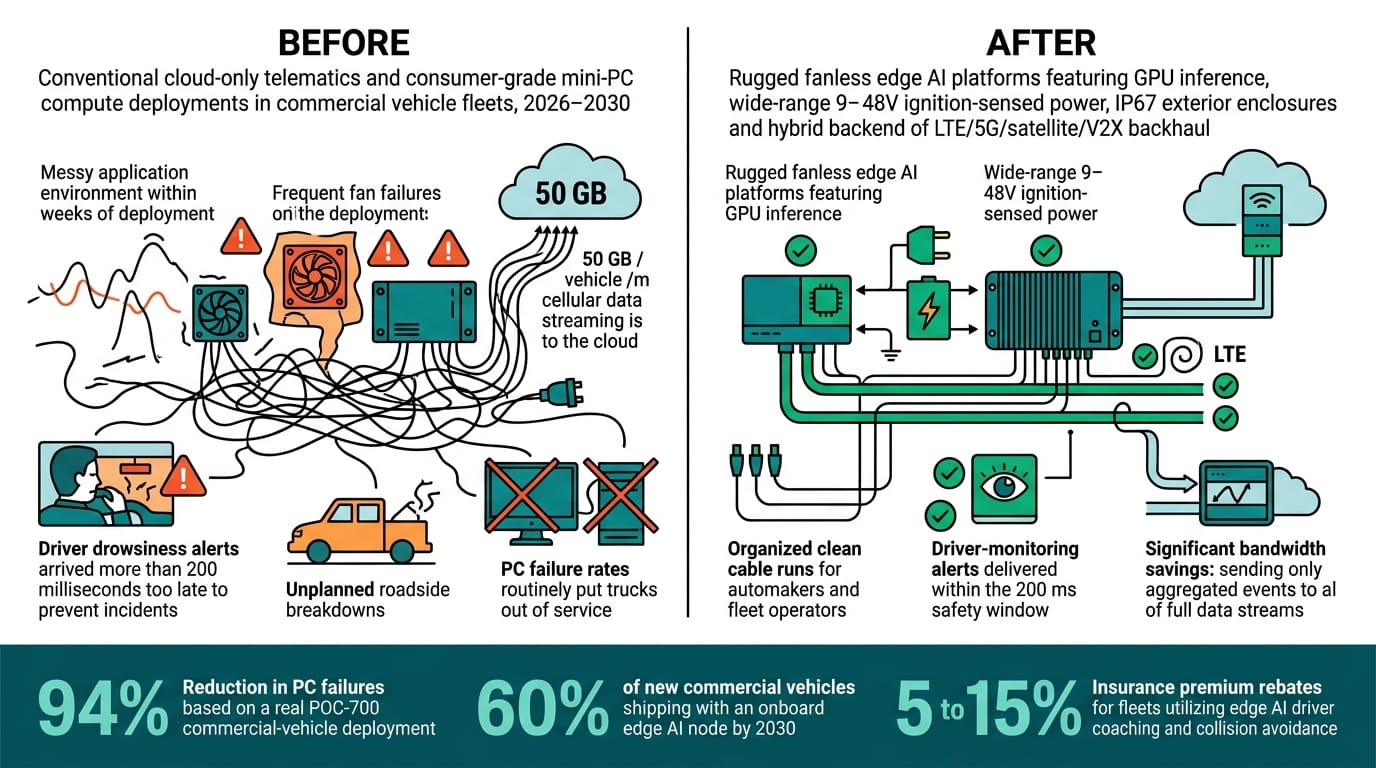
Edge AI flips the model: inference runs locally on an in-vehicle rugged computer with a GPU or NPU, only events and aggregated telemetry go up to the cloud. This is the same architectural shift we covered in our private 5G edge AI outlook — except the "factory floor" is now the cab of a Class 8 truck bouncing down I-80. Real-world fleet outcomes back this up: a POC-700 commercial-vehicle deployment reduced PC failures by 94% versus the consumer mini-PCs it replaced.
Key trends shaping 2026–2030
| Trend | 2026 baseline | 2030 projection |
|---|---|---|
| New commercial vehicles with onboard AI | ~18% | ~62% |
| Typical in-vehicle compute budget | 20–40 TOPS | 150–300 TOPS |
| Video channels processed per vehicle | 2–4 | 6–12 |
| Required operating temperature | -30°C to 70°C | -40°C to 85°C |
| Ingress protection target | IP54 | IP67 |
| Vehicle-level OTA model updates | Pilot | Standard |
Impact on edge computing hardware
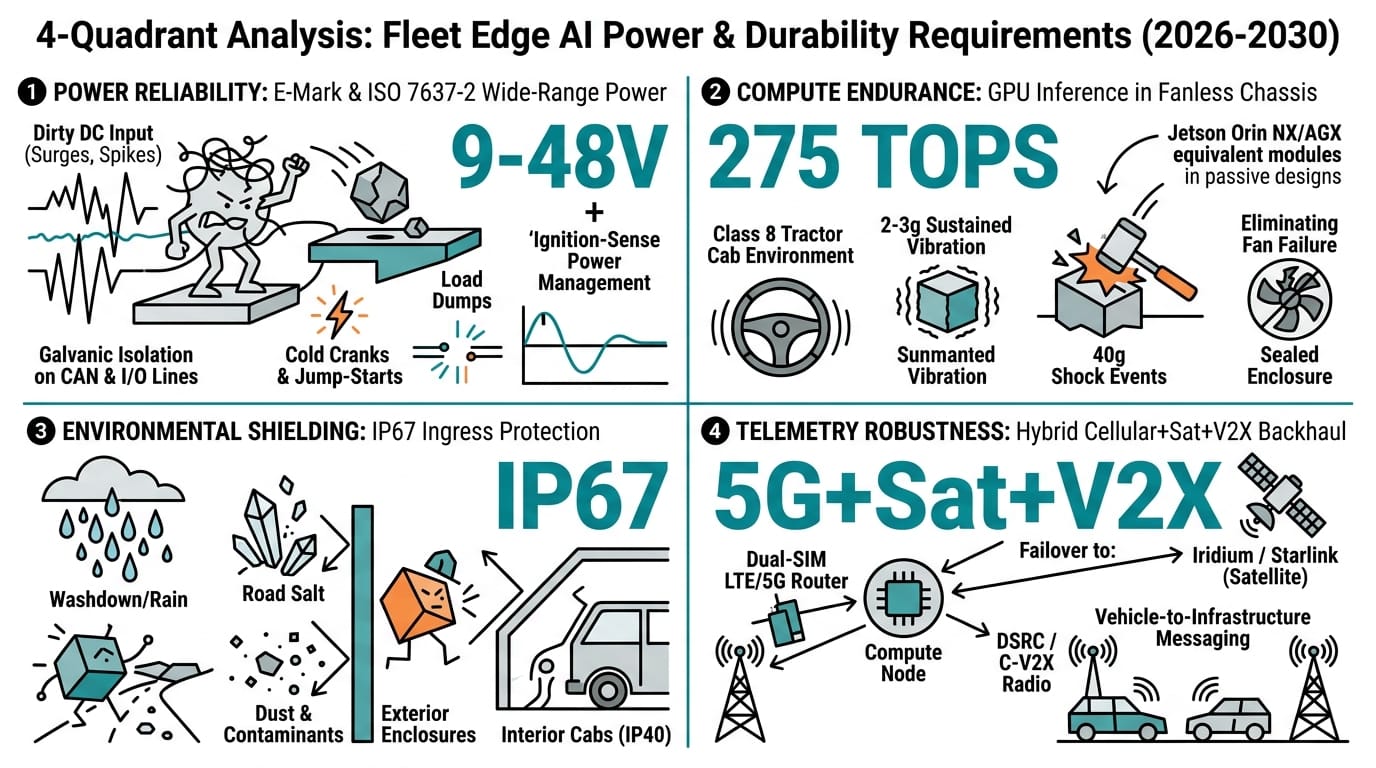
The hardware implications are specific and unforgiving. Four requirements dominate procurement conversations we're having with fleet integrators right now.
E-Mark, ISO 7637-2, and wide-range power
In-vehicle computers must accept dirty 9–48V DC input and survive load dumps, cold cranks, and jump-starts. Consumer-grade mini PCs fail within weeks. We published a design guide on NVH and vibration that covers the mechanical side; the electrical side demands ignition-sense power management and galvanic isolation on CAN/I/O lines.
GPU inference in a fanless chassis
Class 8 tractor cabs see 2–3g of sustained vibration and 40g shock events. Rotating fans are the first thing to fail. Fanless Jetson-based platforms using Orin NX or Orin AGX modules now deliver 70–275 TOPS in sealed enclosures — enough headroom for multi-camera perception plus a safety-driver-monitoring model running concurrently.
IP67 for trailer-mounted and exterior boxes
Trailer-side cameras, refrigeration controllers, and autonomous yard-truck sensors all need IP67-rated compute that tolerates washdown, road salt, and rain. Interior cab computers can run IP40; anything mounted outside the cab needs full ingress protection.
Hybrid cellular + satellite + V2X backhaul
Vehicles operate across spotty coverage zones. The reference architecture we're seeing deployed in 2026 pairs a compute node with a dual-SIM LTE/5G router that fails over to Iridium or Starlink, plus a DSRC or C-V2X radio for vehicle-to-infrastructure messaging. A multi-radio cellular router handles the WAN aggregation cleanly.
What to watch between now and 2030
Three inflection points will shape the next four years. First, NHTSA's expected 2027 mandate on impaired-driver detection will force driver-monitoring compute into every commercial cab — even fleets that don't want it. Second, insurance carriers are starting to offer premium rebates (5–15%) for fleets running edge AI driver coaching and collision avoidance; this is quietly doing more to drive adoption than any OEM roadmap. Third, model-update governance becomes critical: when an OTA pushes a new perception model to 50,000 vehicles, how do you validate it won't regress on edge cases? Expect shadow-mode deployment frameworks to become a standard procurement checklist item by 2028.
Conclusion
The window for fleet operators and integrators to standardize on edge AI hardware architectures is 2026–2027. Vehicles specced today will be in service through 2033–2035. Choosing compute that can run 150+ TOPS, tolerate -40°C to 85°C, accept 9–48V power, and ship with a clean path to OTA model updates is the difference between a platform that ages gracefully and one that needs ripping out in three years.
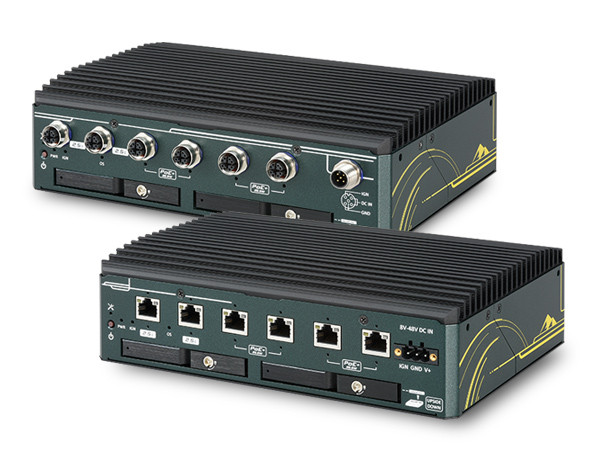
Neteon ships ruggedized in-vehicle and edge AI computers built for exactly this class of deployment — fanless Intel and NVIDIA platforms, E-Mark and ISO 7637-2 compliant, with IP40 to IP67 options depending on mounting location. Talk to our team about sizing the right platform for your fleet architecture.
Related Neteon Products
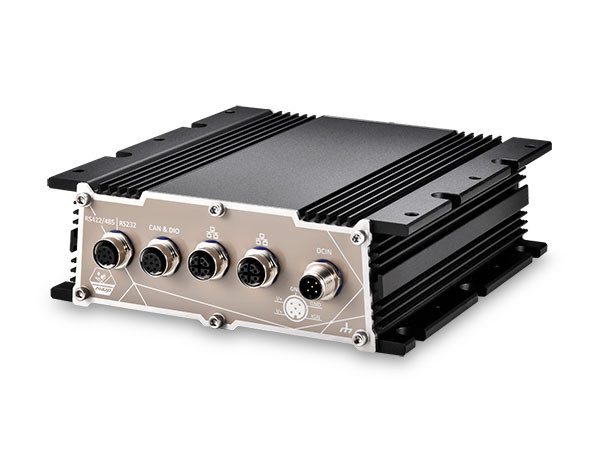
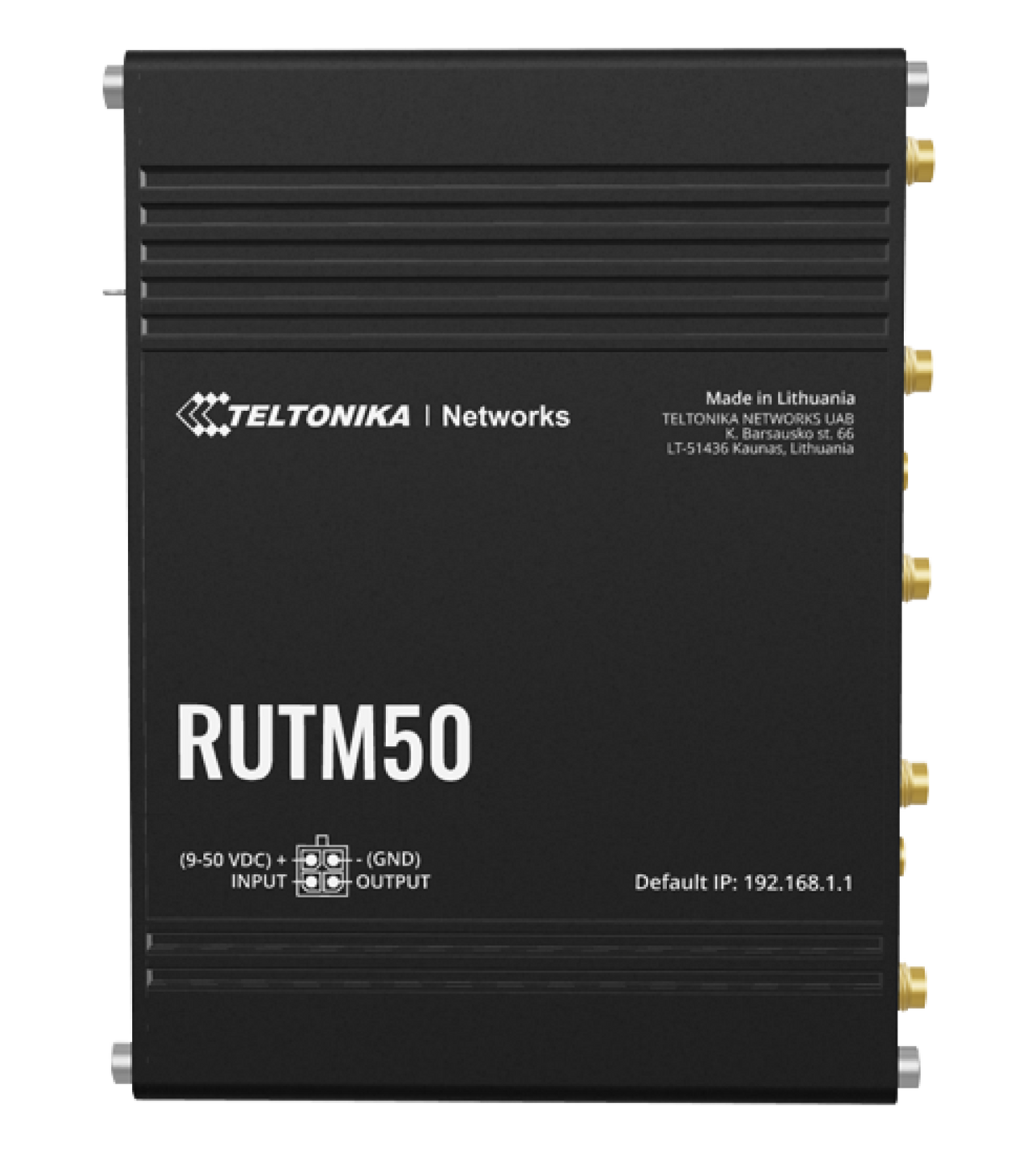
Ruggedized edge AI and connectivity platforms referenced in this article:


FAQs
Why are automakers moving edge AI inside fleet vehicles instead of running inference in the cloud?
Three reasons: latency (safety-critical detections like drowsy-driver monitoring need sub-200ms response times that cellular can't guarantee), cellular bandwidth cost (streaming 1080p video per vehicle burns ~50GB/month per cam), and data sovereignty requirements that vary by jurisdiction. Running inference locally on a rugged in-vehicle computer keeps raw video on the vehicle and only sends events and aggregated telemetry to the cloud.
What temperature and power specs should in-vehicle edge AI computers meet?
For 2026-era deployments, target -30°C to 70°C operating temperature, 9–48V DC input, and ISO 7637-2 / E-Mark compliance for load-dump and cold-crank tolerance. By 2030, expect -40°C to 85°C to be the new baseline as vehicles deploy to wider geographic regions and exterior mounting becomes more common.
How much GPU inference power (TOPS) do fleet vehicles need in 2026 versus 2030?
Typical 2026 deployments use 20–40 TOPS (Jetson Orin Nano to Orin NX class) for 2–4 camera channels. By 2030, expect 150–300 TOPS (Orin AGX or successor) to handle 6–12 camera channels plus concurrent driver-monitoring, cargo-monitoring, and perception models.
What's the difference between IP40, IP54, and IP67 for in-vehicle compute placement?
IP40 is adequate for interior cab mounting — it protects against tools and small objects but not water. IP54 tolerates light splash and dust and works for engine-compartment or semi-exposed locations. IP67 is required for trailer-mounted, chassis-mounted, or exterior boxes that face washdown, road salt, rain, and temporary submersion.
How should fleet integrators handle OTA model updates for edge AI?
Adopt a staged deployment framework: shadow mode (new model runs alongside production, logs disagreements but doesn't act), canary rollout (enable on 1–5% of fleet, monitor regression metrics), then phased production rollout with automated rollback on safety-metric degradation. Expect this workflow to become a standard procurement checklist item by 2028.
For the hands-on build, see How to Connect a Cellular IoT Gateway to a Neousys POC-700 for Fleet Monitoring.
Sources and further reading
Neousys rugged computer product catalog.
NIST AI Risk Management Framework.
Related Neteon guides
Warehouse AMRs and Edge AI Through 2030.
Edge AI for Ports and Container Terminals.
Browse the industry outlook 2 topic hub for more deployment guidance.
Recommended next: Sensor Fusion Navigation for General Aviation.