TLDR
Food manufacturers deploying AI-powered quality control systems at the edge are cutting defect rates by 60-75% while maintaining HACCP and FDA compliance. This shift—driven by real-time inference requirements and contamination prevention—positions GPU-accelerated edge computers like the Nuvo-10108GC as critical infrastructure for high-speed packaging lines. By 2028, AI-first quality systems will be the baseline for facilities processing 100+ tons per day.
When you are ready to specify hardware, our IP69K vision inspection buyer's guide covers sizing the GPU and handling washdown.
Overview
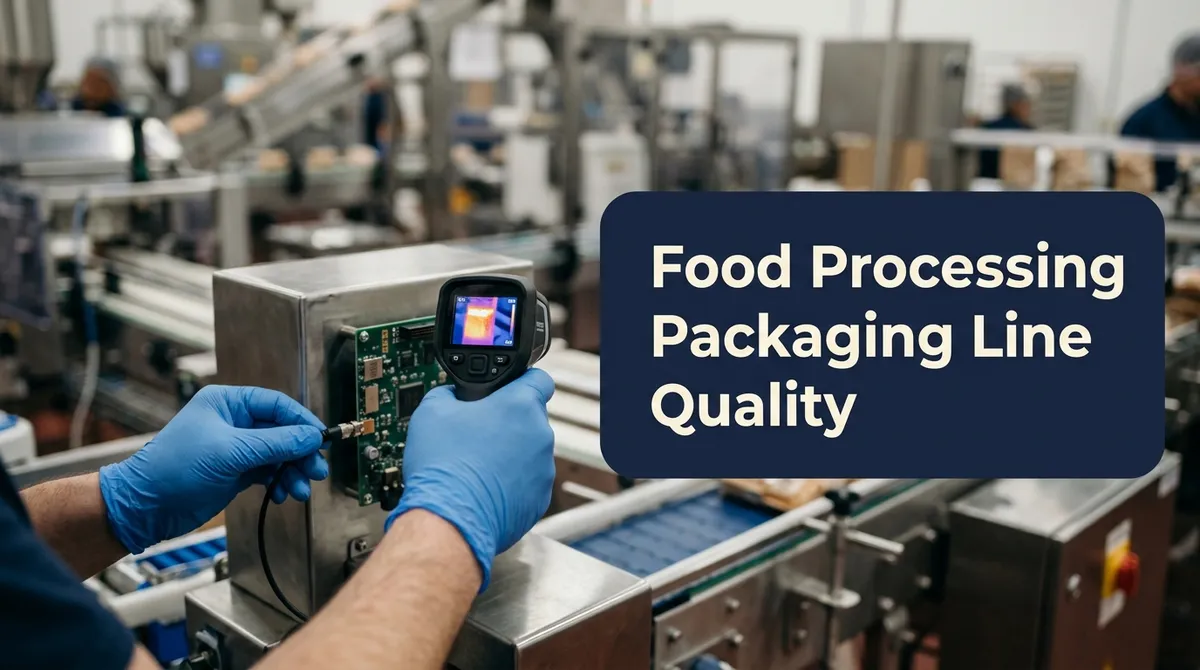
Food and beverage manufacturing faces mounting pressure to reduce waste, prevent contamination, and maintain traceable quality. Traditional centralized vision systems bottleneck at line speeds above 60-80 packages/minute because they rely on cloud connectivity. Facilities processing high-volume categories—frozen meals, dairy products, fresh-cut produce, pharmaceutical capsules—now face a quality control paradox: detect micro-defects at machine speed without latency or network dependency.
The 2024-2026 inflection point: GPU-accelerated edge inference makes real-time, on-premise defect detection feasible. Food processing facilities are deploying industrial edge computers with NVIDIA GPUs to run vision models (YOLOv8, SAM2) locally, eliminating network round-trips and enabling immediate line stops.
Key Trends in Food & Beverage AI Deployment (2026-2030)
| Trend | Impact | Timeline | Key Driver |
|---|---|---|---|
| Micro-defect detection (sub-1mm) | Reduces customer complaints by 45-60% | 2026–2027 | Pharma/QA moving from sampling to 100% inspection |
| HACCP-compliant audit trails | Regulatory confidence; enables traceability | 2026–ongoing | FDA push on preventive controls (FSMA) |
| Multi-camera fusion | Simultaneous defect + contamination detection | 2027–2028 | Computer vision models mature; GPU cost drops |
| Real-time yield analytics | Line operators see live defect maps, adjust in seconds | 2027–2029 | Edge inference latency now <50ms per frame |
| Thermal + RGB anomaly detection | Catches packaging/seal integrity issues | 2028–2030 | Multimodal AI adoption accelerates |
Why Edge AI? The Defect Detection Workflow
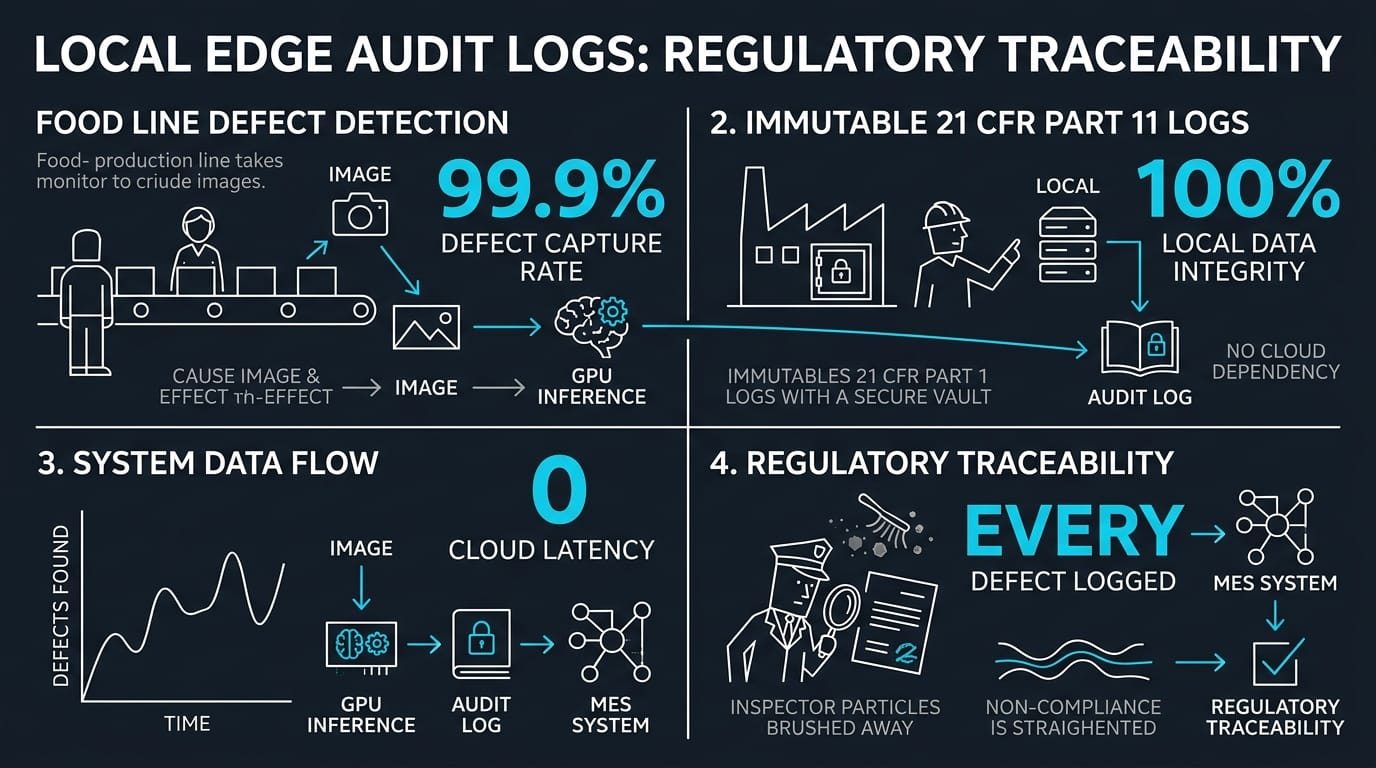
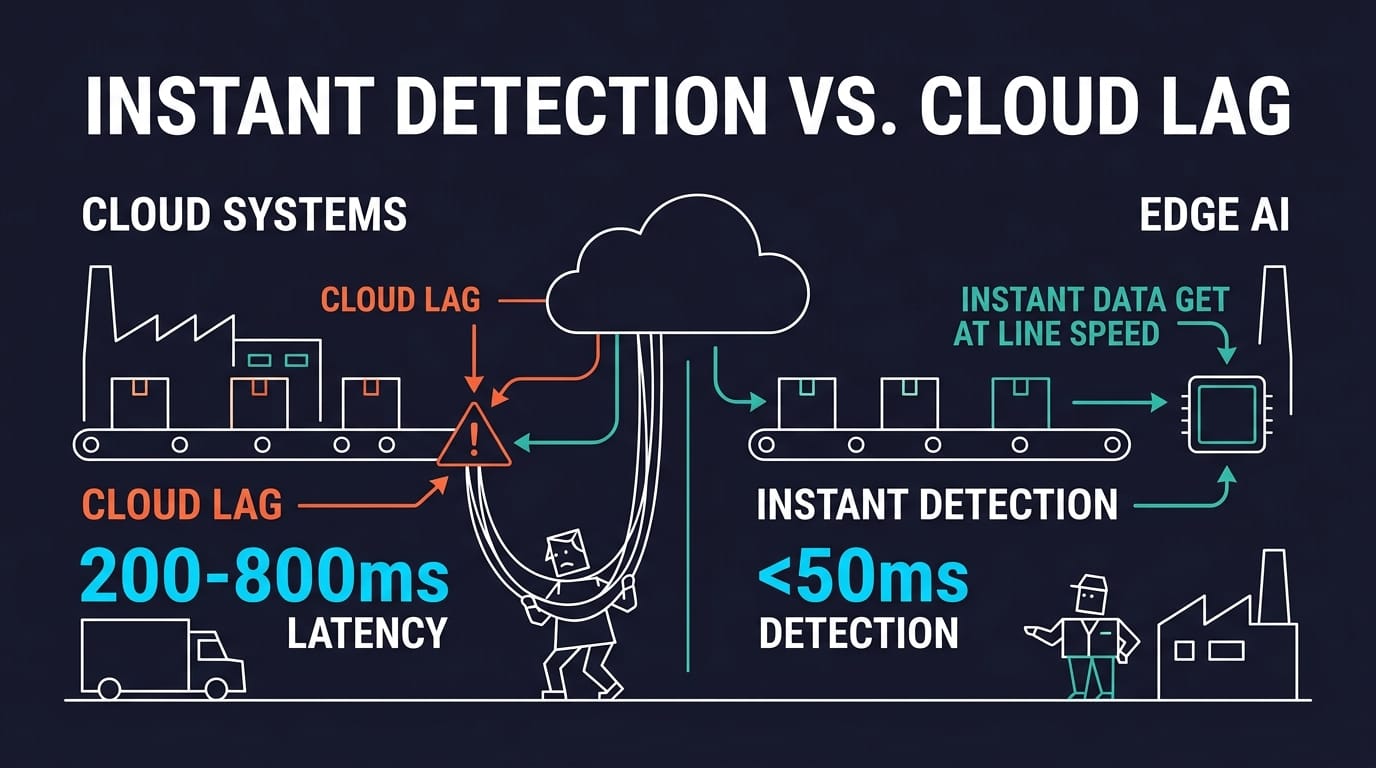
Legacy cloud-based approach:
- Camera captures image → local buffer
- Upload to cloud → inference delay 200–800ms
- Result returns → line has moved 10–50 packages
- Stop line or accept defect
Edge AI with Nuvo-10108GC:
- Camera → local GPU inference <50ms
- Defect detected → immediate trigger (valve, pneumatic stop, reorientation)
- Real-time callback to ERP/MES systems
- Zero network dependency; HIPAA/GDPR-proof (data stays on-premise)
This speed advantage drives adoption in:
- High-speed lines (120+ packages/min): dairy, ice cream, pharmaceuticals
- Contamination-critical (powder, capsule, injectable): healthcare, food safety
- Supply-chain-critical (export facilities): need 100% traceability, offline-first operation
Impact on Edge Computing: What Facilities Are Deploying
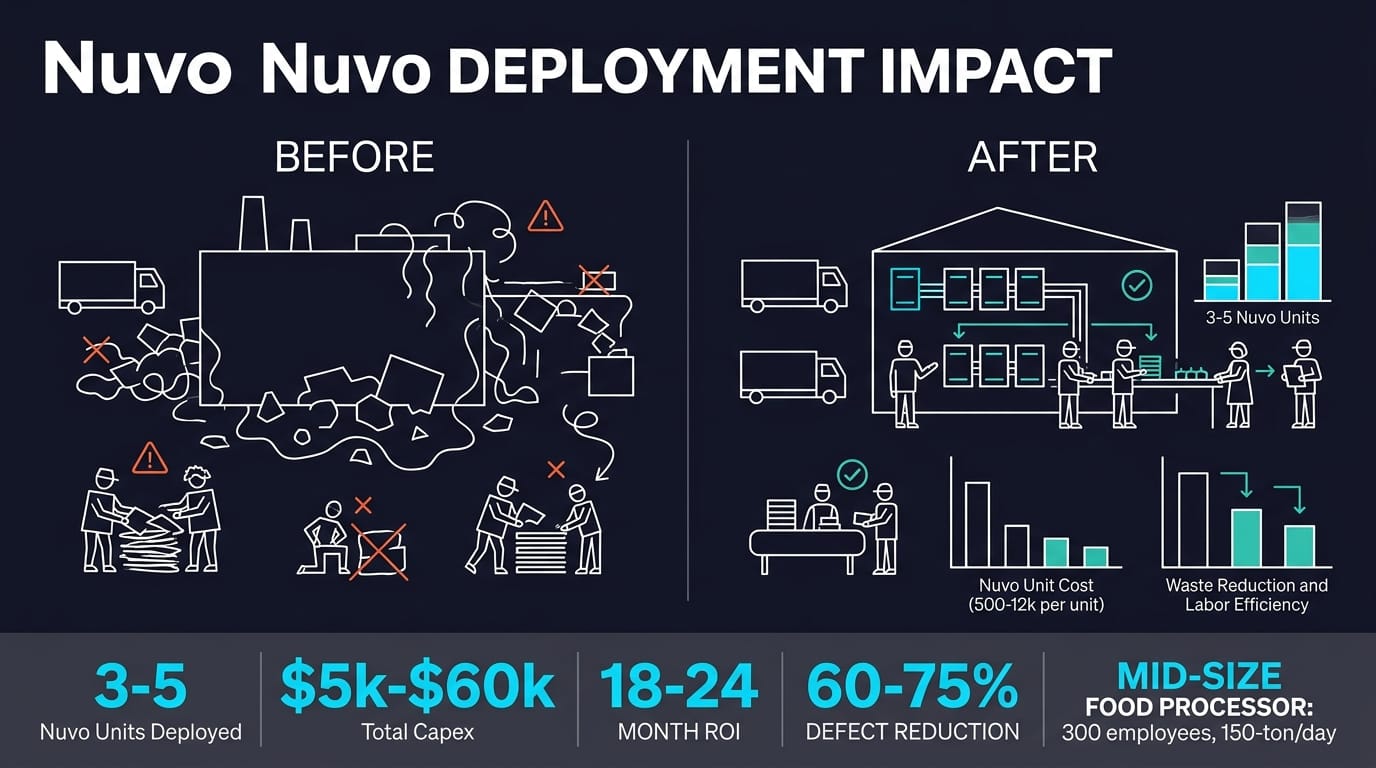
Typical 2026 installation—Mid-size food processor (300 employees, 150-ton/day capacity):
- 3–5 Nuvo-10108GC units (one per high-speed line, 1 spare)
- Each unit: 2x NVIDIA RTX GPUs, fanless (dust-free), IP65-rated for washdown
- Cost: $8,500–12,000 per unit (1/4 the price of a custom integration)
- Payback: 18–24 months (defect reduction + labor efficiency gains)
- Integration time: 4–6 weeks (vs. 12+ weeks for custom systems)
Key requirements:
- Ruggedness: Dust, vibration, occasional water spray (washdown protocols)
- Redundancy: Dual-NIC for MES failover; local SSD for audit logging
- Software: NVIDIA CUDA 12.x, OpenVINO, TensorFlow Lite (multi-model support)
- Compliance: FDA 21 CFR Part 11 (electronic records), HACCP traceability
What To Watch: 2027–2030 Roadmap
- Edge-native training frameworks — TinyML, Quantized Diffusion models enable on-device fine-tuning for facility-specific defect classes (your chocolate crackers, your capsule fills). Nuvo units will retrain models weekly with 1-2 GPU hours.
- Thermal edge inference — Combining RGB + thermal will detect seal integrity, metal contamination, and temperature excursions in one pass. Requires dual-camera support + thermal SDK maturity.
- Supply-chain integration — Direct MES/ERP data feeds will auto-flag defects back to ingredient suppliers, enabling ingredient-level root-cause analysis. Edge computers act as data aggregation points.
- Regulatory AI audit trails — FDA expectations around AI model validation and continuous drift monitoring will drive demand for edge systems that keep full inference logs locally (immutable, audit-ready).
- Modular GPU upgrades — By 2028, edge computers with hot-swappable GPUs will enable mid-life upgrades (RTX → Hopper → Blackwell) without replacing the entire system.
Related Products for Food Quality Systems
- Nuvo-9160GC — Single-camera vision systems, lower-speed lines (<60 packages/min)
- Nuvo-10000 — Ruggedized for outdoor/cold-chain monitoring in distribution centers
- NRU-220 — Mobile defect-detection robots for post-line QA sampling (pharmaceutical blister pack verification)
Conclusion
Food and beverage processing is at an inflection point: edge AI vision systems are moving from "nice-to-have" (advanced facilities) to "must-have" (compliance + competitiveness). The ability to run GPU-accelerated defect detection at line speed—with zero network latency and full regulatory audit trails—is reshaping QA operations. Facilities delaying edge AI deployment risk margin compression from scrap, liability exposure, and customer churn.
For manufacturers running 24/7 high-speed lines, the question is no longer "Do we need edge AI?" but "How many Nuvo units do we need to cover all critical lines?" By 2028, the answer for mid-scale food processors will be 3–6 units per facility, becoming as standard as conveyor systems.
Keywords: AI quality control, food safety, computer vision, GPU inference, edge computing, HACCP compliance, real-time defect detection, industrial AI, pharmaceutical inspection, automated packaging QA
Sources and further reading
Neousys rugged computer product catalog.
Related Neteon guides
Edge AI in Fleet Vehicles: 2026–2030 Outlook.
Private 5G and Industrial Edge AI Through 2030.
Browse the edge ai topic hub for more deployment guidance.