Key points
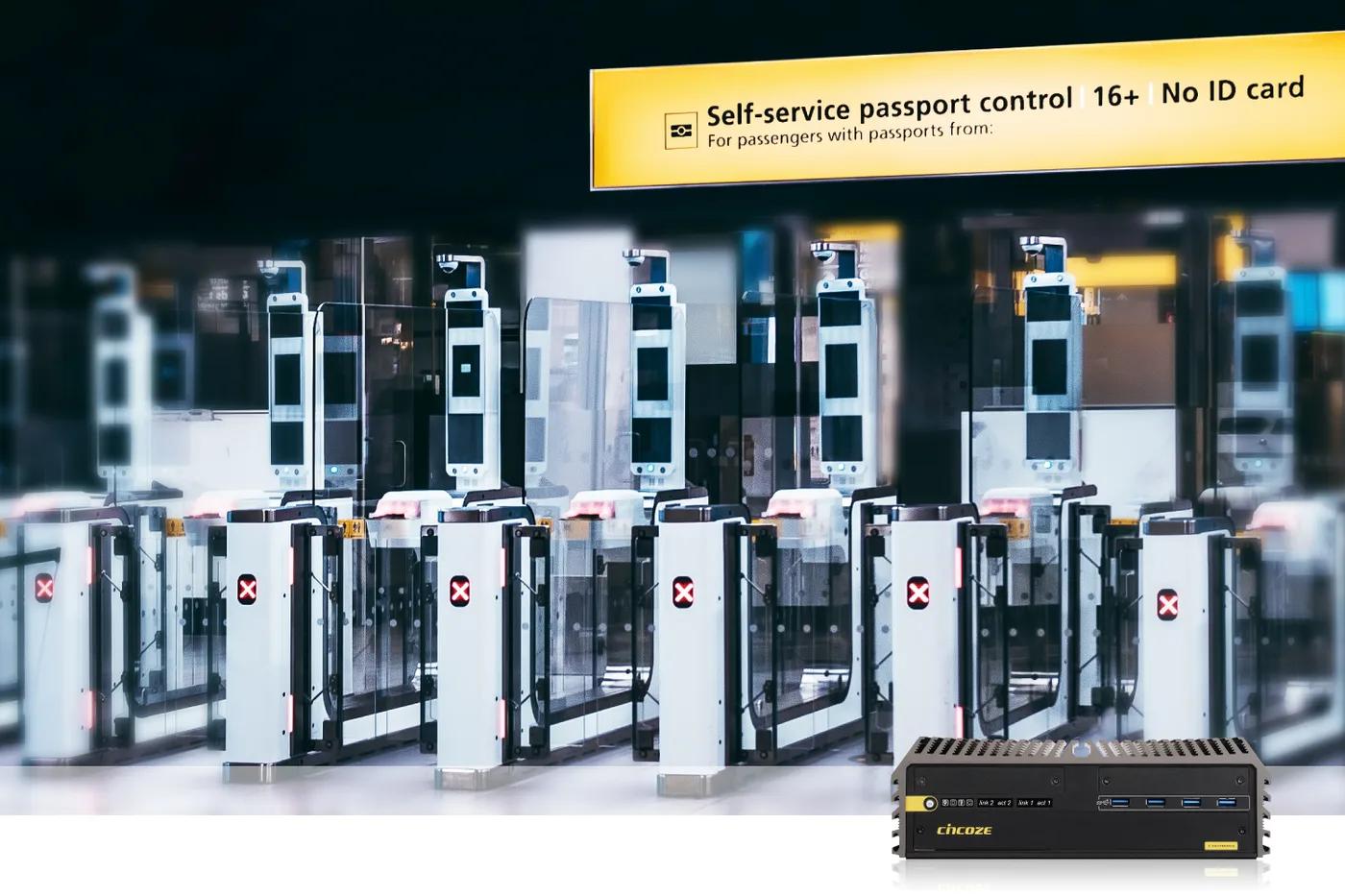
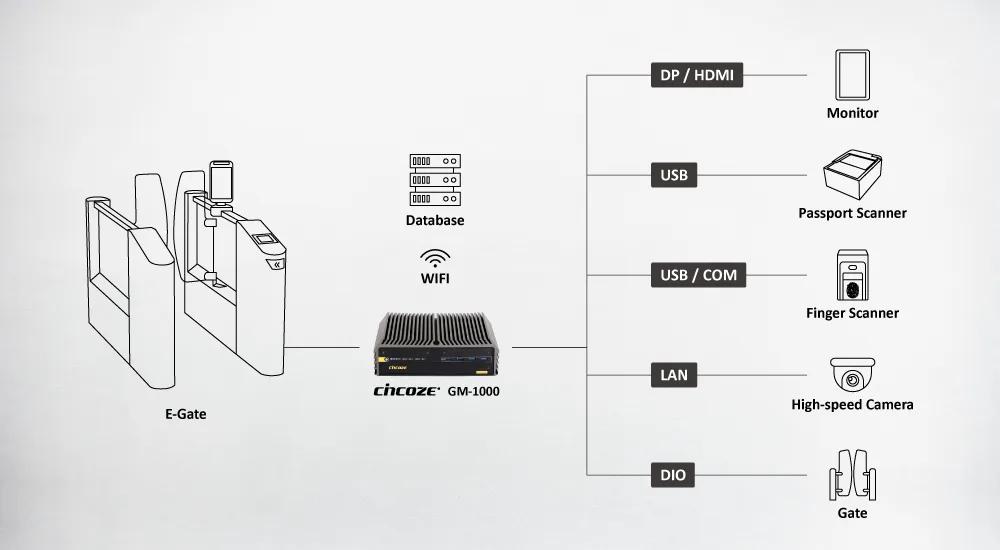
- At an international airport in Southwest Europe, the Cincoze GM-1000 is the central control computer of the e-gate system. It scans passports, processes face and fingerprint data, checks a database and controls the gate.
- The GM-1000 measures 260 × 200 × 85 mm and takes MXM 3.1 Type A/B GPU modules, which puts GPU computing inside the gate equipment.
- Dual GbE LAN with optional 10GbE, USB 3.2 Gen2, COM ports and DVI, DisplayPort and HDMI outputs connect the scanners, cameras, displays and gate controller.
- MXM module compatibility and a consistent mechanical design let the GPU be upgraded later for heavier workloads.
Deployment Takeaway
For airport e-Gates, the industrial computer is the control point between passenger identity, physical gate movement, and backend security systems. It has to process biometric data quickly, connect to multiple peripherals, and keep running reliably in a space-constrained installation.
Application Snapshot
Application: Automated airport e-Gate system for rapid customs and border control.
Customer profile: Major European multinational enterprise serving security, transportation, aerospace, and defense markets.
Industrial computer: Cincoze GM-1000 MXM GPU computer.
Core requirement: Real-time face and fingerprint processing with database verification.
Deployment needs: Compact GPU computing, rich I/O, high-speed networking, rugged 24/7 operation, and upgrade flexibility.
Deployment Context
Long border-control queues are one of the least welcome parts of international travel. Automated e-Gates help airports move passengers through identity checks faster while maintaining the security requirements of customs and immigration workflows.
In this deployment, an international airport in Southwest Europe needed to improve customs efficiency and the passenger travel experience. The system had to scan passports, capture facial and fingerprint data, compare identity information against a database, and control the physical gate.
The project team integrated the Cincoze GM-1000 MXM GPU computer as the central control platform for the e-Gate system. The goal was practical: shorten clearance time, reduce manual workload, and keep passenger processing stable in continuous airport operation.

What the System Needed
1. Real-time biometric processing
The e-Gate computer needed enough CPU and GPU performance to process facial images and fingerprint data in real time. Fast processing matters because passengers should not have to wait while the system verifies identity, checks documents, and compares biometric data with backend records.
2. Peripheral connectivity in a compact footprint
An e-Gate depends on several connected devices: passport scanners, fingerprint scanners, high-speed cameras, displays, gate controllers, and network access to security databases. Because the computer sits inside the e-Gate equipment, the platform also needed to fit into limited installation space without sacrificing I/O.
3. Reliable operation in an enclosed environment
Airport systems run around the clock. The computer had to operate continuously inside an enclosed installation where sustained high temperatures can become a real deployment constraint. Stable thermal design and industrial protection were essential for reducing downtime.
Why the GM-1000 Fit
The GM-1000 matched the project requirements by combining compact GPU computing, industrial I/O, rugged design, and modular upgrade options in one embedded platform.
- Compact GPU performance: The GM-1000 measures 260 x 200 x 85 mm and supports workstation-grade Intel Xeon CPUs with MXM 3.1 Type A/B GPU modules, including NVIDIA embedded GPU options.
- Real-time image handling: CPU and GPU support help the system process large volumes of facial recognition data quickly and accurately at the edge.
- Flexible I/O for e-Gate peripherals: Native I/O and CMI expansion support connections for displays, passport scanners, fingerprint scanners, cameras, gate control, and database networking.
- High-speed connectivity: Dual GbE LAN with optional 10GbE via expansion module, USB 3.2 Gen2, COM, DVI, DisplayPort, HDMI, and wired or wireless networking give system designers room to connect the full workflow.
- Rugged airport operation: Wide-temperature support (up to -40 to 70 degrees C depending on CPU configuration), 9 to 48 VDC input, shock and vibration resistance, and overvoltage, overcurrent, and ESD protection support long-term operation.
- Upgrade flexibility: Consistent mechanical design and MXM module compatibility help protect the original equipment investment when future workloads require stronger GPU performance.
Resulting Value
With the GM-1000 as the e-Gate control computer, the airport system could process passenger identity data, coordinate gate control, and connect to verification databases from one compact industrial platform.
For airport and security teams, the broader lesson is clear: automated border-control systems depend on more than a camera or scanner. The edge computer has to bring together real-time performance, peripheral integration, network connectivity, thermal reliability, and long-term serviceability.
Application source: Cincoze's airport e-gate application story.
How Neteon Supports Similar Projects
Neteon IPC Store helps engineering and operations teams move from product selection to deployment faster. For e-Gates, transportation security, smart kiosks, edge AI, and industrial automation projects, that means helping teams compare IPC options, confirm I/O and performance requirements, and prepare project-ready industrial computing systems.
Need help choosing the right GPU computer or embedded platform for an airport, security, or edge AI project? Contact Neteon at https://ipc.neteon.net/contact-us/ or explore IPC solutions at https://ipc.neteon.net/.