
TLDR
Substation and smart-grid monitoring is the hardest deployment environment a small-form-factor edge AI computer will ever see: continuous EMI, surge transients, wide temperature swings, and ten- to twenty-year service expectations. Four hardware decisions decide whether your edge node survives long enough to be useful: power isolation, surge handling, thermal envelope, and protocol stack. This guide walks each one and matches it to a Neousys platform you can spec today. Related: battery storage thermal-runaway monitoring.
For a neighbouring utility vertical, see our edge AI buyer's guide for water and wastewater.
Overview
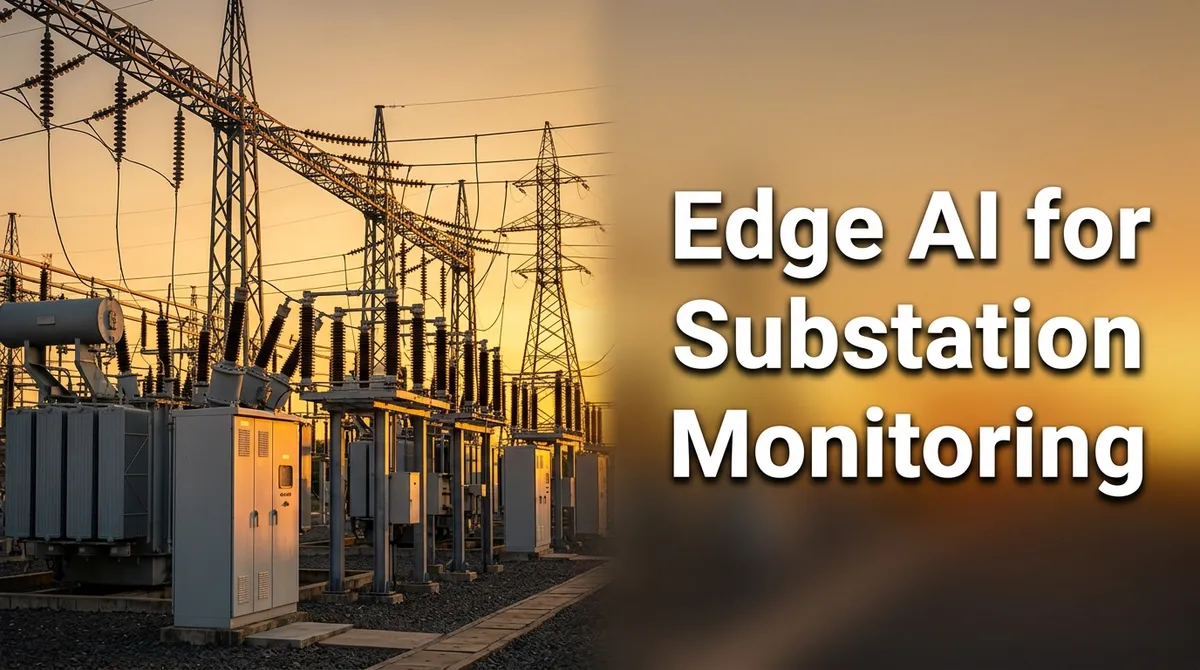
A modern distribution substation now hosts more compute than a small data center did a decade ago. Phasor measurement units, line-differential relays, condition-monitoring sensors on transformers, and an increasing number of vision cameras for security all feed into local servers that have to publish summaries to SCADA and to a regional grid operator over a constrained WAN.
The hard part is that the box doing this work sits inside a switchgear cabinet, two meters from a 138 kV bus. It needs to ride through fault clearing transients, run for a decade without scheduled maintenance, and stream useful data the moment power returns after a black-start. Most desktop-class industrial PCs simply will not do that.
Two earlier articles cover adjacent ground worth reading first: the outdoor energy and telecom design guide covers cabinet thermal layout, and the ATEX and C1D2 hazardous location guide explains how surge and ignition-protection certifications differ from plain ruggedness ratings. The recent Nuvo-10000 wind-turbine vibration deployment shows what a substation-class IPC actually does in the field once installed.
Key selection criteria
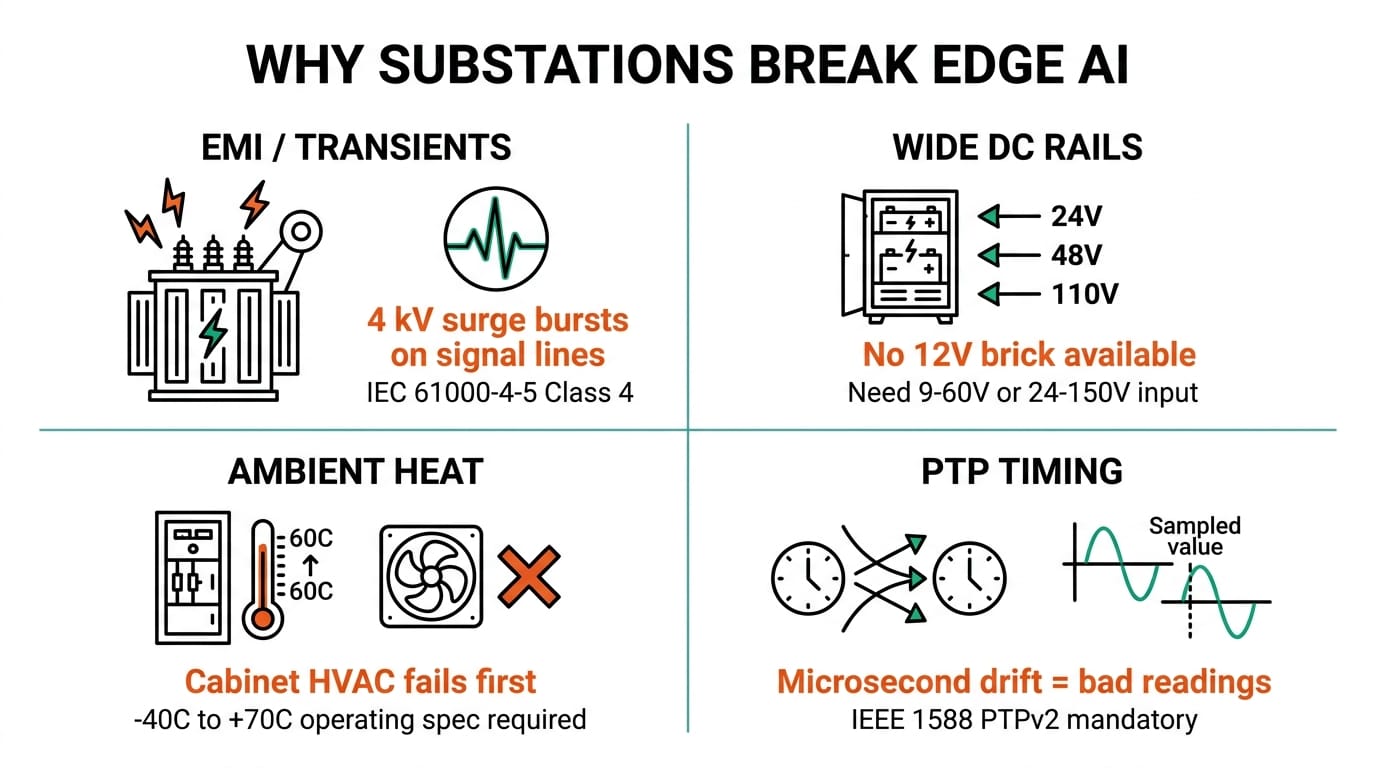
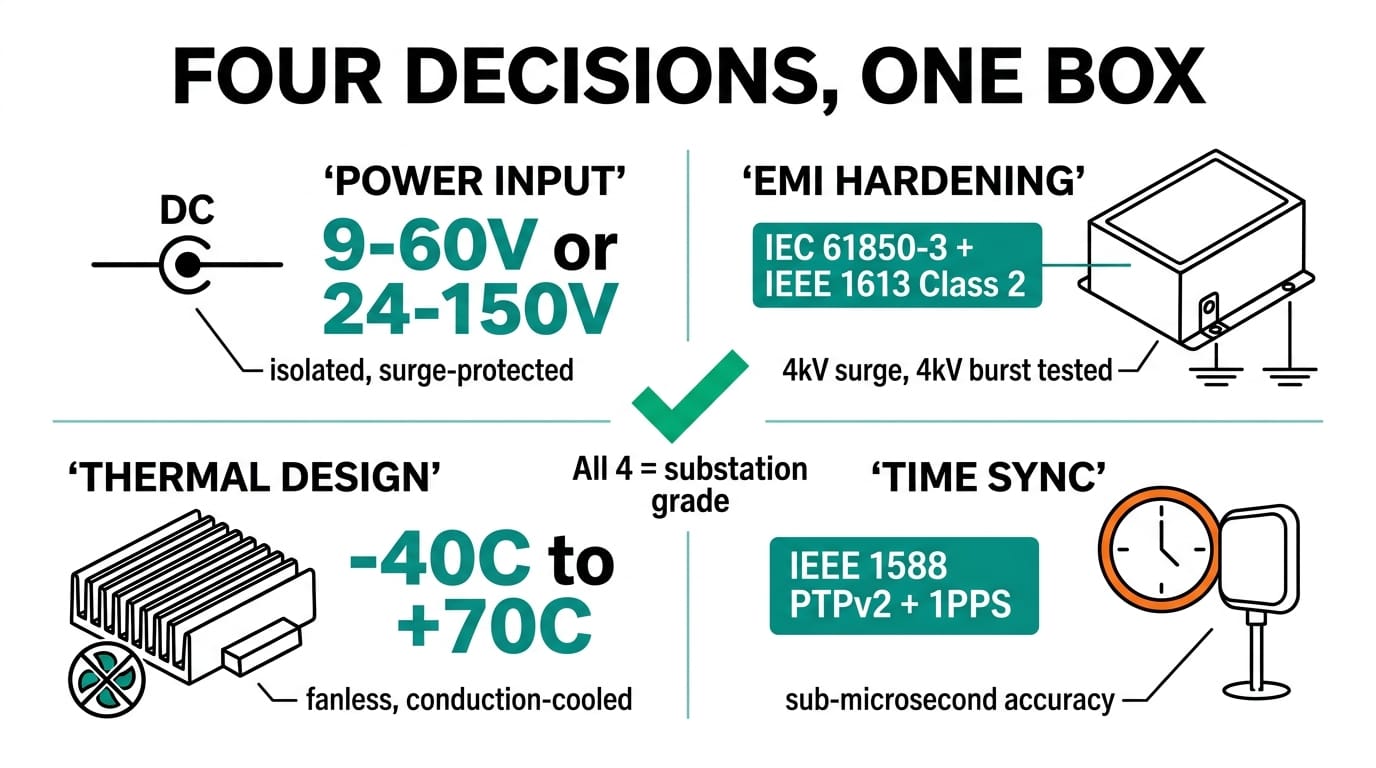
Four specs separate substation-grade edge AI from generic ruggedized hardware. Pin them down before discussing CPU or GPU performance.
| Spec | Why it matters in a substation | Minimum target |
|---|---|---|
| Wide-range DC input | Cabinets are fed from station batteries that float between 18 and 60 V depending on load and charging state | 8–48 V DC isolated, or 24/48 V with surge module |
| Surge and EFT immunity | IEC 61000-4-5 Level 4 covers 4 kV common-mode surges typical near MV/HV bus | IEC 61000-4-5 Level 4 + IEC 61000-4-4 Level 4 |
| Operating temperature | Outdoor pad-mount cabinets in summer regularly hit 65 °C internal | -25 to +70 °C continuous, fanless |
| Time sync and protocol stack | IEC 61850-9-2 sampled values demand sub-microsecond PTP; SCADA needs DNP3/MMS | PTP IEEE 1588 v2 + DNP3 over TCP/IP |
A platform that misses any of these four does not belong in a substation, regardless of how attractive its CPU benchmark looks.
Decision matrix: matching the platform to the role
A typical substation will run two or three edge nodes side by side, each tuned to a different workload. The selection table below maps Neousys platforms to the role they fit best.
| Role | Recommended platform | Compute profile | Why this one |
|---|---|---|---|
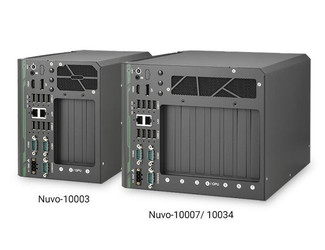
| Aggregation gateway in main switchgear cabinet | Nuvo-10000 (Intel 13th/14th-gen, 8–48 V DC) | 6–14 cores, PCIe expansion for analog acquisition cards | Expansion slots take a Meinberg PTP card or a sampled-values acquisition card without cabinet redesign |
| GPU node for transformer thermal vision and partial-discharge analysis | Nuvo-9160GC (Intel 12th-gen + RTX 2000 Ada) | 50 TOPS GPU, dual GbE, 8–48 V DC | Handles thermal-camera streams plus an acoustic feature pipeline on the same box |
| Compact AI inference inside relay panels | NRU-220 (NVIDIA Jetson Orin, fanless) | 100 TOPS, 25 W, 32 GB RAM | Fits in 1U panel space; runs vision models for breaker-position confirmation |
| Outdoor pole-mount monitoring (recloser cabinet, ring main unit) | POC-766AWP (IP67, fanless, wide-temp) | 4 cores, sealed enclosure, M12 connectors | Survives direct sun and rain without an external NEMA box |
For the LAN backbone that ties these nodes back to the substation router, pair them with a Layer 3 hardened aggregation switch such as the PLANET IGS-6325-8T8S4X so PRP ring redundancy and DSCP-tagged 61850 traffic both have headroom.
Common pitfalls
Three mistakes recur in first-time substation rollouts:
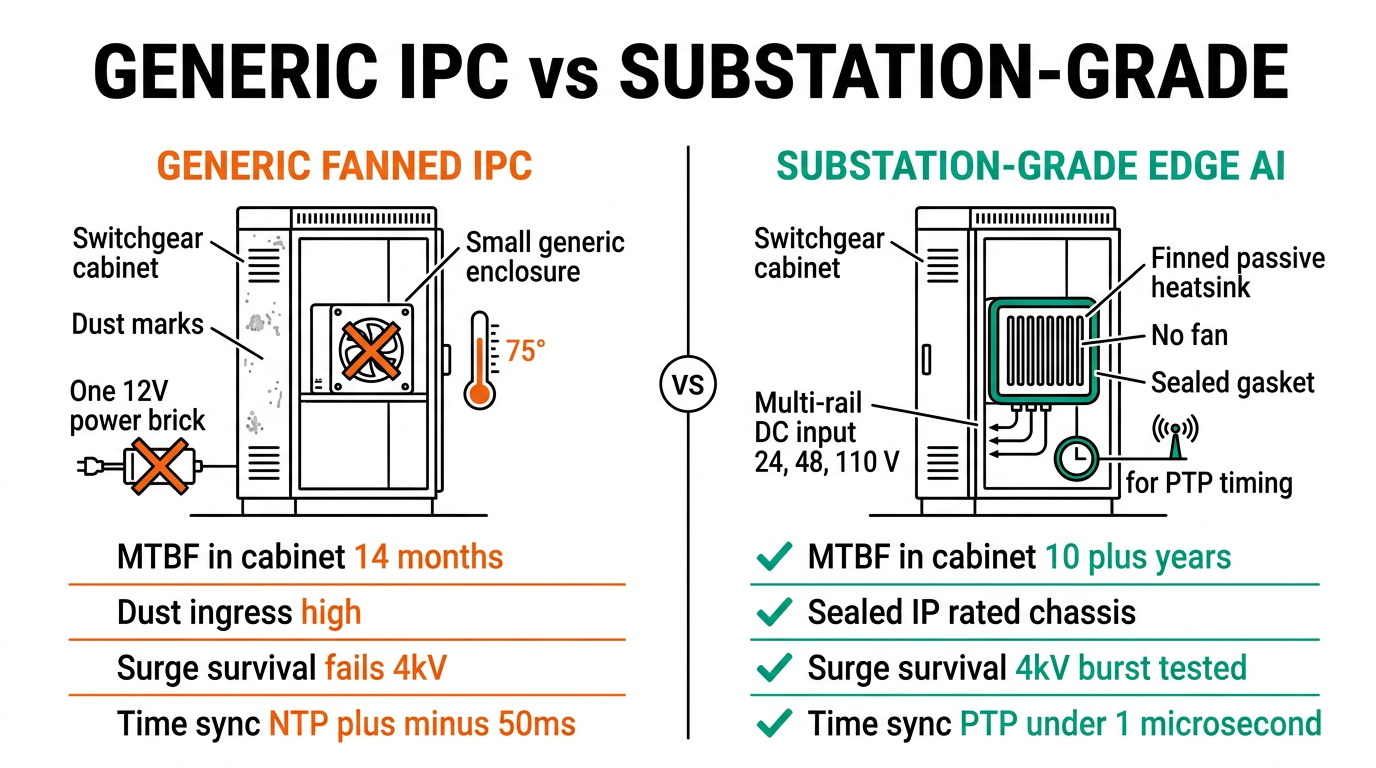
Spec'ing a 12 V single-rail brick supply because the IPC accepts it. The cabinet only has 24 or 48 V available, so a step-down converter has to be added in front of the box. That converter is then the first thing to fail under surge, and it takes the IPC down with it.
Choosing a fanned chassis with the assumption that cabinet HVAC will keep ambient down. Cabinet HVAC fails far more often than the IPC does. Once it fails, the fan ingests dust and conductive particulate, and the box fails not long after. Fanless is not a luxury here.
Treating PTP as optional. If two relays' sampled values cannot be lined up to the same microsecond, every downstream protection decision a vendor analytics product makes is suspect. Specify PTP support at procurement, not after.
Conclusion
The right edge AI computer for substation and smart-grid monitoring is the one that survives the cabinet long enough to pay back its install cost. That is typically a decade. The order in which you evaluate specs matters: DC input range first, then surge immunity, then fanless thermal envelope, then PTP support. CPU and GPU choices come last, after that floor is set. The Nuvo-10000, Nuvo-9160GC, NRU-220, and POC-766AWP cover the four roles a typical substation needs, and a Layer 3 hardened switch ties them into a redundant ring that operations can adopt and run.
Follow Neteon on LinkedIn, contact www.neteon.net or [email protected] for datasheets, surge-test reports, and substation reference designs.
Related Products


FAQs
What ruggedness specs matter most for a substation edge AI computer?
Wide-range DC input (8 to 48 V), IEC 61000-4-5 Level 4 surge and IEC 61000-4-4 Level 4 EFT immunity, fanless operation from -25 to +70 degrees C, and PTP IEEE 1588 v2 time sync. Skip any of these and the box will not survive a typical switchgear cabinet for ten years.
Why does PTP matter for substation monitoring?
IEC 61850-9-2 sampled values from current and voltage transformers must be aligned to the same microsecond before any line-differential or merging-unit analytic can use them. PTP IEEE 1588 v2 provides that synchronization across Ethernet without dedicated GPS wiring at every cabinet.
Can a fanned IPC be used in a substation cabinet with HVAC?
It is not recommended. Cabinet HVAC fails more often than the IPC itself. Once it fails, the fan ingests dust and conductive particulate from the bus, and the box follows shortly. Fanless platforms remove that failure mode.
Which Neousys platform fits a pole-mount recloser cabinet?
The POC-766AWP. Its IP67-sealed enclosure and M12 connectors let it sit outdoors without an extra NEMA box, and its wide-temperature fanless design handles direct sun on aluminum.
What switch should pair with these edge nodes inside a substation LAN?
A hardened Layer 3 industrial switch such as the PLANET IGS-6325-8T8S4X. Its 10G uplinks, 2.5G ports, and full L3 routing give headroom for PRP redundancy and DSCP-tagged 61850 traffic on the same backbone.
For a closely-related deployment story on the renewables side, read how POC-766AWP cut solar farm inverter downtime 67%.
Sources and further reading
Neousys rugged computer product catalog.
NIST AI Risk Management Framework.
Related Neteon guides
Sourcing Rugged PCs from Taiwan: Buyer’s Guide.
Custom vs Off-the-Shelf Industrial PCs.
Browse the edge ai topic hub for more deployment guidance.