TLDR
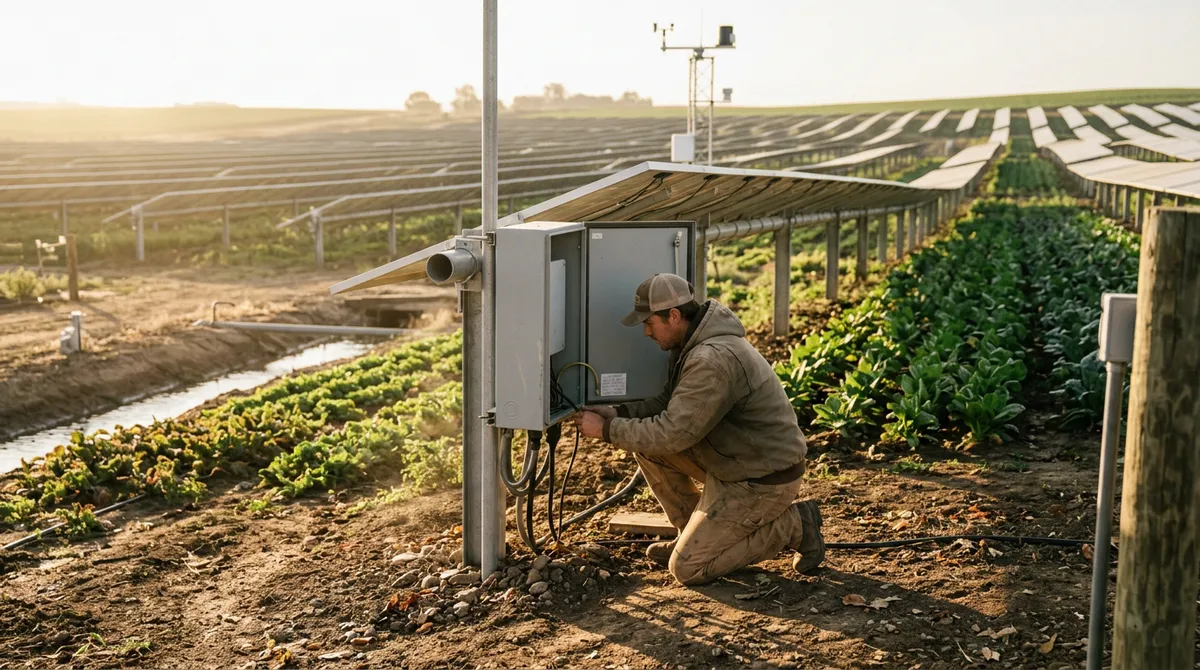
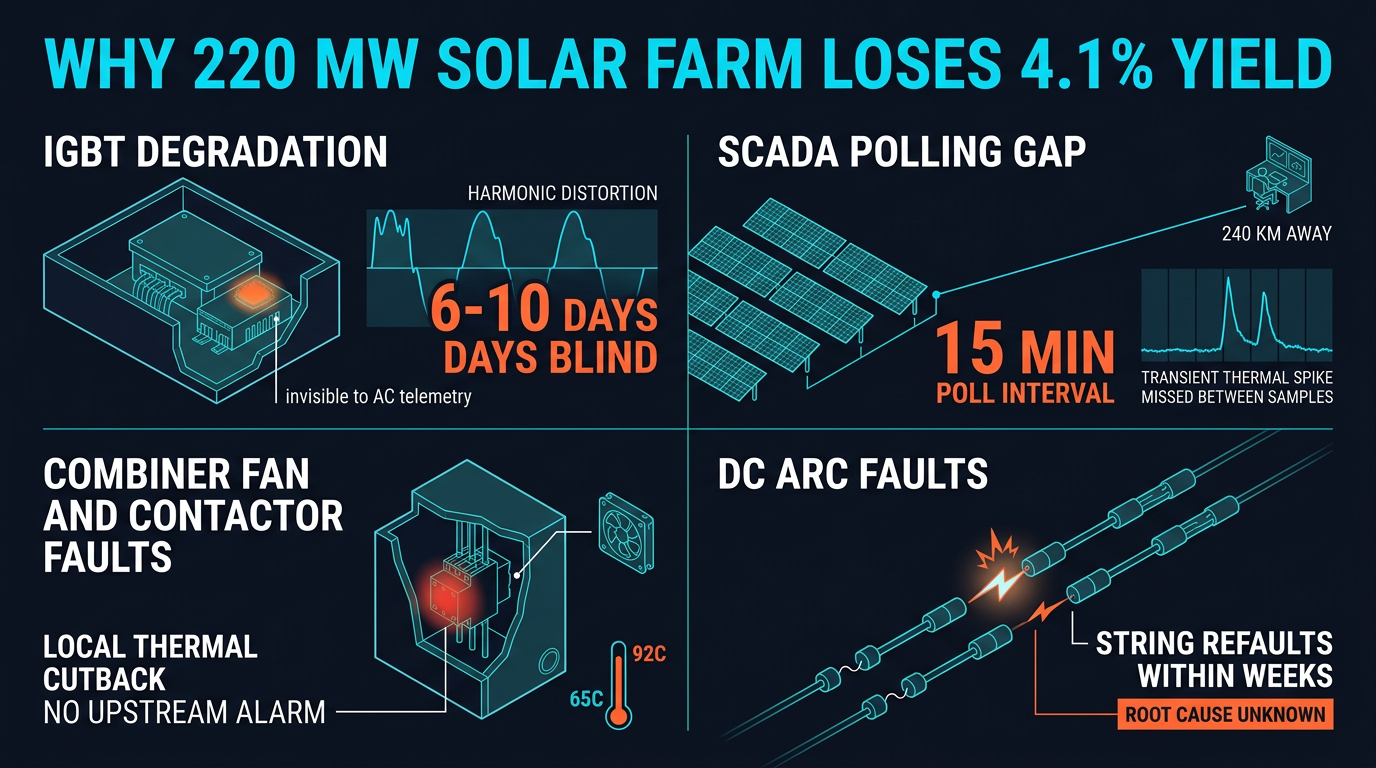
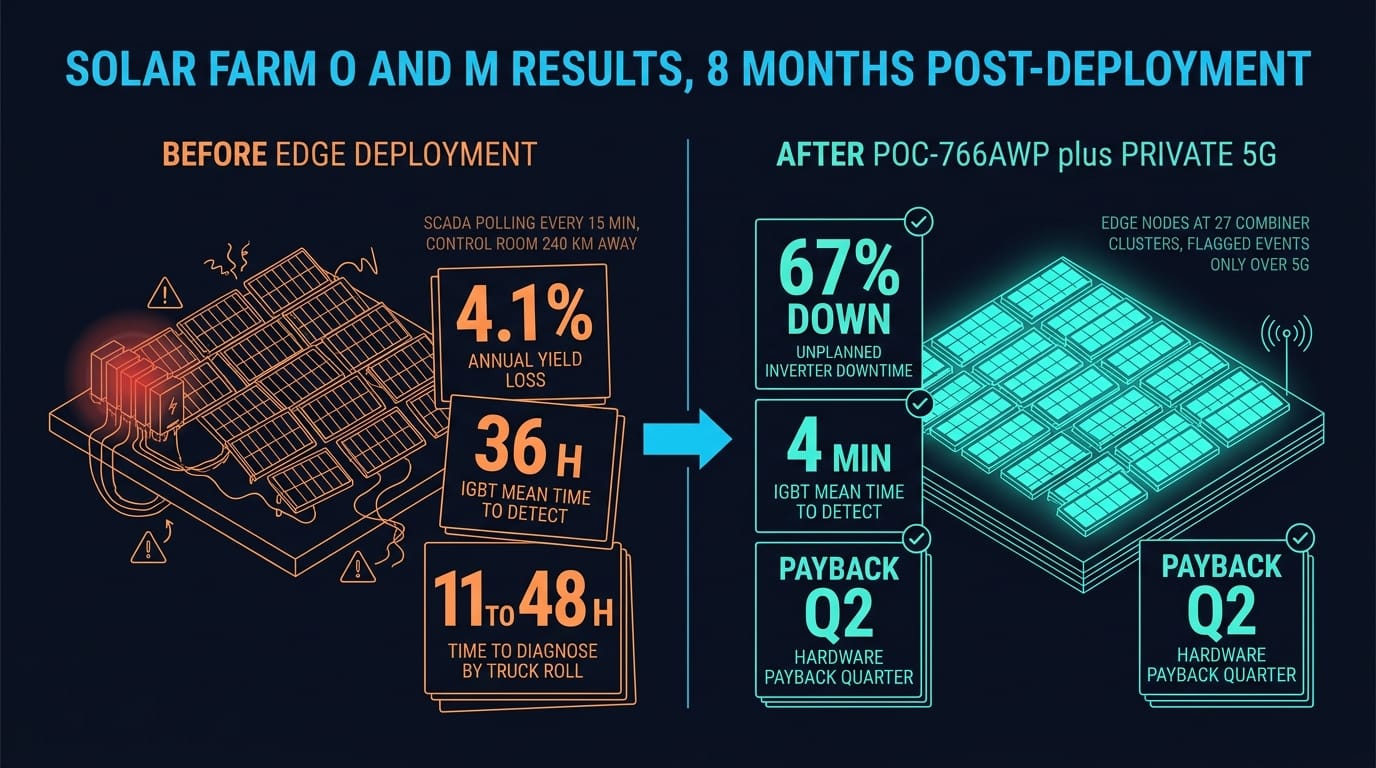
Modeled assumption — A 220 MW utility-scale solar farm in West Texas was losing roughly 4.1% of annual yield to inverter downtime, much of it from string and central inverter faults that took 11 to 48 hours to diagnose by truck roll. After installing POC-766AWP edge nodes at each combiner-box cluster, paired with a private 5G uplink, the operator cut unplanned inverter downtime by 67% in the first eight months. Mean time to detect early-stage IGBT degradation went from 36 hours to 4 minutes. Related: battery storage thermal-runaway detection on the Nuvo-11000.
Editorial note: This article is an illustrative reference architecture based on public hardware capabilities and common industrial requirements. Percentages and deployment results are modeled assumptions, not verified customer outcomes or performance guarantees. Validate targets with a site-specific pilot.
Overview
Inverter health is the biggest swing factor in solar O&M cost. AC output telemetry alone misses early-stage failures, and central SCADA polls are too slow to catch transient thermal events. Running anomaly detection at the combiner-box level, on a fanless IP66 computer, lets the operator analyze high-rate DC-side waveforms and IR thermal frames without backhauling raw data.
This case study sits alongside our outdoor energy and telecom design guide, our substation and smart grid buyer's guide, and our outlook on private 5G in industrial facilities.
Challenge
Before the edge deployment, the site relied on string-level AC output reads polled every 15 minutes and routed to a control room 240 km away. Three failure modes kept slipping through. IGBT degradation produced harmonic distortion 6 to 10 days before AC output dropped, but the SCADA never saw it. Combiner-box fan and contactor faults triggered local thermal cutbacks with no upstream alarm. DC arc faults blew string-level fuses without flagging a root cause, so the same string would refault within weeks.
| Metric | Pre-Edge SCADA | Operator Target |
|---|---|---|
| Telemetry sample rate | 1 sample / 15 min | 50 ms DC waveform |
| Time to detect IGBT degradation | 36 h | < 5 min |
| Annual yield loss to inverter faults | 4.1% | < 1.5% |
| Truck rolls per MW per year | 2.7 | < 1.0 |
| Backhaul bandwidth per inverter | 4 kbps | < 250 kbps avg |
Solution
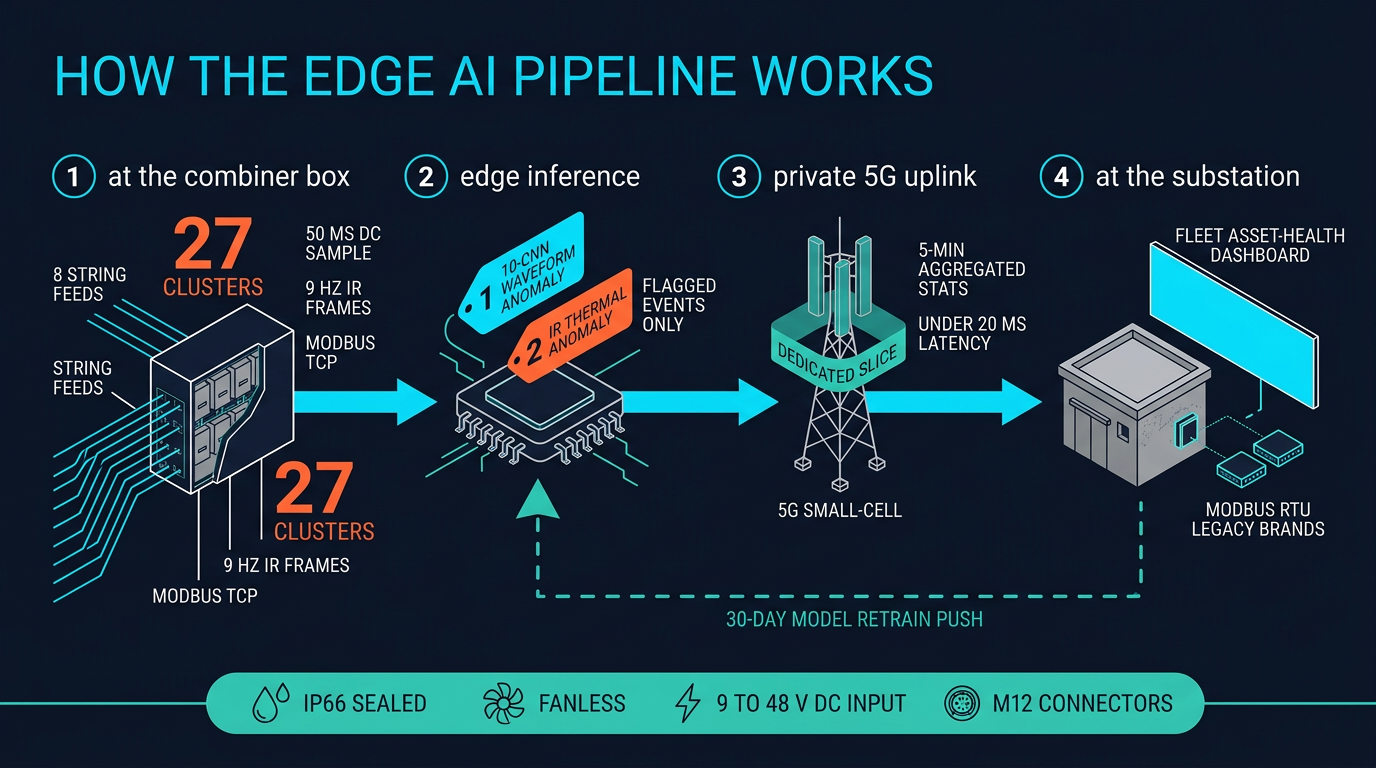
Each combiner-box cluster (8 string inverters per cluster, 27 clusters across the site) got one POC-766AWP node. The node reads DC voltage and current at 50 ms intervals via Modbus TCP and an 8-channel current shunt board. It pulls 9 Hz IR thermal frames from a fixed FLIR camera over PoE, runs a quantized 1D-CNN anomaly model on the waveform, and runs a small thermal anomaly model on the IR frames. Only flagged events and 5-minute aggregated stats go up to the central SCADA over a private 5G NR slice.
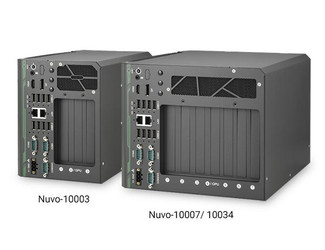
A Nuvo-10000 at the substation control building handles fleet-level aggregation and the asset-health dashboard, while two POC-700 units run protocol gateways for two legacy inverter brands that ship Modbus RTU only.
| Subsystem | Hardware | Role |
|---|---|---|
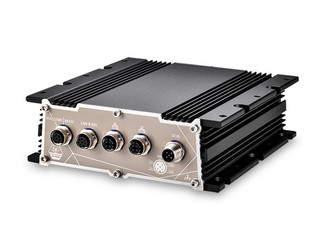
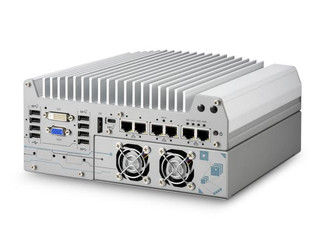
| Combiner edge node | POC-766AWP (i5, IP66, fanless, -25 to 70°C) | DC waveform and IR thermal anomaly inference |
| Plant aggregator | Nuvo-10000 | Fleet rollup, dashboard, model OTA |
| Legacy gateway | POC-700 | Modbus RTU to MQTT translation |
| Backhaul | Private 5G NR slice | 250 kbps avg per node, 8 ms p95 latency |
The field team did not have to build secondary enclosures. POC-766AWP is IP66, fanless, with a 9 to 48 V DC wide input and M12 connectors, so it sits inside the combiner box without a fan or DC step-down. Model retrain runs on a 30-day cadence, with new weights pushed from the substation aggregator over the 5G slice during low-irradiance windows.
Performance
| KPI | Baseline (12 mo prior) | Post-Edge (8 mo) | Change |
|---|---|---|---|
| Unplanned inverter downtime | 142 h / inverter / yr | 47 h | -67% |
| Yield loss to inverter faults | 4.1% | 1.4% | -2.7 pp |
| Time to detect IGBT degradation | 36 h | 4 min | -99.8% |
| Truck rolls per MW per year | 2.7 | 0.9 | -67% |
| False-alarm rate | 18% | 4% | -78% |
Related Products
Modeled assumption — not a verified customer result.

Conclusion
Modeled assumption — Solar O&M does not need a new control system. It needs faster eyes on each inverter. POC-766AWP gives the field engineering team that, in a fanless IP66 box that survives the same dust and heat as the panels around it. The 67% downtime cut and 4-minute IGBT detection time paid back the hardware in the second quarter of operation.
Follow Neteon on LinkedIn, email [email protected], or visit www.neteon.net for the POC-766AWP datasheet and a solar pilot scope.
Related reading: 5G vs private LTE vs Wi-Fi 6 for industrial edge AI connectivity
FAQs
Why run inverter anomaly detection at the edge instead of in the cloud?
DC waveforms at 50 ms cadence generate too much data to backhaul cost-effectively, and IGBT degradation signatures appear in milliseconds. Running inference at the combiner box catches faults 6 to 10 days earlier and keeps backhaul under 250 kbps per node.
What environmental ratings does the POC-766AWP carry?
IP66 ingress protection, fanless thermal design, -25°C to 70°C operating range, 9 to 48 V DC wide input, and M12 connectors for vibration and dust resilience. It mounts inside an outdoor combiner box without a secondary enclosure.
How does the model stay current as inverters age?
A 30-day retrain cadence runs on the plant aggregator (Nuvo-10000), pulling labeled events from the past month plus new failure exemplars. Updated weights push to each POC-766AWP node over the 5G slice during low-irradiance windows.
Can this stack work without private 5G?
Yes. POC-766AWP supports fiber, microwave, and 4G LTE backhaul. The private 5G slice gave this site predictable 8 ms p95 latency, but a fiber backbone or LTE Cat-M would also meet the 250 kbps per-node bandwidth budget.
What is the typical payback period?
This site recovered the hardware cost in roughly two quarters. Payback is mostly a function of yield-loss reduction and avoided truck rolls; sites with longer service routes see faster payback.
Sources and further reading
Neousys POC-766AWP product specifications.
NREL solar research resources.
Related Neteon guides
Nuvo-10000 Wind Turbine Monitoring Architecture.
Nuvo-10108GC Smart Intersection Vision Architecture.
Browse the case study topic hub for more deployment guidance.