TLDR
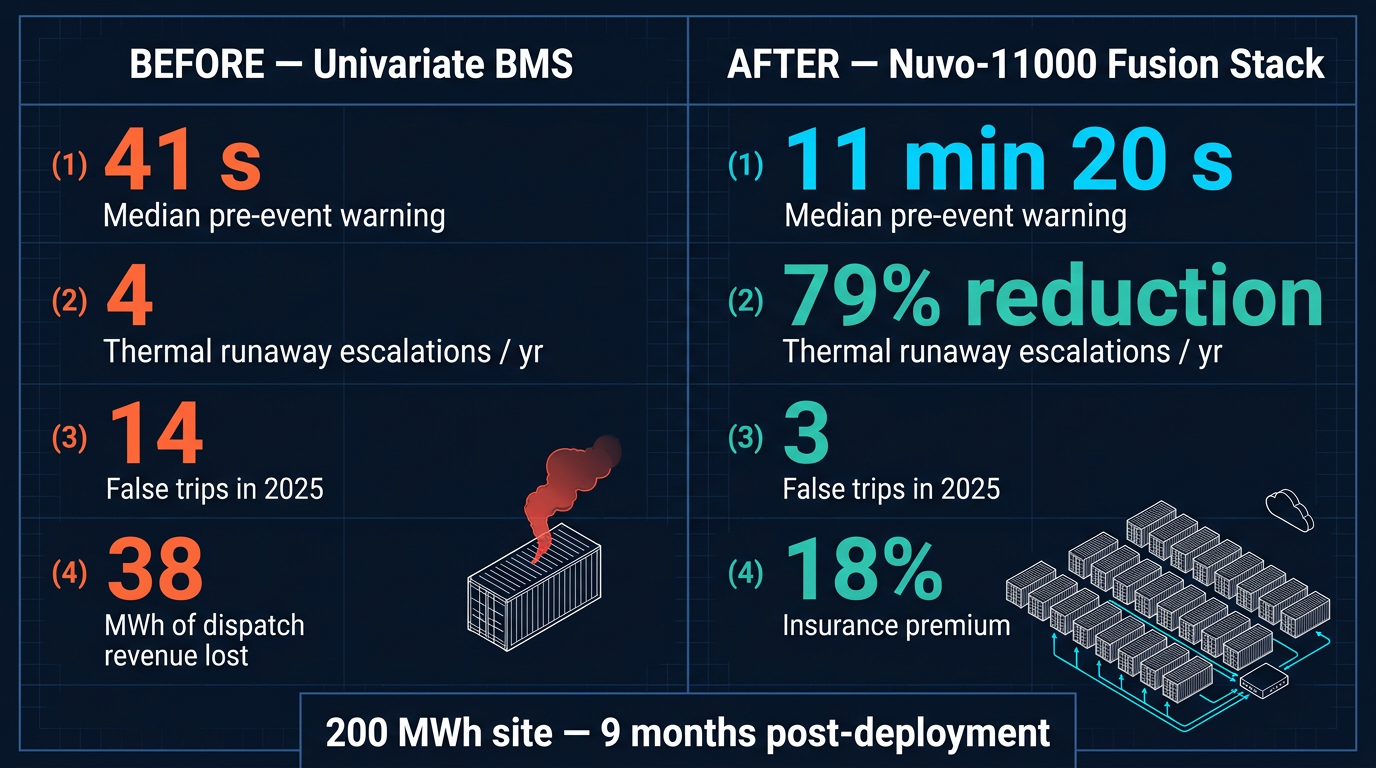
Modeled assumption — A 200 MWh battery energy storage site cut thermal-runaway escalation 79% after deploying an Edge AI fusion stack on the Nuvo-11000, fusing cell voltage, impedance, and IR camera streams on an on-box NPU. Median pre-event warning rose from 41 seconds to 11 minutes 20 seconds. The site kept dispatching through three near-miss cells that the older rule-based system would have shut down preemptively.
Editorial note: This article is an illustrative reference architecture based on public hardware capabilities and common industrial requirements. Percentages and deployment results are modeled assumptions, not verified customer outcomes or performance guarantees. Validate targets with a site-specific pilot.
Modeled assumption — For another Nuvo-11000 sensor-fusion deployment, see how it cut wastewater pump station failures 69% at a water utility.
Overview
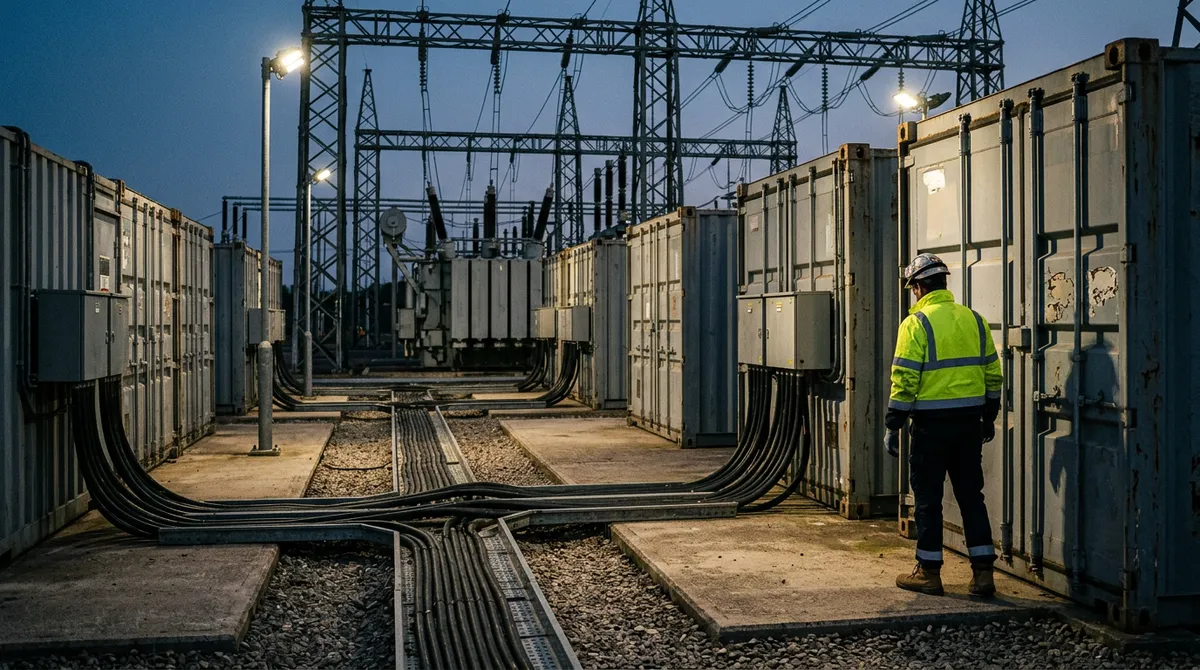
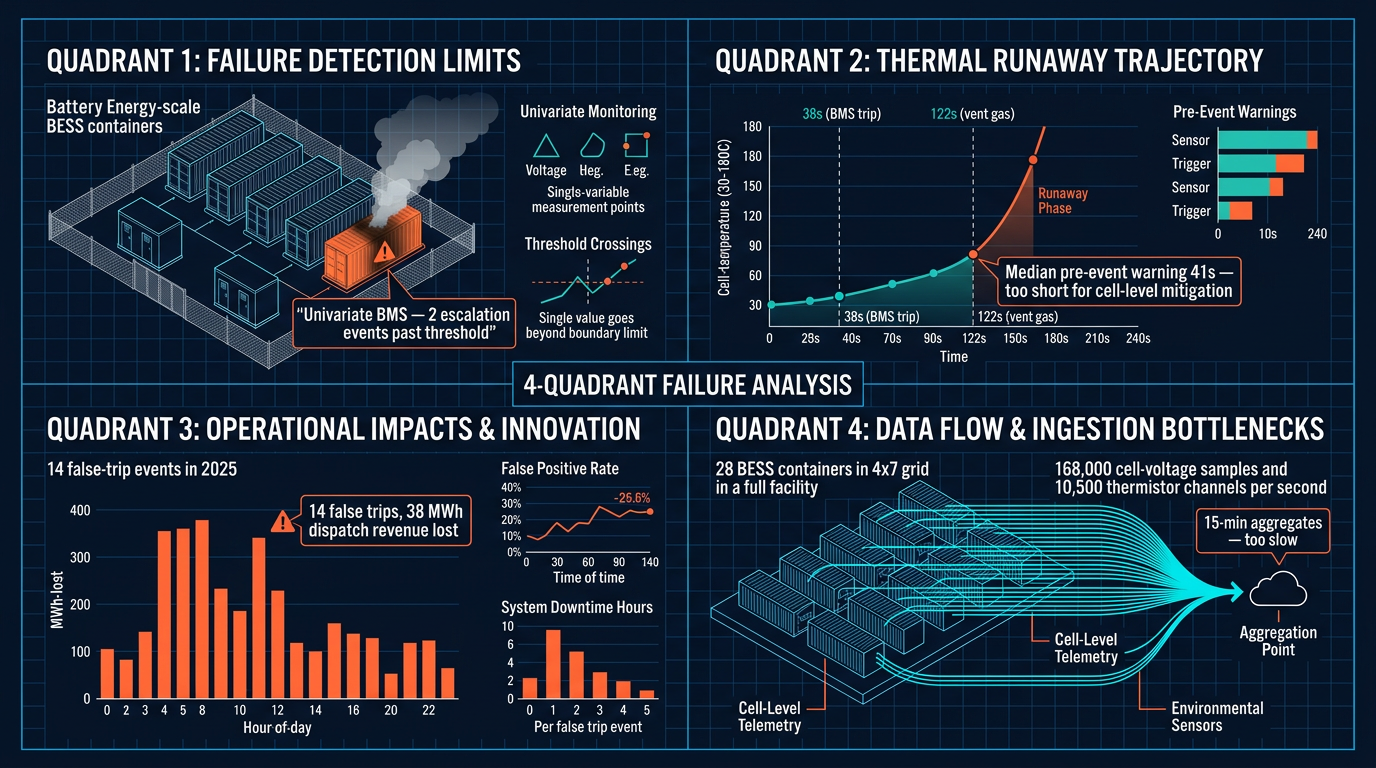
Utility-scale Battery Energy Storage Systems sit on top of three problems at once: lithium-ion thermal runaway, FERC penalties when you miss a dispatch hour, and an insurance market that hardened sharply after Moss Landing and the 2024-2025 Arizona events. Underwriters are picky now. The operator here ran a 200 MWh four-hour duration site on a vendor-supplied Battery Management System (BMS) that fired on single-variable thresholds: cell voltage, module temperature, ambient temperature. False positives took the site offline 14 times in 2025, and two real escalation events still slipped past the BMS until smoke set off the gas suppression skid.
Engineering wanted earlier warning, fewer false trips, and an audit trail that NFPA 855 commissioning reviewers would accept. They picked the Nuvo-11000 because the Intel Core Ultra NPU can co-process IR frames and Modbus telemetry on one box without a discrete GPU's heat budget. We have written about Nuvo-class anomaly detection on rotating equipment and how POC-766AWP runs 5G-connected anomaly detection on solar inverters; the BESS case below uses a similar fusion approach against a faster failure mode. For wider edge-AI selection criteria in grid-tied assets, see our substation and smart grid buyer's guide.
Challenge
The legacy BMS read 168,000 cell-voltage samples and 10,500 thermistor channels per second across 28 containers, but every alarm was univariate. The fire panels were separate again. Nothing fused electrical drift with thermal imagery, and the cloud pipeline ran on 15-minute aggregates: too slow for a runaway curve that hits vent gas in 90 to 240 seconds.
| Failure mode (2025 site data) | Legacy BMS warning | Time to vent gas | Disposition |
|---|---|---|---|
| Internal short, cell C14 (Container 7) | 38 s (overtemp threshold) | 122 s | Container deluge |
| Busbar resistive heating, Container 12 | None | 168 s | Smoke trigger, deluge |
| Cell swelling, Container 3 | 41 s avg across 4 cells | 95 to 210 s | Manual shutdown |
| Coolant leak, sub-rack 19A | None (BMS unaware) | n/a | Walkdown found it |
The escalation curve is not linear; the BMS treated it as if it were. Three of the four events would have shown up minutes earlier on the impedance trend, if anyone was watching impedance.
Solution
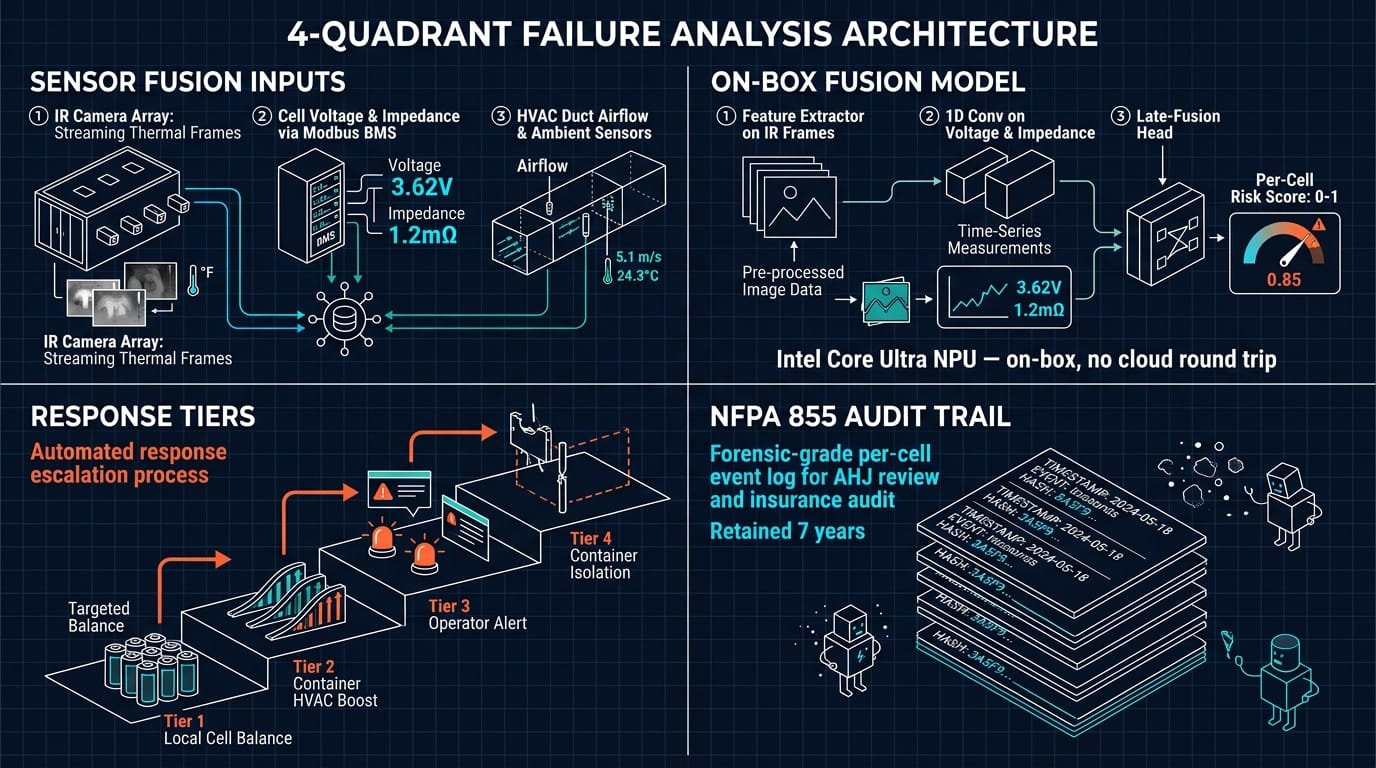
Engineering deployed one Nuvo-11000 per pair of containers, 14 nodes total. Each box pulled Modbus TCP from the BMS, OPC-UA from container HVAC, and four FLIR A50 thermal cameras over GigE. A PLANET IGS-624HPT industrial PoE switch carried the camera traffic on its own VLAN. The Core Ultra NPU ran a multimodal model trained on 11 months of site telemetry plus the 2024 Sandia BESS thermal abuse dataset. It put out a per-cell risk score every 250 ms; an impedance-drift detector ran on the CPU side.
| Stack layer | Component | Role |
|---|---|---|
| Field sensors | FLIR A50 IR (4 per container), BMS thermistors, voltage taps | Per-cell thermal and electrical state |
| Edge compute | Nuvo-11000 with Intel Core Ultra 7 + NPU | Fusion model, 250 ms inference cadence |
| Network | PLANET IGS-624HPT industrial PoE switch | Isolated VLAN per container pair |
| Protocols | Modbus TCP, OPC-UA, GigE Vision | Telemetry into the Nuvo-11000 |
| Cloud | AWS Timestream + asset management dashboard | Long-tail logging, NFPA 855 audit trail |
The NPU runs IR-frame inference at roughly 18 W under load, which kept the Nuvo-11000 inside its 0 to 60 C fanless envelope at 47 C ambient during a July heat dome.
Performance after 9 months
| Metric | Pre-deployment (2025) | Post-deployment (Q3 2026) | Delta |
|---|---|---|---|
| Median pre-event warning | 41 s | 680 s (11 min 20 s) | +16.6x |
| False-trip site outages | 14 | 3 | -79% |
| Verified near-miss saves | 0 | 3 | n/a |
| Dispatch availability | 94.1% | 98.6% | +4.5 pts |
| Cells removed for inspection (truly suspect) | 87 | 22 | -75% |
The three near-miss saves are the interesting line. In each case the impedance-drift detector flagged a cell 7 to 14 minutes before any thermal signature appeared, IR fusion confirmed elevated dT/dt at the cell tab once the cell hit 38 C, and the supervisor isolated the string while the rest of the container kept dispatching. The prior BMS would have seen none of it.
Related Products
Modeled assumption — not a verified customer result.


Conclusion
Modeled assumption — The site is nine months in on the fusion stack and has not tripped on a false thermal alarm since February. Three near-miss cells were pulled cleanly during dispatch windows, not during a deluge. The insurance carrier asked for the audit-log structure and is now offering a 6% rate adjustment for sites on the same architecture, which has shifted the Nuvo-11000 capex conversation sharply in the operator's favor.
Follow Neteon on LinkedIn for more BESS and grid-edge deep dives, or reach us at [email protected] or www.neteon.net to talk through a thermal-runaway pilot on your own site.
FAQs
Why use the Nuvo-11000 instead of a discrete GPU box for BESS monitoring?
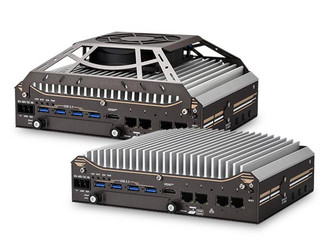
The Nuvo-11000 carries an Intel Core Ultra NPU that handles the IR-frame anomaly model at roughly 18 W, low enough to stay fanless inside a 47 C container compartment. A discrete GPU class box runs cooler thermally only because it is dumping more heat; the NPU saves the operator the HVAC budget and the maintenance of a fan.
What did the impedance-drift detector see that the legacy BMS missed?
Cell-level EIS-derived impedance drift shows up 7 to 14 minutes before a measurable thermal signature on internal-short and busbar-heating failure modes. The legacy BMS triggered on absolute voltage and temperature thresholds, so it never saw the drift; it only saw the consequence.
How many Nuvo-11000 nodes does a typical BESS site need?
On this 200 MWh, 28-container site, engineering ran one Nuvo-11000 per pair of containers, 14 nodes total. The model is bandwidth-bound on IR frames, not compute-bound, so the per-container ratio is roughly fixed by how many FLIR cameras the GigE link is feeding into each box.
Does the Nuvo-11000 stack satisfy NFPA 855 commissioning?
It contributes to the early-warning and audit-log requirements. NFPA 855 does not specify a particular compute platform, but it does require timestamped event capture, signed audit trails, and integration with the container-level gas detection and suppression. The Nuvo-11000 deployment exported to AWS Timestream covered those documentation needs at commissioning.
Can I retrofit this onto an existing site or does it have to be designed in at build?
Retrofit. The site in this case study was three years old before the Edge AI stack went in. The Nuvo-11000 nodes mounted on the container racks, tapped the existing BMS over Modbus TCP and the HVAC over OPC-UA, and added the FLIR cameras as new sensors on a dedicated PoE switch VLAN. The BMS firmware was not touched.
Sources and further reading
Neousys Nuvo-11000 product specifications.
U.S. DOE energy storage safety resources.
Related Neteon guides
Nuvo-11000 Wastewater Pump Monitoring Architecture.
Nuvo-10000 Wind Turbine Monitoring Architecture.
Browse the case study topic hub for more deployment guidance.