
Overview
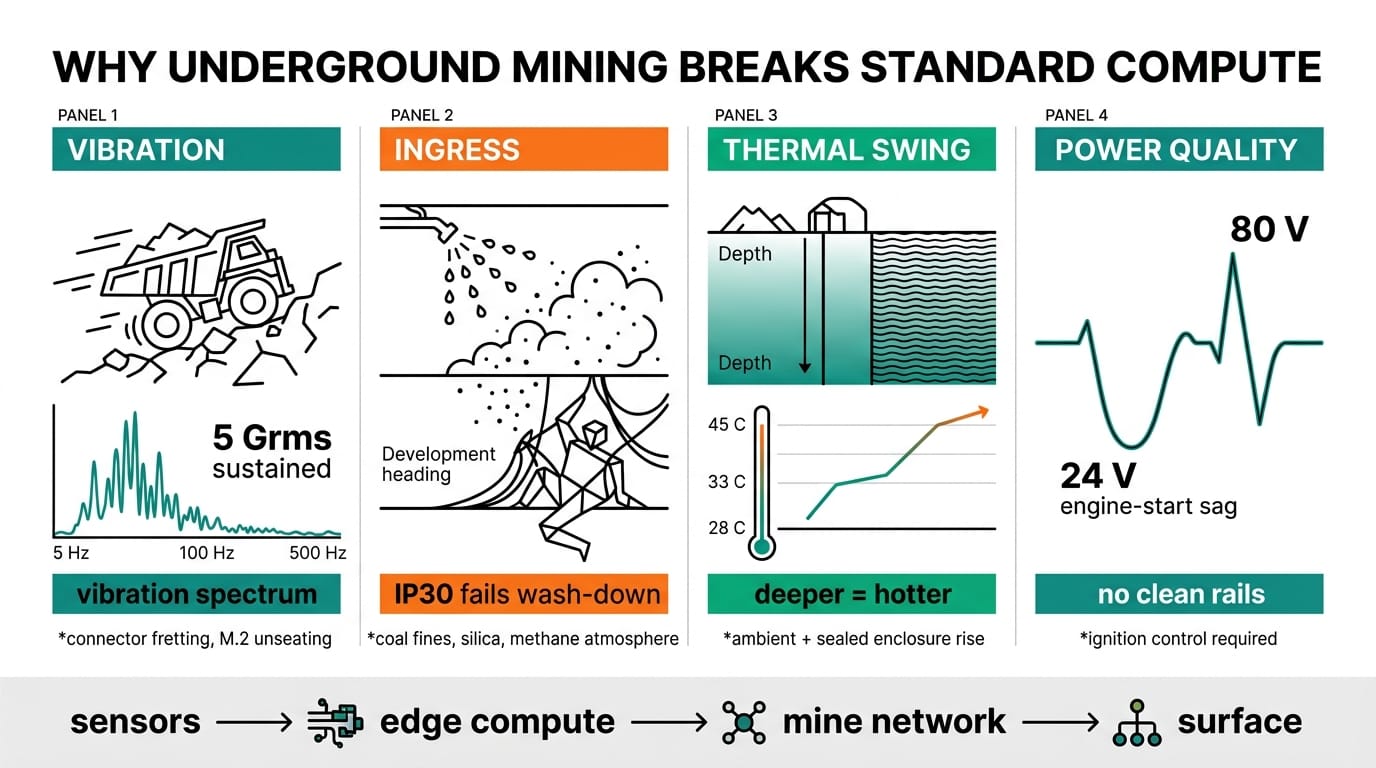
Underground mining is one of the harshest environments an edge AI computer will see. A face drill rig pulls sustained 5-8 Grms vibration, a ventilation drift sits 800 meters below grade with no service-vehicle access for weeks, and a haul truck cab swings -20 to +60 C across a single shift. Pick the wrong compute platform and the result is nuisance trips on day 30, thermal throttling on day 90, and a service call to a development heading that costs forty hours of lost production.
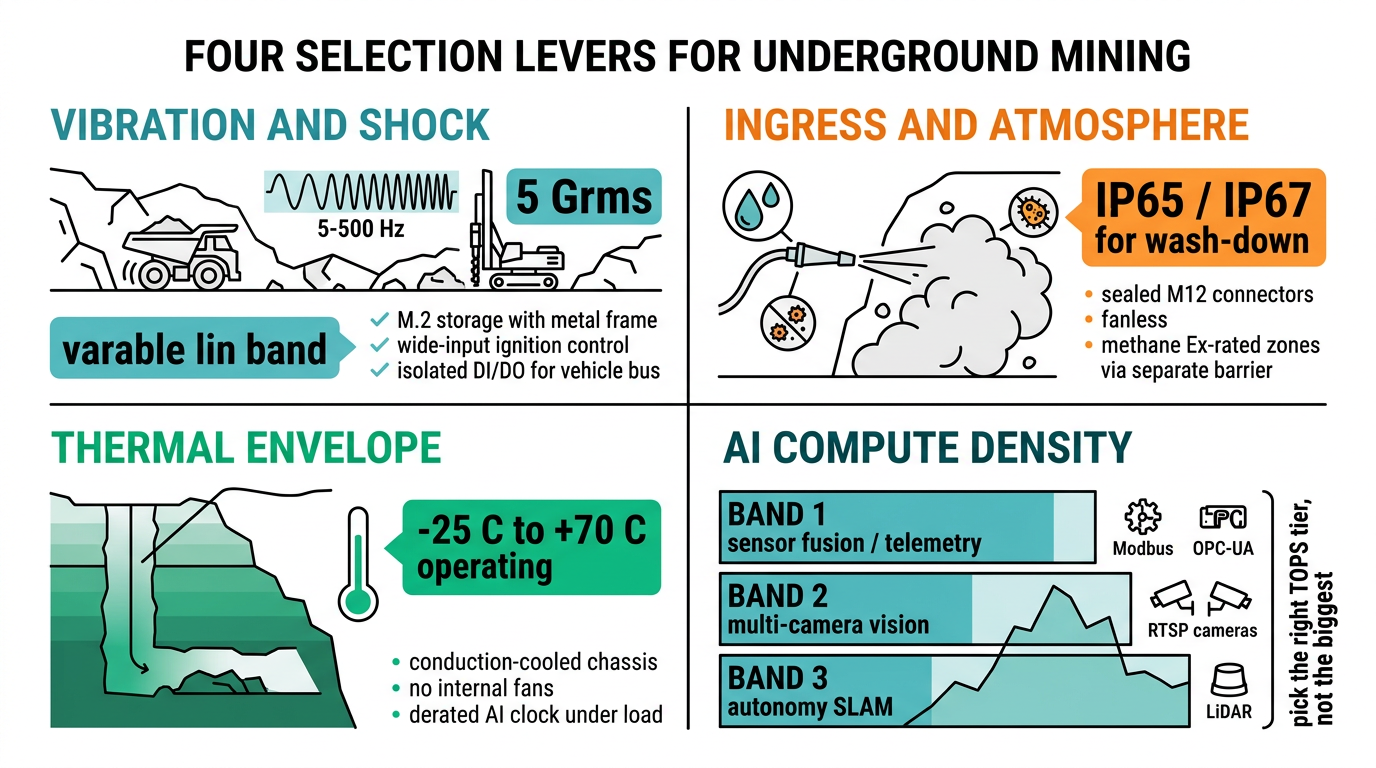
This buyer's guide walks through the four selection levers that matter for underground deployment: vibration and shock rating, ingress and atmosphere compliance, thermal envelope, and AI compute density. Each lever maps to reference SKUs from the Neousys channel that Neteon ships today. For wider safety-compliance reasoning, see our ATEX and C1D2 hazardous location explainer, the market view in our Edge AI in Underground Mining 2026-2030 outlook, and a live deployment in our sub-100ms collision avoidance case study.
Selection Lever 1: Vibration and Shock
Underground rolling stock and drill rigs run sustained vibration in the 5 to 500 Hz band. A spinning disk fails inside the first quarter. A heatsink-on-spring CPU fails inside the first year. Specify MIL-STD-810G certified fanless platforms with M.2 SSD storage.
| Vibration profile | Example application | Minimum rating |
|---|---|---|
| 5 Grms random | Vent shaft, fixed pump skid | MIL-STD-810G 514.6 Cat 4 |
| 1.5 Grms 5-500 Hz | Haul truck cab, LHD vehicle | MIL-STD-810G 514.6 Cat 20 |
| 50 G shock, 11 ms | Jumbo drill carriage, face rig | MIL-STD-810G 516.6 Procedure I |
The POC-700 series clears 5 Grms with M.2 mounting and ignition control for vehicle power buses. For higher shock loads on drilling equipment, step up to the POC-766AWP, which adds wide-temperature operation and M12 ruggedized connectors.
Selection Lever 2: Ingress and Atmosphere
Mines combine water spray, fine coal or silica dust, and on some seams methane. The IP rating depends on where the box mounts.
| Mount location | IP rating | Atmosphere |
|---|---|---|
| Inside electrical cabinet | IP30 acceptable | Conditioned |
| On equipment frame, open drift | IP40 with conformal coat | Dusty, splash |
| Direct wash-down zone | IP65 or sealed IP67 housing | Wet |
| Gassy seam, Class I Div 2 | UL Class I Div 2 cert | Methane risk |
Standard fanless boxes clear IP30 to IP40 out of the box. For wash-down and dust-laden drifts, the POC-766AWP with its closed chassis and M12 connectors reaches IP65 with no extra housing. Class I Div 2 deployments need a certified enclosure plus intrinsically safe barriers. That workflow is in the hazardous-location explainer linked above.
Selection Lever 3: Thermal Envelope
Underground ambient temperatures swing widely. A development heading sits 28-35 C. A remote ventilation drift runs 8-12 C. A haul truck cab hits 60 C in summer. Size for the worst week, not the annual average.
| Ambient range | Cooling strategy | Reference SKU |
|---|---|---|
| 0 to +50 C | Standard fanless | POC-700, Nuvo-9160GC |
| -25 to +70 C | Wide-temperature fanless | POC-766AWP |
| -40 to +85 C startup | Cold-start qualified | POC-766AWP, NRU-220 |
If the deployment includes a Jetson-class AI workload, the NRU-220 series carries a fanless Jetson AGX Orin chassis with -25 to +70 C operation and ignition sensing for vehicle power.
Selection Lever 4: AI Compute Density
Mining edge AI workloads split into three bands.
Band one is sensor fusion and telemetry: Modbus from the BMS, OPC-UA from the PLC, accelerometer streams off the gearbox. A 15-25 W fanless CPU like the POC-700 or POC-766AWP handles this with headroom for one 720p anomaly-detection camera.
Band two is multi-camera vision: collision avoidance on an LHD, face mapping on a jumbo, conveyor object detection. The Nuvo-10208GC runs an NVIDIA RTX-class GPU at 65 W and handles three to six camera streams in real time.
Band three is autonomy stack: SLAM, path planning, multi-sensor fusion on an autonomous shuttle. This is where the NRU-220 with its 64 GB Jetson AGX Orin module earns its slot. Orin AGX delivers 275 TOPS in a 60 W envelope, fanless.
Putting It Together: A Decision Matrix
| Use case | Vibration | Ingress | Temperature | Recommended platform |
|---|---|---|---|---|
| Fixed ventilation monitor | 5 G | IP40 | 0 to +50 C | POC-700 |
| LHD collision avoidance | 1.5 G | IP65 | -25 to +70 C | POC-766AWP or NRU-220 |
| Jumbo drill telemetry | 50 G shock | IP65 | 0 to +50 C | POC-766AWP |
| Haul truck autonomy stack | 1.5 G | IP65 | -25 to +70 C | NRU-220 |
| Conveyor vision QA | 5 G | IP40 | 0 to +50 C | Nuvo-10208GC |
Procurement and Field Service Notes
Stocked SKUs ship in four to six weeks. Custom storage, wireless, or extended-temperature variants run eight to twelve weeks. Spares policy in mining usually calls for one cold spare per ten installed units, kept above grade. Conformal coating is a chargeable option, specify at order for any drift-mount deployment. Cable strain relief and M12 pigtails are the most common field-failure point, not the compute box itself, so include them in commissioning checks.
Related Products


Conclusion
Match the platform to the worst-case combination of vibration, ingress, temperature, and compute load, not the spec-sheet headline. The POC-700, POC-766AWP, Nuvo-10208GC, and NRU-220 cover the bulk of underground roles in the Neousys channel. For help mapping a specific shaft, drift, or fleet to the right SKU, follow Neteon on LinkedIn, or reach the team at [email protected] or www.neteon.net.
FAQs
What MIL-STD-810G category fits an underground haul truck or LHD vehicle?
Category 20 of MIL-STD-810G 514.6 (1.5 Grms, 5 to 500 Hz, three axes, one hour per axis) is the right floor for haul trucks, LHDs, and shuttle cars. Fixed pumps and ventilation skids can drop to Category 4 (5 Grms random) without risk. Face drill carriages need the 50 G, 11 ms shock spec from Procedure I in addition to the random vibration profile.
Do I need IP67 underground, or is IP65 enough?
IP65 is enough for most open drifts where the box sees splash but not jet wash. Direct wash-down zones near scoops, primary crushers, and conveyor transfer points need IP67, which the POC-766AWP delivers without an external housing. Anything mounted inside a sealed electrical cabinet can drop to IP30 with the cabinet doing the ingress work.
Can a fanless box really handle GPU-class vision workloads in a mine?
Yes, within thermal limits. The Nuvo-10208GC runs an RTX-class GPU at 65 W fanless up to 50 C ambient. Above 50 C ambient, derating kicks in and the GPU clocks back to keep the heatsink temperature inside spec. For wider ambient swings or higher continuous loads, the NRU-220 Jetson AGX Orin platform delivers 275 TOPS at 60 W with a -25 to +70 C rating.
How does Class I Division 2 certification change platform selection?
Class I Div 2 changes the enclosure problem more than the compute problem. The compute box can be a standard rugged fanless platform (POC-766AWP or NRU-220 are common picks) as long as it sits inside a UL-certified Class I Div 2 enclosure with intrinsically safe barriers on all external interfaces. Direct-rated Class I Div 2 compute boxes exist but are slower, more expensive, and rarely needed when the enclosure approach is cheaper to commission.
What is a reasonable spares policy for a remote underground deployment?
One cold spare per ten installed units, kept above grade in a climate-controlled spares cage, with M12 pigtails and SSD modules stocked separately. Mean time to swap a rugged fanless box is twenty minutes once the spare is on site, but the trip from the spares cage to a development heading can be two to six hours depending on shaft access. Build the lead time, not the swap time, into your downtime model.
For a related in-vehicle deployment, see how an NRU-220 cut open-pit haul-truck near-miss events 71%.
Sources and further reading
MSHA proximity detection systems guidance.
IEC 60529 enclosure protection (IP Code).
U.S. DoD ASSIST: MIL-STD-810 environmental testing.
Related Neteon guides
Underground Mining Edge AI Outlook Through 2030.
Vehicle Edge Computing: NVH and Vibration Guide.
Browse the edge ai topic hub for more deployment guidance.