
TL;DR
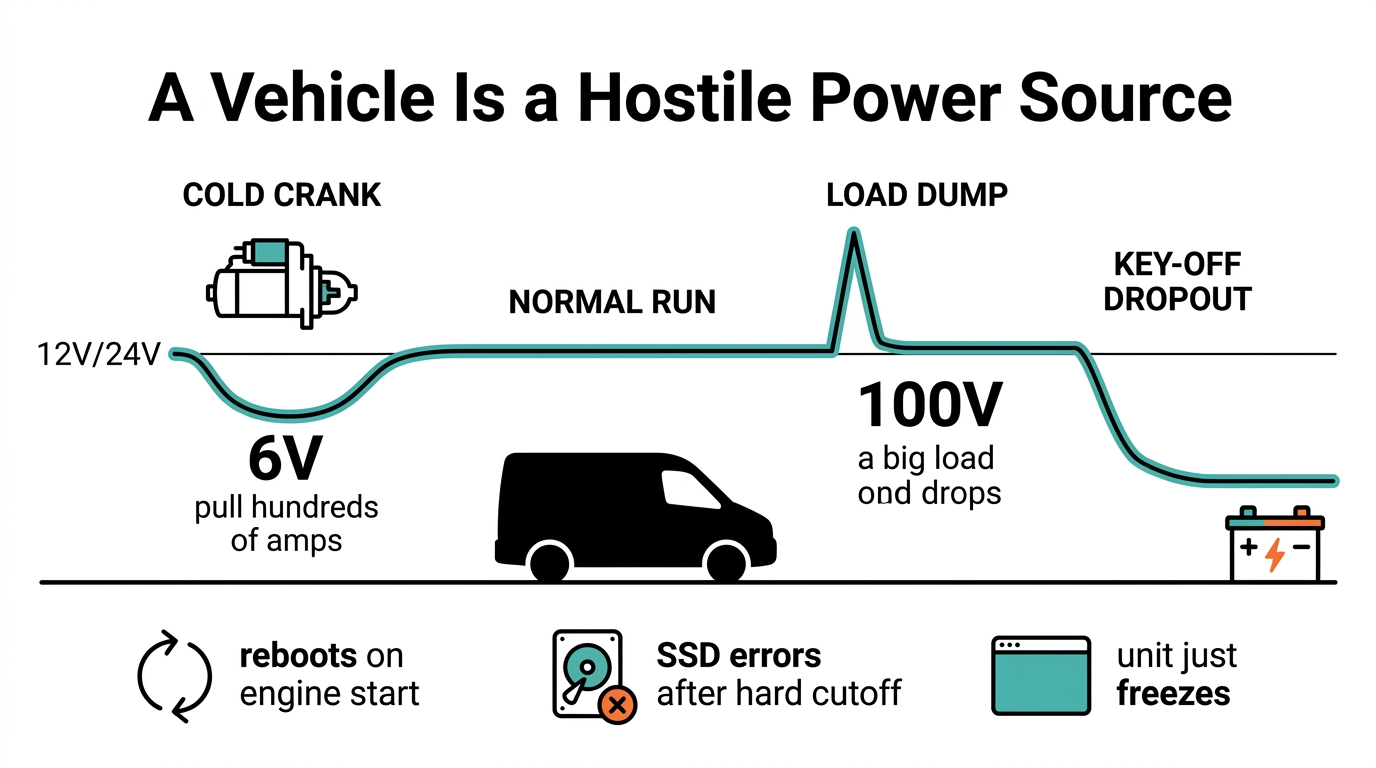
A vehicle is a hostile power source. The 12V or 24V rail sags toward 6V during a cold crank, can spike past 100V on load dump, and drops out the moment someone turns the key. Wire an edge AI box straight to that rail and it either browns out mid-inference or corrupts a model update on shutdown. The fix is power design, not more compute: wide-range DC input, ignition power control, and transient protection sized for real automotive noise. A POC-700 or POC-766AWP builds these in, but you still have to design the install around them.
Overview
Most edge AI failures in vehicles are not compute failures. They are power failures. The unit reboots on every engine start, the SSD throws errors after a hard cutoff, or a field tech reports "it just freezes" and nobody connects it to the alternator. We saw the mechanical side of this in our NVH and vibration design guide; power is the other half of the same problem. It is also why fleet programs care so much about it, as covered in our look at why automakers are embedding edge AI in fleet vehicles.
This guide walks through the power path from the vehicle battery to the computer, the electrical parameters it has to survive, and a short checklist to validate the install. If you are still selecting a platform, our guide to choosing an industrial edge AI computer covers where power input sits among the other selection criteria.
Power architecture
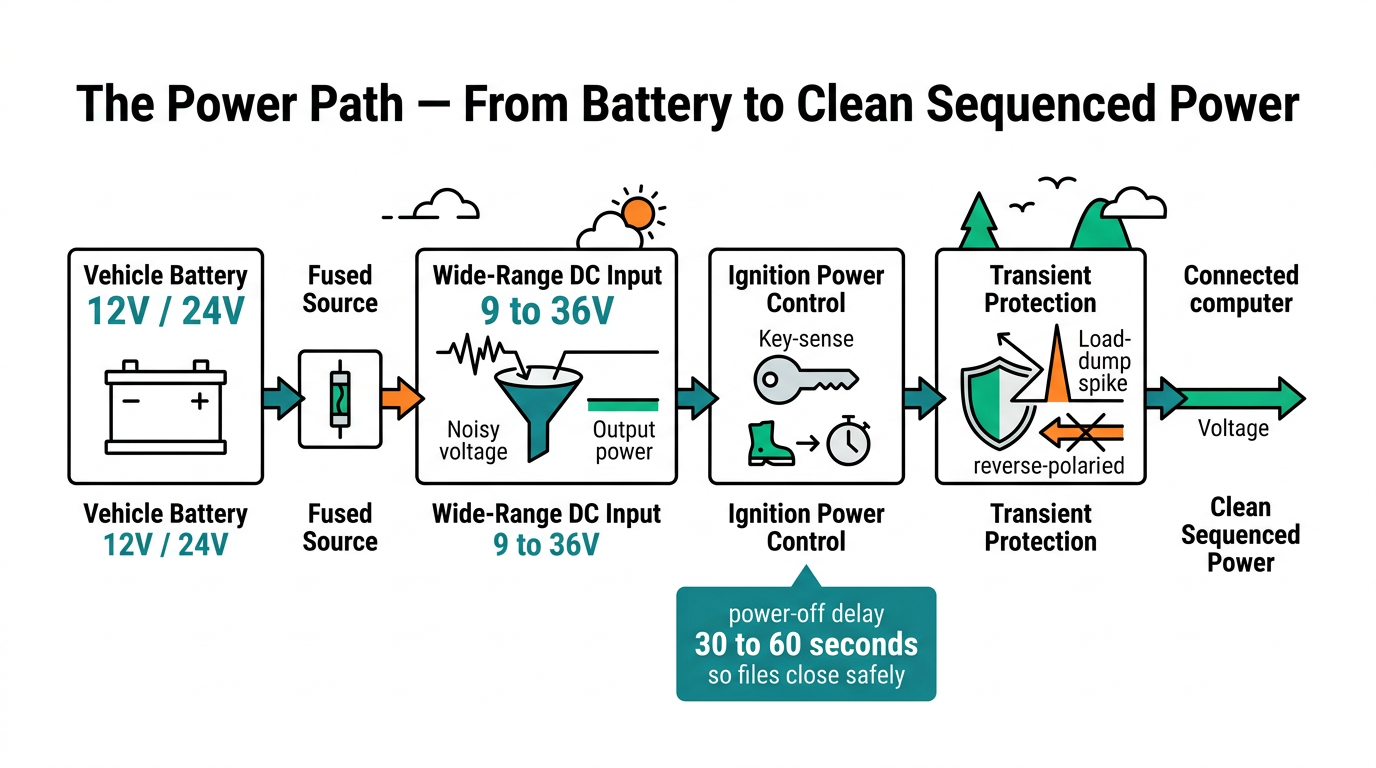
The job is to turn a noisy, intermittent vehicle rail into clean, sequenced power the computer can trust. Each stage below does one part of that.
| Stage | Function | Design target |
|---|---|---|
| Vehicle rail | Source power from battery and alternator | Handle 12V or 24V nominal, 6V to 32V in practice |
| Input protection | Block reverse polarity, clamp surges | Survive ISO 7637-2 transients and load dump |
| Wide-range DC input | Accept the raw rail without an external converter | 8V to 35V direct input |
| Ignition control (IGN) | Sequence power to the key state | Start with ignition on, not on battery contact |
| Power-off delay | Hold power after key-off | Configurable delay for a clean shutdown |
| Internal rails | Feed CPU, GPU, and storage | Stable output through input dips |
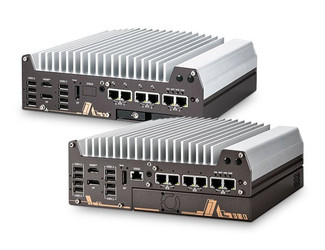
The POC-700 and POC-766AWP take the wide-range input and ignition signal directly, so the vehicle harness connects with no inline DC-DC brick. For heavier inference loads, the Nuvo-11000 uses the same input scheme in a larger chassis.
Electrical design factors
These are the numbers the power input has to tolerate. Design to the worst case in the right column, not the nominal in the middle.
| Parameter | Typical vehicle value | What the computer must tolerate |
|---|---|---|
| System voltage | 12V car, 24V truck | Continuous run across the full band |
| Cold-crank dip | Down to about 6V for tens of ms | Ride through without rebooting |
| Load dump | 100V or higher transient | Clamp it before it reaches the board |
| Reverse polarity | Down to -14V if miswired | Block, do not conduct |
| Ignition switching | Momentary key event | Sequence power, do not chatter |
Cold crank and load dump are the two that catch people. A 12V system does not stay at 12V. It collapses when the starter motor pulls hundreds of amps, then rebounds high when that load drops. A box rated only for a tidy 9V to 36V range and nothing else will reboot on the dip and take damage on the spike.
Integration notes
Run the power feed from a fused source close to the battery, not from an accessory tap that a body control module can cut. Size the wire for the inrush at start, not the steady draw. Tie the ignition wire to a true key-sense line so the computer boots with the vehicle and shuts down with it. Set the power-off delay long enough for the operating system to close files and finish any pending model update, which is usually 30 to 60 seconds for edge workloads. Keep the power ground and the chassis ground separate back to a single point to avoid ground loops that show up as camera noise. On the POC-766AWP, the M12 power connector is keyed and sealed, so an exposed mount does not need an extra enclosure for the connection itself.
Validation checklist
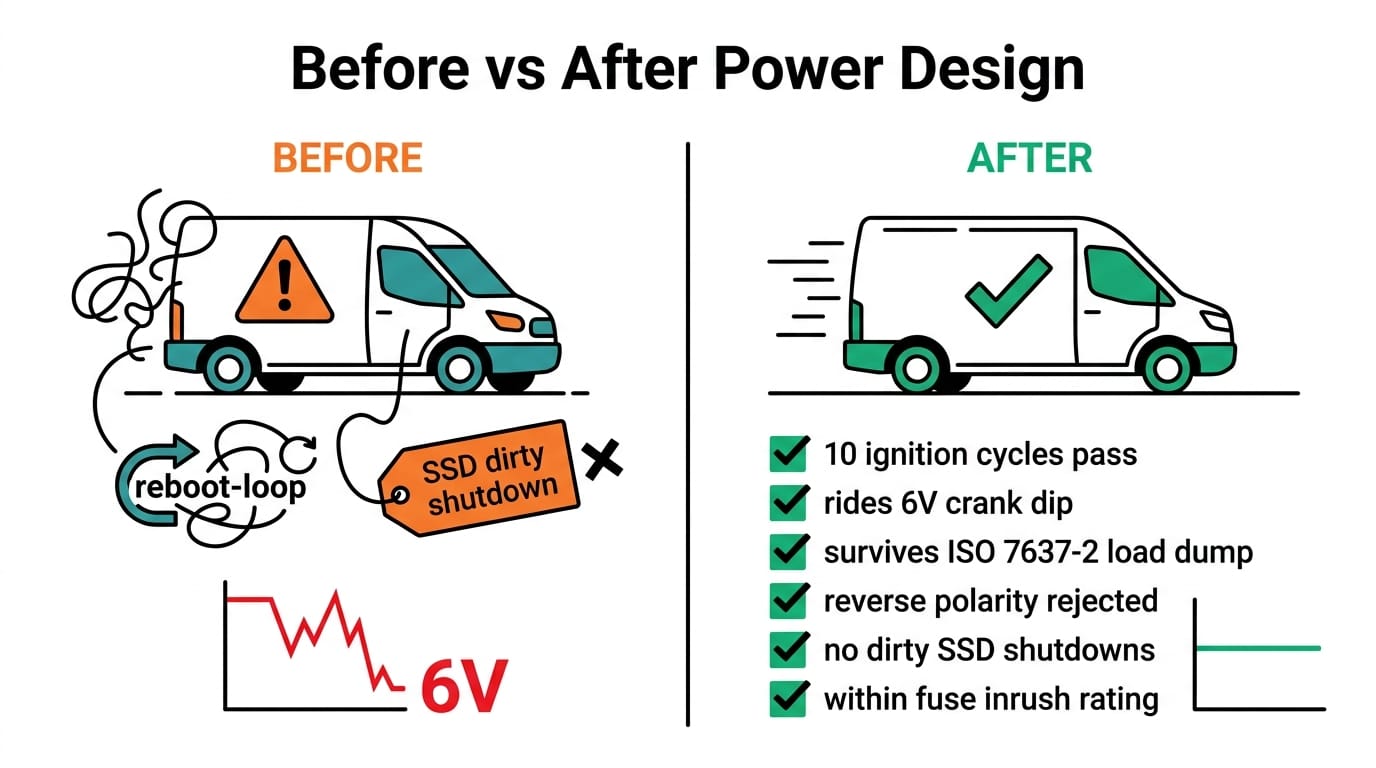
Before a unit ships to the field, confirm it survives these:
- Boots with ignition on and shuts down cleanly on ignition off, every time across ten cycles.
- Rides through a cranking-profile dip to 6V without rebooting.
- Survives an ISO 7637-2 load-dump pulse with no data loss.
- Rejects reverse polarity with no damage and no current draw.
- Holds power for the configured delay so the SSD reports no dirty shutdowns.
- Draws within the fuse rating at cold-start inrush.
Conclusion
Vehicle power is boring right up until it takes down a fleet. Get the input range, ignition sequencing, and transient protection right and the compute side simply does its job. A POC-700 covers most in-cab installs, while the POC-766AWP handles exposed and washdown mounts. Follow Neteon on LinkedIn for more of these design deep dives, or reach us at [email protected] or www.neteon.net to talk through a vehicle edge AI pilot and pull the datasheets.
Related Products


FAQs
Related reading: What Is CAN Bus and CAN FD? A Guide for Vehicle Edge AI
Why does an edge AI computer reboot when I start the vehicle?
The 12V or 24V rail dips toward 6V during a cold crank as the starter pulls hundreds of amps. A computer without wide-range DC input and cold-crank ride-through resets on that dip. The POC-700 and POC-766AWP accept 8V to 35V and hold through it.
What voltage range do Neousys in-vehicle computers accept?
The POC-700 and POC-766AWP take a wide-range 8V to 35V DC input, so they run on 12V car and 24V truck systems directly without an external DC-DC converter.
What is ignition power control?
Ignition control ties the power sequence to the vehicle key state. The computer boots when the ignition turns on and shuts down cleanly after key-off, with a configurable power-off delay so it can finish writes first.
How do I protect the computer from load dump?
Load dump can push the rail past 100V when a large load drops. Use input protection that clamps ISO 7637-2 transients before they reach the board. The POC-700 series includes this on its power input.
How long should the power-off delay be?
Long enough for the operating system to close files and finish any pending model update, which is typically 30 to 60 seconds for edge AI workloads.
Sources and further reading
Neousys rugged computer product catalog.
NIST AI Risk Management Framework.
Related Neteon guides
Vehicle Edge Computing: NVH and Vibration Guide.
What Is CAN Bus and CAN FD? A Guide for Vehicle Edge AI.
Browse the design guide topic hub for more deployment guidance.
About the author and technical review
Author: Olivia Parker covers product-to-market strategy for edge AI, AIoT, and embedded systems.
Technical review: Neteon Industrial Computing Editorial Team. Reviewed August 5, 2026 for source quality, product-specification links, standards references, and clear separation of measured results from reference-architecture assumptions.
Evidence note: Unless a linked primary source explicitly identifies measured field results, performance figures and system outcomes in this article are design targets or planning estimates, not guaranteed results.