
TL;DR
PTP (Precision Time Protocol, IEEE 1588) keeps the clocks on every device in a network aligned to within a microsecond, sometimes to tens of nanoseconds. For edge AI, that shared clock is what lets a box like the Nuvo-10108GC line up frames from several cameras and readings from several sensors so they describe the same instant. Without it, a multi-camera system is stitching together moments that never happened at the same time.
Overview
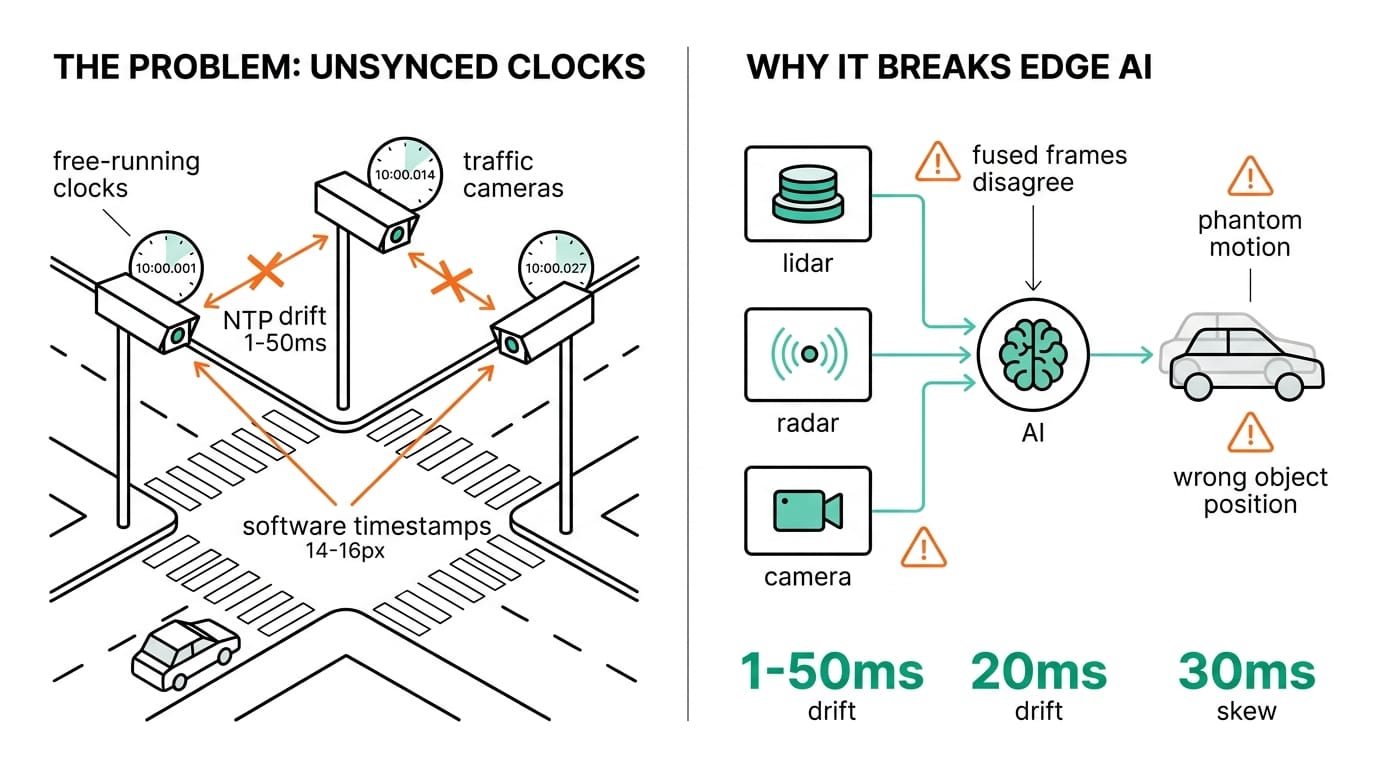
Most people meet time sync through NTP, the protocol that keeps a laptop's clock roughly right. NTP is fine when "roughly right" means a few milliseconds. It falls apart when an inference pipeline has to know which camera saw the forklift first, down to the microsecond. That gap is what PTP fills.
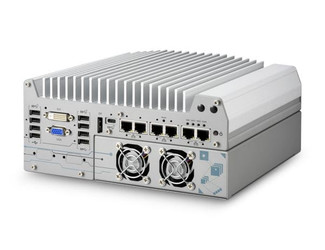
PTP shows up next to the industrial protocols we've explained before. TSN leans on a PTP profile called gPTP to schedule traffic, and PROFINET carries its own clock distribution for the same reason. If you're still choosing hardware, our guide to picking an industrial edge AI computer covers which platforms ship with the networking to support it. This post sticks to one question: what PTP does, and why sensor fusion breaks without it.
Plain-english definition
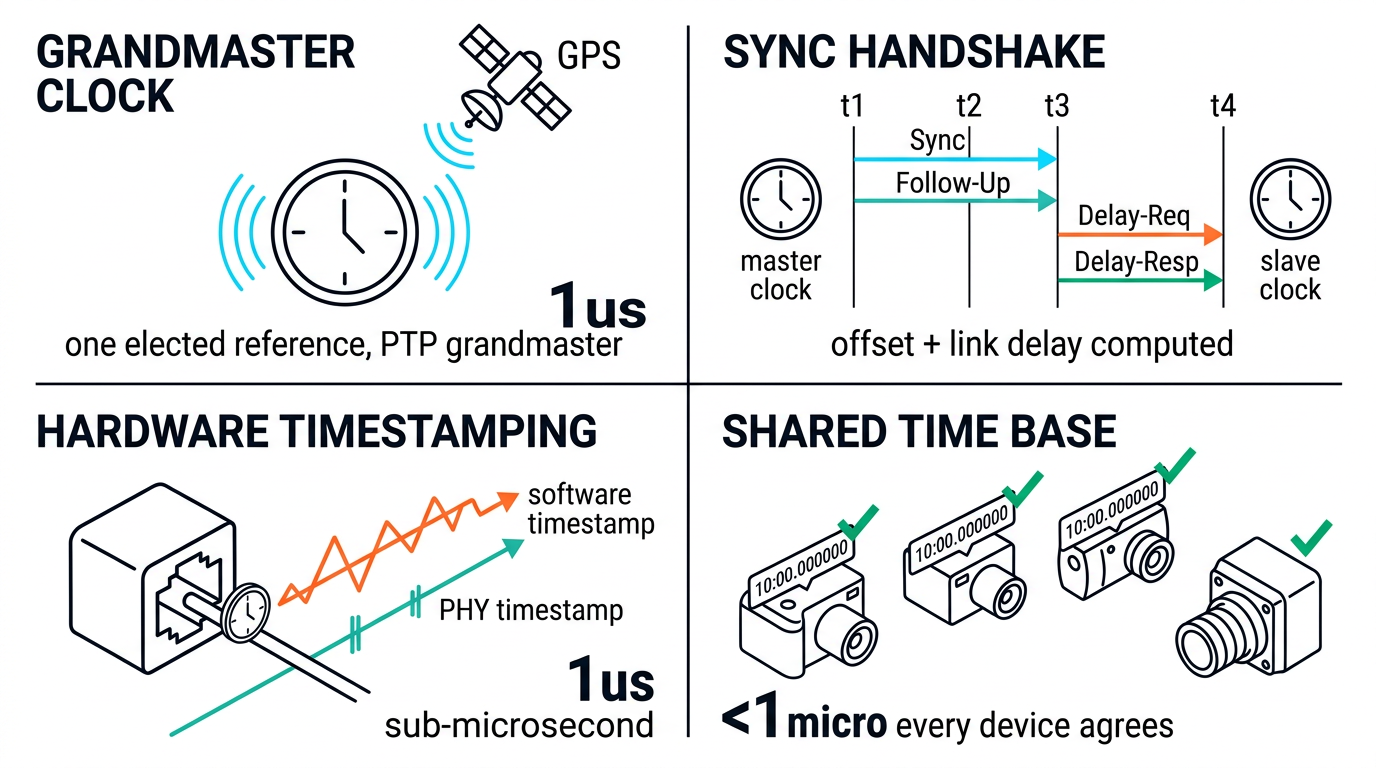
PTP elects one clock on the network as the reference, the "grandmaster," then measures link by link how far every other clock has drifted from it. Each device corrects itself continuously. The payoff is a network where a timestamp means the same thing on the camera, the switch, and the edge computer, within about a microsecond on decent hardware and tens of nanoseconds when the switches do hardware timestamping.
The number that matters is not the protocol version. It's where the timestamp gets stamped. Software timestamps drift with CPU load. Hardware timestamps, taken inside the network interface, do not.
How it works
PTP works out two values: the offset between a device's clock and the grandmaster, and the delay across the link between them. It does this with a short exchange of timestamped messages.
| Message | Direction | What it captures |
|---|---|---|
| Sync | Grandmaster to device | When the reference clock sent the frame (t1) |
| Follow_Up | Grandmaster to device | The precise t1, sent separately for accuracy |
| Delay_Req | Device to grandmaster | When the device asked to measure link delay (t3) |
| Delay_Resp | Grandmaster to device | When the grandmaster received that request (t4) |
From t1 through t4 the device computes its offset and the one-way link delay, then trims its own clock. It repeats this several times a second, so drift never gets a chance to build up.
Why edge AI needs it
A single-camera detector doesn't care about network time. It timestamps its own frames and moves on. The need appears the moment two data streams have to be fused, because fusion math assumes every input describes the same instant. When clocks disagree, that assumption quietly fails and the model starts reasoning about a world that isn't there.
How much accuracy you need depends on how tightly the streams are coupled.
| Method | Typical accuracy | Timestamp source | Fit for edge AI |
|---|---|---|---|
| NTP | 1 to 50 ms | Software | Logging, general IT |
| PTP, software | around 100 us | Operating system | Light coordination |
| PTP, hardware (1588v2) | under 1 us | NIC hardware | Multi-camera sync, sensor fusion |
| gPTP (802.1AS, TSN) | tens of ns | NIC plus TSN switch | Motion control, tight fusion |
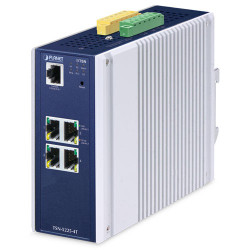
PTP support is a property of the network interface, not the CPU. Platforms like the Nuvo-11000 and Nuvo-9160GC pair Intel NICs with drivers that hardware-timestamp, and a TSN switch such as the PLANET TSN-5225-4T distributes gPTP so accuracy holds across a whole segment instead of just one hop.
Real-world examples
Three patterns from deployments we've documented show where the microseconds earn their keep.
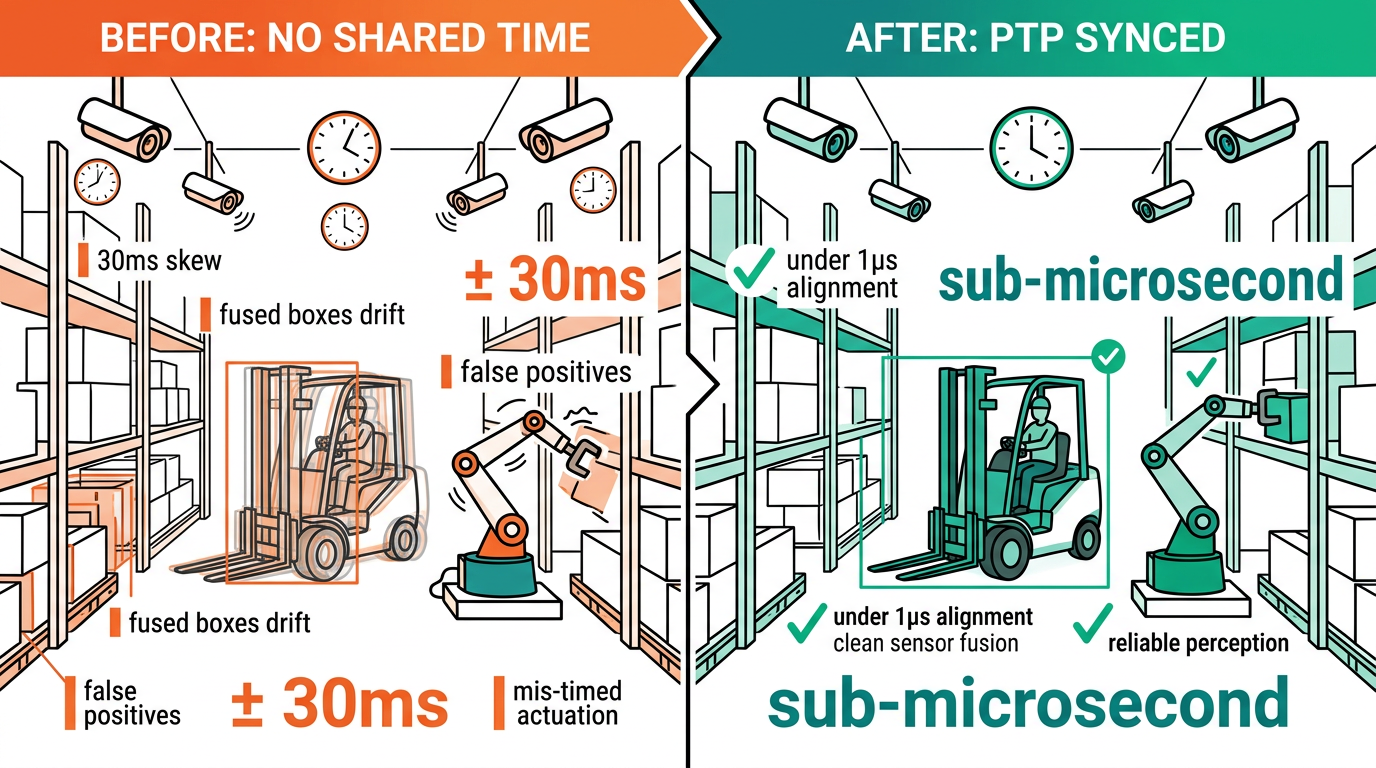
Multi-camera perception is the obvious one. An intersection or a warehouse aisle watched by four cameras has to know that a frame from camera 1 and a frame from camera 2 landed in the same 5 ms window. Let the clocks slip 30 ms apart and one moving object shows up in two places; the tracker either duplicates it or drops it. Our smart-city intersection case study with the Nuvo-10108GC ran exactly this pattern.
Sensor fusion is the second. Lidar, radar, and camera feeding one model only agree if their timestamps agree. Skew there turns into phantom velocity, a target that appears to jump because two sensors disagree about when "now" was.
Coordinated actuation is the third. When an edge decision drives a robot arm or a diverter downstream, the cameras, the compute, and the PLC all have to share the same "now" or the action lands late.
Related Products

Conclusion
PTP isn't glamorous, but it's the line between a multi-sensor system that agrees with itself and one that quietly invents motion. If your deployment fuses more than one stream, treat time sync as a spec line rather than an afterthought, and confirm both the edge computer and the switch do hardware timestamping before you commit. Follow Neteon on LinkedIn for more plain-English protocol explainers, or reach us at [email protected] or www.neteon.net to talk through the networking for a sensor-fusion pilot.
FAQs
What is the difference between NTP and PTP?
NTP keeps clocks within a few milliseconds and is fine for logging and general IT. PTP (IEEE 1588) targets sub-microsecond accuracy by taking timestamps in the network interface hardware, which is what multi-sensor edge AI needs.
How accurate is PTP?
Software PTP lands around 100 microseconds. With hardware timestamping in the NIC it drops under 1 microsecond, and gPTP over a TSN network reaches tens of nanoseconds.
Does PTP need special hardware?
For sub-microsecond accuracy, yes. The network interface has to support hardware timestamping, and the switches should be PTP-aware. Platforms like the Nuvo-11000 and Nuvo-9160GC pair Intel NICs with the driver support for this.
What is gPTP and how does it relate to TSN?
gPTP (IEEE 802.1AS) is a tightly bounded PTP profile that TSN uses to schedule time-sensitive traffic. A TSN switch such as the PLANET TSN-5225-4T distributes gPTP so timing holds across the whole network segment.
Which edge AI computers support PTP for sensor fusion?
Look for platforms with Intel NICs and hardware-timestamping drivers. The Nuvo-10108GC, Nuvo-11000, and Nuvo-9160GC are common choices for multi-camera and sensor-fusion workloads.
Sources and further reading
IEEE 1588-2019 Precision Time Protocol standard.
Neousys rugged computer product catalog.
Related Neteon guides
EtherCAT Explained for Industrial Edge AI.
PROFINET Explained for Industrial Edge AI.
Browse the edge ai fundamentals topic hub for more deployment guidance.
About the author and technical review
Author: Olivia Parker covers product-to-market strategy for edge AI, AIoT, and embedded systems.
Technical review: Neteon Industrial Computing Editorial Team. Reviewed August 5, 2026 for source quality, product-specification links, standards references, and clear separation of measured results from reference-architecture assumptions.
Evidence note: Unless a linked primary source explicitly identifies measured field results, performance figures and system outcomes in this article are design targets or planning estimates, not guaranteed results.