
TLDR
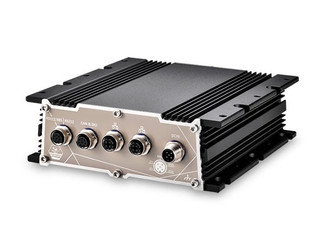
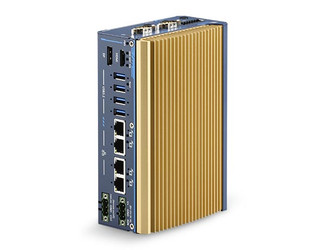
Three wireless options dominate industrial edge AI deployments: Wi-Fi 6, private LTE, and 5G. Wi-Fi 6 wins indoors on cost and throughput. Private LTE covers large outdoor sites with predictable mobility. 5G handles high-bandwidth, low-latency mobile workloads but costs the most to stand up. This guide compares the three head to head, maps each to real deployment scenarios, and covers what to plan for before you commit. The POC-766AWP, NRU-220, and POC-700 pair with all three, so the network choice rarely locks your compute choice.
Overview
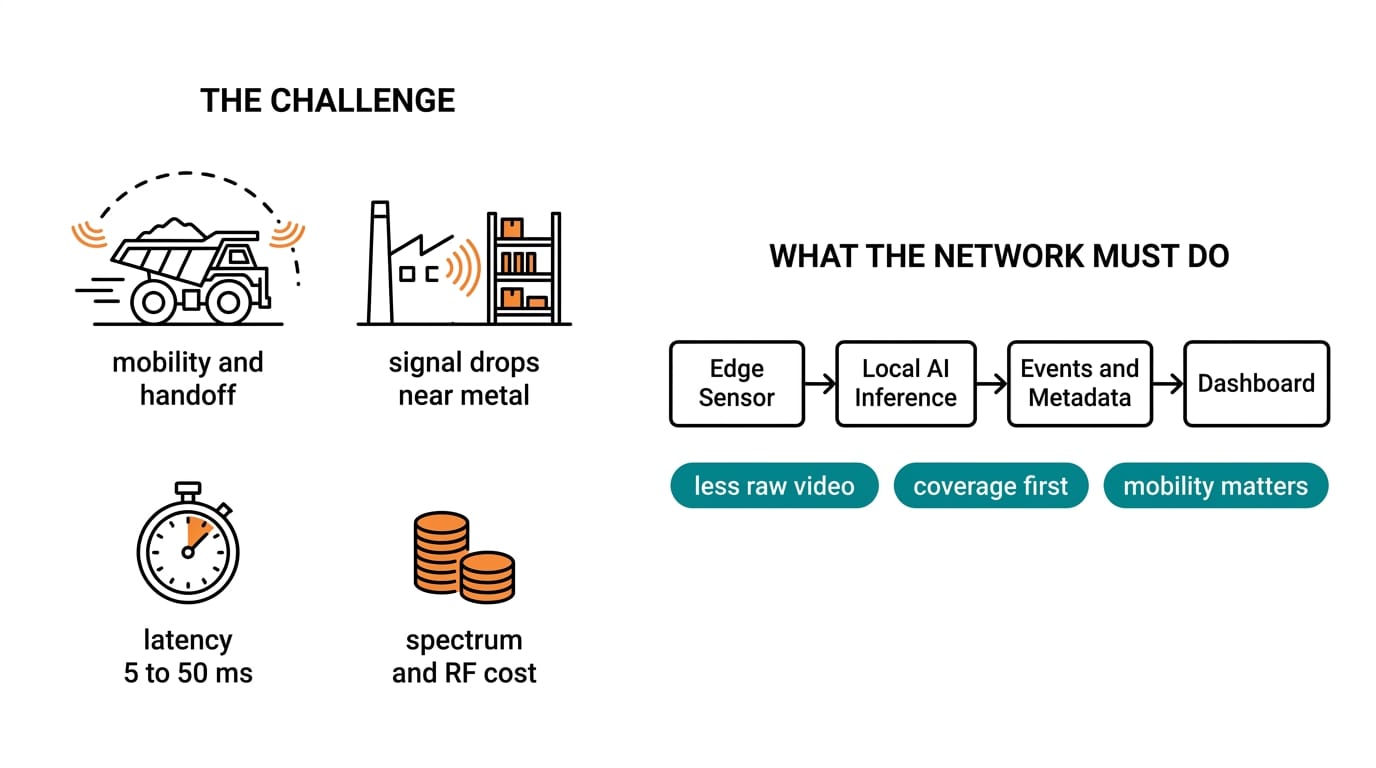
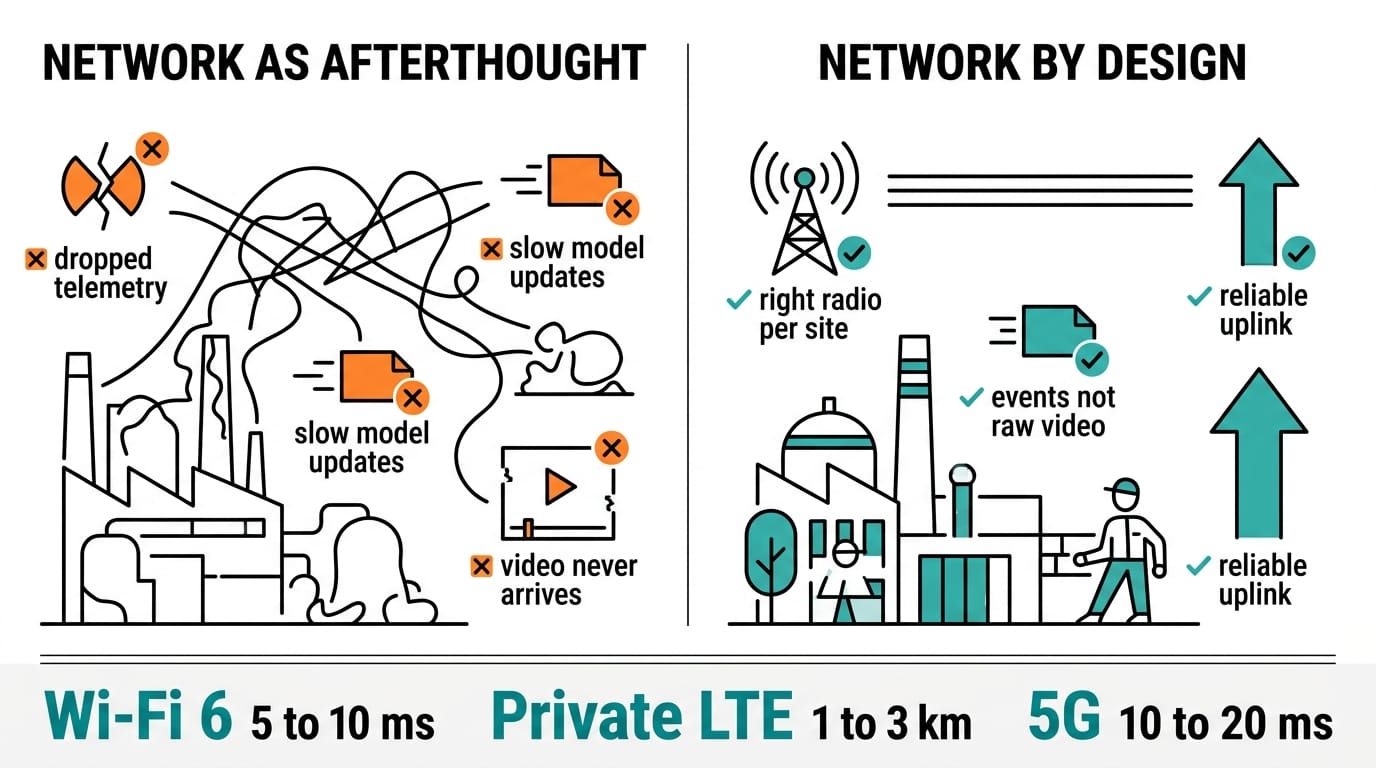
Most edge AI projects settle the compute question first and treat connectivity as an afterthought. That order causes trouble later. A Jetson box doing 360-degree perception on a haul truck has very different network needs than a fixed vision station on a packaging line, and picking the wrong radio shows up as dropped telemetry, slow model updates, or video that never makes it back to the dashboard.
The good news: when inference runs locally, the network carries far less. A unit like the NRU-220 scores frames on the vehicle and ships events and metadata, not raw 4K streams. That shrinks the bandwidth question and shifts the decision toward coverage, mobility, and how much you want to spend on spectrum and RF planning. We covered the broader site design in our guide on designing a converged IT/OT network for edge AI inference, and the spectrum trends in our outlook on private 5G in industrial facilities. If you are still choosing the compute platform itself, start with our guide to choosing an industrial edge AI computer.
Head-to-head comparison
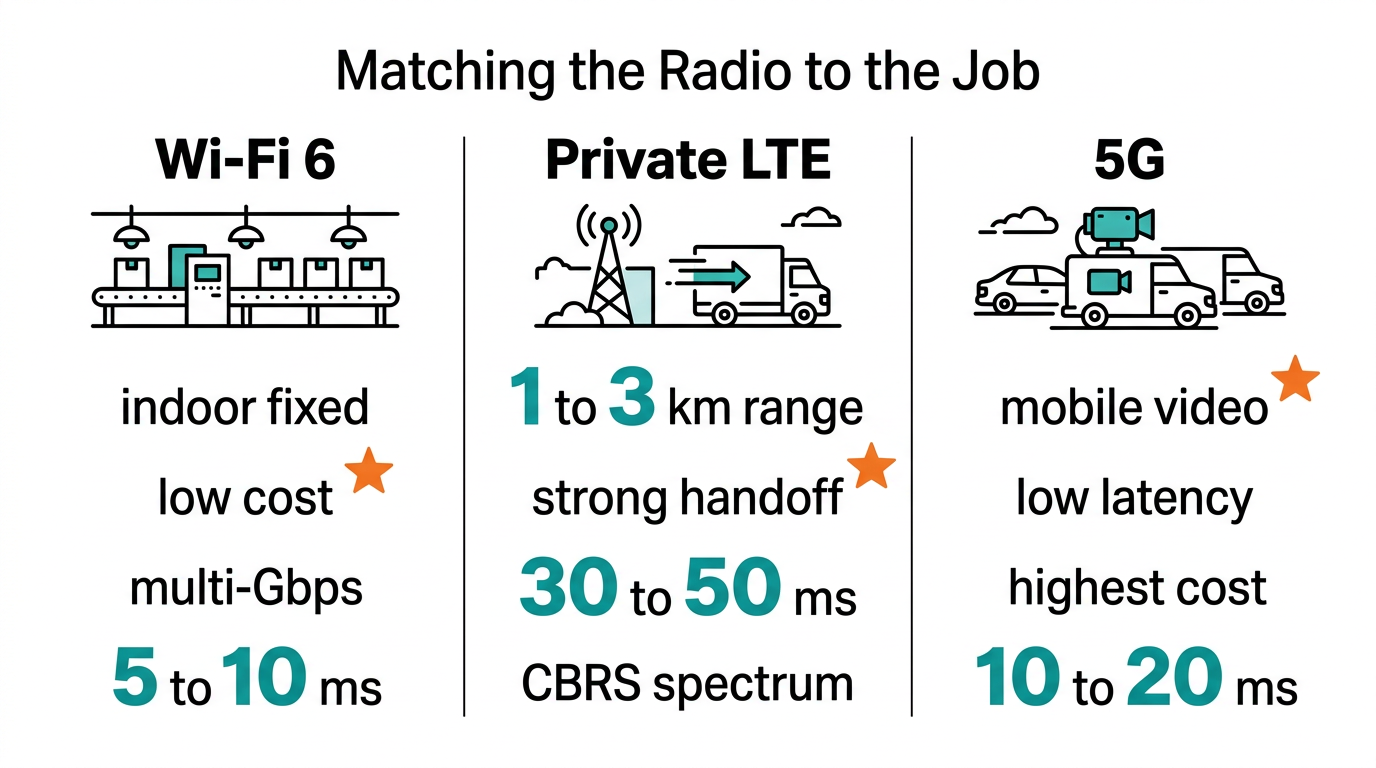
Latency figures below are typical real-world ranges, not lab minimums. 5G can reach roughly 1 ms in URLLC mode, but few brownfield sites run that configuration on day one.
| Dimension | Wi-Fi 6 (802.11ax) | Private LTE (CBRS) | 5G (private NR / carrier) |
|---|---|---|---|
| Spectrum | Unlicensed 2.4 / 5 / 6 GHz | Shared 3.5 GHz (SAS-managed) | 600 MHz to mmWave |
| Typical latency | 5 to 10 ms | 30 to 50 ms | 10 to 20 ms (URLLC lower) |
| Coverage per node | 30 to 50 m indoor | 1 to 3 km outdoor | mmWave short, sub-6 ~1 km |
| Mobility / handoff | Moderate | Strong | Strong |
| Peak throughput | Multi-Gbps shared | ~150 Mbps per device | Hundreds of Mbps to Gbps |
| Setup cost / effort | Low | Moderate to high | High |
| Best fit | Dense fixed indoor | Wide outdoor, mobile | Mobile, video-heavy, low-latency |
Use case mapping
| Scenario | Best choice | Reason |
|---|---|---|
| Packaging or assembly line, fixed vision stations | Wi-Fi 6 | Cheap, high throughput, mobility not needed |
| Mining yard, port, or rail depot with moving vehicles | Private LTE | Kilometer-scale coverage and clean handoff |
| Fleets of AMRs or AGVs streaming video at scale | 5G | Bandwidth plus low latency for closed-loop control |
| Single remote asset (inverter, pump, gate) | Cellular LTE/5G router | One link, no on-site RF buildout |
For that last row, a gateway such as the PLANET VCG-1500WG-LTE-US backhauls a lone POC-766AWP without standing up a private network. It is the same pattern we used in our POC-766AWP solar farm anomaly detection case study, where one rugged node talked to the cloud over a cellular uplink.
Migration considerations
Spectrum is the first gate. In the US, private LTE and private 5G on CBRS need a SAS (Spectrum Access System) registration, and outdoor coverage depends on real RF planning, not guesswork. Budget for a site survey.
Device management is the second. Cellular radios mean SIM or eSIM provisioning across every node, so plan for a way to manage that at fleet scale rather than swapping cards by hand. Wi-Fi sidesteps SIMs but trades that for denser access-point counts and roaming tuning.
Security comes third. Keep OT traffic segmented from IT, regardless of radio. A rugged compute platform like the POC-700 or NRU-220 can host the inference workload and a hardened network stack on the same box, which cuts the number of devices exposed at the edge.
Plan for failover too. Many deployments run a primary radio with a cellular backup so a single outage does not blind the line. Dual-radio designs cost more up front and save a service truck roll later.
Conclusion
There is no single winner. Match the radio to the site: Wi-Fi 6 indoors, private LTE across wide outdoor areas, 5G where mobile bandwidth and latency both matter. Because the POC-766AWP, NRU-220, and POC-700 run any of the three, you can pick compute and connectivity on their own merits instead of forcing one to fit the other. Follow Neteon on LinkedIn for more deep dives, or reach us at [email protected] or www.neteon.net to scope a connectivity pilot.
Related Products


FAQs
Is 5G always better than Wi-Fi 6 for industrial edge AI?
No. Wi-Fi 6 usually beats 5G on cost and throughput for fixed indoor stations. 5G earns its premium only when you need mobile, high-bandwidth, low-latency links across a site.
Do I need a license to run private LTE or private 5G in the US?
You register with a Spectrum Access System (SAS) for CBRS rather than buying licensed spectrum outright. It is lighter than a carrier license but still needs coordination and RF planning.
How does local inference change my connectivity needs?
Running models on the device, for example on an NRU-220, means you send events and metadata instead of raw video. That cuts bandwidth sharply and makes coverage and mobility the bigger factors.
What is the simplest option for a single remote asset?
A cellular gateway such as the PLANET VCG-1500WG-LTE-US backhauls one node over LTE without building a private network or pulling fiber.
Can one rugged computer handle both inference and networking?
Yes. Platforms like the POC-700 and NRU-220 can run the AI workload and a hardened network stack on the same box, reducing the device count at the edge.
Sources and further reading
Neousys rugged computer product catalog.
Related Neteon guides
Vehicle Edge Computing: NVH and Vibration Guide.
IK Impact Ratings and Vandal Resistance for Outdoor Edge AI.
Browse the poc 766awp topic hub for more deployment guidance.