Skip to content
All

Video analytics

Analytics systems watch many cameras continuously for people, vehicles, hazards or events. The load is steady and scales with stream count, so the computer is sized by how many streams it decodes and analyzes at once.

What the computer does

Each IP camera sends a compressed stream. The computer decodes every stream, runs detection or tracking on the frames and raises an event when a rule is met. Footage is often recorded locally so an event can be reviewed.

What to look for

  • A GPU or Jetson module with hardware video decode for the stream count
  • PoE ports on the computer, or uplinks to a PoE switch
  • Storage bays for recording
  • Wide-temperature operation for roadside and outdoor cabinets
  • A cellular router when the site has no wired backhaul

How do the cameras connect and get power?

IP cameras send compressed streams over Ethernet, so the interface question comes down to what powers the cameras and how much bandwidth the uplink has.

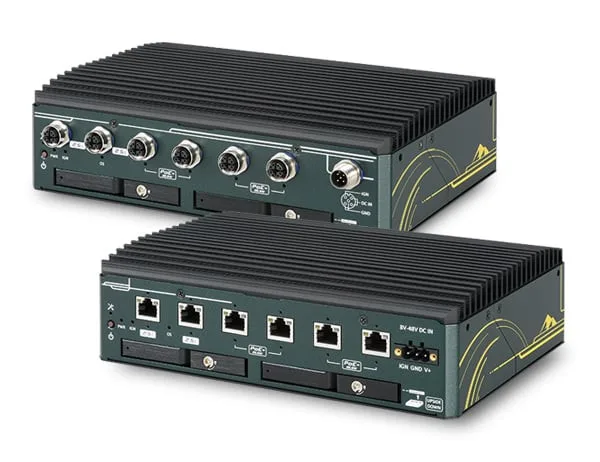
  • PoE from the computer: the Neousys NRU-220S and NRU-222S supply 802.3at PoE+ on four ports with a 100 W total budget, and the NRU-222S uses M12 connectors. Those four ports share 1 Gbps of bandwidth.
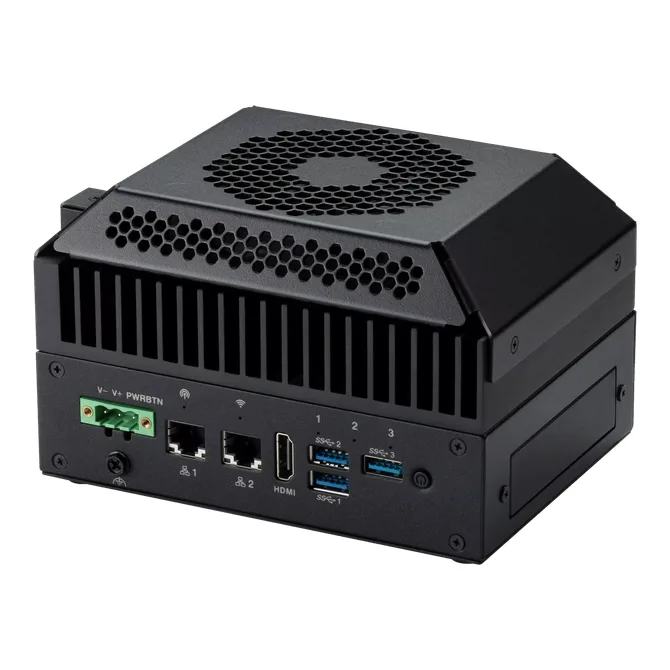
  • The ASUS IoT PE2100N has four PoE ports, 802.3af at 15 W on all four or 802.3at at 30 W on ports 1 and 2, and a separate 10 Gbps Ethernet port.
  • PoE from a switch: for more cameras, or cameras spread over a wide area, put them on a PoE switch and bring one uplink to the computer. Add up the peak draw of every camera, add about 20%, and check the result against the switch's total PoE budget.
  • Camera draw sets the PoE class. Our PoE guide lists typical peak draw as 4 to 8 W for a fixed camera without a heater, 10 to 15 W for a fixed dome with IR, 20 to 30 W for a PTZ dome, and 40 to 60 W for a heated PTZ with IR, which needs 802.3bt.
  • Uplink: sixteen cameras can send 400 to 800 Mbps sustained. A gigabit uplink at that load buffers, and the delay looks like slow inference, so plan a 10GbE port and 10G switching at that scale.
  • SDI and HDMI sources need a capture input. The YUAN Pandora Health systems have HDMI or SDI capture built in, and YUAN capture cards fit other computers.
  • MIPI CSI and GMSL: the YUAN Pandora, AIR6N0-C and VPP6N0-S systems list 8 or 16 MIPI CSI-2 lanes, and AIR6N0-C daughter boards add four or eight GMSL2 inputs. The other Jetson listings publish no inputs of these types, so ask us about a specific model.

How quickly does an event have to be raised?

The budget runs from something happening in front of the camera to the alert, relay output or recording flag. The camera's encoder, the network, decode and inference on the computer, and the rule that turns detections into an event each take part of it.

The figures depend on camera settings, codec, resolution and the model, so we do not quote a typical number. Three stages respond to hardware choices.

  • Network: keep sustained camera traffic well inside the uplink. A saturated gigabit link buffers, and the added delay is easy to mistake for a slow GPU.
  • Decode: every stream is decoded before the model sees it, so hardware decode capacity is a limit of its own. Check it separately from inference speed.
  • Inference: running the model on every frame takes more compute than running it on every few frames. If the event you are watching for lasts seconds, analyzing fewer frames per second leaves capacity for more cameras.

When events from several cameras are compared, the clocks also have to agree. NTP keeps devices within a few milliseconds of each other. PTP with hardware timestamping in the network interface brings that under a microsecond.

NPU PC, Jetson system or GPU computer for video analytics?

Stream count and where the computer sits usually settle this. The decode and power rows come from our GPU guide. The camera power and recording rows describe this catalog.

Platforms for multi-stream video analytics
What to compareIntel Core Ultra AI PCNVIDIA Jetson systemGPU computer
FitsA few streams and a compact modelA camera group served from an outdoor or fanless enclosureHigh stream counts, large models, cameras close together
4K streams decoded at onceNo figure in the guide4 to 8 on Jetson Orin NX and AGX Orin8 to 16 on RTX 4000 and 5000 Ada cards
Accelerator powerNo figure in the guide15 to 60 W130 to 350 W per card
Camera powerPoE standard or optional on many modelsPoE on the NRU-220S, NRU-222S, PE2100N and MIC-715PoE on the Nuvo-9160GC PoE variant; otherwise a PoE switch
RecordingHot-swap drive bays on some modelsM.2 NVMe SSD on the PoE models aboveHot-swap drive bays on some models
Softwarex86, with OpenVINOArm, with CUDA and TensorRTx86, with CUDA and TensorRT

A model moved between an RTX card and a Jetson module has to be rebuilt. TensorRT engines are specific to the GPU they were compiled for, and our GPU guide suggests budgeting two engineering weeks for INT8 calibration and accuracy validation.

GPU and Jetson systems for multi-stream analytics

Showing 8 of 63 matching parts, one per model family.

Browse GPU computers
YUAN MIL6N0 IGX 700

GPU Computers

MIL6N0 IGX 700

Provide 1705 TOPS of AI Computing. Powered by NVIDIA IGX Orin and NVIDIA RTX 6000 Ada; NVIDIA IGX Orin Motherboard; Up to 1705 TOPS AI Performance; Multi-View Support…

YUAN
Processor
NVIDIA IGX Orin
AI performance
Up to 1705 TOPS
LAN
2x 100GbE + 2x GbE
ASUS IoT PE2100N / AGX Orin 64GB/US

NVIDIA Jetson Systems

PE2100N / AGX Orin 64GB/US

Intelligent Edge AI System with NVIDIA Jetson AGX Orin, 275 TOPS, Quad PoE, 9-36V

ASUS IoT
Processor
NVIDIA Jetson AGX Orin
AI performance
Up to 275 TOPS
LAN
1x GbE, PoE
Operating temp
-25 to 55 °C
Cincoze GM-1100-R10

GPU Computers

GM-1100-R10

14/13/12th Gen. Intel Core Series Embedded GPU Computer, Supports 1x MXM 3.1 GPU Expansion Socket

Cincoze
Processor
Intel Core, 14/13/12th Gen
Accelerator
MXM GPU
LAN
1x 2.5GbE
Operating temp
-40 to 70 °C
Advantech MIC-715-OX

NVIDIA Jetson Systems

MIC-715-OX

Ruggedized AI System with NVIDIA Jetson Orin NX 16GB

Advantech
Processor
NVIDIA Jetson Orin NX
Accelerator
Jetson GPU module
LAN
6x GbE M12, PoE
Operating temp
-20 to 60 °C
Neousys NRU-220S-JAO32G-NE

NVIDIA Jetson Systems

NRU-220S-JAO32G-NE

NRU-220S, Jetson AGX Orin 32GB with pre-installed device tree and BSP, including active DP to HDMI adapter.

Neousys
Processor
NVIDIA Jetson AGX Orin
Accelerator
Jetson GPU module
LAN
6x Ethernet, PoE
Operating temp
-25 to 70 °C
YUAN VPP6N0 IGX 700

GPU Computers

VPP6N0 IGX 700

1705 TOPS of AI Computing by NVIDIA RTX 6000 Ada. Powered by NVIDIA IGX Orin and NVIDIA RTX 6000 Ada; NVIDIA IGX Orin Motherboard; Up to 1705 TOPS AI Performance…

YUAN
Processor
NVIDIA IGX Orin
AI performance
Up to 1705 TOPS
LAN
2x 100GbE + 2x GbE
ASUS IoT PE1100N V2/Orin NX 16G/FAN Kit/US

NVIDIA Jetson Systems

PE1100N V2/Orin NX 16G/FAN Kit/US

Rugged Compact Edge AI with NVIDIA Jetson Orin/Nano, 157 TOPS, AEM Expansion

ASUS IoT
Processor
NVIDIA Jetson Orin NX
AI performance
Up to 157 TOPS
LAN
2x GbE
Operating temp
-20 to 60 °C
Cincoze GP-3100-R10

GPU Computers

GP-3100-R10

14/13/12th Gen Intel Core Modular GPU Computer, Supports Dual Full-length GPU Expansion Up to 500W

Cincoze
Processor
Intel Core, 14/13/12th Gen
Accelerator
Discrete NVIDIA GPU
LAN
4x 2.5GbE, PoE optional
Operating temp
-40 to 70 °C

Case studies

Questions we hear

Should analytics run on one large computer or several small ones?

One GPU computer is simpler to manage when cameras are close together. Small Jetson systems near each camera group cut cabling and keep working if another node fails. The camera layout usually decides.

How many cameras can one system handle?

It depends on resolution, frame rate, codec and the model. As a starting point, our GPU guide puts hardware decode at 4 to 8 simultaneous 4K streams for Jetson Orin NX and AGX Orin modules and 8 to 16 for RTX 4000 and 5000 Ada cards. Inference load then depends on the model and on how many frames per second it analyzes. Send the camera list and we size with headroom.

Can the computer power the cameras itself?

Some can. The Neousys NRU-220S and NRU-222S supply 802.3at PoE+ on four ports within a 100 W total budget, and the ASUS IoT PE2100N has four PoE ports. For more cameras, or for cameras that need 802.3bt power such as heated PTZ units, use a PoE switch and check its total budget.

Do I need 10GbE for video analytics?

At high camera counts, yes. Our GPU guide puts a sixteen-camera workload at 400 to 800 Mbps sustained, which a gigabit uplink cannot carry without buffering. Below that, add up the camera bitrates and keep the total well inside the link.

Will a model built for a desktop GPU run on a Jetson system?

Yes, after it is rebuilt for the module. TensorRT engines are tied to the GPU they were compiled for, so the engine is recompiled and INT8 calibration is repeated. Our GPU guide suggests budgeting two engineering weeks for that work.

Which systems suit an outdoor or roadside cabinet?

Look at operating temperature and cooling first. The Neousys NRU-220S and NRU-222S are rated for -25 to 70 °C with passive cooling in 30 W mode and take 8 to 48 VDC with ignition control. A GPU computer such as the Neousys Nuvo-10108GC is rated to 60 °C and needs airflow for the card. Each listing shows the range for the exact model.