
TLDR
Power over Ethernet sends power and data down one cable, which is why most edge AI camera installs run on it. The catch is the power budget. A basic fixed camera sips 5W, but a PTZ dome with a heater and IR illuminator can pull 60W or more, and that number decides whether your switch, cabling, and edge computer can support it. This guide walks through the PoE, PoE+, and PoE++ classes, what real cameras draw, and how to size the system around a GPU box like the Nuvo-9160GC.
For a PoE camera deployment in the field, see how a POC-700 reads container codes at the terminal gate while powering the gate cameras over the same cabling.
Overview
Every multi-camera vision project eventually runs into the same wall: the cameras work on the bench and then brown out in the field. Nine times out of ten the wiring is fine and the power budget is wrong. Power over Ethernet (PoE) is the standard that carries both the video stream and the camera's power over a single Cat5e or Cat6 run, so understanding its limits is part of specifying any edge AI camera system.
We covered the camera-to-inference chain in our machine vision system design guide, and PoE is the layer that feeds that chain. If you are also weighing the network side, our converged IT/OT network guide covers where PoE switches sit relative to the rest of the plant, and our PROFINET explainer covers the protocol running on top of that same cable.
What PoE and PoE++ are
PoE is an IEEE standard that lets a switch or injector (the power sourcing equipment, or PSE) deliver DC power to a camera (the powered device, or PD) over the same twisted pairs that carry Ethernet. The device negotiates its power class during a handshake before full voltage is applied, so a low-power camera and a high-power PTZ can share the same switch without either being over- or under-fed.
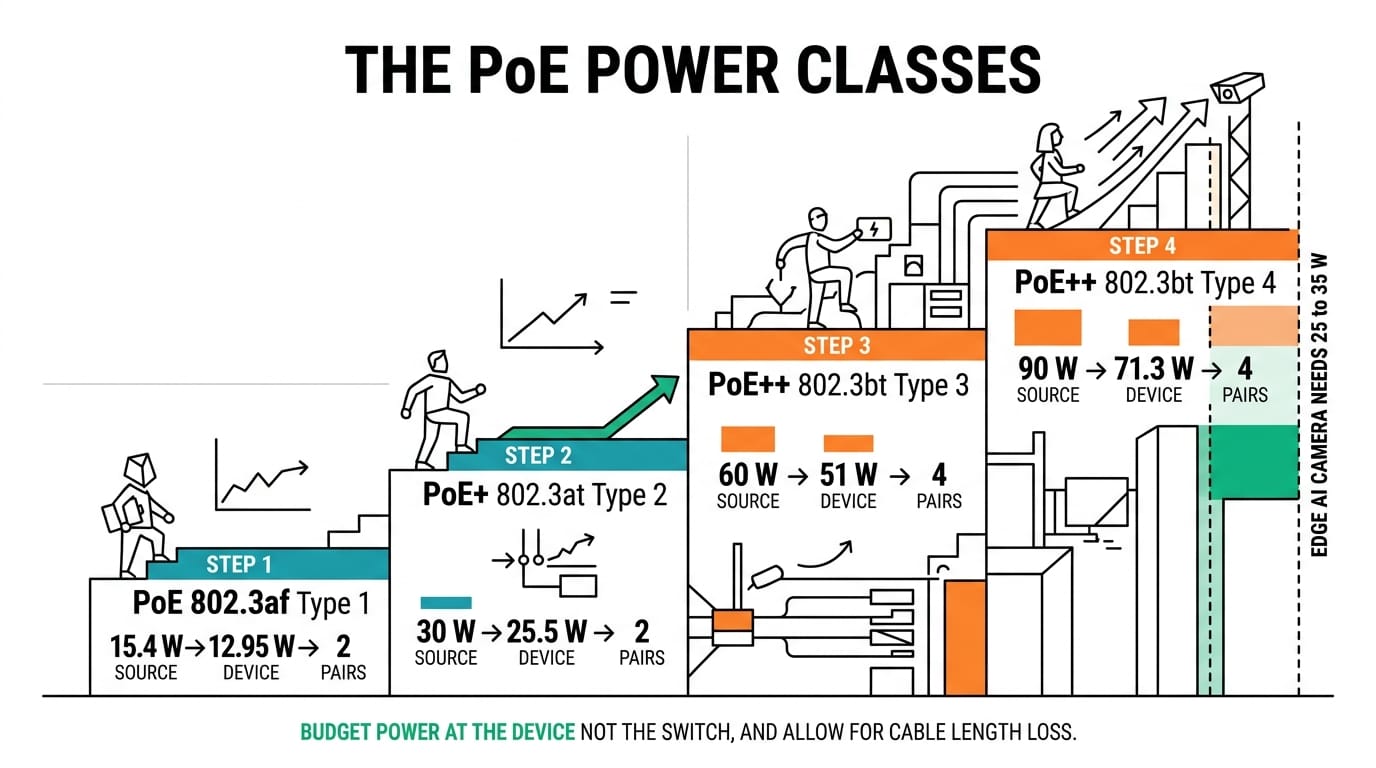
The naming is where people trip up. "PoE" usually means 802.3af, "PoE+" means 802.3at, and "PoE++" covers the two power tiers in 802.3bt. Each tier raises the ceiling.
How it works: the power classes
The PSE always budgets more than the camera receives, because some power is lost as heat in the cable. That gap is why the number on the switch and the number on the camera datasheet never match.
| Standard | Common name | PSE power/port | Power at the camera | Pairs used |
|---|---|---|---|---|
| 802.3af | PoE | 15.4W | 12.95W | 2 |
| 802.3at | PoE+ | 30W | 25.5W | 2 |
| 802.3bt Type 3 | PoE++ | 60W | 51W | 4 |
| 802.3bt Type 4 | PoE++ | 90W | 71.3W | 4 |
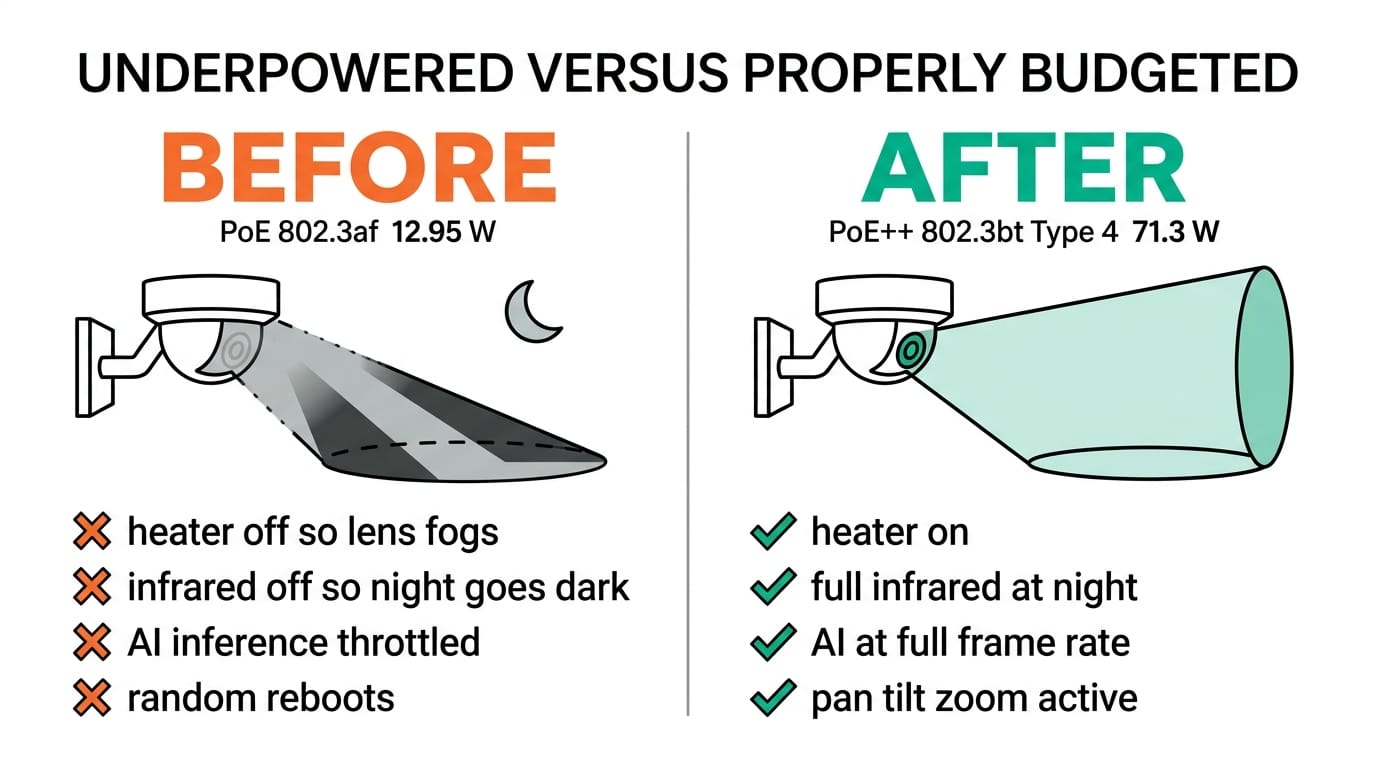
The jump from PoE+ to PoE++ matters most for cameras that heat themselves in the cold or run active illumination. Below freezing, a dome's heater can draw as much as its imager and motor combined.
How much power edge AI cameras really draw
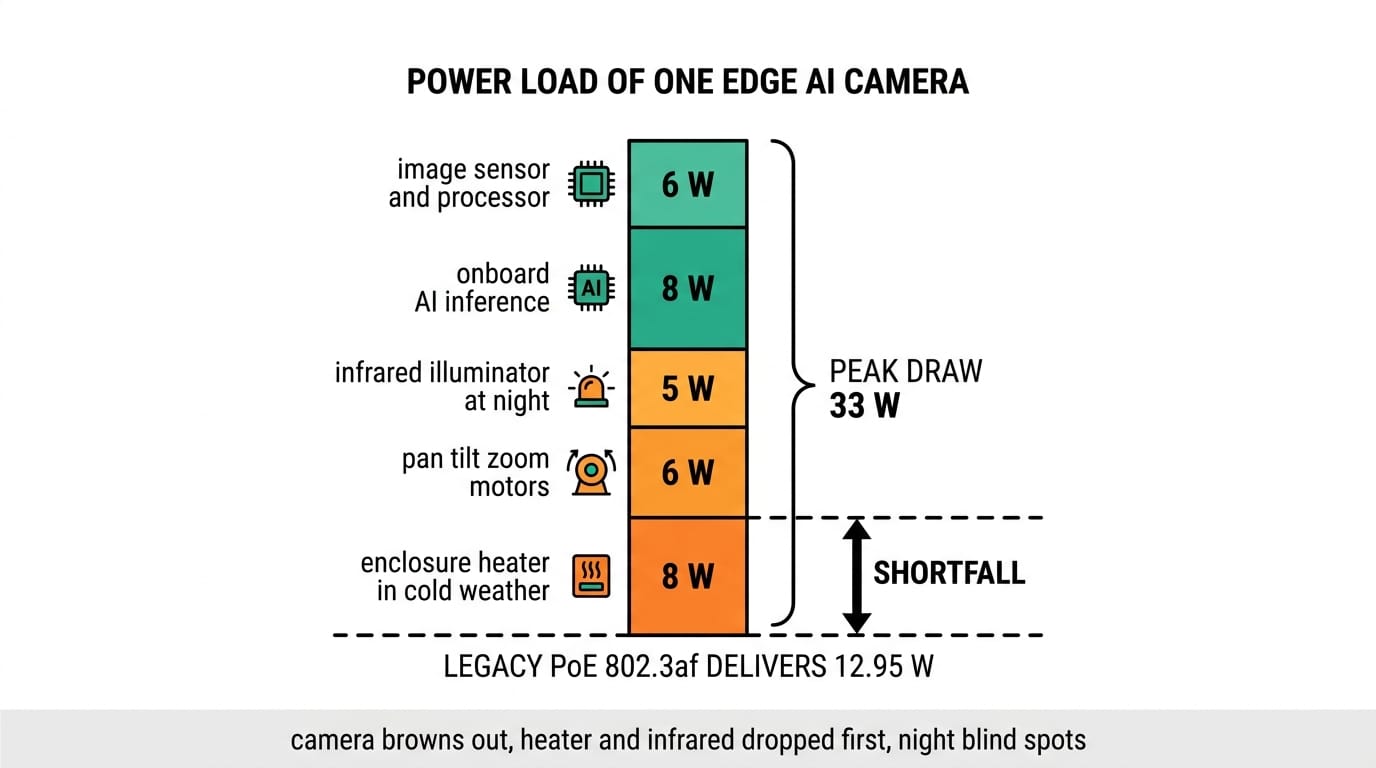
Budget for peak, not idle. Nameplates list the peak figure, and that is the one your supply has to survive. These are the ranges we see in the field.
| Camera type | Typical peak draw | Class you need |
|---|---|---|
| Fixed bullet / box, no heater | 4 to 8W | PoE (af) |
| Fixed dome with IR | 10 to 15W | PoE+ (at) |
| PTZ dome, no heater | 20 to 30W | PoE+ (at) |
| PTZ with heater and IR illuminator | 40 to 60W | PoE++ (bt Type 3) |
| Multi-sensor / thermal / radar-fused | 60 to 90W | PoE++ (bt Type 4) |
An eight-camera line of fixed domes fits inside a modest PoE+ budget. Swap four of those for heated PTZ units at a cold site and the same switch runs out of headroom, even though the port count did not change. Size against total budget, not port count.
Why edge AI needs PoE
Edge AI vision puts cameras where power outlets usually are not: on gantries, light poles, tunnel ceilings, and machine frames. Running a separate AC circuit to each of those is slow and expensive, and every extra enclosure is another thing to fail. PoE collapses power and data into one cable that a single technician can pull and terminate.
There is a reliability angle too. Put the PoE switch on a UPS and the whole camera array rides through a power blip on one backed-up rail, so the inference pipeline does not drop frames during a brownout. On a line running twenty-four hours a day, that is the difference between a logged event and a missed one.
Which products support it
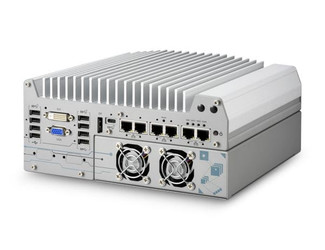
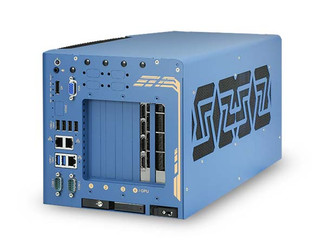
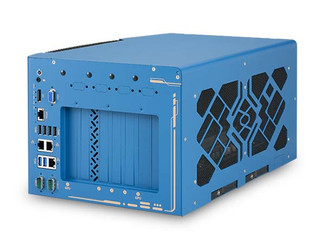
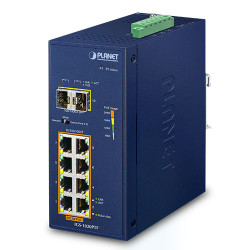
Neousys offers a PoE variant of the Nuvo-9160GC that integrates 802.3at PoE+ ports, so cameras connect straight to the edge computer and pull power and data over one run without a separate switch in the loop. For higher camera counts, or where cameras spread across a wider area, an external industrial PoE switch such as the PLANET IGS-1020PTF feeds the array and hands a single aggregated uplink to the GPU box. Larger GPU platforms like the Nuvo-10108GC and Nuvo-10208GC handle the inference side while the PoE fabric handles delivery.
Whichever layout you choose, add up the peak draw of every camera, add roughly 20% for cable loss and cold-weather margin, and confirm the switch or the computer's PoE budget clears that total before you order.
Conclusion
PoE is not complicated, but the power budget is where camera projects quietly go wrong. Match the class to the camera's real peak draw, size the switch against the whole array rather than the port count, and give the PoE source a backed-up power rail. Do that and the cameras behave in January the way they did on the bench.
Follow Neteon on LinkedIn for more edge AI deep dives, or reach us at [email protected] or www.neteon.net to talk through a PoE camera deployment.
Related Products
FAQs
What is the difference between PoE, PoE+, and PoE++?
They are three tiers of the same IEEE standard. PoE (802.3af) delivers up to 15.4W per port, PoE+ (802.3at) up to 30W, and PoE++ (802.3bt) up to 60W on Type 3 or 90W on Type 4. The higher tiers use all four cable pairs instead of two.
How much power does an edge AI camera actually use?
A fixed camera without a heater draws 4 to 8W. A PTZ dome runs 20 to 30W, and a heated PTZ with IR illumination can reach 40 to 60W. Multi-sensor and thermal cameras can hit 90W at peak.
Why is the power at the camera lower than the switch rating?
Some power is lost as heat in the cable, so the sourcing equipment budgets more than the camera receives. PoE+ delivers 30W at the port but about 25.5W at the camera.
Can I power cameras straight from a Neousys edge computer?
Yes. The PoE variant of the Nuvo-9160GC includes 802.3at PoE+ ports, so cameras connect directly for power and data without a separate switch in the loop.
How do I size a PoE switch for a camera array?
Add up the peak draw of every camera, add about 20% for cable loss and cold-weather margin, and confirm the switch's total PoE budget clears that number, not just the per-port rating.
Sources and further reading
IEEE 802.3 Ethernet standards program.
Neousys rugged computer product catalog.
Related Neteon guides
Remote Monitoring with Nuvo-9160GC and MQTT.
MIL-STD-810G vs IP67 vs IP69K Ratings.
Browse the edge ai fundamentals topic hub for more deployment guidance.
About the author and technical review
Author: Olivia Parker covers product-to-market strategy for edge AI, AIoT, and embedded systems.
Technical review: Neteon Industrial Computing Editorial Team. Reviewed August 5, 2026 for source quality, product-specification links, standards references, and clear separation of measured results from reference-architecture assumptions.
Evidence note: Unless a linked primary source explicitly identifies measured field results, performance figures and system outcomes in this article are design targets or planning estimates, not guaranteed results.