TLDR
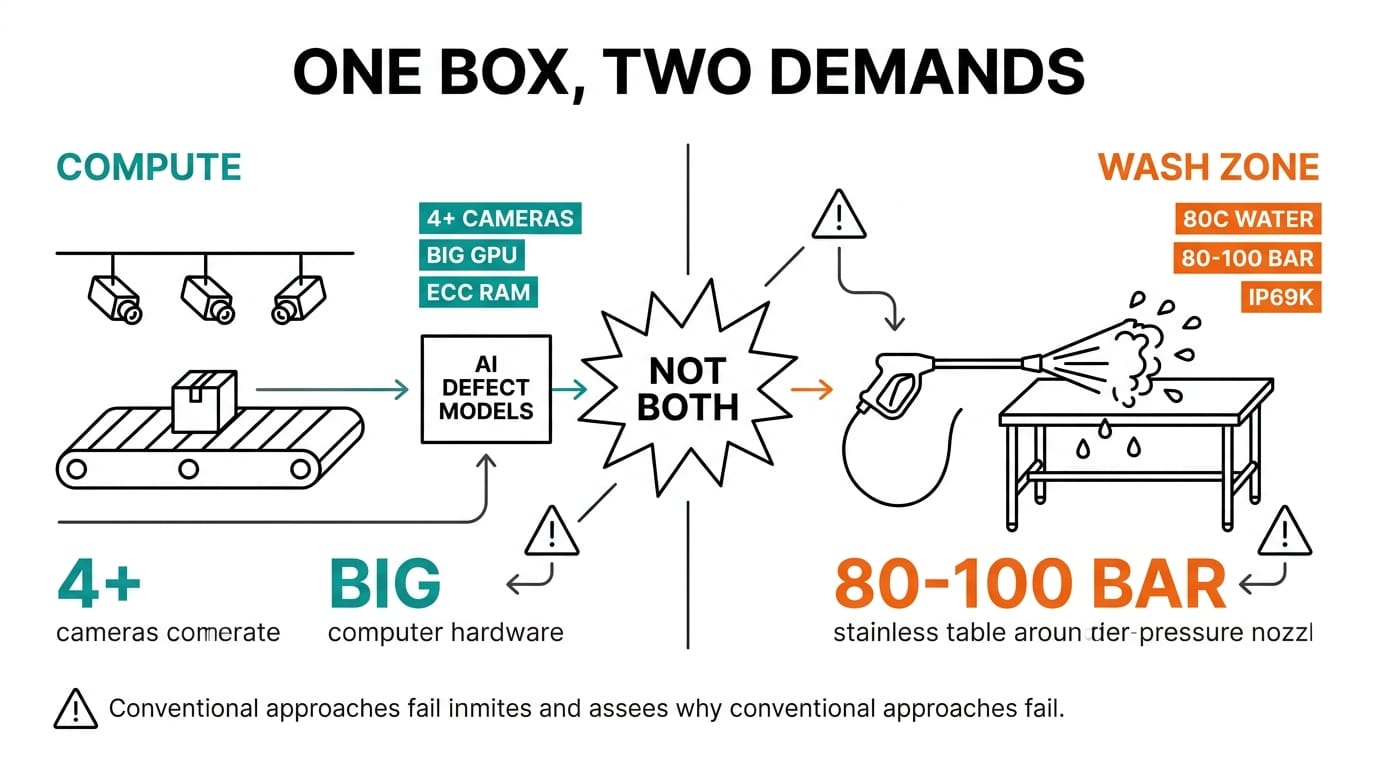
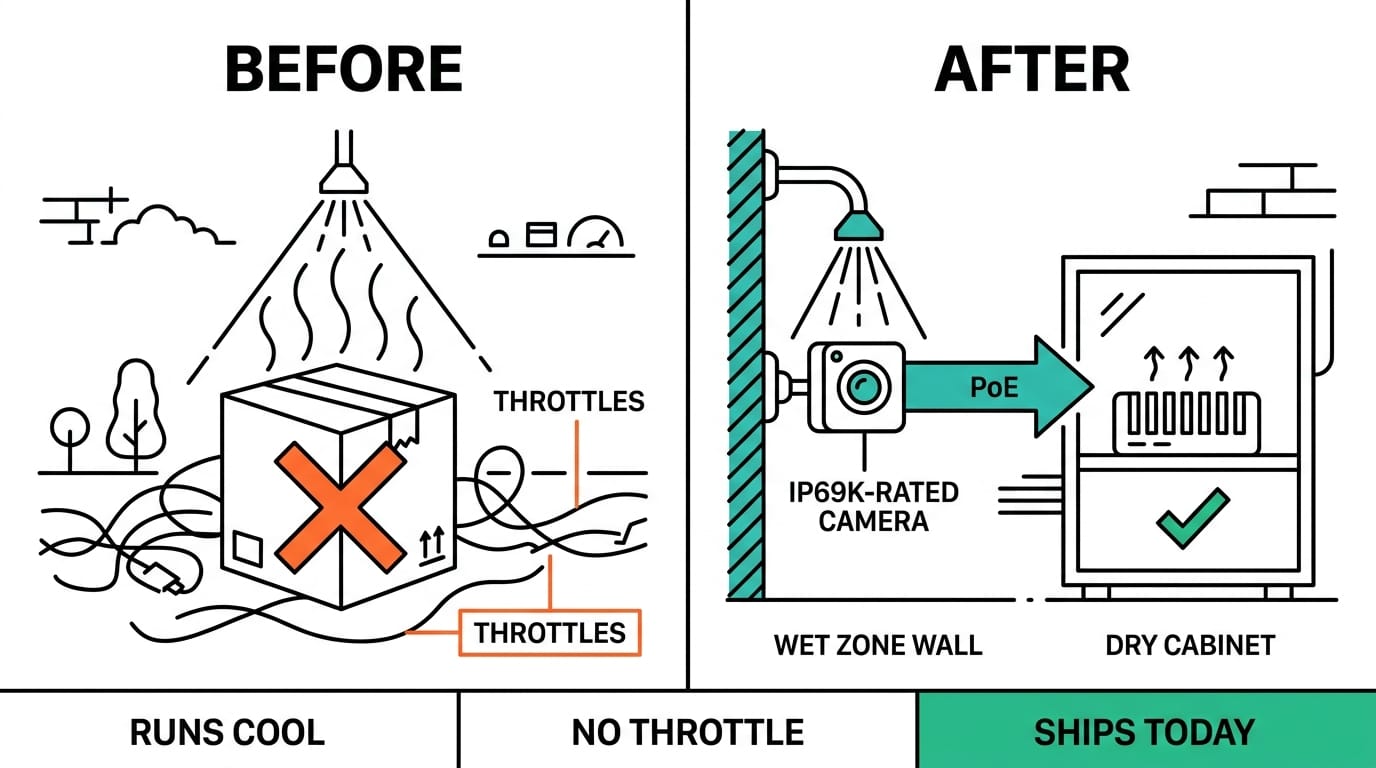
A food and beverage inspection line asks two things of a vision computer at once: enough GPU to run deep-learning defect models across several cameras at line speed, and survival in a zone that gets hosed with 80°C water at 80 to 100 bar. One box rarely does both. The workable answer is to split the system. Put IP69K-rated cameras and enclosures in the wash zone, and keep a MIL-STD-810H fanless GPU computer like the Nuvo-10208GC in a dry cabinet or a stainless washdown enclosure next to it. This guide sizes the compute, pins down where IP69K actually applies, and lists the mistakes that sink these builds.
Overview
Washdown vision is now routine on high-throughput food lines, from fill-level checks to foreign-object detection on moving belts. Our outlook on edge AI vision in food processing covers why demand keeps climbing. Here the focus is the buying decision.
The common trap is treating "IP69K" as a computer spec. IP69K describes resistance to close-range, high-temperature, high-pressure spray, and it is defined in ISO 20653. That is the right rating for a camera housing or a junction box standing in the wet zone. It is almost never the rating of the GPU computer running inference, because the parts that make that computer useful, a 350W RTX card, hot-swap drives, and real airflow, do not fit inside a sealed washdown chassis. So the selection question is really two questions: how much GPU do you need, and how do you keep it out of the water. Our guide to choosing an industrial edge AI computer frames the compute side, and the MIL-STD-810G vs IP67 vs IP69K explainer frames the ingress side. If you are still weighing GPU tiers, the Nuvo-9160GC vs Nuvo-10108GC comparison for food line inspection goes deeper on throughput.
Key selection criteria
Match GPU headroom to camera count and model complexity first, then decide how the box is protected from spray. These four platforms cover most food and beverage lines.
| Criterion | Nuvo-10208GC | Nuvo-10108GC | Nuvo-9160GC | POC-766AWP |
|---|---|---|---|---|
| GPU support | Up to 2x RTX, 350W | 1x RTX, 350W | 1x GPU, 130 to 150W | None, CPU only |
| CPU | 12 to 14th Gen Core | 12 to 14th Gen Core | 12 to 14th Gen Core | i3-N305 |
| Memory | 128GB DDR5, ECC option | 128GB DDR5, ECC option | 64GB DDR5 | 16GB DDR5 |
| Storage | 2x hot-swap RAID + M.2 | 2x hot-swap RAID + M.2 | 2x 2.5" RAID + M.2 | M.2 NVMe |
| Ingress rating | MIL-STD-810H, not sealed | MIL-STD-810H, not sealed | MIL-STD-810G, not sealed | IP67, M12 |
| Best-fit role | Multi-camera, multi-model line | Single high-res line, 10GbE | Compact single-camera cell | Wet-adjacent light edge task |
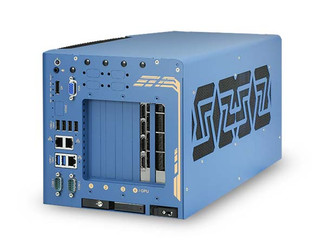
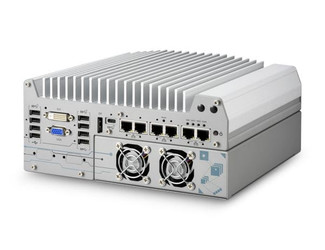
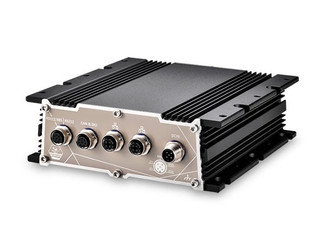
The Nuvo-10208GC is the one to reach for when several cameras feed several models at once, since a second RTX card lets you keep detection and classification on separate GPUs. The Nuvo-10108GC trades the second card for a built-in 10GbE port, which suits one high-resolution camera pushing large frames. The Nuvo-9160GC is the compact option for a single QA cell or a robot-mounted check. The POC-766AWP is the only one with a real ingress rating, IP67 with M12 connectors, but it runs an i3-N305 with no discrete GPU, so keep it to rules-based or light-model tasks near the rinse zone.
Decision matrix
| Line profile | Cameras | Model load | Recommended |
|---|---|---|---|
| Foreign-object detection, multi-lane conveyor | 4 to 8 | Several concurrent | Nuvo-10208GC |
| High-resolution single-lane inspection | 1 to 2 | One heavy model | Nuvo-10108GC |
| Compact QA cell or robot-mounted check | 1 to 2 | One light model | Nuvo-9160GC |
| Rinse-zone presence or level check | 1 | Rules or light CNN | POC-766AWP |
Common pitfalls
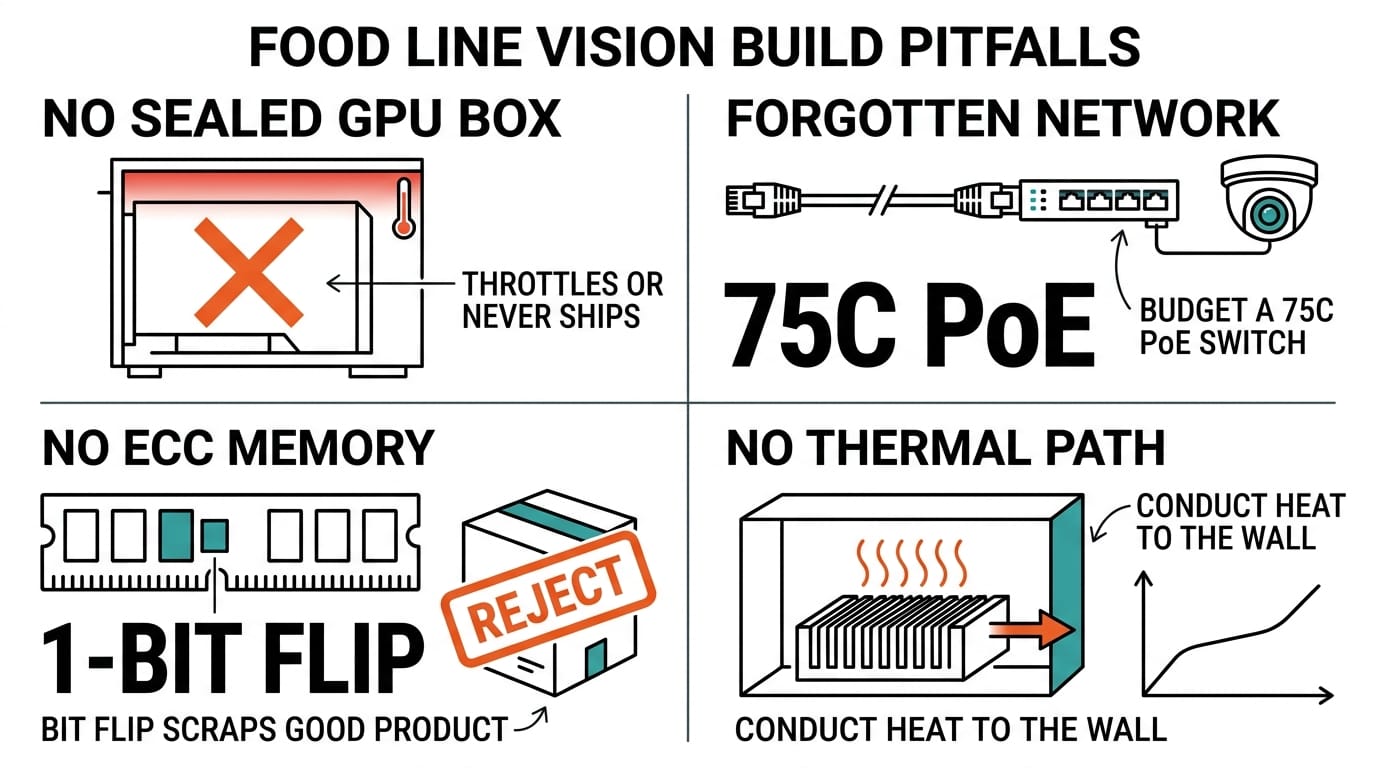
Chasing a sealed IP69K computer in a class that does not exist is the one that stalls projects most often. You either overpay for a unit that throttles, or you wait for a product that never ships. Size the GPU box for the models and solve ingress with the enclosure and the camera.
Then there is the network, which teams forget until commissioning. IP69K cameras usually draw Power over Ethernet, so budget a hardened managed switch such as the PLANET IGS-10020PT, rated to 75°C, and run IP69K M12 cabling into the wet zone.
Two more catch people on 24/7 lines. Skipping ECC memory invites a bit flip that flags good product as scrap, which is why both the Nuvo-10208GC and Nuvo-10108GC offer ECC DDR5. And a fanless box bolted into a sealed cabinet with no thermal path will still cook; it needs conduction to the cabinet wall, or it hits its ceiling on the first hot afternoon.
Conclusion
Buy the compute for the model, not the marketing rating, and handle washdown with the camera and the enclosure. For most food and beverage vision lines that means a Nuvo-10208GC or Nuvo-10108GC in a stainless washdown cabinet, IP69K cameras in the wet zone, and a hardened PoE switch tying them together. Follow Neteon on LinkedIn for more of these deep dives, or reach us at [email protected] or www.neteon.net to talk through a food and beverage inspection build.
Related Products
FAQs
Is the Nuvo-10208GC rated IP69K for washdown?
No. The Nuvo-10208GC is a MIL-STD-810H fanless GPU computer, not a sealed washdown unit. On a food line it belongs in a dry cabinet or a stainless IP69K enclosure, paired with IP69K-rated cameras in the wet zone.
What does IP69K actually protect against?
IP69K, defined in ISO 20653, covers close-range spray of 80C water at 80 to 100 bar. It is the rating for equipment standing in a washdown zone, such as camera housings and junction boxes, not for the GPU computer running inference.
How much GPU do I need for food line inspection?
It scales with cameras and model complexity. One light model on a single camera runs on a Nuvo-9160GC; several cameras feeding concurrent models want the dual-RTX Nuvo-10208GC.
Can I place the computer near the wash zone?
Only a properly rated unit. The IP67 POC-766AWP can sit wet-adjacent for light, rules-based tasks, but it has no discrete GPU. Heavy vision inference should stay in a protected cabinet.
Do I need ECC memory on an inspection line?
On a 24/7 line, yes. ECC DDR5, available on the Nuvo-10208GC and Nuvo-10108GC, guards against bit flips that can flag good product as scrap.