
TLDR
A digital twin is a live software model of a physical asset, fed by sensor data and kept in step with the real thing. Run it at the edge, on a box like the Nuvo-11000, and the loop between sensor and simulation stays inside a few milliseconds, so the model can flag a fault or nudge a setpoint before the next machine cycle. This guide explains what an edge digital twin is, how the sync works, and what compute it needs.
Overview
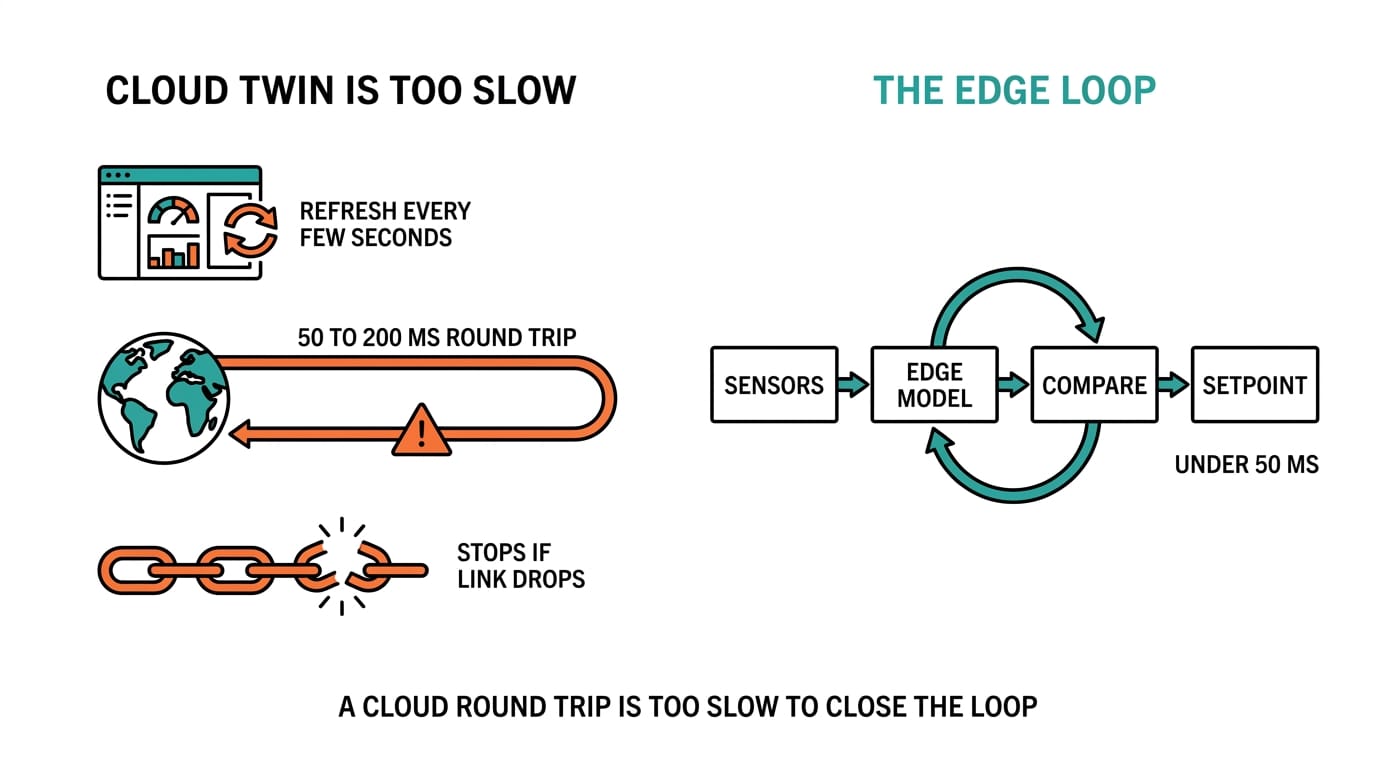
Most plant teams meet the digital twin as a cloud dashboard: a 3D render of a machine that refreshes every few seconds from historian data. That view is fine for reporting, but it is too slow to close a control loop. Once the twin has to influence what the machine does next, the simulation has to sit near the machine. That is the edge digital twin.
This post is a primer, not a deployment manual. For the full sensor-to-cloud picture, see our pillar on designing an edge AI system. The data plumbing a twin depends on is covered in our walkthrough of an edge-to-cloud data pipeline, and OPC-UA is the protocol most twins read their live state from.
Plain-English definition
A digital twin is three things held in sync. First, a model of how an asset behaves, which can be physics equations, a trained network, or a mix of both. Second, a live feed of that asset's actual state from its sensors. Third, a running comparison between what the model expects and what the sensors report. When the two drift apart, something has changed: wear, a loose fitting, a bearing starting to fail.
The word "edge" only says where the model runs. Instead of a data center, it runs on an industrial computer wired to the same sensors as the machine, often in the same cabinet.
How an edge twin stays in sync
The twin runs a tight loop. Each pass reads the latest sensor values, advances the model, and checks the gap against the real reading.
| Step | What happens | Typical latency | Runs on |
|---|---|---|---|
| Ingest | Read sensors over Modbus, OPC-UA, or a camera frame | Under 1 ms | Edge PC I/O |
| Update state | Push new values into the model's variables | 1 to 5 ms | CPU |
| Simulate | Advance the model one step and predict the next state | 5 to 20 ms | CPU or GPU |
| Compare and act | Measure the residual, raise an alarm or adjust a setpoint | Under 5 ms | Edge PC |
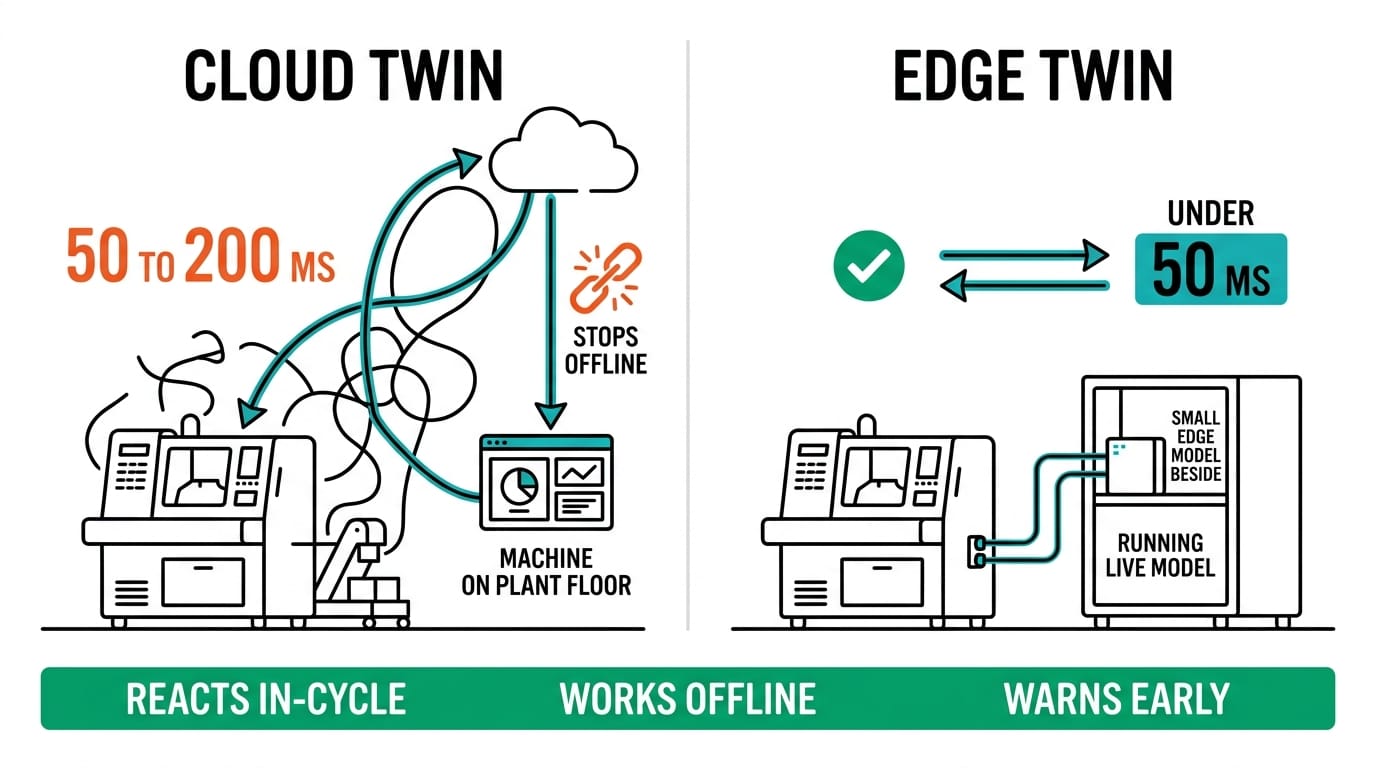
The whole loop can finish in well under 50 ms on a Nuvo-11000, which is fast enough to react inside most mechanical cycles. A cloud round trip alone often adds 50 to 200 ms before the WAN has its own bad day, and it stops entirely when the link drops.
Why it matters for edge AI
The AI in a digital twin is usually the model that predicts the next state or scores how far off the current one is. A pump twin that predicts cavitation only earns its keep if it warns before the impeller pits, not an hour later in a report. Keeping the model on the same box as the sensors removes the network from that decision, so the twin keeps working even when the uplink does not.
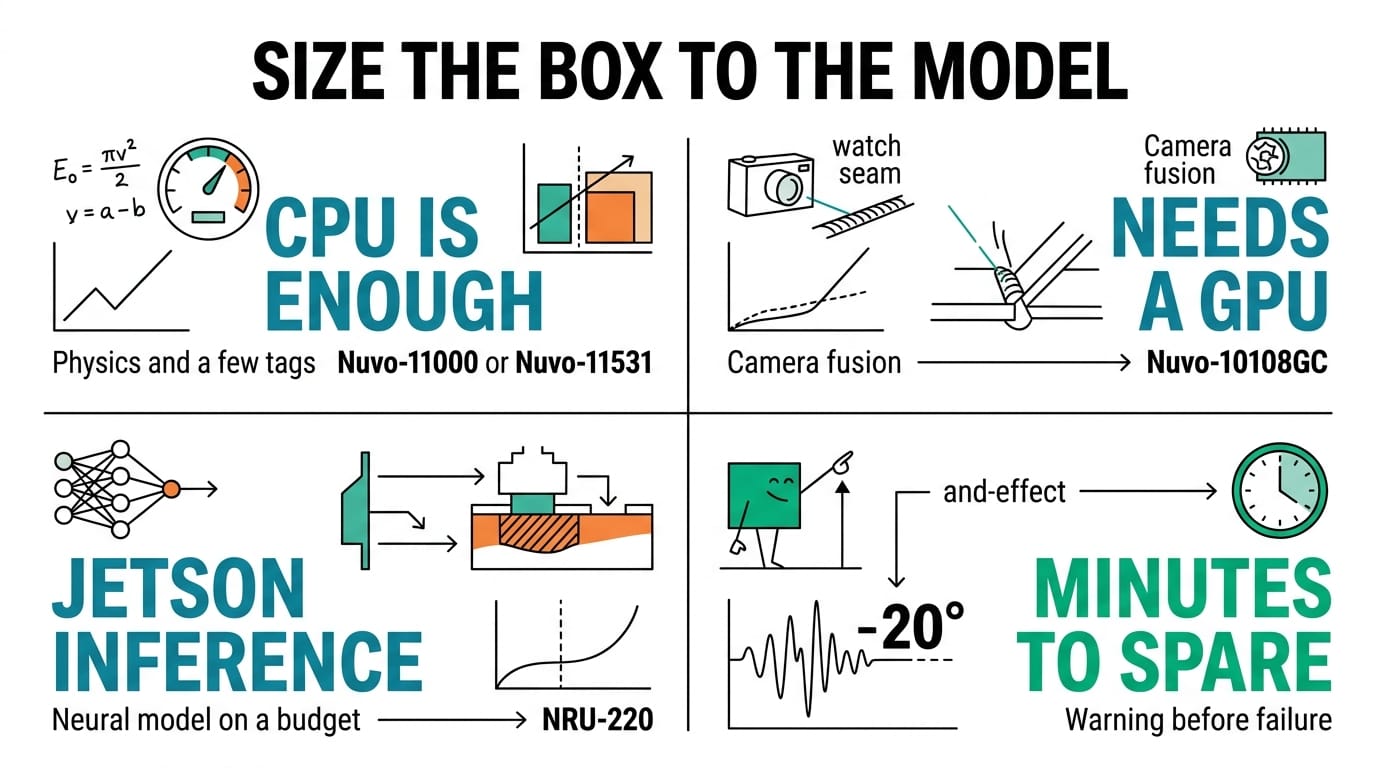
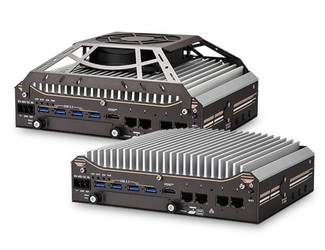
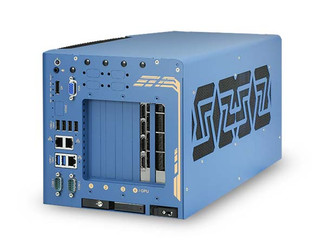
Compute scales with the model. A twin built from physics equations and a few dozen tags runs comfortably on the CPU of a Nuvo-11000 or the smaller Nuvo-11531. A twin that fuses camera data, such as tracking weld geometry or product shape, wants a GPU, which is where the Nuvo-10108GC fits. For twins built around neural models on power and space budgets, the Jetson-based NRU-220 carries the inference without a discrete card.
Real-world examples
| Asset | What the twin models | Main inputs | Local action |
|---|---|---|---|
| Water pump | Flow, head, and vibration signature | Pressure, current, accelerometer | Warn on early cavitation |
| CNC spindle | Tool wear and thermal growth | Load, temperature, position | Trim feed rate, flag tool change |
| Conveyor drive | Belt tension and motor load | Current, encoder, IR camera | Slow down before a jam |
| Battery rack | Cell temperature and state of charge | Voltage, temperature array | Throttle charge to hold safe margin |
None of these need a cloud connection to do their job. They log upstream for the fleet view, but the decision that protects the asset happens on the edge PC.
Related Products


Conclusion
The useful version of a digital twin is smaller than the marketing suggests: a fast model running next to the machine, watching for the moment real behavior pulls away from what the model predicts. Size the hardware to the workload and the warning shows up with minutes to spare, not in the next shift report.
Follow Neteon on LinkedIn for more edge AI explainers, or reach us at [email protected] or www.neteon.net to scope a digital twin pilot on the right box.
FAQs
What is a digital twin in simple terms?
It is a live software model of a physical asset. Sensor data keeps the model in step with the real machine, and the gap between what the model predicts and what the sensors report tells you when something has changed.
How is an edge digital twin different from a cloud one?
A cloud twin refreshes every few seconds and is built for reporting. An edge twin runs on an industrial computer next to the machine, so its loop finishes in milliseconds and can influence the next control cycle without a network round trip.
Do I need a GPU to run a digital twin?
Not always. A twin built from physics equations and a few dozen tags runs on the CPU of a Nuvo-11000 or Nuvo-11531. You want a GPU, such as the Nuvo-10108GC, when the twin fuses camera data or runs larger neural models.
What latency should the control loop hit?
Ingest, state update, simulation, and the compare-and-act step should finish well under 50 ms for most mechanical cycles. A cloud round trip alone often adds 50 to 200 ms, which is why the model runs at the edge.
Which Neousys computer fits a digital twin project?
Use a Nuvo-11000 or Nuvo-11531 for CPU-side physics twins, a Nuvo-10108GC when vision feeds the model, and the Jetson-based NRU-220 for neural twins on tight power and space budgets.