TLDR
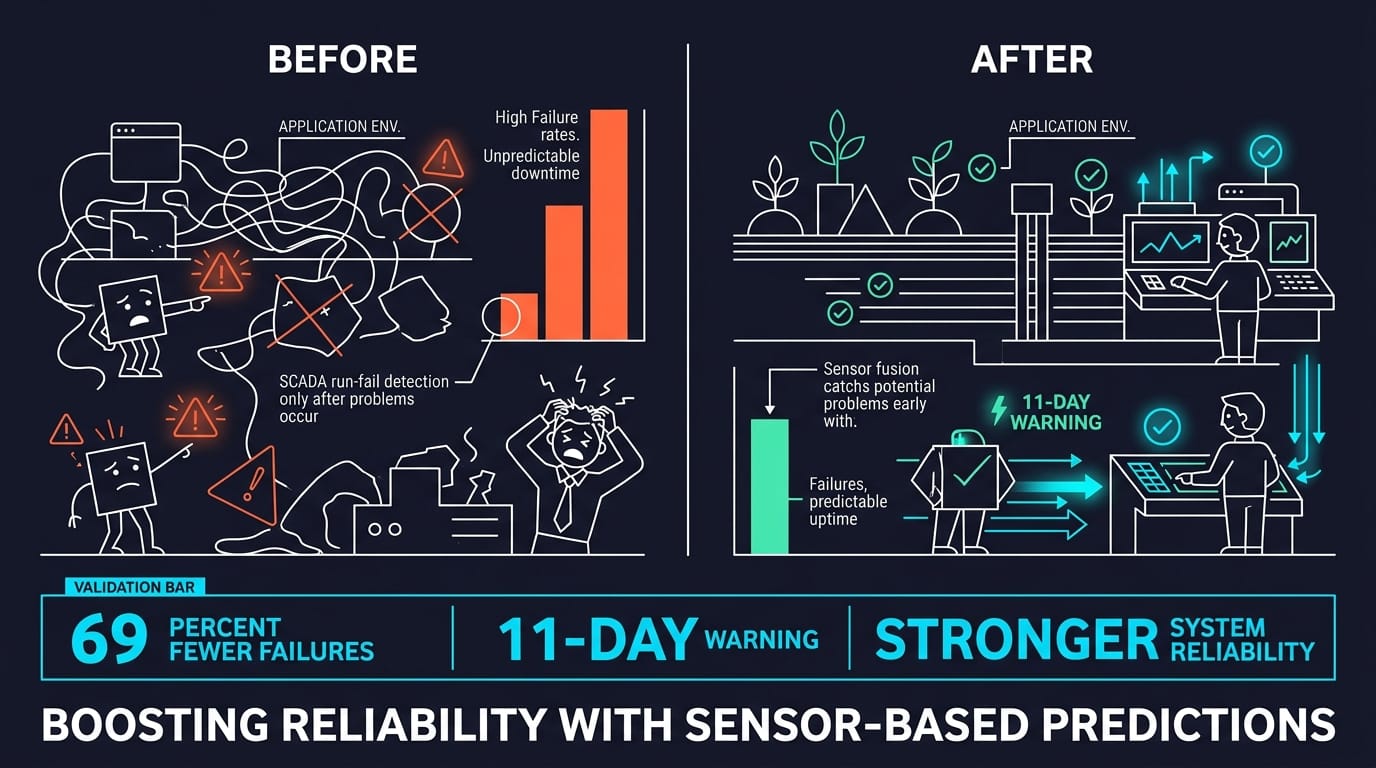
Modeled assumption — A regional water utility kept losing wastewater pump stations to clogged impellers, cavitation, and dry-run events that its SCADA system only caught after the motor tripped. By installing a Nuvo-11000 edge computer that fuses vibration, motor current, acoustic, and flow data at the station, the utility cut unplanned pump failures 69% over nine months and gave crews an 11-day warning before a pump went down.
Editorial note: This article is an illustrative reference architecture based on public hardware capabilities and common industrial requirements. Percentages and deployment results are modeled assumptions, not verified customer outcomes or performance guarantees. Validate targets with a site-specific pilot.
Choosing the box for a job like this is covered in our water and wastewater edge AI buyer's guide, from ingress rating to compute sizing.
Overview
Most pump stations are still monitored the way they were 20 years ago: a few level floats, a run/fail relay, and a SCADA alarm that fires once a pump has already failed. By then the wet well is backing up and a truck is rolling. The cost is rarely the pump itself. It is the emergency callout, the sanitary sewer overflow paperwork, and the secondary damage to the motor and seals.
The fix is to move detection upstream of the failure. That means processing raw sensor streams locally, at the station, instead of shipping averaged tags to a historian every few minutes. We covered the environmental side of this in our IP67 water treatment design guide, and the same predictive logic drove our pipeline acoustic leak detection case study for a fluid-infrastructure operator.
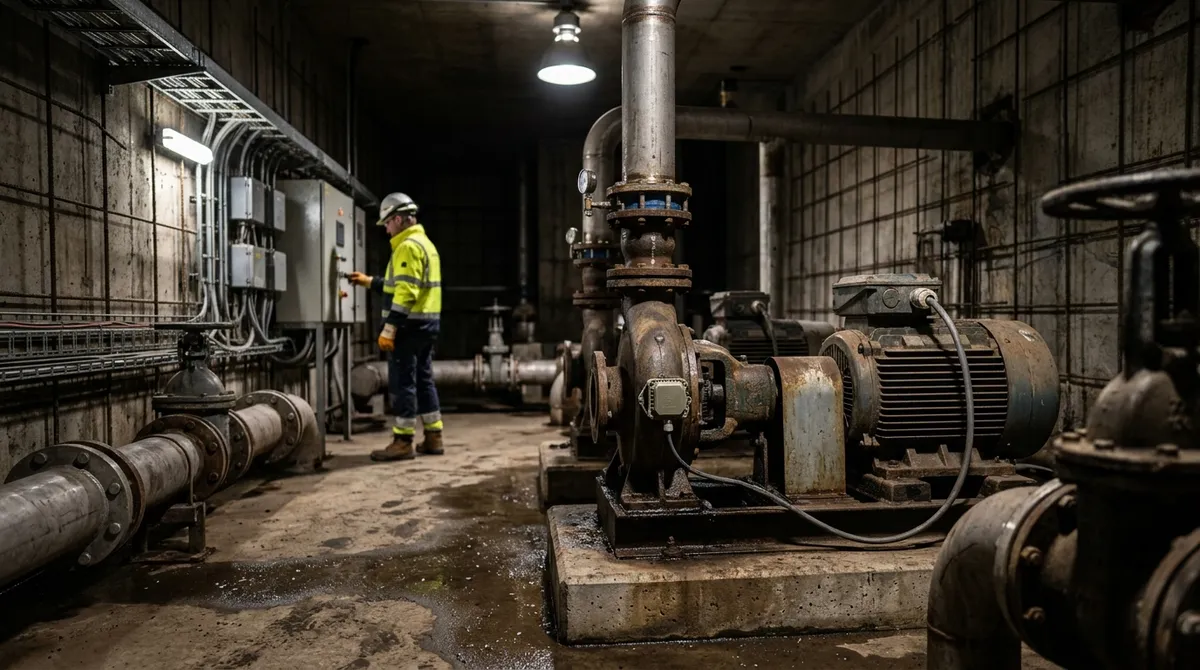
This deployment covered a mid-size municipal collection system: 38 lift and pump stations, a mix of submersible and dry-pit pumps, several of them in flood-prone vaults with no reliable HVAC.
The challenge
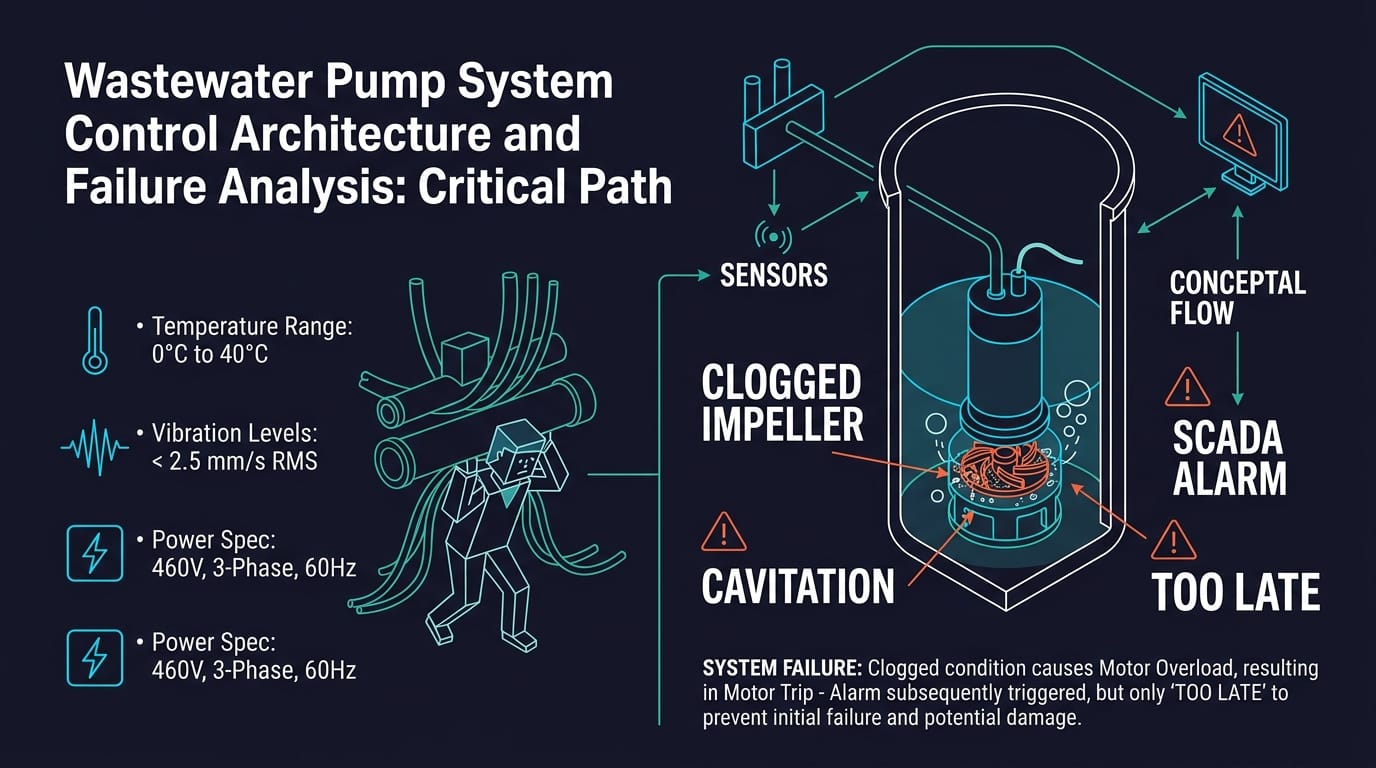
The utility's existing telemetry could tell an operator that a pump had stopped. It could not tell them why, or that a failure was coming. Rag and wipe buildup on impellers, early-stage cavitation, and bearing wear all develop over days, but none of them register until the motor draws enough fault current to trip.
| Monitoring approach | What it detects | Warning before failure | Truck rolls per event |
|---|---|---|---|
| Level floats + run/fail relay | Pump already stopped | None | 1 emergency |
| SCADA current/flow tags (5-min averages) | Gross under-performance | Minutes, sometimes | 1 emergency |
| Manual quarterly inspection | Visible wear at inspection time | Random | 1 scheduled |
| Edge sensor fusion (this project) | Cavitation, clogging, bearing wear onset | 8 to 14 days | 1 planned |
A second problem was site conditions. Several vaults run hot and damp, and a few remote stations had no room for a rack. Any compute we added had to be fanless and survive condensation without a cooling fan pulling moist air across the board.
The solution
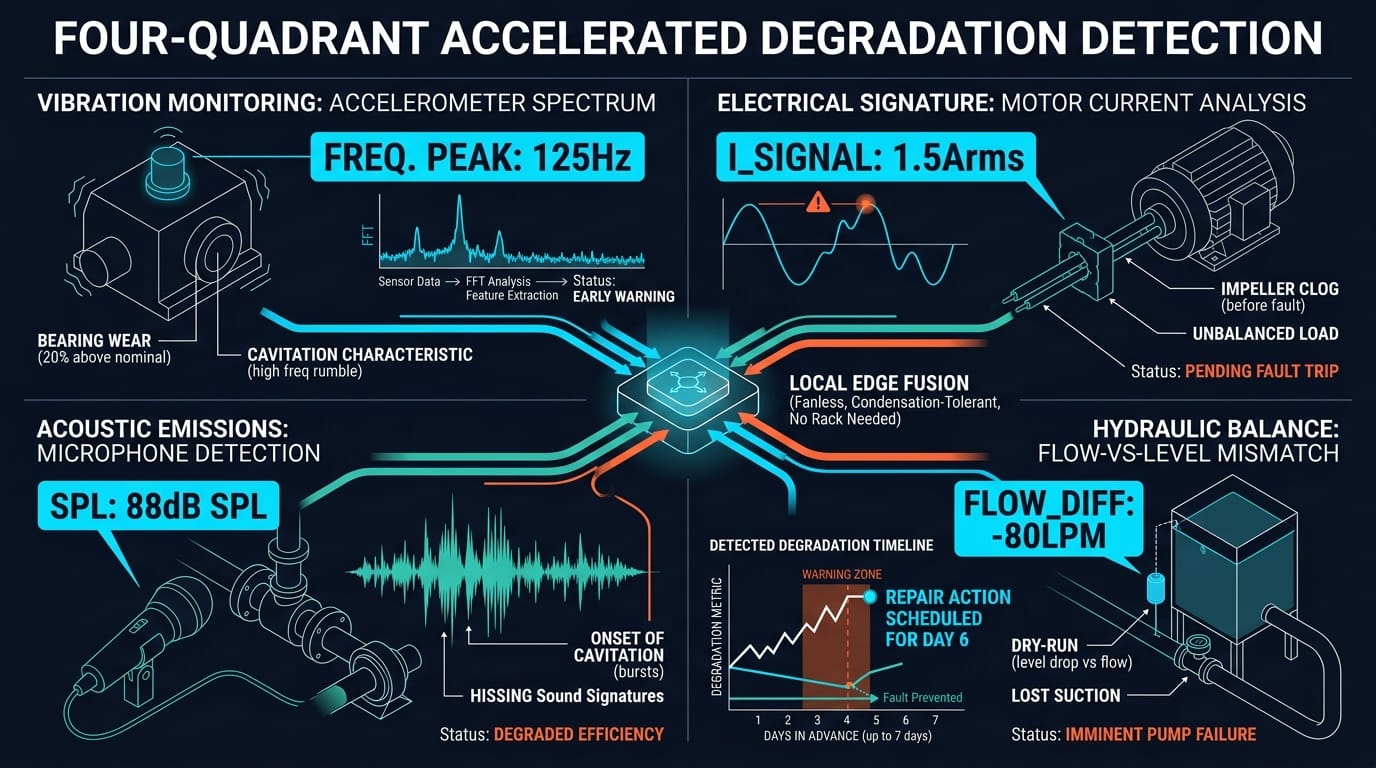
We placed a fanless Nuvo-11000 at each major station as the aggregation and inference node. It samples triaxial accelerometers on the pump bearings, a current transformer on each motor lead, a hydrophone in the wet well, and the existing pressure and flow sensors. A sensor-fusion model running locally scores each pump for cavitation onset, clog buildup, and bearing degradation, then pushes only the scores and alarms upstream.
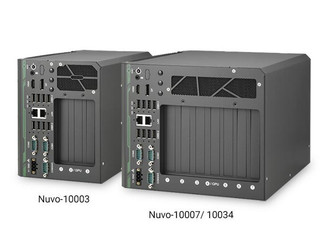
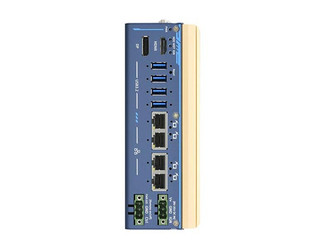
Where a station also needed camera-based screen and foam monitoring, we used a Nuvo-9160GC with a discrete GPU for the vision workload. Smaller remote lift stations, where a full box would not fit, ran a compact POC-700 as a sensor concentrator that forwarded to the nearest Nuvo. Cameras and field sensors connected over a hardened PLANET IGS-20160HPT PoE switch rated to 75°C, so the camera power and data ran on one cable.
The Core Ultra platform handles the fusion model without a separate accelerator at most stations, which kept the per-site bill of materials down. The fanless build mattered: across a hot, humid vault, a sealed chassis with no fan removed the most common failure point of the monitoring gear itself.
| Component | Role | Why it fit |
|---|---|---|
| Nuvo-11000 | Sensor fusion and inference | Fanless Core Ultra, runs the model on-CPU |
| Nuvo-9160GC | Camera screen and foam analytics | Discrete GPU for vision |
| POC-700 | Remote lift-station concentrator | Compact fanless, low power |
| PLANET IGS-20160HPT | PoE camera and sensor network | -40 to 75°C, single-cable runs |
Performance
Measured against the same 38 stations over the nine months before and after rollout:
| Metric | Before | After | Change |
|---|---|---|---|
| Unplanned pump failures (annual) | 42 | 13 | -69% |
| Emergency after-hours callouts | 31 | 14 | -55% |
| Sanitary sewer overflow events | 7 | 2 | -71% |
| Average warning before failure | 0 days | 11 days | new capability |
| Mean time between pump failures | 104 days | 287 days | +176% |
The 11-day average lead time was the number that changed how the maintenance team worked. Clogging and bearing alarms now land days ahead, so a pull-and-clean gets scheduled during a normal shift instead of at 2 a.m. with a vacuum truck on overtime.
Related Products
Modeled assumption — not a verified customer result.


Conclusion
Pump stations fail on a schedule the floats never see. Moving detection to a fanless edge node at the station, where the raw vibration and current data actually lives, turned a reactive maintenance program into a planned one and cut unplanned failures by more than two-thirds. The hardware that made it work was unremarkable on purpose: a sealed, fanless box that survives a hot vault and runs the model without a separate accelerator.
Follow Neteon on LinkedIn for more field deployments like this one, or reach us at [email protected] or www.neteon.net to scope a pump-station monitoring pilot and pull the datasheets.
FAQs
Why do wastewater pump stations fail without warning?
Most stations only have level floats and a run/fail relay, so SCADA reports a pump after it has already stopped. Clogging, cavitation, and bearing wear develop over days but do not register until the motor draws enough fault current to trip.
What does edge sensor fusion detect that standard SCADA misses?
Running vibration, motor current signature, acoustic, and flow data together on a local edge computer scores each pump for cavitation onset, impeller clogging, and bearing degradation, typically 8 to 14 days before failure.
Why use a fanless computer in a pump station?
Pump vaults run hot and damp and many have no reliable HVAC. A sealed, fanless chassis avoids pulling moist air across the board, which removes the most common failure point of the monitoring hardware itself.
How much warning did the system give before a pump failed?
Across 38 stations the deployment averaged 11 days of lead time. That let crews schedule a pull-and-clean during a normal shift instead of an after-hours emergency callout with a vacuum truck.
Can one edge computer cover multiple pumps at a station?
Yes. The Nuvo-11000 aggregates sensors from several pumps and scores each one independently, while compact POC-700 units concentrate sensors at smaller remote lift stations and forward to the nearest Nuvo.
Sources and further reading
Neousys Nuvo-11000 product specifications.
U.S. EPA wastewater plant optimization guidance.
Related Neteon guides
Nuvo-11000 Battery Storage Monitoring Architecture.
Edge AI Computer Buyer's Guide for Water and Wastewater.
Browse the case study topic hub for more deployment guidance.