TL;DR
A pantograph that loses contact with the overhead line, or wears a contact strip unevenly, can strand a train and damage the catenary. Manual depot checks catch problems late. Putting a rugged edge AI computer on the roof cabinet lets a train watch its own pantograph at line speed and flag defects the moment they appear. A deployment documented by Cincoze used this approach on rolling stock; the current equivalent in our catalog is the DX-1300, a fanless box PC certified to the full EN 50155 railway suite.
Overview
On an electrified line, the pantograph is a single point of failure. The contact strip, the carbon bar that slides against the overhead wire, wears with every mile and arcs when contact breaks. Let it go too far and a cracked strip or a bent horn can pull down the catenary and take a whole section of track out of service. That is an expensive, slow thing to fix.
Onboard machine vision moves the inspection from the depot to the train. Roof-mounted cameras watch the pantograph-catenary interface, and an edge computer runs the detection models locally so a defect is flagged in the same second it is seen, not on the next maintenance cycle. That computer has to survive a place with no climate control, constant vibration, and the electromagnetic noise of a 25 kV line. This is the same environment we covered in our railway and transit buyer's guide and the standards work in our EN 50155 onboard compliance guide. For the mechanical side, our industrial ruggedness and compliance reference walks through the vibration and fire requirements that decide what hardware is even eligible.
The Cincoze story ran on a previous-generation box. Neteon does not stock that model, so this post is written around the DX-1300, the current SKU with the same rail credentials.
The challenge: watching the pantograph at line speed
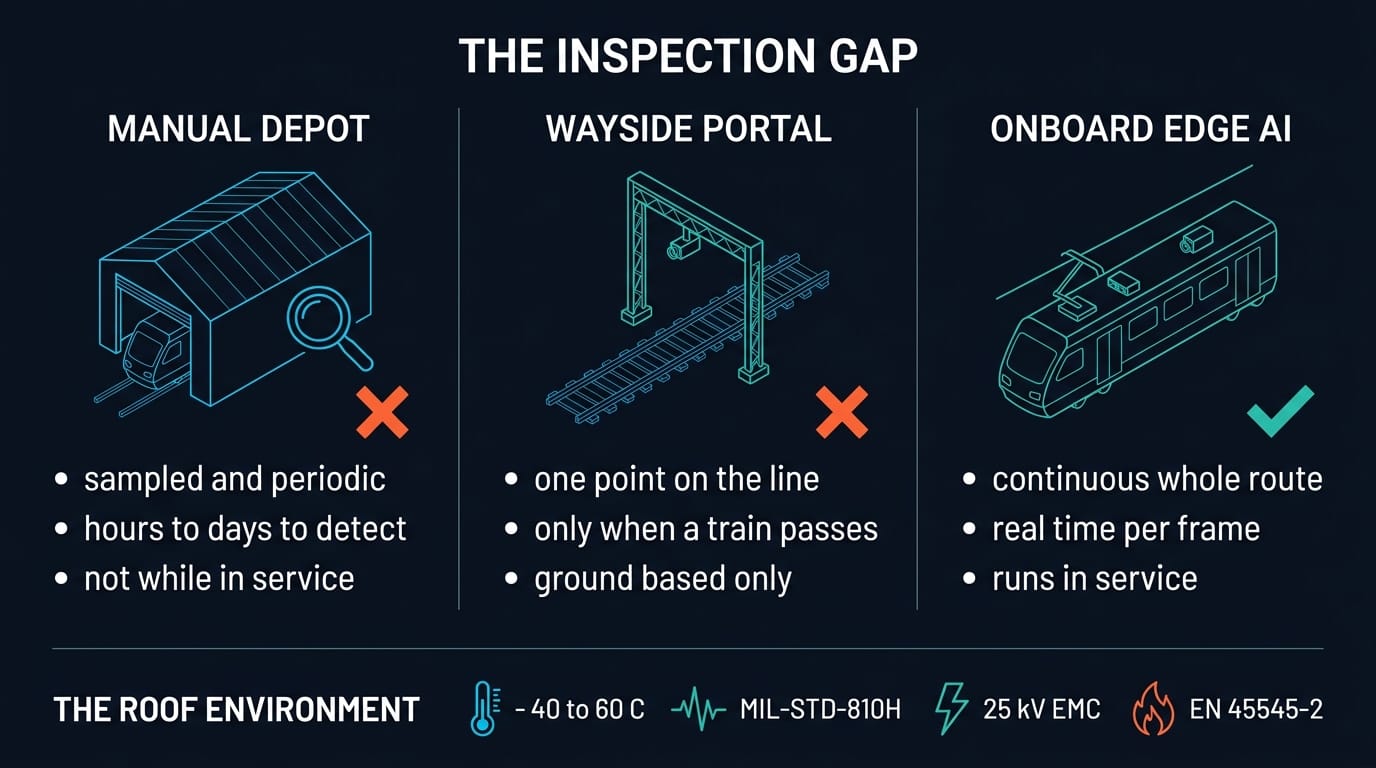
Railway operators have inspected pantographs three ways, and each leaves a gap.
| Inspection method | Route coverage | Time to detect a fault | Runs while in service |
|---|---|---|---|
| Manual depot inspection | Sampled, periodic | Hours to days | No |
| Fixed wayside camera portal | One point on the line | Only when a train passes | Ground-based only |
| Onboard edge AI vision | Continuous, whole route | Real time, per frame | Yes |
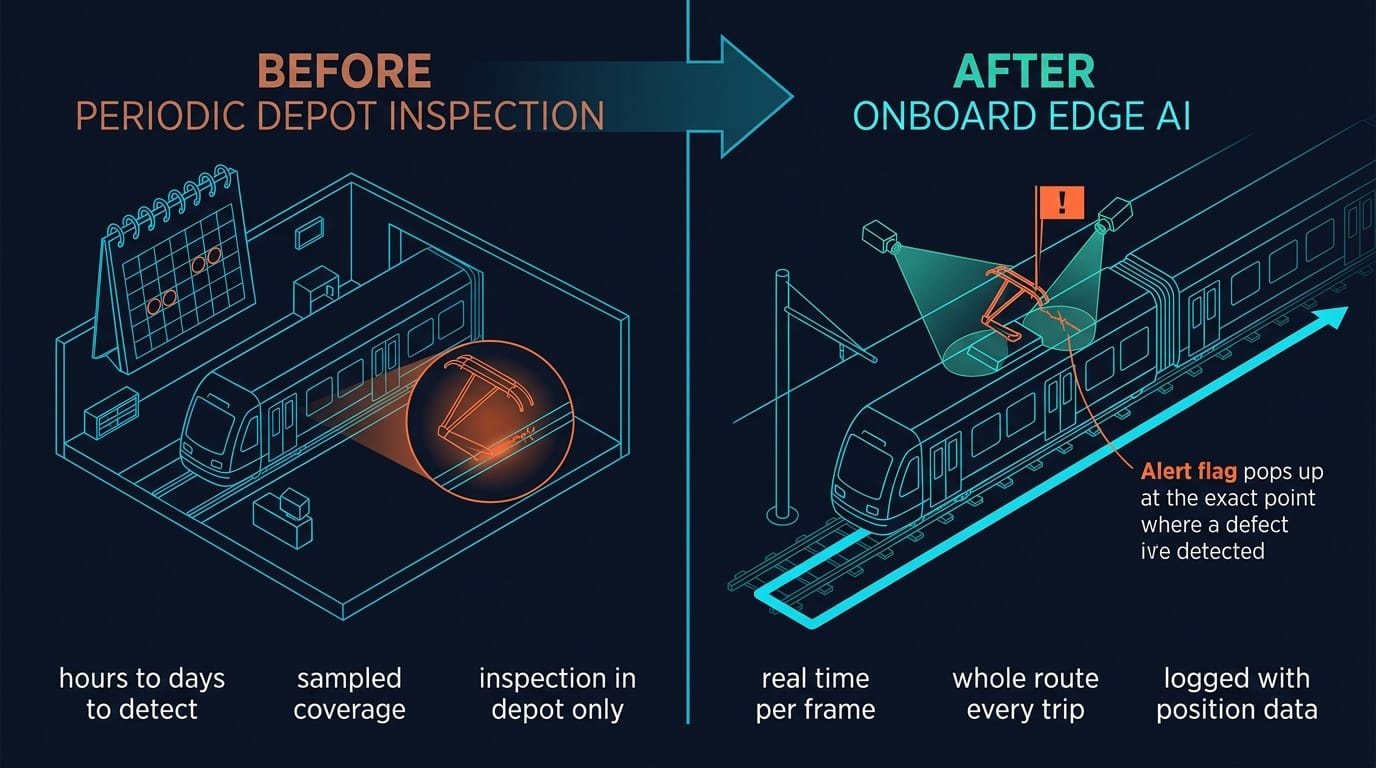
Depot checks are thorough but infrequent, so a strip that cracks mid-week is not seen until the train comes home. Wayside portals watch one spot and miss everything between them. Onboard vision is the one method that inspects the pantograph over the entire route, every trip. The catch is that it puts the computer on the vehicle, where temperature, shock, and EMC rule out an office-grade PC.
The solution: onboard edge AI on the DX-1300
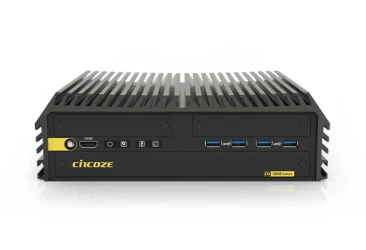
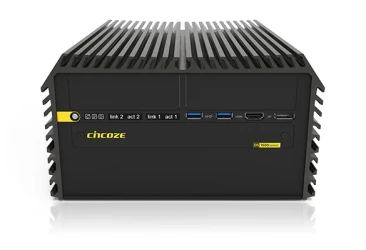
The DX-1300 is a fanless Intel Core Ultra 200S (Arrow Lake-S) system built for rolling stock. It has the compute headroom to run several camera streams through a defect model and the certifications to sit in a roof or underframe cabinet without a separate conditioned enclosure. Multiple cameras feed the box, the model scores each frame for contact-strip wear, chips, and arc events, and results are logged with position data so maintenance knows which pantograph and which stretch of line.
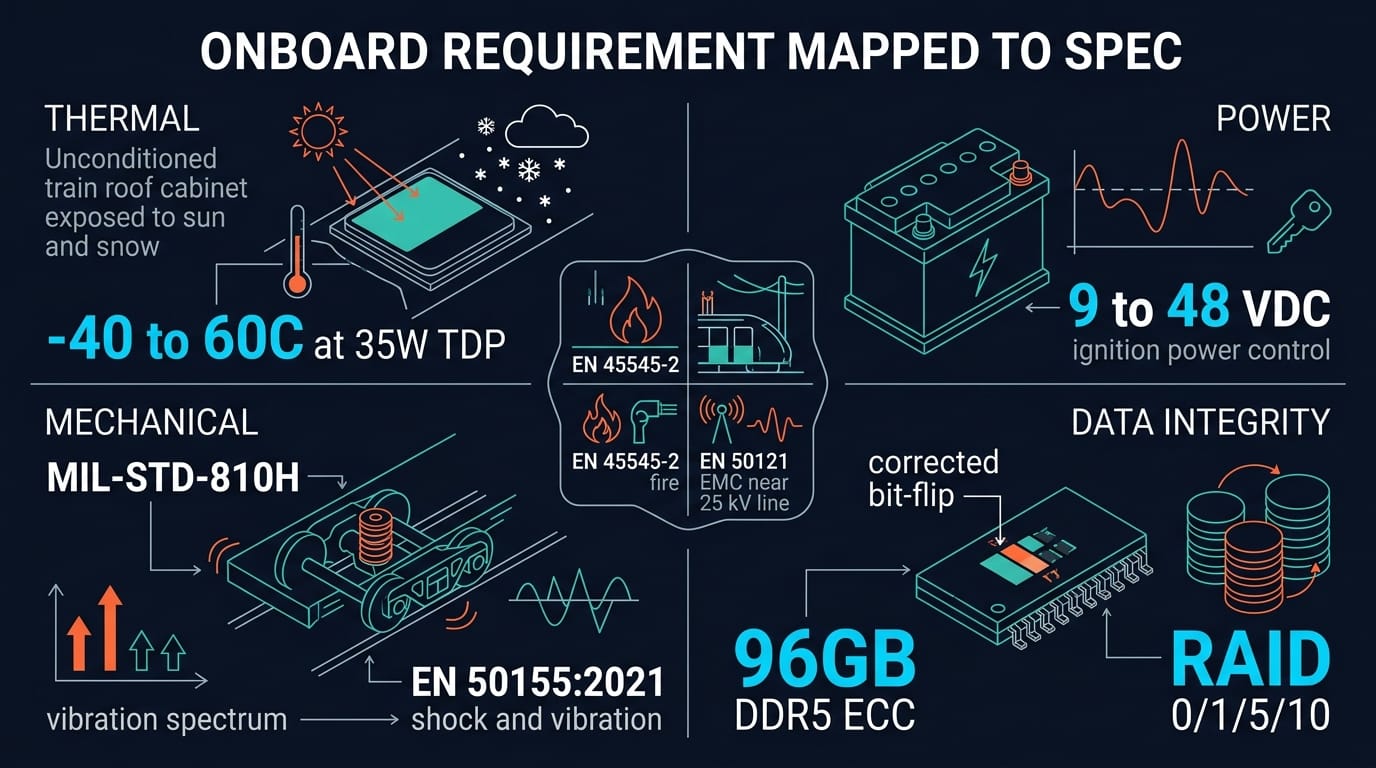
Every onboard requirement maps to a specific DX-1300 spec.
| Onboard requirement | Why it matters on a train | DX-1300 |
|---|---|---|
| Wide operating temperature | Roof cabinets are unconditioned | -40 to 60°C at 35W TDP |
| Power input | Vehicle battery sags and spikes | 9 to 48VDC, ignition power control |
| Shock and vibration | Constant carbody movement | MIL-STD-810H, EN 50155:2021 (Cl. 4.4.6, 13.4.9) |
| Fire safety | Rolling stock fire code | EN 45545-2 |
| EMC near a 25 kV line | Traction current is noisy | EN 50121-1, EN 50121-3-2 |
| Vision compute | Several cameras, one model | Core Ultra 200S, up to 24 cores, 96GB DDR5-6400 ECC |
| Event logging | Store clips, protect data | 2x 2.5" plus M.2, RAID 0/1/5/10 |
ECC memory matters here. A single bit flip from radiated interference can corrupt an inference result, and ECC corrects it before it reaches the log. RAID keeps event footage intact if a drive fails in the field. The temperature rating is honest: -40 to 60°C at 35W, dropping to 50°C at 65W with the fan kit, so a system integrator sizes the CPU to the thermal budget of the actual cabinet rather than a lab bench.
Related Products

Conclusion
Onboard pantograph monitoring turns a periodic depot task into a continuous one, and the compute has to earn its place on the roof with the right certifications rather than raw performance alone. The DX-1300 carries the full EN 50155 suite, EN 45545-2, and MIL-STD-810H, with ECC memory and RAID for the parts of the job that are easy to overlook. Follow Neteon on LinkedIn for more onboard edge AI deep dives, or reach us at [email protected] or www.neteon.net for datasheets and to talk through a rail vision pilot.
FAQs
What does onboard pantograph monitoring actually detect?
Roof-mounted cameras watch the pantograph-catenary interface and an onboard model scores each frame for contact-strip wear, cracks and chips, bent horns, and arcing events. Faults are flagged in real time and logged with position data so maintenance knows which pantograph and which stretch of line.
Why can't a standard industrial PC run this on a train?
Roof and underframe cabinets are unconditioned, constantly vibrating, and sit near a noisy 25 kV traction supply. The computer has to hold EN 50155, EN 45545-2, and MIL-STD-810H, run across a wide temperature range, and accept a wide DC input. An office-grade PC meets none of that.
What rolling-stock certifications does the DX-1300 carry?
The DX-1300 holds EN 50155:2021 (Cl. 4.4.6, 13.4.9), EN 50121-1, EN 50121-3-2, EN 45545-2, and MIL-STD-810H, with UL/cUL/CB. It does not carry E-Mark, so it is a rail box first, not a road-vehicle box.
How much compute does pantograph vision need?
Enough to run several camera streams through a defect model at line speed. The DX-1300 uses an Intel Core Ultra 200S processor with up to 24 cores and up to 96GB of DDR5-6400 ECC memory, sized to the thermal budget of the actual cabinet.
Why does ECC memory matter for onboard AI?
Radiated interference near traction current can flip a memory bit, which can corrupt an inference result or an event log. ECC corrects single-bit errors before they propagate, so a flagged defect is a real defect rather than a glitch.
Sources and further reading
Federal Railroad Administration safety resources.
Neousys rugged computer product catalog.
Related Neteon guides
Nuvo-9160GC Pipeline Acoustic Monitoring Architecture.
Nuvo-11531 Construction Safety Monitoring Architecture.
Browse the case study topic hub for more deployment guidance.
About the author and technical review
Author: Olivia Parker covers product-to-market strategy for edge AI, AIoT, and embedded systems.
Technical review: Neteon Industrial Computing Editorial Team. Reviewed August 5, 2026 for source quality, product-specification links, standards references, and clear separation of measured results from reference-architecture assumptions.
Evidence note: Unless a linked primary source explicitly identifies measured field results, performance figures and system outcomes in this article are design targets or planning estimates, not guaranteed results.