TLDR
PROFINET is the most widely deployed industrial Ethernet protocol in factory automation, moving cyclic I/O data between PLCs, drives, and sensors over ordinary Ethernet cabling. For edge AI, it is how an inference box reads live machine state and writes a decision back, inside the same control cycle. This guide covers the three conformance classes, how the protocol actually moves data, and which Neteon edge computers can terminate a PROFINET line.
For how PROFINET compares with the other real-time Ethernet and fieldbus options, see our reference on industrial protocols and connectivity for edge AI.
Related reading: what PTP (IEEE 1588) time synchronization is and why edge AI needs it.
Overview
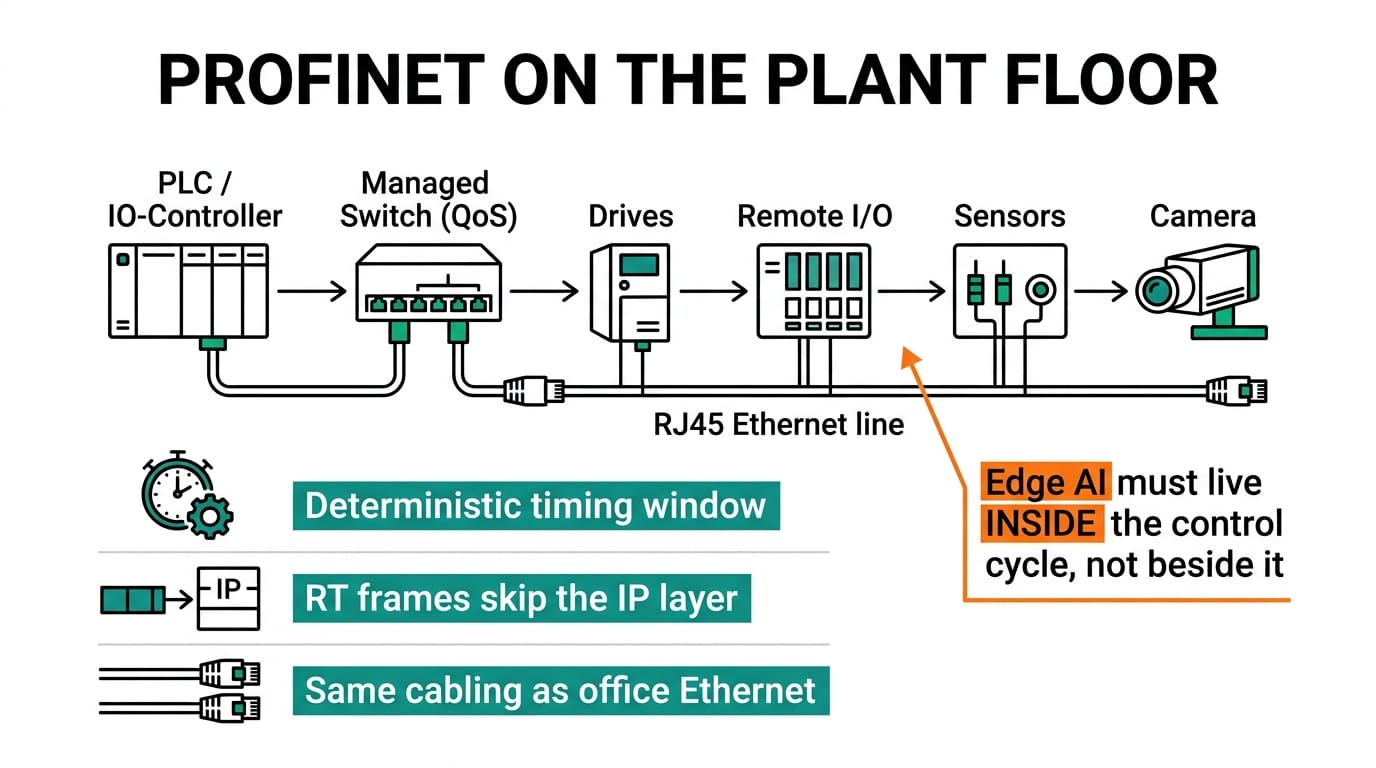
Walk through an automotive or packaging plant in Europe and the controller network is very likely PROFINET. It runs on the same RJ45 cabling as office Ethernet, then layers deterministic timing on top so a drive command arrives in a known window instead of whenever the packet happens to show up.
Edge AI raises the bar on what that network carries. A vision model that flags a defect is only useful if it can also read line speed, trigger a reject arm, and log the event to the PLC, all before the next part arrives. The edge computer has to speak PROFINET, not just sit next to it.
If you have read our guide on what EtherCAT is or MQTT vs Modbus TCP, PROFINET sits in the same family. It is the Siemens-led answer to real-time Ethernet, and like the others it leans harder on time-sensitive networking as cycle times drop.
What it is
PROFINET (Process Field Net) is an open standard managed by PROFIBUS and PROFINET International. It defines how a controller, the IO-Controller and usually a PLC, exchanges data with field devices: drives, remote I/O blocks, sensors, and now cameras and edge computers. Three conformance classes set the timing bar, from light monitoring traffic to hard motion control.
How it works
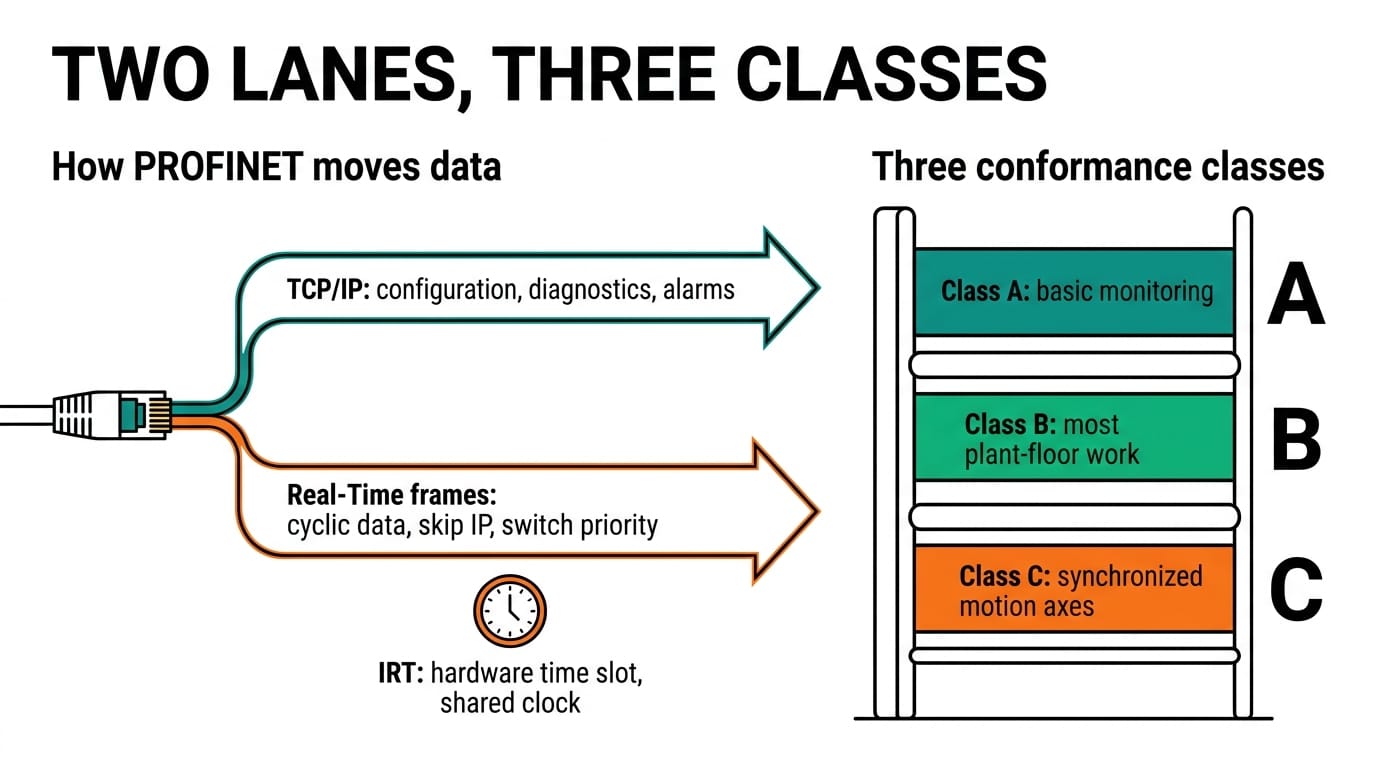
PROFINET splits traffic into two lanes on the same wire. Configuration, diagnostics, and alarms ride the normal TCP/IP stack. Cyclic process data uses Real-Time frames that skip the IP layer and get priority at the switch, which is why a managed switch with QoS earns its place in the cabinet. For the hardest jobs, Isochronous Real-Time reserves a slice of every cycle in hardware and locks every node to a shared clock.
| Conformance class | How it moves data | Typical cycle time | Where it fits |
|---|---|---|---|
| Class A | Standard TCP/IP stack | 100 ms and up | Monitoring, parameter and asset data |
| Class B (RT) | Prioritized Layer 2 frames, VLAN tagging | 1 to 10 ms | General machine and process control |
| Class C (IRT) | Hardware-scheduled, clock-synced | Under 1 ms, jitter under 1 microsecond | Motion control, robotics, synchronized axes |
Most plant-floor work lives in Class B. Class C shows up where mechanical axes have to move in lockstep.
Why edge AI needs it
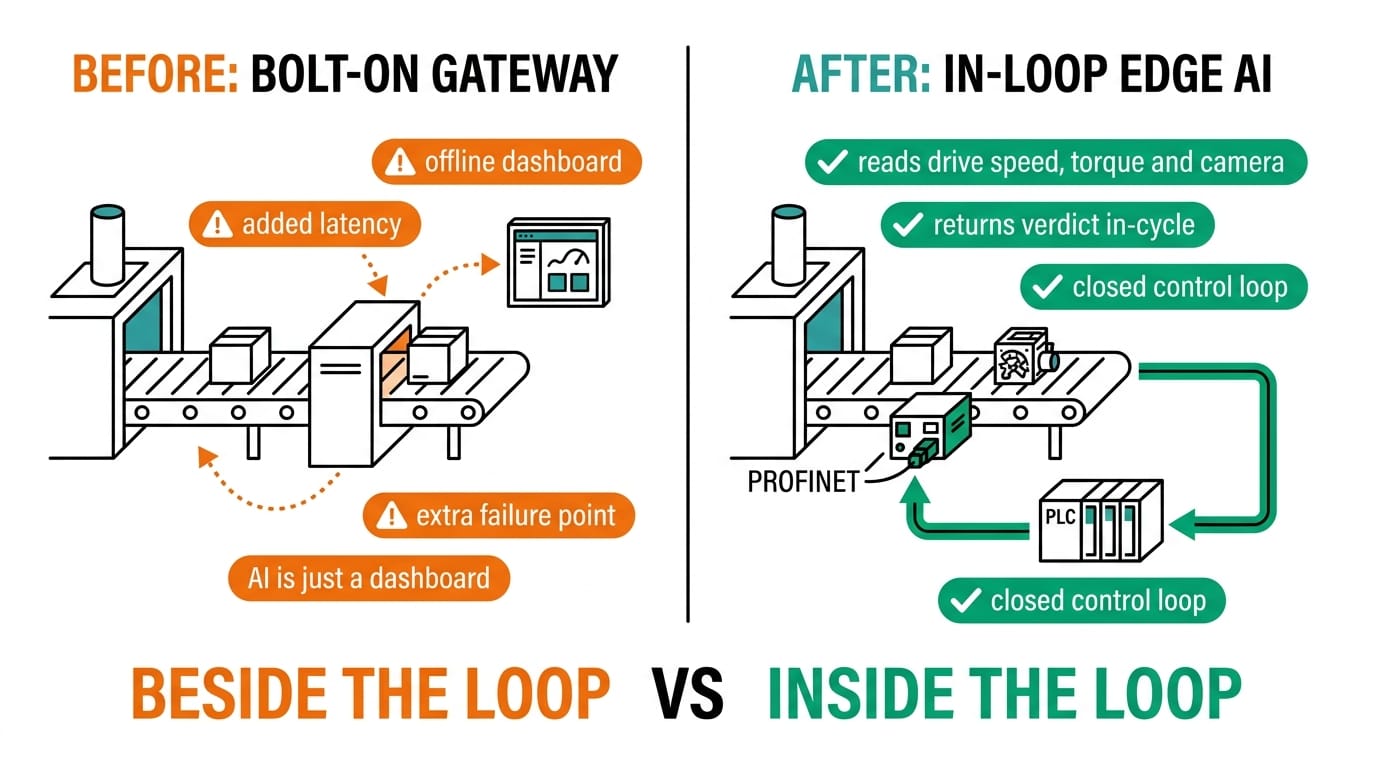
An inference result that cannot act on the line is just a dashboard. Closing the loop means the edge box subscribes to the same cyclic data the PLC sees, runs the model, and returns a verdict the controller can act on without a translation layer in between. Do that over a separate gateway and you add latency and one more thing to fail.
PROFINET also gives the AI useful context for free. Reading drive speed, torque, and station state alongside the camera frame lets a model correlate a visual defect with a machine condition, which is the difference between flagging bad parts and explaining why they went bad. The catch is determinism: if RT and IRT frames are not prioritized end to end, jitter creeps in and the control loop loosens. That is a switch and stack problem as much as a compute problem.
Which products support it
A PROFINET edge node usually terminates the protocol one of two ways: a software master or device stack running on the host, or a dedicated fieldbus add-in card. Both need clean, prioritized Ethernet and enough headroom to run the stack next to an AI workload.
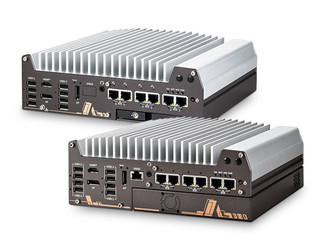
The Nuvo-11531 fits the software-stack route. Its Intel Core Ultra platform and multiple 2.5GbE ports leave one NIC for the RT control segment and another for the camera or uplink, so inference and PROFINET traffic do not fight over the same interface.
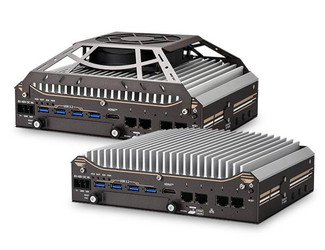
The Nuvo-10000 takes the card route. Its expansion slots can host a PROFINET master card or extra industrial NICs, which suits brownfield lines that already standardized on a specific stack vendor. The expandable Nuvo-11000 family covers the same ground when you need more slots.
Neither is sold as a certified PROFINET device, so validate the stack or card against your conformance class before deployment. On the network side, a managed switch such as the PLANET IGS-10020MT handles the VLAN tagging and QoS that keep RT frames ahead of bulk traffic.
Related Products


Conclusion
PROFINET is not the newest real-time Ethernet protocol, but it is the one you are most likely to meet on a European plant floor, and edge AI only pays off when it lives inside that control loop rather than beside it. Pick the termination method that matches your line, give the RT traffic a managed switch, and validate conformance before you commit. Follow Neteon on LinkedIn for more protocol deep dives, or reach us at [email protected] or www.neteon.net to talk through a PROFINET edge AI build.
For the power side of a camera build, see our guide to PoE and PoE++ power budgets for edge AI cameras.
FAQs
What is PROFINET?
PROFINET (Process Field Net) is an open industrial Ethernet standard managed by PROFIBUS and PROFINET International. It defines how a controller, usually a PLC, exchanges cyclic I/O data with field devices like drives, remote I/O, and sensors over standard Ethernet cabling with deterministic timing.
What is the difference between PROFINET RT and IRT?
RT (Real-Time) uses prioritized Layer 2 frames that skip the TCP/IP stack and reach cycle times of roughly 1 to 10 ms, which covers most machine control. IRT (Isochronous Real-Time) reserves a hardware-scheduled slot in every cycle and synchronizes all nodes to a shared clock, hitting sub-millisecond cycles with jitter under 1 microsecond for motion control.
Does an edge AI computer need a special card to use PROFINET?
Not always. An edge computer can terminate PROFINET with a software master or device stack running on the host, or with a dedicated fieldbus add-in card. The software route suits systems with spare CPU headroom and multiple NICs; the card route suits brownfield lines standardized on a specific stack vendor.
Why does PROFINET need a managed switch?
PROFINET RT and IRT frames must stay ahead of bulk traffic to preserve determinism. A managed switch with VLAN tagging and QoS prioritizes those frames so jitter does not creep into the control loop. Without prioritization end to end, the loop loosens regardless of how fast the compute is.
How is PROFINET different from EtherCAT?
Both are real-time industrial Ethernet protocols, but PROFINET is the Siemens-led standard common on European plant floors and runs RT and IRT classes over standard switched Ethernet. EtherCAT uses a processing-on-the-fly approach for very tight motion cycles. The right choice usually follows the existing controller ecosystem on the line.
Sources and further reading
PROFINET technology description.
Neousys rugged computer product catalog.
Related Neteon guides
EtherCAT Explained for Industrial Edge AI.
PTP and IEEE 1588 Time Sync for Edge AI.
Browse the edge ai fundamentals topic hub for more deployment guidance.