Key Takeaways
- Edge AI in transportation means running perception, monitoring, and decision models on a rugged computer mounted in the vehicle or at the roadside, so safety-critical decisions happen in milliseconds instead of waiting on a cloud round trip.
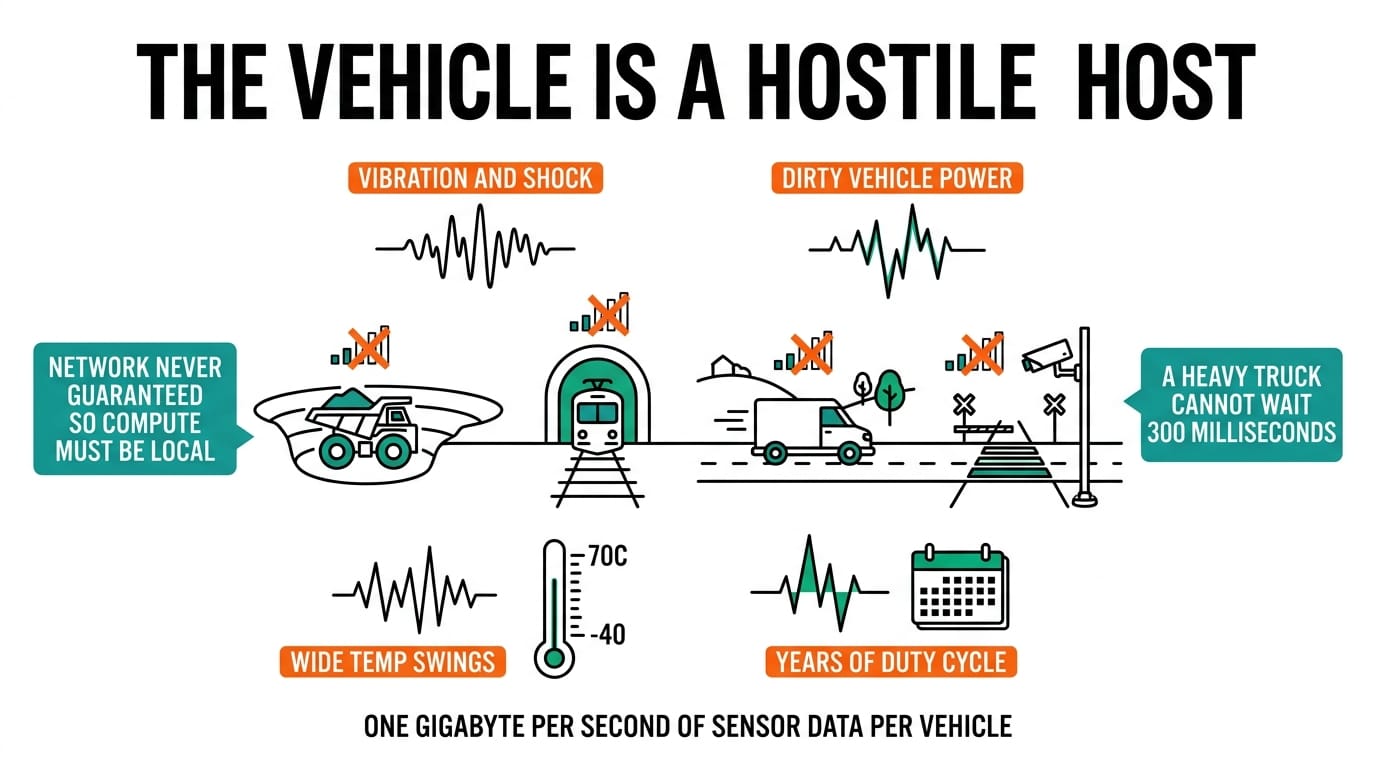
- Transportation is one environment where the network is never guaranteed. A haul truck in an open pit, a train in a tunnel, and a fleet van on a rural route all lose connectivity, so the compute has to be local.
- The hard part is rarely the AI model. It is surviving vibration, shock, wide temperature swings, dirty vehicle power, and years of duty cycle without a fan failure or a loose connector.
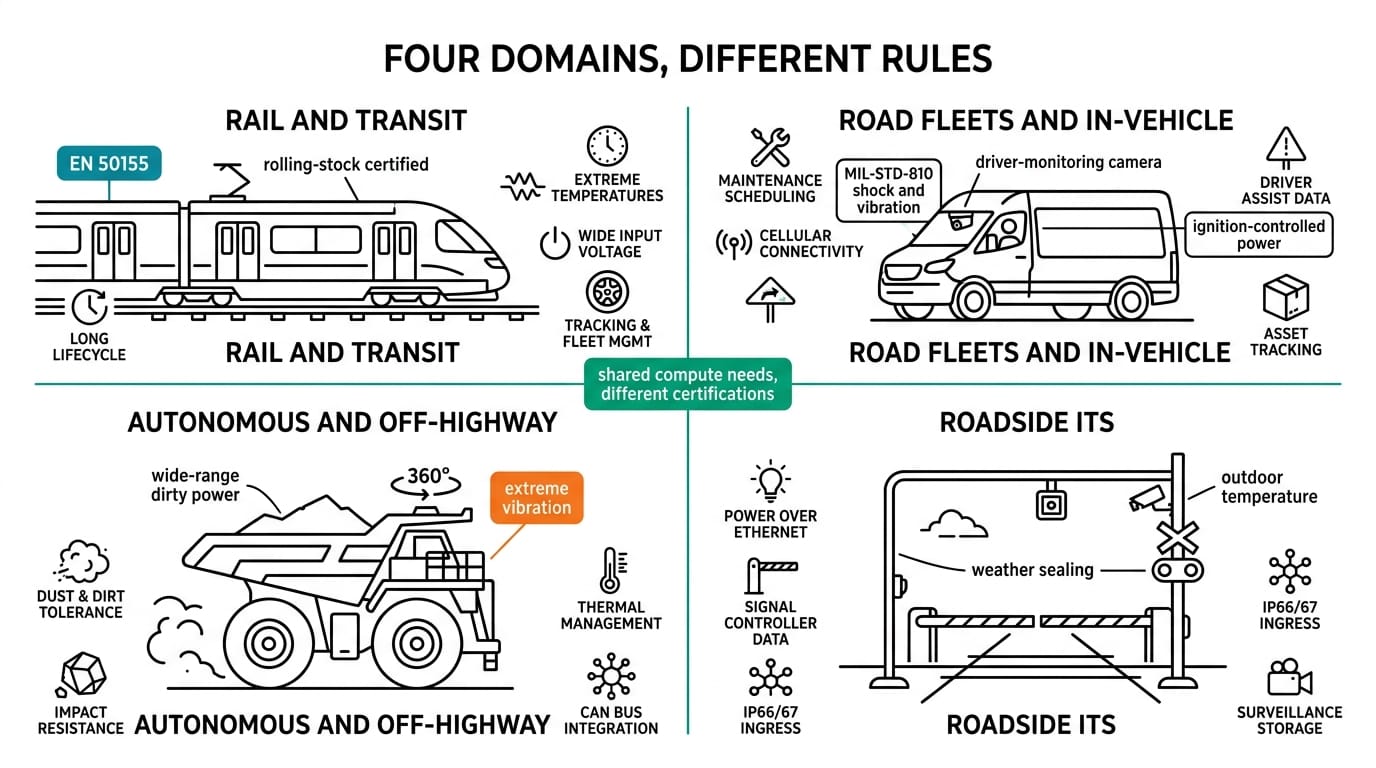
- The four transportation domains, rail and transit, road fleets and in-vehicle systems, autonomous and off-highway machines, and roadside intelligent transportation systems, share compute needs but demand very different certifications.
- Getting the certification right is not optional. Railway rolling stock needs EN 50155. Vehicle mounting needs MIL-STD-810 shock and vibration testing plus ignition-controlled power. The wrong box passes a lab demo and fails in the field.
What is edge AI in transportation?
Edge AI in transportation is the practice of running artificial-intelligence inference on a hardened computer that travels with the vehicle or sits beside the road, rather than streaming raw sensor data to a data center. A camera watching a level crossing, a 360-degree perception rig on a mining truck, and a driver-monitoring system in a delivery van all do the same thing: they turn a sensor feed into a decision on the spot.
Two facts make transportation different from a factory floor. The first is motion. Everything is shaking, and the power comes from a battery or an alternator that spikes and sags. The second is connectivity. A vehicle spends much of its life out of reliable network range, so the inference cannot depend on a link that may not be there. Those two constraints shape every hardware choice that follows, and they are why a transportation deployment starts with the environment, not with the model.
This guide maps the transportation cluster end to end: what the onboard environment demands, how the four transportation domains differ, and which compute platform fits each job. Every section links to a focused deep-dive for engineers who want the full analysis of a single topic.
Why transportation moved inference onto the vehicle
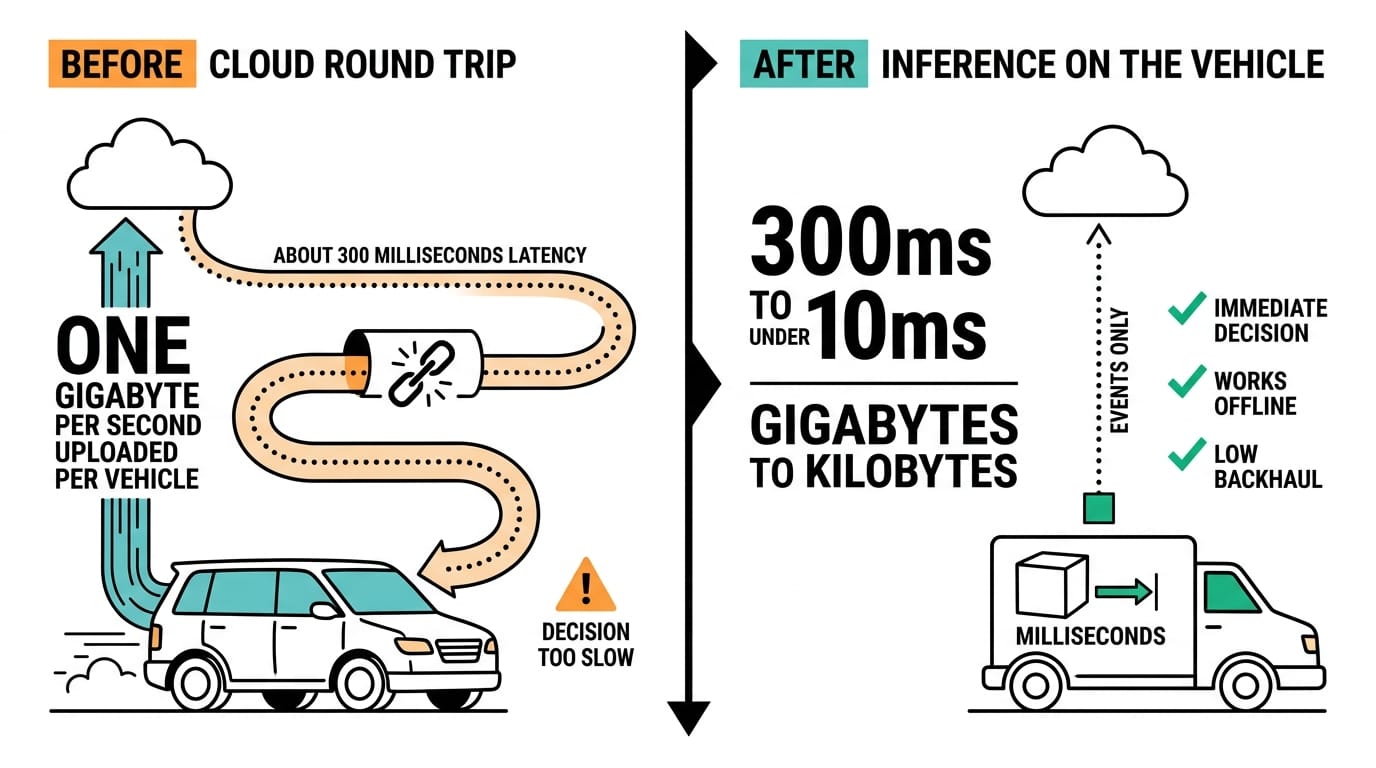
For years the assumption was that vehicle data would flow to the cloud and come back as insight. That model breaks on latency and bandwidth. A collision-avoidance system that has to stop a 200-tonne truck cannot tolerate a 300-millisecond trip to a server and back, and a fleet generating a gigabyte of sensor data per second per vehicle cannot afford to move all of it over cellular. Processing at the vehicle solves both problems: the decision is immediate, and only the results, a few kilobytes of events, travel over the network.
The shift also changed what the onboard computer has to be. A telematics box that logs GPS and engine codes is a simple device. A perception computer running multi-camera fusion is a small GPU workstation that happens to live under a seat or in a cabinet on a train. The industry outlook pieces on why automakers are embedding edge AI in fleet vehicles and on edge AI in construction and heavy equipment trace where this is heading through 2030: more sensors, heavier models, and a growing gap between vehicles that compute locally and those that do not.
The onboard environment: what a transportation computer must survive
Before any discussion of CPUs or GPUs, a transportation computer has to earn its place by surviving the vehicle. This is the ruggedness question, and it is a stack of independent requirements rather than a single rating. The complete reference on industrial ruggedness and compliance standards covers the full set; three of them dominate transportation.
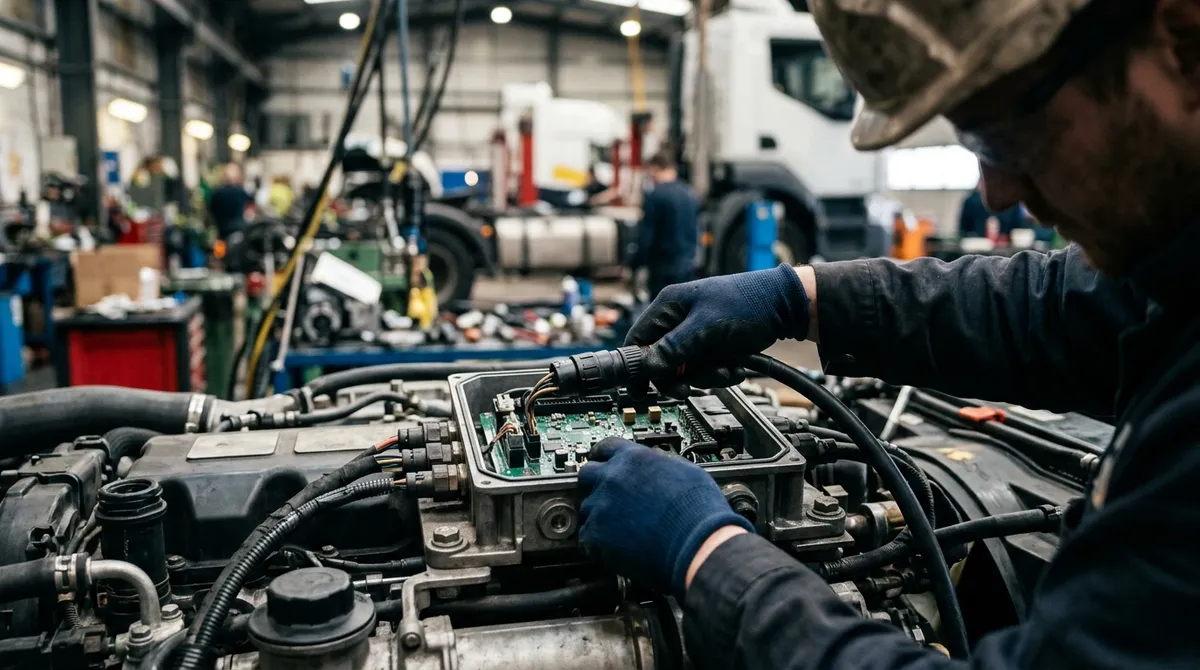
Vibration and shock come first. A computer bolted to a chassis sees continuous vibration and occasional hard shocks that will loosen connectors, crack solder joints, and kill any spinning disk. Environmental test methods here follow MIL-STD-810, and the practical design work of isolating a computer from a moving platform is its own discipline, covered in the NVH and vibration design guide for vehicle-mounted edge computing. Fanless construction and solid-state storage are effectively mandatory, because a fan is a moving part waiting to fail and a bearing is a vibration victim.
Power is the second problem, and it catches teams off guard. Vehicle electrical systems are noisy. Voltage sags during engine cranking, spikes during load dumps, and never sits at a clean rail. A transportation computer needs a wide-range DC input, isolation, and ignition control so it powers up and shuts down with the vehicle instead of draining the battery overnight. The power design guide for vehicle edge AI walks through wide-range input, ignition sensing, and the delayed-shutdown behavior that protects both the data and the battery.
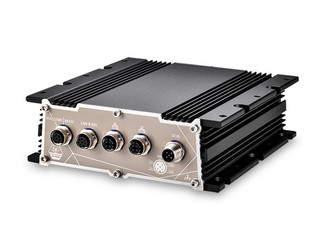
Temperature is the third. An enclosure in a vehicle cabin, an engine bay, or a sealed roadside box has no facility air conditioning, so the computer must hold its rated performance across the real operating range rather than the lab's 25°C. A platform such as the POC-700 series is built around exactly this profile: fanless, wide-temperature, MIL-STD-810 shock and vibration, and vehicle-grade power. Where the box is exposed to weather or washdown, a sealed IP-rated design such as the POC-766AWP series adds ingress protection on top of the same rugged base.
Rail and transit
Railway is the most standards-heavy transportation domain, and for good reason: a computer on rolling stock has to keep working through decades of vibration, temperature extremes, and fire-safety scrutiny. The governing standard is EN 50155, the CENELEC specification for electronic equipment on railway vehicles, and it pulls in a family of related tests for shock, EMC, and fire behavior. The EN 50155 compliance guide for railway edge AI breaks down what onboard hardware actually has to demonstrate, and the broader buyer's guide for railway and transit applications covers how to shortlist a platform against those requirements.
The applications are expanding past passenger counting and CCTV into condition monitoring. A worked example is onboard pantograph monitoring, where a rail-certified computer watches the pantograph-to-catenary contact and flags wear before it becomes a service failure. The pattern generalizes: a rugged, certified computer, a camera or sensor package, and a model that turns a video feed into a maintenance signal. Rail is unusual in that the certification, not the compute, is the long pole, so the platform decision starts from the EN 50155 requirement and works back to the workload.
Road fleets and in-vehicle systems
Commercial fleets are where edge AI reaches the largest number of vehicles, and the value case is direct: fewer failures, less downtime, and safer drivers. Two case studies make the reliability point concretely. Replacing consumer-grade hardware with a rugged platform cut fleet PC failures by 94 percent in commercial vehicles, and consolidating multiple boxes onto one computer cut the fleet computing footprint by 62 percent in urban transit. A related deployment in electric bus monitoring reported an 81 percent power reduction and a 41 percent faster install, which matters when a transit authority is retrofitting hundreds of vehicles.
The in-vehicle computer also has to speak the vehicle's own language. That means the CAN bus, the network that carries engine, brake, and body data, so a driver-monitoring or telematics model can read speed, steering, and fault codes directly. The plain-English guide to CAN bus and CAN FD explains how vehicle edge AI taps that data. Getting results off the vehicle is the other half: a cellular link handles the uplink, and the guide to connecting a cellular IoT gateway to a Neousys POC-700 for fleet monitoring shows the practical wiring. Once a fleet is in the field, keeping the software current across thousands of moving computers is its own operational challenge, addressed in remote management of edge AI fleets: OTA updates and monitoring.
For most fleet and in-vehicle roles, the compact fanless class is the right fit. The POC-700 series covers telematics, driver monitoring, and single-camera vision in a small footprint, and steps up to the Nuvo-11531 when the workload needs more compute in a compact chassis.
Autonomous machines, mining, and off-highway
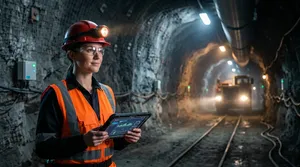
Off-highway is where transportation edge AI gets the most demanding, because the vehicles are large, the sites are remote, and the stakes are physical safety. A mining haul truck has blind spots measured in vehicle lengths, and the perception system that fills them has to fuse several cameras in real time. One deployment achieved sub-100-millisecond collision avoidance by processing a gigabyte per second of mining-truck sensor data on the vehicle, and a related 360-degree camera-fusion system cut open-pit haul-truck near-miss events by 71 percent. The market context sits in the underground mining 2026-2030 outlook, and the platform-selection detail in the buyer's guide for underground mining.
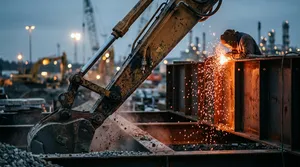
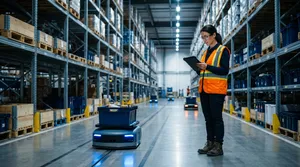
The same perception pattern shows up wherever machines move autonomously among people. A camera-fusion system cut airport ground-vehicle collisions by 74 percent, an IP67 fanless computer runs 24/7 autonomous street cleaning, and construction sites use multi-camera AI to reduce safety incidents by 67 percent. Indoors, the logistics version is the autonomous mobile robot, covered in the warehouse AMR outlook and a case where GPU-accelerated 3D vision cut warehouse AMR collision rates by 91 percent.
These workloads are GPU-bound, and they favor a power-efficient inference platform that tolerates a sealed, fanless enclosure. The Arm-based NRU-220 series runs an integrated GPU for multi-camera perception at a low power budget, which is why it recurs across the mining, airport, and mobile-robot cases above.
Intelligent transportation systems and roadside compute
Not every transportation computer moves. A large share of the value is roadside: cameras and sensors at intersections, along highways, and at inspection points, running the same perception models on a fixed rugged box. A smart-intersection deployment cut collision risk by 73 percent using multi-camera detection, a survey vehicle turned road-crack assessment from weeks into seconds, and a highway installation runs roadside license-plate recognition for automated weight enforcement.
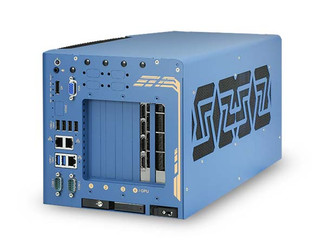
Roadside boxes trade vehicle vibration for weather exposure, so ingress protection and wide-temperature operation move to the top of the list while shock testing relaxes. The compute, though, is often heavier than in-vehicle work, because a busy intersection may run many camera streams at once. This is the mainstream GPU tier, where the Nuvo-10108GC handles multi-camera detection, and the sealed POC-766AWP series suits exposed roadside cabinets that face rain and washdown.
Ports, terminals, and freight logistics
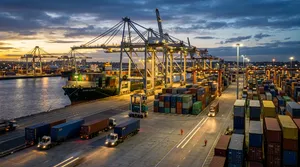
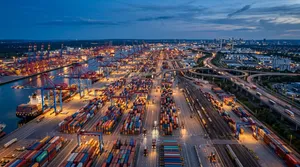
Ports combine every transportation challenge in one place: heavy vehicles, cranes, rail, sea air, and round-the-clock throughput. The outlook on edge AI in ports and container terminals lays out the application map, and a gate-automation case shows the payoff, where imagery recognition cut harbor-gate turnaround time by 58 percent by reading container and truck identifiers automatically. Terminal deployments lean on the same platform split as the rest of the cluster: compact rugged boxes at gates and on vehicles, GPU systems where multi-camera vision runs, and sealed enclosures wherever salt air and weather are in play.
Matching the platform to the transportation job
Transportation workloads sort cleanly onto four platform tiers. Use this as a starting shortlist, then validate against the specific vibration, ingress, temperature, and certification requirements of the deployment. The full selection framework lives in the guide on how to choose an industrial edge AI computer.
| Transportation job | Typical compute | Key environmental demand | Look at |
|---|---|---|---|
| Telematics, driver monitoring, single-camera in-vehicle | Compact fanless, CPU or iGPU | Vibration, vehicle power, wide temp | POC-700 series |
| Weather-exposed roadside or washdown mounting | Compact fanless, sealed | IP67 ingress, wide temp | POC-766AWP series |
| Multi-camera perception on autonomous / off-highway machines | Power-efficient Arm GPU | Vibration, sealed thermal, low power | NRU-220 series |
| Multi-stream roadside ITS and intersection vision | Mainstream x86 GPU | Camera bandwidth, sustained thermal | Nuvo-10108GC |
| Compact in-vehicle workloads needing more headroom | Compact x86 | Vibration, vehicle power | Nuvo-11531 |
| Highest multi-GPU onboard workloads | Multi-GPU x86 | Power and thermal budget | Nuvo-11000 series |
Connectivity and moving the data
A transportation computer is only useful when its results reach the people and systems that act on them, which makes connectivity a first-class design concern rather than an add-on. In-vehicle systems read the CAN bus locally and push events over cellular; roadside systems use wired or private-wireless backhaul; both eventually feed a central platform. The full picture of fieldbus, industrial Ethernet, and IT/OT convergence is covered in the reference on industrial protocols and connectivity for edge AI, and the end-to-end path from a sensor on the vehicle to a dashboard in the operations center is the subject of the guide to designing an edge AI system from sensor to edge to cloud. Designed well, the vehicle sends events, not video, and the network cost stays flat as the fleet grows.
How the four transportation domains compare
The four domains share a perception-on-the-vehicle pattern, but the constraint that dominates each one is different, and that is what decides the platform. Rail is governed by certification, off-highway by physical safety margins, roadside by weather, and fleets by scale and cost-per-vehicle. Reading the table below by its "dominant constraint" column is the fastest way to place a new project.
| Domain | Dominant constraint | Motion profile | Typical connectivity | Compute tier |
|---|---|---|---|---|
| Rail and transit | EN 50155 certification | Continuous vibration, decades of duty | Wired onboard, station backhaul | Compact to mainstream |
| Road fleets and in-vehicle | Cost and scale per vehicle | Vibration, cranking power | CAN bus local, cellular uplink | Compact fanless |
| Autonomous and off-highway | Physical safety margins | Heavy shock, dust, remote sites | Local only, intermittent link | Power-efficient GPU |
| Roadside ITS | Weather and ingress | Fixed, no vibration | Wired or private wireless | Mainstream GPU |
The practical lesson is that a platform proven in one domain does not automatically transfer to another. A fleet-grade in-vehicle box is not railway-certified, and a roadside GPU system built for a weatherproof cabinet is not specified for the shock a haul truck sees. Each project starts from its dominant constraint and works back to the compute, which is the reverse of the instinct to pick the fastest processor first.
Storage, logging, and the onboard black box
Transportation adds a requirement most factory deployments do not have: the vehicle is often its own black box. Safety events, video clips around an incident, and continuous sensor logs have to be written locally, survive a crash or power loss, and hold up as an evidentiary record. That puts real weight on storage endurance and on graceful shutdown. Spinning disks are out on vibration grounds, and consumer solid-state drives wear out fast under continuous logging, so a transportation computer needs industrial-grade storage rated for sustained writes and a power design that finishes its writes before the system loses power.
Ignition-controlled shutdown ties directly into this. When the vehicle powers down, the computer needs a controlled window to flush buffers and close files rather than dropping dead with the ignition, which is one more reason the power design for vehicle edge AI matters as much as the compute. Sizing storage for the retention policy, days of video versus months of event logs, is a decision to make before selecting the chassis, because it drives the number of drive bays and the expansion the platform must offer.
Retrofit and lifecycle realities
Most transportation edge AI is a retrofit, not a clean-sheet vehicle design, and that shapes the hardware choice as much as any spec. A computer going into an existing bus, truck, or rail car has to fit a cramped, awkward space, run off whatever power the vehicle provides, and install fast enough that the vehicle is not out of service for long. The electric-bus deployment noted above reported a 41 percent faster install for exactly this reason: a smaller, better-integrated computer is cheaper to fit across a large fleet.
Lifecycle is the other half. A vehicle stays in service for a decade or more, so the onboard computer has to be available and supportable for years, not quarters. A platform that reaches end-of-life mid-program forces a re-qualification across the whole fleet, which usually costs more than the original hardware. Long-term availability, revision control, and field support belong in the selection criteria alongside the compute and ruggedness numbers, a point the guide to how to choose an industrial edge AI computer develops in full.
Related Products


Standards referenced in this guide
- EN 50155 — Electronic equipment used on railway rolling stock. CENELEC.
- MIL-STD-810 — Environmental engineering considerations and laboratory tests, including vibration and shock. US Department of Defense.
- IEC 60529 — Degrees of protection provided by enclosures (IP code). International Electrotechnical Commission.
Transportation edge AI is half perception model and half survival engineering, and the survival half is where deployments succeed or fail. Follow Neteon on LinkedIn for more deep dives, or reach us at [email protected] or www.neteon.net to talk through a transportation edge AI deployment for a specific vehicle or roadside application.
FAQs
What is edge AI in transportation?
Edge AI in transportation is running AI inference, such as camera perception or condition monitoring, on a rugged computer mounted in the vehicle or at the roadside, instead of sending data to the cloud. It gives immediate decisions for safety-critical tasks and keeps working when the network is unavailable, which is common on moving vehicles.
Why not just process transportation data in the cloud?
Two reasons: latency and bandwidth. Safety functions like collision avoidance cannot wait for a cloud round trip, and vehicles generating large sensor volumes cannot economically stream everything over cellular. Processing on the vehicle delivers millisecond decisions and sends only compact event results over the network.
What certifications does a railway edge AI computer need?
Railway rolling-stock electronics follow EN 50155, the CENELEC standard for onboard equipment, which brings in related requirements for shock, EMC, temperature, and fire safety. The certification, not the compute, usually drives the platform choice, so railway projects specify the EN 50155 requirement first and select hardware to meet it.
What makes a computer suitable for vehicle mounting?
Vehicle mounting demands fanless construction and solid-state storage to survive vibration, MIL-STD-810 shock and vibration test methods, a wide-range DC input with isolation and ignition control for noisy vehicle power, and a wide operating temperature range. A standard PC lacks all four and fails quickly in the field.
Which platform fits autonomous machine perception?
Multi-camera perception on autonomous and off-highway machines is GPU-bound but power- and thermal-constrained, which favors a power-efficient Arm GPU platform in a sealed, fanless enclosure. This is the class used across mining-truck, airport-vehicle, and mobile-robot deployments where several camera streams are fused in real time.